How to Cite




Share
Copyright (c) 2026 Denitza D. Voutchkova, Birgitte Hansen, Lærke Thorling, Hyojin Kim, Jens Aamand, Rasmus Jakobsen

This work is licensed under a Creative Commons Attribution 4.0 International License.
Abstract
Denitrification is the most important process for nitrate removal in groundwater. Although carbonate aquifers are important for drinking water supply, the denitrification process in these systems is less understood than for unconsolidated sedimentary aquifers. We reviewed studies (1) providing evidence for denitrification in carbonate aquifers, (2) discussing the specific location where it occurs, and (3) quantifying the denitrification rates. Literature sources were identified by systematic search of scientific databases and follow-up reference tracking.
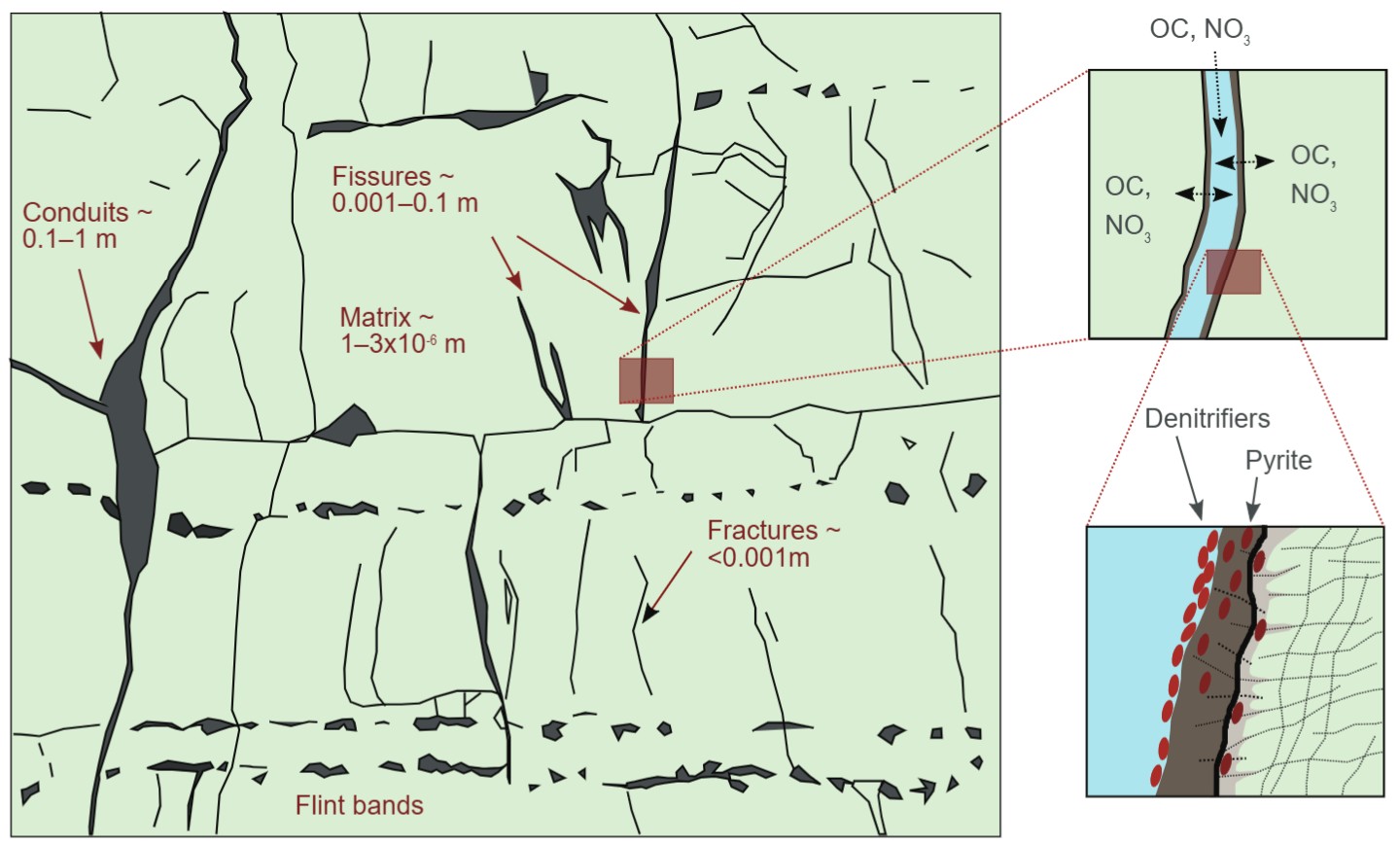
The key finding is that denitrification in carbonate aquifers is possible, supported by microbiologic and/or isotopic evidence for several locations. Pore-size and connectivity are major limiting factors for denitrification within the matrix. Denitrification in fissures/fractures would be limited by electron donor availability and unfavourable redox conditions. However, it has also been hypothesised that denitrification could occur in micro-anaerobic environments and biofilms. Denitrification rates for carbonate aquifers varied several orders of magnitude (0.01–36,792 mg N/L/y). High and reactive organic carbon from waste-water contamination and high groundwater temperatures are characteristic for some of the studies. Thus, the rates may not be transferable to cooler oligotrophic conditions. Future research is needed to fill identified knowledge gaps.
How to Cite
Share
Copyright (c) 2026 Denitza D. Voutchkova, Birgitte Hansen, Lærke Thorling, Hyojin Kim, Jens Aamand, Rasmus Jakobsen
This work is licensed under a Creative Commons Attribution 4.0 International License.
Data Availability Statement
A Supplementary File detailing the literature review method can be found at https://doi.org/10.22008/FK2/MD5QBY.
Funding
Financial support for conducting this study was provided by the Danish Ministry of Environment.Downloads
An annual collection of articles submitted to GEUS Bulletin and published throughout 2026. Published online only. This issue is open for submissions until the end of 2026.
Cover image coming soon.

References
- Bakalowicz, M. 2005: Karst groundwater: A challenge for new resources. Hydrogeology Journal 13, 148–160. https://doi.org/10.1007/s10040-004-0402-9
- Böhlke, J.K. & Denver, J.M. 1995: Combined use of groundwater dating, chemical, and isotopic analyses to resolve the history and fate of nitrate contamination in two agricultural watersheds, Atlantic Coastal Plain, Maryland. Water Resources Research 31, 2319–2339. https://doi.org/10.1029/95WR01584
- Corbett, D.R., Kump, L., Dillon, K., Burnett, W. & Chanton, J. 2000: Fate of wastewater-borne nutrients under low discharge conditions in the subsurface of the Florida Keys, USA. Marine Chemistry 69, 99–115. https://doi.org/10.1016/s0304-4203(99)00099-7
- Einsiedl, F. & Mayer, B. 2006: Hydrodynamic and microbial processes controlling nitrate in a fissured-porous Karst Aquifer of the Franconian Alb, Southern Germany. Environmental Science & Technology 40, 6697–6702. https://doi.org/10.1021/es061129x
- Foley, A.E. & Worthington, S.R.H. 2023: Advances in conceptualizing transport in chalk aquifers. Geological Society London, Special Publications 517, 75–91. https://doi.org/10.1144/SP517-2020-173
- Gregory, S.P., Maurice, L.D., West, J.M. & Gooddy, D.C. 2014: Microbial communities in UK aquifers: Current understanding and future research needs. Quarterly Journal of Engineering Geology and Hydrogeology 47, 145–157. https://doi.org/10.1144/qjegh2013-059
- Griggs, E.M., Kump, L.R. & Böhlke, J.K. 2003: The fate of wastewater-derived nitrate in the subsurface of the Florida Keys: Key Colony Beach, Florida. Estuarine, Coastal and Shelf Science 58, 517–539. https://doi.org/10.1016/S0272-7714(03)00131-8
- Groffman, P.M. et al. 2006: Methods for measuring denitrification: Diverse approaches to a difficult problem. Ecological Applications 16, 2091–2122. https://doi.org/10.1890/1051-0761(2006)016[2091:mfmdda]2.0.co;2
- Hansen, B. et al. 2024: Assessing groundwater denitrification spatially is the key to targeted agricultural nitrogen regulation. Scientific Reports 14, 5538. https://doi.org/10.1038/s41598-024-55984-9
- Hansen, B., Aamand, J., Jakobsen, R., Kim, H., Thorling, L. & Voutchkova, D.D. 2025: Groundwater denitrification in Denmark – Evolution, extent and reaction rates. Environmental Research Letters 20, 094041. https://doi.org/10.1088/1748-9326/adeb9e
- Henson, W.R., Huang, L., Graham, W.D. & Ogram, A. 2017: Nitrate reduction mechanisms and rates in an unconfined eogenetic karst aquifer in two sites with different redox potential. Journal of Geophysical Research: Biogeosciences 122, 1062–1077. https://doi.org/10.1002/2016JG003463
- Hernández-del Amo, E., Menció, A., Gich, F., Mas-Pla, J. & Bañeras, L. 2018: Isotope and microbiome data provide complementary information to identify natural nitrate attenuation processes in groundwater. Science of the Total Environment 613–614, 579–591. https://doi.org/10.1016/j.scitotenv.2017.09.018
- Hiscock, K.M., Lloyd, J.W. & Lerner, D.N. 1991: Review of natural and artificial denitrification of groundwater. Water Research 25, 1099–1111. https://doi.org/10.1016/0043-1354(91)90203-3
- Howard, K.W.F. 1985: Denitrification in a major limestone aquifer. Journal of Hydrology 76, 265–280. https://doi.org/10.1016/0022-1694(85)90137-4
- Jahangir, M.M.R., Johnston, P., Addy, K., Khalil, M.I., Groffman, P.M. & Richards, K.G. 2013: Quantification of in situ denitrification rates in groundwater below an arable and a grassland system. Water, Air, & Soil Pollution 224, 1693. https://doi.org/10.1007/s11270-013-1693-z
- Jakus, N. et al. 2021: Nitrate removal by a novel lithoautotrophic nitrate-reducing, Iron(II)-oxidizing culture enriched from a pyrite-rich limestone aquifer. Applied and Environmental Microbiology 87, e00460-21. https://doi.org/10.1128/AEM.00460-21
- Kalhor, K., Ghasemizadeh, R., Rajic, L. & Alshawabkeh, A. 2019: Assessment of groundwater quality and remediation in karst aquifers: A review. Groundwater for Sustainable Development 8, 104–121. https://doi.org/10.1016/j.gsd.2018.10.004
- Katz, B.G., Kingsbury, J.A., Welch, H.L. & Tollett, R.W. 2012: Processes affecting geochemistry and contaminant movement in the middle Claiborne aquifer of the Mississippi embayment aquifer system. Environmental Earth Sciences 65, 1759–1780. https://doi.org/10.1007/s12665-011-1157-y
- Khan, M.A.I., Strand, S., Puntervold, T. & Mamonov, A. 2023: Comparing outcrop analogues with north sea reservoir chalk for laboratory studies. In: IOR+ 2023, pp. 1–15. Presented at the IOR+ 2023, European Association of Geoscientists & Engineers, The Hague, Netherlands.
- Kidmose, J., Nilsson, B., Klem, N.K., Pedersen, P.G., Henriksen, H.J. & Sonnenborg, T.O. 2023: Can effective porosity be used to estimate near-well protection zones in fractured chalk? Hydrogeology Journal 31, 2197–2212. https://doi.org/10.1007/s10040-023-02743-1
- Kim, H., Jakobsen, R., Aamand, J., Claes, N., Erlandsen, M. & Hansen, B. 2021: Upscaling of denitrification rates from point to catchment scales for modeling of nitrate transport and retention. Environmental Science & Technology 55, 15821–15830. https://doi.org/10.1021/acs.est.1c04593
- Korom, S.F. 1992: Natural denitrification in the saturated zone: A review. Water Resources Research 28, 1657–1668. https://doi.org/10.1029/92WR00252
- Le Bideau, L. 2012: Caractérisation du fonctionnement des aquifers – Exemples de phénomènes de dénitrification naturelle dans les aquifères sédimentaires. Géologues 159, 4–8.
- Masciopinto, C. 2007: Biodegradation of wastewater nitrogen compounds in fractures: Laboratory tests and field observations. Journal of Contaminant Hydrology 92, 230–254. https://doi.org/10.1016/j.jconhyd.2006.12.003
- Maurice, L., Farrant, A.R., Mathewson, E. & Atkinson, T. 2023: Karst hydrogeology of the Chalk and implications for groundwater protection. Geological Society London, Special Publications 517, 39–62. https://doi.org/10.1144/SP517-2020-267
- Morris, J.T., Whiting, G.J. & Chapelle, F.H. 1988: Potential denitrification rates in deep sediments from the southeastern coastal plain. Environmental Science and Technology 22, 832–836. https://doi.org/10.1021/es00172a014
- Nilsson, B. & Gravesen, P. 2018: Karst Geology and Regional Hydrogeology in Denmark. In: White, W.B. et al. (eds): Karst groundwater contamination and public health, Advances in Karst Science. Springer International Publishing, Cham, pp. 289–298. https://doi.org/10.1007/978-3-319-51070-5_34
- Nilsson, B., Li, F., Chen, H., Sebok, E. & Henriksen, H.J. 2023: Evidence of karstification in chalk and limestone aquifers connected with stream systems and possible relation with the fish ecological quality ratio in Denmark. Hydrogeology Journal 31, 53–70. https://doi.org/10.1007/s10040-022-02565-7
- Osenbrück, K. et al. 2022: Nitrate reduction potential of a fractured Middle Triassic carbonate aquifer in Southwest Germany. Hydrogeology Journal 30, 163–180. https://doi.org/10.1007/s10040-021-02418-9
- Otero, N., Torrentó, C., Soler, A., Menció, A. & Mas-Pla, J. 2009: Monitoring groundwater nitrate attenuation in a regional system coupling hydrogeology with multi-isotopic methods: The case of Plana de Vic (Osona, Spain). Agriculture, Ecosystems & Environment 133, 103–113. https://doi.org/10.1016/j.agee.2009.05.007
- Parker, J.M. & James, R.C. 1985: Autochthonous bacteria in the Chalk and their influence on groundwater quality in East Anglia. Journal of Applied Bacteriology 59, 15S–25S. https://doi.org/10.1111/j.1365-2672.1985.tb04887.x
- Payne, W.J. 1986: 1986: Centenary of the isolation of denitrifying bacteria. ASM News 52, 627–629.
- Postma, D., Boesen, C., Kristiansen, H. & Larsen, F. 1991: Nitrate reduction in an unconfined sandy aquifer: Water chemistry, reduction processes, and geochemical modeling. Water Resources Research 27, 2027–2045. https://doi.org/10.1029/91WR00989
- Rebata-Landa, V. & Santamarina, J.C. 2006: Mechanical limits to microbial activity in deep sediments. Geochemistry, Geophysics, Geosystems 7, 2006GC001355. https://doi.org/10.1029/2006GC001355
- Rivett, M.O., Buss, S.R., Morgan, P., Smith, J.W.N. & Bemment, C.D. 2008: Nitrate attenuation in groundwater: A review of biogeochemical controlling processes. Water Research 42, 4215–4232. https://doi.org/10.1016/j.watres.2008.07.020
- Tesoriero, A.J., Liebscher, H. & Cox, S.E. 2000: Mechanism and rate of denitrification in an agricultural watershed: Electron and mass balance along groundwater flow paths. Water Resources Research 36, 1545–1559. https://doi.org/10.1029/2000WR900035
- Walton, C.R. et al. 2020: Wetland buffer zones for nitrogen and phosphorus retention: Impacts of soil type, hydrology and vegetation. Science of The Total Environment 727, 138709. https://doi.org/10.1016/j.scitotenv.2020.138709
- Wang, X. et al. 2025: Characterization of a novel Pseudomoas species for Dissimilatory nitrate reduction to ammonium and denitrification in microaerobic conditions. International Journal of Environmental Science and Technology 22, 3213–3222. https://doi.org/10.1007/s13762-024-05838-8
- West, J.M. & Chilton, P.J. 1997: Aquifers as environments for microbiological activity. Quarterly Journal of Engineering Geology and Hydrogeology 30, 147–154. https://doi.org/10.1144/GSL.QJEGH.1997.030.P2.06
- West, L.J., Farrell, R.P., Foley, A.E., Howlett, P.R. & Massei, N. 2023: An introduction to the chalk aquifers of northern Europe. Geological Society, London, Special Publications 517, 1–14. https://doi.org/10.1144/SP517-2023-3
- Whitelaw, K. & Rees, J.F. 1980: Nitrate-reducing and ammonium-oxidizing bacteria in the vadose zone of the chalk aquifer of England. Geomicrobiology Journal 2, 179–187. https://doi.org/10.1080/01490458009377760
- Yang, M., Lee, J., Jang, S., Annable, M.D. & Jawitz, J.W. 2023: Nitrate attenuation potential in karst conduits and aquifer matrix. Journal of Hydrology 624, 129896. https://doi.org/10.1016/j.jhydrol.2023.129896