 |
RESEARCH ARTICLE  |
Community heat flow recommendations: suitable basal boundary conditions for Greenland and Antarctica in ISMIP7
Mareen Lösing1,2*  , William Colgan3 , Tobias Stål4,5 , Jörg Ebbing6 , Anne G. Busck7 , Tong Zhang8 , Hélène Seroussi9 , Felicity S. McCormack10 , Dominik Fahrner3 , Leigh Stearns11 , Synne H. Svendsen3 , Anya Reading4,5
Abstract
Geothermal heat flow (GHF) influences ice sheet thermal conditions, affecting ice flow by sliding and deformation. However, GHF distribution under polar ice sheets remains poorly constrained, with few direct borehole-derived estimates and large discrepancies between glaciological and geophysical models caused by methodological differences and data limitations. As a result, many ice sheet models rely on uniform GHF estimates, ensemble averages or outdated fields that oversimplify reality. The choice of GHF product can lead to significantly different thermal conditions simulated at the ice-bed interface, which affects the projected evolution of ice sheets under climate warming. Therefore, we conducted an expert elicitation survey to identify the most suitable GHF fields for use as basal boundary conditions in ice sheet modelling, particularly for the Ice Sheet Modelling Intercomparison Project for CMIP7 (ISMIP7). GHF fields generally fall into three categories: (1) outdated due to improved data availability, (2) overly simplified parameterisations and (3) current and preferred. For GHF fields that rank highly in the survey, we discuss uncertainty and data dependency and guide their use in different applications. Finally, we recommend two Antarctic and one Greenlandic GHF fields for ISMIP7.
Citation: Lösing et al. 2026: GEUS Bulletin 62. 8411. https://doi.org/10.34194/r0w9rf81
Copyright: GEUS Bulletin (eISSN: 2597-2154) is an open access, peer-reviewed journal published by the Geological Survey of Denmark and Greenland (GEUS). This article is distributed under a CC-BY 4.0 licence, permitting free redistribution, and reproduction for any purpose, even commercial, provided proper citation of the original work. Author(s) retain copyright.
Received: 18 Sep 2025; Re-submitted: 5 Dec 2025; Accepted: 19 Dec 2025; Published: 27 Mar 2026
Competing interests and funding: The authors declare no competing interests.
*Correspondence: mareenisabell@gmail.com
Keywords: geothermal heat flow, basal boundary conditions, ice sheet modelling (ISMIP7), Antarctica and Greenland expert elicitation survey
Abbreviations:
AIS: Antarctic Ice Sheet
CMIP7: Coupled Model Intercomparison Project - phase 6
EGU: European Geoscience Union
GHF: geothermal heat flow
GIS: Greenland Ice Sheet
INSTANT: INStabilities and Thresholds in ANTarctica
ISMIP6: Ice Sheet Model Intercomparison Project for CMIP6
ISMIP7: Ice Sheet Modelling Intercomparison Project for CMIP7
NGRIP: North Greenland Ice Core Project
Edited by: Signe H. Larsen (GEUS, Denmark)
Reviewed by: Høgni Kalsø Hansen (University of Copenhagen, Denmark), Derek Schutt (Colorado State University, USA) and an anonymous reviewer
1 Introduction to polar geothermal heat flow
1.1 Context and motivation
Geothermal heat flow (GHF) plays a vital role in ice sheet dynamics by influencing the thermal conditions at the ice sheet base and the englacial rheology. High GHF can cause basal melting, increasing ice flow by basal sliding (Bell et al. 1998, 2007; Fahnestock et al. 2001), while low GHF can lead to frozen basal conditions, limiting basal sliding. However, both the magnitude and the spatial variability in GHF are important (Näslund et al. 2005; Pittard et al. 2016; Seroussi et al. 2017; Jordan et al. 2018; McCormack et al. 2022; Stål et al. 2024). Estimating GHF in Antarctica and Greenland is challenging due to sparse direct measurements (Burton-Johnson et al. 2020a; Talalay et al. 2020; Colgan et al. 2022; Freienstein et al. 2024; Fuchs et al. 2024) and complex and poorly characterised geology (Dawes 2009; Goodge 2018; Aitken et al. 2014; Li & Aitken 2024). As a result, GHF fields often rely on indirect methods based on seismic, radar, gravity and magnetic data (Section 1.2). However, these methods face significant challenges and uncertainties in resolving the lithospheric thermal structure, constraining heat production at depth and accounting for spatial variability in crustal properties (Burton-Johnson et al. 2020a, b; Reading et al. 2022).
For ice sheet modelling, different GHF products can lead to variations in basal temperatures of over 10°C across large areas of the Greenland Ice Sheet (GIS), affecting the extent of thawed-bed regions, which can range from 33.5 to 60% (Zhang et al. 2024). Zhang et al. (2024) showed that the coldest GHF fields produced the highest iceberg calving because they resulted in thicker ice near tidewater fronts. At the North Greenland Ice Core Project (NGRIP) site, models estimate basal melt rates of approximately 7 mm/year when using a GHF that matches observed basal temperatures. In contrast, using a lower GHF results in negligible melt rates (< 0.1 mm/year; Greve 2005). Karlsson et al. (2021) estimate that GHF contributes about one quarter to the basal mass balance over grounded ice, that is, a substantial portion of the total mass balance of the ice sheet. Llubes et al. (2006) show that a uniform increase in GHF by 20 mW/m² under the Antarctic Ice Sheet (AIS) leads to a 6°C rise in mean basal temperature. This change tripled the basal melt rate from 6.7 to 18 km³/year. A more recent study (Raspoet & Pattyn 2025) investigated the basal thermal conditions and meltwater production of the AIS using an ensemble ice sheet modelling approach.
Evaluating the impact of nine different GHF fields, they find a mean basal melt rate of 6.9 mm a-1, with GHF contributing approximately 51% of the total basal meltwater production across the ice sheet and show that uncertainties in GHF have the greatest impact on the simulated ice basal temperatures and melt rates.
The Ice Sheet Model Intercomparison Project for CMIP6 (ISMIP6), the Coupled Model Intercomparison Project – phase 6, is a global initiative aimed at improving our understanding of ice sheet dynamics, particularly how the AIS and GIS respond to climate change (Nowicki et al. 2016, 2020). By providing a platform for comparing and refining ice sheet models, ISMIP6 helped produce more reliable predictions of ice sheet behaviour over the coming century and its impact on sea level rise. These predictions are crucial for informing climate policy, especially in coastal management and adaptation efforts.
In ISMIP6 Antarctica (Seroussi et al. 2020, 2024) and Greenland (Goelzer et al. 2020), four different GHF fields were used, including outdated and uniform fields, which could significantly affect not only the model initialisation but also future projections. This paper provides an assessment of GHF appropriateness for ice sheet modelling through an online expert elicitation. We aim to provide detailed information for ice sheet modellers and improve the use of GHF in ice sheet models like those participating in ISMIP6, reducing uncertainties and enhancing predictions of future ice dynamics and sea level contributions in a warming climate.
1.2 Methods and assumptions
Approaches to polar GHF (Table 1) fall into three broad categories:
| Publication | Domain | Method |
| Hazzard & Richards (2024) | Antarctica | Seismic, forward |
| Haeger et al. (2022) | Antarctica | Seismic and gravity, forward |
| Lösing & Ebbing (2021) | Antarctica | Multivariate |
| Stål et al. (2021) | Antarctica | Multivariate |
| Shen et al. (2020) | Antarctica | Seismic, statistical |
| Guimarães et al. (2020) | Antarctica | Interpolation |
| An et al. (2015) | Antarctica | Seismic, forward |
| Purucker (2012) | Antarctica | Magnetic, forward |
| Martos et al. (2017, 2018) | Antarctica + Greenland | Magnetic, forward |
| Fox Maule et al. (2005, 2009) | Antarctica + Greenland | Magnetic, forward |
| Colgan et al. (2022) | Greenland | Multivariate |
| Artemieva (2019) | Greenland | Thermal isostasy, forward |
| Greve (2019) | Greenland | Glaciological, inverse |
| Rezvanbehbahani et al. (2017) | Greenland | Multivariate |
| Lucazeau (2019) | Global | Multivariate |
| Shapiro & Ritzwoller (2004) | Global | Seismic, statistical |
Forward – Uses the 1-D steady-state heat equation with geophysical inputs (crustal thickness, Curie depth, etc.). Physically grounded but highly sensitive to assumed parameters, homogeneous property simplifications and debated Curie depth interpretations.
Data-driven/statistical – Geostatistics and machine learning infer GHF from correlations among temperature gradients, conductivity and heat production data. They capture local variability and give probabilistic uncertainty bands, yet still hinge on data coverage; ±20–30 mW/m² errors are common.
Inverse – Combined physics and statistics, for instance, a coupled approach with ice sheet-model tuning.
Across all methods, accuracy is ultimately limited by sparse, heterogeneous observations and uncertain thermal properties (Reading et al. 2022). A more detailed description of the methods can be found in Supplementary File 1.
1.3 Current GHF fields and their role in ISMIP6
1.3.1 Antarctica
A total of 12 key continent-wide GHF fields are available for Antarctica (Table 1), two of them adapted from global compilations (Shapiro & Ritzwoller 2004; Lucazeau 2019). The diversity in methods, data inputs and resolution leads to notable discrepancies in inferred GHF, exceeding ±30 mW/m². The strongest disagreements prevail in (1) the West Antarctic Rift System and Thwaites–Marie Byrd Land, (2) the interior of East Antarctica, and (3) the Transantarctic Mountains and Victoria Land volcanic province.
Among the 16 modelling groups participating in ISMIP6 (Seroussi et al. 2024), three used Shapiro & Ritzwoller (2004), three used Martos et al. (2017), and one used Fox Maule et al. (2005), despite the availability of more recent regional models. Assessments of nine ISMIP6 model outputs find West Antarctica to be predominantly thawed with widespread subglacial water, while in East Antarctica, thawed zones are confined to pockets around major subglacial lake districts. From this synthesis, overall, c. 18% of the AIS bed is likely frozen, c. 46% likely thawed, and c. 36% remains uncertain (Seiner et al. 2025).
1.3.2 Greenland
There are currently eight key GHF maps available for Greenland (Table 1). Two of these are global products (Shapiro & Ritzwoller 2004; Lucazeau 2019). These fields are evaluated against in situ measurements, although evaluation datasets range from <10 to >300 measurements of Greenland heat flow.
Significant disagreements exist among GHF fields, particularly in North Greenland. Some depict a widespread high heat flow anomaly there (e.g. Greve 2019), while others do not (e.g. Lucazeau 2019). Rezvanbehbahani et al. (2017) provide products with and without this feature. Other key discrepancies include: (1) detection of the Iceland Hotspot Track in Greenland by Martos et al. (2018), (2) proximity-influenced elevated heat flow in East Greenland by Artemieva (2019) and (3) a low heat flow anomaly linked to the North Atlantic Craton in South Greenland identified by Colgan et al. (2022).
Of the 21 Greenland submissions in ISMIP6, 12 prescribed Shapiro & Ritzwoller (2004), five prescribed Greve (2019), two prescribed GHF as a hybrid assimilation of four largely deprecated older GHF fields (Pollack et al. 1993; Tarasov & Peltier 2003; Fox Maule et al. 2009; Rogozhina et al. 2016) and one used a spatially uniform GHF (Goelzer et al. 2020). Under these boundary conditions, the ISMIP6 ensemble suggests that c. 40% of the GIS bed is frozen, and c. 33% of the ice sheet bed is thawed or at the pressure melting point (MacGregor et al. 2022). The ISMIP6 ensemble disagrees on the basal thermal state beneath c. 28% of the ice sheet. It is unclear what portion of this disagreement is associated with the use of differing GHF boundary conditions across ensemble members, and which portion comes from other parameters and processes included by the ice flow models.
2 Expert survey on geothermal heat flow fields in Antarctica and Greenland
We conducted an online expert survey with the aim of gathering community insights on which GHF fields are considered to be most suitable for ice sheet modelling, specifically for the forthcoming ISMIP7 simulations in support of IPCC AR 7 (Intergovernmental Panel on Climate Change Seventh Assessment Report).
The survey was advertised widely in community forums such as Cryolist, INSTANT (INStabilities and Thresholds in ANTarctica), and the EGU (European Geoscience Union) Annual Meeting. We opened the survey from 21 March to 5 May 2025 and ultimately received 32 completed entries. No survey respondents were declined on the basis of failing to fulfil the expert inclusion criterion or any other reason. Further details on the survey’s content and ethical considerations can be found in Supplementary File 2, section 1. We acknowledge that in conducting our expert elicitation, there is a large overlap between the experts organising the survey and the experts responding to the survey, which is inherent when conducting a highly specialised expert elicitation in a niche field.
2.1 Criteria for evaluating heat flow fields
In the survey, experts were asked to evaluate each GHF field based on five criteria:
The spatial resolution, referring to its ability to capture relevant variations at the scale of ice sheet processes.
The method used to generate the field.
The calibration and/or evaluation, such as comparisons to borehole data or other ground truth.
The novelty at the time of publication, reflecting whether new data, techniques or insights were introduced.
The overall suitability for use as a basal boundary condition in ISMIP7 simulations.
Each criterion was rated on a six-point scale: no opinion on this aspect, very unsuitable (almost all models are better), unsuitable (most models are better), neutral, suitable (better than most models), and very suitable (almost no models are better). Freeform comments were also encouraged to qualify or elaborate on individual assessments.
2.2 Results of the expert elicitation
Fig. 1 summarises expert assessments of the overall suitability of GHF fields for use as subglacial boundary conditions. Results for the remaining criteria (method, calibration/evaluation, spatial resolution and variability, novelty at the time of publication) are shown in Supplementary File 2, section 2. Each model was rated by survey participants on a scale from 1 (very unsuitable) to 5 (very suitable). For Antarctica, recent fields using multivariate or statistical approaches (e.g. Shen et al. 2020; Lösing & Ebbing 2021; Stål et al. 2021) received the highest suitability scores, while older magnetic or seismic-only fields were rated lower. For Greenland, the multivariate machine learning field by Colgan et al. (2022) received the most favourable ratings. The figure displays both the distribution of individual ratings and the average score for each model, highlighting a shift in expert preference toward newer, data-integrated approaches. Across all approaches, the distribution of expert ratings, particularly the high ‘No answer’ proportion (Supplementary File 2, Fig. S2_9), especially for the Greenland fields, underscores the hesitation of even thematic experts in identifying an appropriate GHF field. This response pattern may reflect differences in familiarity with region-specific datasets and methods, limited cross-community interaction, and the greater representation of Antarctic specialists among respondents. Additionally, older models generally received more responses than newer models (Supplementary File 2, Fig. S2_26), which may exemplify an ‘incumbent advantage’, whereby older models likely garner more responses due to their familiarity, rather than their inherent quality.
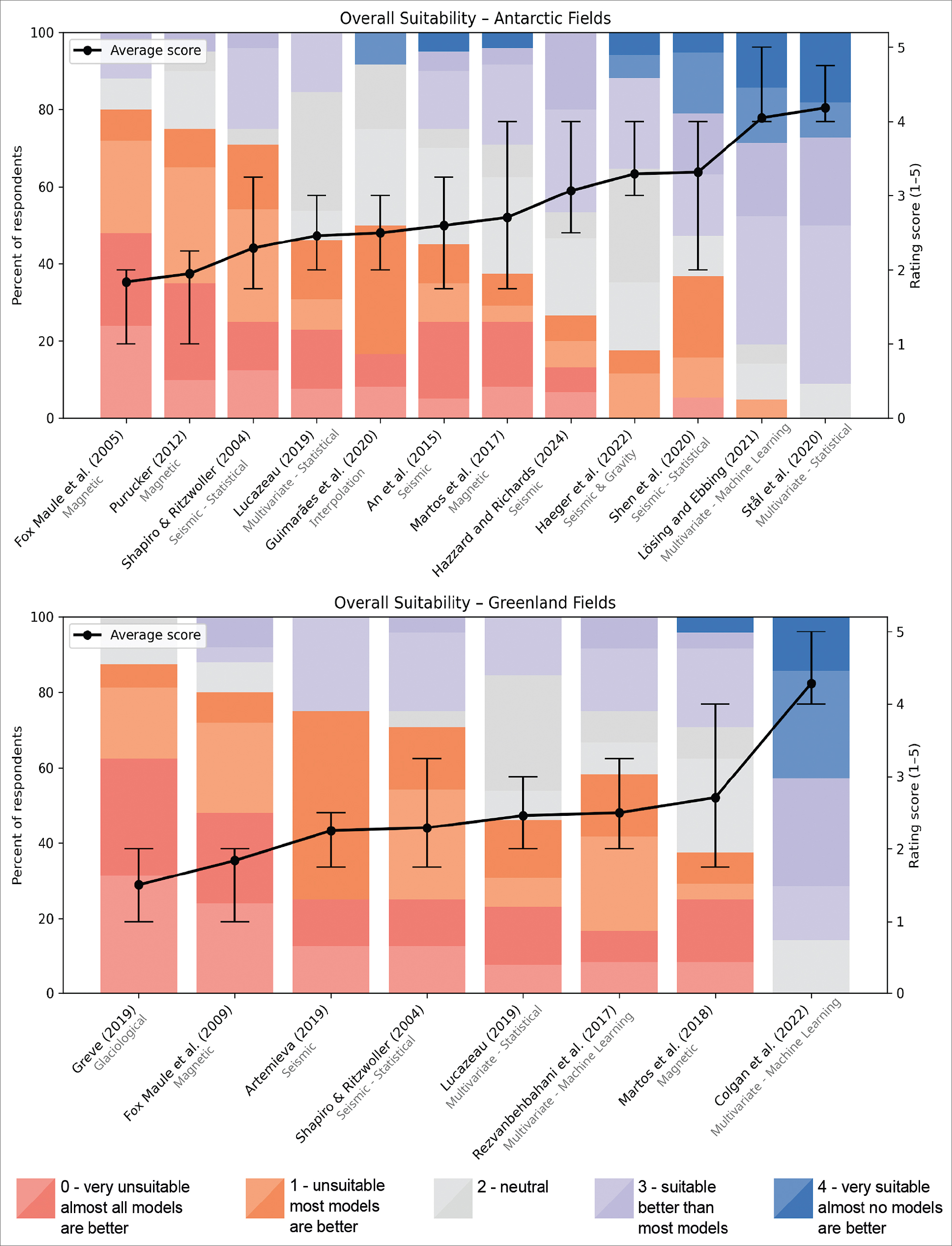
Fig. 1 Online expert survey results. Darker shades represent the percentage of answers from ‘Solid Earth modellers’, lighter shades represent the remaining respondents. Black dots indicate the average rating, and vertical whiskers denote the 25th–75th percentile range of reported scores of each GHF field with the corresponding scale shown on the right of the diagram.
In the freeform responses (Supplementary File 2, section 2.2), several experts noted the importance of explicitly considering both thermal conductivity and thermal gradients in future approaches, as many current methods rely primarily on proxies like seismic velocity or Curie depth. A number of respondents expressed support for fields that include uncertainty estimates and for ensemble-based or weighted combinations of multiple fields to account for regional discrepancies. The need for high spatial resolution required by ice sheet models was highlighted, especially at the catchment-scale, alongside cautions about applying coarse continental-scale models inappropriately. While machine learning and multivariate approaches were generally seen as promising, concerns were raised about their inherent absence of physical processes, as well as their limited spatial meaning and resolution. Respondents also mentioned the importance of including oceanic shelf areas in GHF products, improved crustal characterisation and integration of subglacial geological information. Finally, several comments pointed to the methodological diversity and challenges in GHF estimation and suggested that greater engagement from the ice sheet modelling community with updated GHF fields may help reduce reliance on outdated models.
3 Recommendations for ISMIP7
3.1 Top recommended field(s)
Based on natural breaks in the average suitability scores of the elicitation survey for both domains, we recommend the use of Colgan et al. (2022) for Greenland and either Stål et al. (2021) and/or Lösing & Ebbing (2021) for Antarctica. Following Colgan et al. (2022), we further recommend the use of the ‘without NGRIP’ heat flow solution for Greenland, although both versions are in the data repository (Section 3.6.) for sensitivity tests.
The most suitable fields are region-calibrated, continent-wide fields derived from multivariate approaches with robust uncertainty estimates. They rely on frameworks that integrate diverse datasets, but their predictive power depends heavily on the quality and representativeness of the region-specific training data and the resolution of underlying geophysical models. The recommendation to employ these fields for ISMIP7 marks a shift away from the (global) fields derived from forward methods that were the most popular boundary conditions used in ISMIP6.
3.2 Advances and limitations
The Antarctic GHF field by Stål et al. (2021) resolves variations down to c. 20 km, capturing some heterogeneities in crustal composition that strongly influence local ice dynamics. Despite its robustness and reproducibility, the method exhibits larger uncertainties in regions with poorly constrained input data and relies on outdated seismic tomography models. Uncertainty at each grid cell is quantified from the similarity-weighted reference distribution (c. 10–40 mW/m²) and Shannon entropy as a metric for robustness.
Lösing and Ebbing (2021) use a machine learning approach to predict Antarctic GHF at scales of 55 km. While the method offers flexibility and incorporates diverse data types, the result is sensitive to quality and coverage of the training data and inherits uncertainties from its global calibration. Uncertainty is given as the maximum absolute difference across alternative model runs (c. 0–80 mW/m²).
For Greenland, Colgan et al. (2022) compile 419 in situ GHF measurements and apply the same method and resolution as in Lösing and Ebbing (2021) in two simulations, including and excluding the anomalously high NGRIP borehole value. The authors recommend the ‘without NGRIP’ simulation, as NGRIP likely reflects localised subglacial hydrological processes rather than background lithospheric GHF. Uncertainties were estimated via jack knife resampling of the measurements (c. 0–60 mW/m²).
3.3 Paleoclimatic influence
Local GHF can drift far from the steady state values assumed in gridded GHF maps because paleoclimate still imprints the ice–bed boundary. At the DH-GAP04 borehole in West Greenland, for example, model reconstructions show that GHF has oscillated between 11 and 38 mW/m² over the last 100 kyr (Hartikainen et al. 2021), whereas the modern measurement is 28 mW/m² (Claesson Lijiedahl et al. 2016), shifts driven mainly by switches between ice-covered, cold-based and subaerial, warm-based states (Colgan et al. 2022).
Similar time lag effects operate inside thick ice: diffusion and snow advection can delay surface temperature signals by millennia (Calov & Hutter 1997; Greve 2019), so present basal gradients may still mirror past colder climates; at GRIP, the measured 61 mW/m² is c. 20% above the paleoclimatically corrected 51 mW/m² (Dahl-Jensen et al. 1998; Colgan et al. 2022). Because statistical GHF methods use point data drawn from regions with differing climate histories, they generally ignore this spatially variable paleoclimate bias, leaving the true present-day GHF uncertain by amounts comparable to the model spread itself.
3.4 Best practices for ISMIP heat flow boundary condition
ISMIP6 is based on a ‘come as you are’ approach that allows ice sheet modellers to submit simulations performed with a range of spatial resolutions, stress balance approximations, initialisation methods, physical processes and parameterisations (Goelzer et al. 2018; Seroussi et al. 2019). You can learn more about the Ice Sheet Model Intercomparison Project (ISMIP) at https://www.ismip.org.
Based on the expert elicitation, we recommend avoiding averaging different GHF fields, as their varying methodologies and strengths can be obscured in the process. Instead, we recommend using their published uncertainty bounds to drive an ensemble framework, sampling the upper and lower limits (and, ideally, the full continuous uncertainty distribution) with robust techniques such as Latin hypercube sampling (e.g. Helton & Davis 2003) or bootstrap resampling (Davison & Hinkley 1997). This approach captures the range of GHF realisations, with quantification of uncertainty propagation through the simulation. Statistical emulators of each GHF field can also be trained on the gridded datasets and their uncertainty layers, allowing rapid draws of new realisations without rerunning the full geophysical inversion.
Although Colgan et al. (2022) is our primary recommendation for Greenland, Lucazeau (2019) and Rezvanbehbahani et al. (2017) are widely supported secondary options based on our survey. However, Colgan et al. (2022) is based on a similar modelling approach, and the main difference is the improved heat flow database. Martos et al. (2018) is a widely used model, but respondents expressed comparatively less support for its methodology, likely reflecting the drawbacks of spectral magnetic Curie depth approaches. Still, magnetic data are arguably the most sensitive geophysical data sets to intra-crustal sources, holding the potential to provide local variations of GHF, not captured by the statistical methods preferred in the survey (Pappa & Ebbing 2021; Betts et al. 2024).
For ice flow models that employ GHF through a planar 2D ice-bed interface and thereby do not explicitly include the effect of 3D topography on GHF, an empirically derived topographic correction for subglacial GHF is available (Colgan et al. 2021). This correction, which can exceed a 100% enhancement of GHF in deeply incised valleys, is also provided in the data repository associated with this article.
3.5 Fields to avoid or use with caution
Many former foundational GHF products are now deprecated at continental scale, due to improvements in data, prediction methods, difficulty of generalising crustal components and availability of more in situ measurements for evaluation (Shapiro & Ritzwoller 2004; Fox Maule et al. 2005, 2009; Purucker 2012). Some were developed before many new seismic and magnetic data were acquired and therefore do not benefit from improved observations over the past decade.
Global fields (Pollack et al. 1993; Goutorbe et al. 2011; Davies 2013; Lucazeau 2019; Gard & Hasterok 2021) lack integration of polar-specific data and are therefore less suited for ice sheet modelling. GHF fields derived from interpolation of sparse direct GHF data offer limited value for constraining subglacial conditions.
Spectral Curie depth mapping (Martos et al. 2017, 2018) suffers the most from poor data coverage: sparse airborne magnetics, unsuitable satellite wavelengths, and the tectonic, rather than thermal control of anomaly wavelengths, mean that Curie depths have to be considered with caution (Ebbing et al. 2009; Núñez Demarco et al. 2020; Gard & Hasterok 2021). They are, however, better posed at the regional scale, where these issues are easier to manage.
3.6 Data availability
The three recommended GHF fields (Lösing & Ebbing 2021; Stål et al. 2021; Colgan et al. 2022) together with their uncertainties, and an additional topographically corrected version, are provided on NetCDF grids in 0.15 and 0.5 km resolution (Fahrner et al. 2025) and can be downloaded here: https://doi.org/10.5281/zenodo.17745730.
4 Future directions and data needs for GHF analysis
Advancing GHF fields requires both methodological enhancements and improved data collection. Future efforts should focus on incorporating updated datasets and refining thermal parameterisation techniques, as well as providing robust uncertainty estimates.
Based on the present study, our recommendations are as follows:
Integrate diverse datasets: Combine geophysical and geological data to create more comprehensive products.
Couple statistical and physical models: Link empirical/statistical GHF estimates with solid Earth models, enabling improved geological plausibility.
Enhance spatial resolution: Develop fields that better capture local variability, particularly in regions with complex geology and high ice sheet sensitivity to GHF variations. Report on differences between inherent spatial variability and resolution.
Use topographic correction: Account for the influence of topographic relief (e.g. Colgan et al. 2021).
Focus on uncertainty: Include robust quantification and clear reporting of uncertainties to enable better interpretation.
Extend beyond coastal boundaries to include the continental shelf: Seamlessly carry heat flow fields across the grounding line into the near-shore ocean and shelf, capturing the land–ocean transition that controls grounding zone melt and ice shelf buttressing.
5 Conclusion
GHF exerts an important control on the basal thermal state and dynamics of polar ice sheets. Our review of existing continent-wide GHF fields indicates a transition in the community towards data-integrated and probabilistic frameworks. While early forward approaches laid foundational work, they often lack the resolution or uncertainty quantification needed for modern ice sheet applications. The expert elicitation shows broad support for using multivariate methods that combine geological and geophysical information, such as those by Lösing and Ebbing (2021), Stål et al. (2021) and Colgan et al. (2022). These are generally viewed as better suited than earlier fields in their ability to represent local heterogeneity, include uncertainty estimates and align with estimated basal conditions. However, it should be noted that machine learning-based fields are not physically based and lack process level understanding.
Finally, continued progress in heat flow predictions depends on both methodological advances and new data (Burton-Johnson et al. 2020a, b). Remote sensing techniques, particularly microwave radiometry, show great potential for indirectly constraining basal temperatures at scale (Yardim et al. 2022). Moving forward, coupling machine learning and physical models, integrating data across disciplines and enhancing spatial resolution will be critical to improve GHF fields.
In preparation for ISMIP7, we provide three recommended GHF fields on standard grids along with uncertainty products and optional topographic corrections (all of which are accessible, Section 3.6). We strongly recommend that future efforts move away from outdated or interpolated GHF maps and adopt data-driven fields that reflect the current state of knowledge.
Acknowledgements
We thank the University of Copenhagen for reviewing the General Data Protection Regulation (GDPR) considerations of this survey. We greatly appreciate the contributions of all the polar GHF experts who participated in the survey and shared their insights. We thank the broader research community for delivering tremendous advances in our understanding of polar GHF in recent decades. We further acknowledge the constructive input of the reviewers and the editorial team, whose careful comments improved the manuscript. The Scientific Committee on Antarctic Research (SCAR) initiatives, Instabilities and Thresholds in Antarctica (INSTANT) and Solid Earth Response and Influence on Cryospheric Evolution (SERCE) facilitated discussions that informed this contribution.
Additional information
Funding statement
M.L. and T.S. were supported by the Australian Research Council Special Research Initiative, Australian Centre for Excellence in Antarctic Science (Project Number SR200100008). W.C., D.F. and H.S. acknowledge support from the Novo Nordisk Foundation under the Challenge Programme 2023 grant number NNF23OC00807040. F.S.M. was supported by an Australian Research Council (ARC) Discovery Early Career Research Award (DECRA; DE210101433) and the ARC Special Research Initiative Securing Antarctica’s Environmental Future (SR200100005). S.H.S. was supported by the European Space Agency under the contract CryoRad Earth Explorer 12 Phase 0 Science and Requirements Consolidation Study (4000145903/24/NL/IB/ar).
Author contributions
Conceptualisation: ML, WC, JE
Formal analysis: ML
Investigation: ML, WC, TS, JE, TZ, HS, FSM
Interpretation: ML, WC, TS, JE, TZ, HS, FSM, LS, SHS, AR
Methodology: ML, WC
Project administration: ML, WC, AGB
Resources: ML, WC, TS, AGB
Supervision: ML, WC, JE
Visualisation: ML, TS, DF
Writing – original draft: ML, WC, TS, JE, TZ, HS, FSM, LS, SHS
Survey governance: AGB
Data curation: DF
Review & editing: ML, WC, TS, JE, TZ, HS, FSM, LS, SHS, AR
Additional files
A Methods Overview can be found in Supplementary File 1, and Expert Panel Selection, Participant Demographics and Survey Results in full, including statistical results, individual ratings, general and specific comments, can be found in Supplementary File 2 at https://doi.org/10.22008/FK2/RJNF92.