 |
REVIEW ARTICLE  |
Review of Greenland’s thermal springs
Eva B. Nielsen*1  , William Colgan1 , Majken D. Poulsen2 , Kristian Svennevig2 , Diogo Rosa2 , Karl B. Zinglersen3 , Kristian Hammeken4, Árni Hjartarson5, Grimur Bjornsson6, Ylva Sjöberg7 , Jon Feilberg8, Reinhardt Møbjerg Kristensen9, Kirsten Seestern Christoffersen10 , Melisa Larsen Platson3, Søren Rysgaard11 , Michael Kühl12
Abstract
Thermal springs are rare but diverse features of Greenland’s ice-free margins, with observed temperatures ranging from near freezing to over 60°C. Greenland’s thermal springs host distinctive biological communities, from thermophilic microbial mats to unique vascular plant assemblages, representing important Arctic biodiversity hotspots. They hold cultural, ecological and scientific importance, yet records are mostly scattered across historical literature, local knowledge and isolated field reports. Here, we present the first comprehensive review and quality-controlled geodatabase of Greenland’s thermal springs, compiled from more than a century of scientific and historical sources, botanical surveys, Greenlandic place names, satellite imagery and field observations. The present database contains entries for 382 individual spring localities, providing names, coordinates, geological setting, thermal characteristics and metadata on source reliability. We describe their geographic distribution, geological setting and possible heat sources, which include radiogenic decay, residual magmatic heat and exothermic chemical weathering. Besides a lack of recent visits and photo documentation of many thermal springs, this synthesis highlights substantial gaps in temperature, chemistry and discharge measurements, underlining the need for systematic sampling and community-based monitoring. The open access database offers a foundation for future interdisciplinary research, supports conservation planning and provides a baseline for assessing climate-driven changes in Greenland’s geothermal systems.
Citation: Nielsen et al. 2026: GEUS Bulletin 62. 8410. https://doi.org/10.34194/0xsx9y27
Copyright: GEUS Bulletin (eISSN: 2597-2154) is an open access, peer-reviewed journal published by the Geological Survey of Denmark and Greenland (GEUS). This article is distributed under a CC-BY 4.0 licence, permitting free redistribution, and reproduction for any purpose, even commercial, provided proper citation of the original work. Author(s) retain copyright.
Received: 03 Sept 2025
Re-submitted: 03 Dec 2025
Accepted: 09 Nov 2025
Published: 16 Apr 2026
Competing interests and funding: The authors declare no competing interests.
E.B.N. and W.C. were supported by the Independent Research Fund Denmark project 3103-00029B. M.K. was supported by the Carlsberg Foundation and the Independent Research Fund Denmark for an expedition to explore hot springs on Liverpool Land and Blosseville Kyst in 2003, the Leister Foundation and Christiane Leister for hot springs work on East and South Greenland during the Leister Go East 2023 Expedition, and the Independent Research Fund Denmark for work in the Ikka fjord. R.M.K. was supported by the Carlsberg Foundation, the Danish Research Agency and the Commission for Scientific Research in Greenland. K.S.C. and R.M.K. acknowledge support from the Faculty of Science at the University of Copenhagen for long-term support of research activities at the Arctic Station in Qeqertarsuaq.
*Correspondence: esbn@geus.dk
Keywords: thermal springs, Greenland, groundwater flow, microbial ecology, geospatial database
Abbreviations:
NSIDC: National Snow and Ice Data Center
SPOT: Satellite pour l’Observation de la Terre (Satellite for observation of Earth)
Edited by: Harold Lovell (University of Portsmouth, UK)
Reviewed by: Allan Pentecost (King’s College London, UK) and Stephen Grasby (Geological Survey of Canada)
1 Introduction
Thermal springs are found at various sites in Greenland’s ice-free margins. Their thermal characteristics are highly variable, with temperatures ranging from homeothermal, such as just above freezing year-round, to > 60°C hot springs (Waring 1965; Halliday et al. 1974; Kliim-Nielsen & Pedersen 1974; Roeselers et al. 2007; Hjartarson & Ármannsson 2010). These springs hold significant cultural, scientific and economic value, offering potential for geothermal energy, helium exploration and tourist activities. They also serve as indicators of climate change, due to their interconnection with permafrost and groundwater flow (Hornum et al. 2023; Koch et al. 2024). In many cases, their discovery has been driven by the coastal exploration of Greenland, often linked to the observation of unusual snow or ice conditions and/or lush vegetation harbouring a unique flora around the springs.
However, such springs have been an integral part of Greenlandic culture for thousands of years. This is reflected in Greenlandic place names such as ‘Uunartoq’, meaning a warm spring that maintains a constant temperature year-round, which is used for many spring localities all over Greenland. Likewise, the Greenlandic place name ‘Puilasoq’ translates into water that is bubbling or seeping out, indicative of a spring. Despite their relevance across disciplines, records of Greenland’s springs remain scattered in the literature, often in popular Danish accounts of their occurrence, which has hampered their scientific exploration. Here, we review all known thermal springs across Greenland and compile a quality-controlled inventory of them. By integrating Greenlandic place names, historical documentation, botanical surveys, field observations and modern geospatial techniques, our resulting database aims to support interdisciplinary research and enhance our understanding of these unique features.
Thermal springs vary widely in form and characteristics, reflecting differences in local geology, hydrology, water chemistry, microclimate, and interactions with surrounding vegetation. Although different classification systems exist, often based on temperature, there is no universally accepted scientific definition distinguishing ‘hot’, ‘warm’, ‘cold’ or even ‘thermal’ springs (Kresic 2010; Liao 2018). According to Kresic (2010), a warm spring is one where the water temperature exceeds the average annual air temperature at the discharge location, while a hot spring is defined as having temperatures above 37°C. The term thermal spring is commonly used as an overarching category that encompasses both warm and hot springs. In Greenland, Kristensen (1987) categorised springs into three temperature classes based on field observations: (1) cold homothermic springs (0–3°C), (2) warm springs (3–12°C) and (3) hot springs (> 12°C). Later, Kristensen (2000) proposed a classification based on physical and chemical properties, dividing Greenlandic springs into three types: (1) radioactive springs rich in helium and salts, (2) methane-rich springs and (3) springs with distilled-like water quality.
Another important temperature threshold is when springs reach water temperatures > 40–45°C, which precludes most multicellular life forms. Our review does not aim to propose a new classification scheme of Greenlandic springs but instead to highlight the diverse forms of thermal springs. In the context of this review, we use the term ‘homeothermal springs’ or ‘thermal springs’ to describe all springs that maintain a stable year-round temperature. Even a spring discharging 0°C water year-round is a net heat source in comparison to mean annual air temperatures in a cold climate. We also use the term ‘hot springs’ to highlight thermal springs reaching water temperatures > 37.5°C. We refrain from generally using inferential terms like ‘geothermal spring’ or ‘hydrothermal spring’, as heat source(s) should be clarified for individual thermal springs.
2 Geographic distribution and records
Thermal springs in Greenland are primarily concentrated in a few key regions, notably Qeqertarsuaq (Disko Island) in central West Greenland, where thousands of springs are believed to exist (Kristensen 2012), and in central East Greenland, where the warmest springs in Greenland are found throughout Blosseville Kyst and Liverpool Land (see Fig. 1 for place names). The most famous spring in Greenland is located on Uunartoq island in South Greenland and reaches temperatures of c. 40°C. It was known for its healing properties as early as 1000–1100 AD (Kristensen 1987) and remains a popular tourist destination today. Thermal springs have been mentioned or documented in other areas of Greenland, but records are limited, and these sites remain largely underexplored. Most documented springs are located near sea level, which likely reflects greater coastal traffic compared to inland areas.
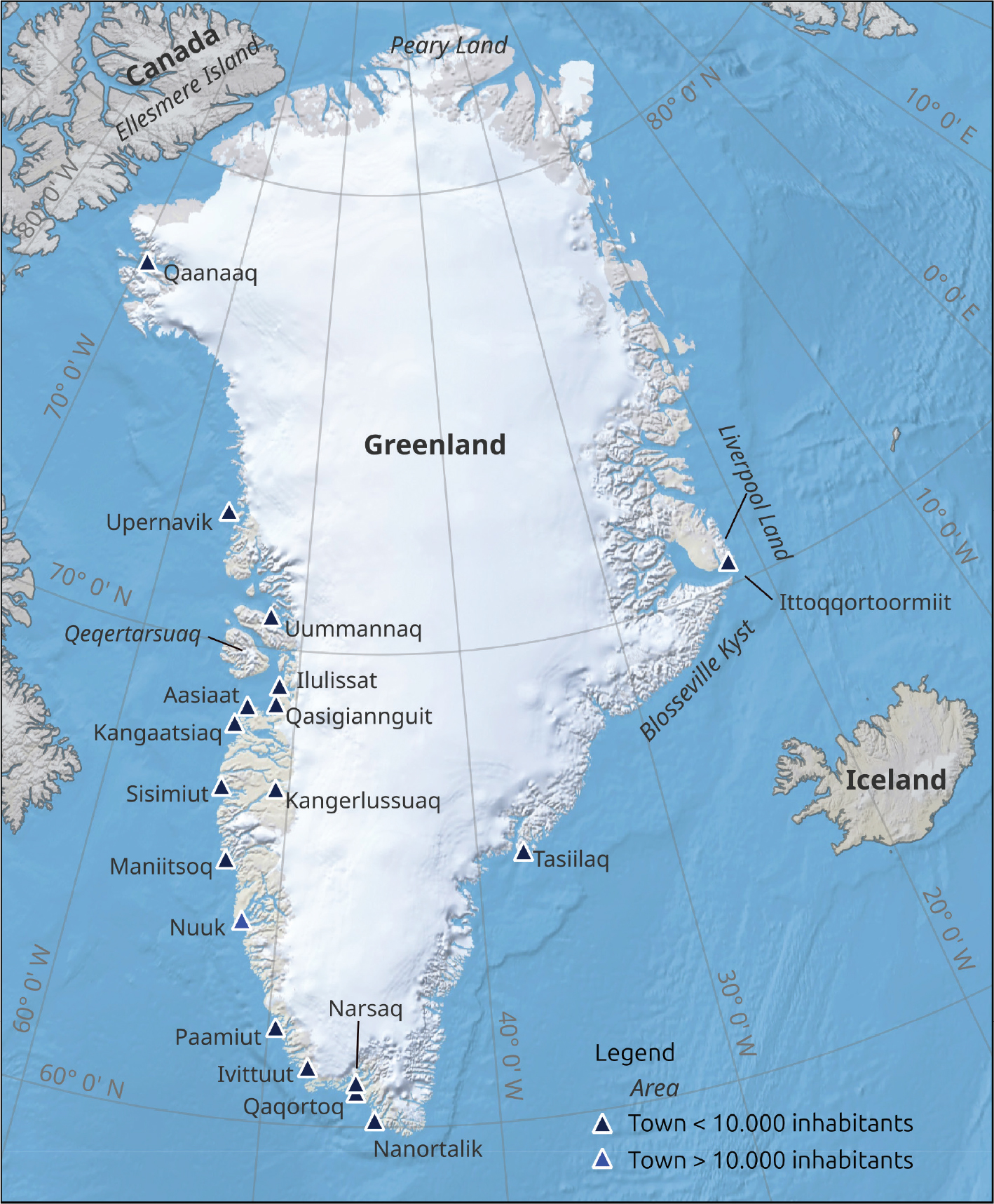
Fig. 1 Map of Greenland. Basemap from QGreenland (Moon et al. 2023).
A few studies have previously attempted to compile records of thermal springs in Greenland. In a global survey of thermal springs, Waring (1965) listed five recorded locations in Greenland, including: Qeqertarsuaq; two sites at Liverpool Land near Ittoqqortoormiit; the Blosseville Kyst; and Uunartoq in South Greenland. Building on these early records, Halliday et al. (1974) conducted the first extensive Greenland-wide mapping of thermal springs. The study focused on vascular plants and bryophytes associated with springs and included data on water temperature, as well as physical and chemical characteristics of known spring environments. Later, Feilberg (1985) expanded these records with an updated map of Greenland’s homeothermal springs, incorporating additional records from Kliim-Nielsen & Pedersen (1974). This latter work further emphasised the relation between thermal spring environments and their associated plant communities. The most recent inventory of thermal springs in Greenland was carried out by the Greenland Institute of Natural Resources, in collaboration with the University of Aarhus, and is published online at NatureMap (NatureMap 2025). While these broader surveys have been valuable, our review identifies additional background information and thermal spring localities, as well as a record of recent visits. The following sections present a region-by-region review of existing records.
2.1 Central West Greenland
Homeothermal springs on Qeqertarsuaq have been thoroughly investigated (Feilberg 1985; Kristensen 1987; Steenstrup 1900; Porsild 1902; Heide-Jørgensen & Kristensen 1999; Kristensen 2000, 2012; Funch & Sørensen 2001; Hjartarson & Ármannsson 2005; Giovannelli et al. 2024) since the first written record described by Rink (1855). In 1906, the University of Copenhagen opened its Arctic Station near the town of Qeqertarsuaq, and research in the area has been conducted ever since, including comprehensive studies of the surrounding thermal springs, as well as various observations and measurements included in student reports from the frequent Bio- and Geoscience Arctic Biology field courses at the Arctic Station. While hundreds of springs are now assumed to exist on Qeqertarsuaq, up until 1976 only 12 homeothermal springs had been formally described on the island (Steenstrup 1900; Porsild 1902; Halliday et al. 1974) and only limited chemical measurements had been carried out by Lettevall (1962) for springs near the Arctic Station. Between 1976 and 1979, Kristensen (1987) conducted a detailed study on the salt springs of Qeqertarsuaq, combining chemical analyses with ecological research focused on tardigrade fauna. Feilberg (1985) later provided a comprehensive description of the vegetation associated with many of the springs, alongside temperature measurements and species identification. From 1990 to 1999, Funch & Sørensen (2001) examined rotifer species across various saline environments, including homeothermal springs. In 2005, six thermal springs were analysed for their geochemical properties and evaluated for their geothermal energy potential (Hjartarson & Ármannsson 2005, 2010). Most recently, spring water, sediments and soils were sampled at thermal spring sites around the south side of Qeqertarsuaq, with the aim of exploring the role of microbial diversity in subsurface biogeochemical cycling (Giovannelli et al. 2024).
Most of the homeothermal springs on Qeqertarsuaq maintain a water temperature of only a few degrees year-round. However, the warmest recorded spring on Qeqertarsuaq, ‘Puilasoq’ in Akulliit, discharges water of up to 18.5°C. Historical records dating back to 1852 (Rink 1855) report temperatures consistent with present-day measurements, suggesting long-term thermal stability. Geothermal activity on Qeqertarsuaq is clearly influenced by seismic events. Historical records show how earthquakes have caused the sudden appearance of new springs. For instance, earthquakes in January 1948 and January 1977 triggered the emergence of springs on the Kannaa peninsula in Kangerluk (Disko Fjord). However, these springs disappeared again within 2–3 months (Kristensen 1987). Similarly, the Uunartukassak spring shifted by over 100 metres, following the 1977 earthquake, with a < 1°C change in water temperature. New thermal springs were also observed at Kangersuatsiaq, just south of Upernavik (Fig. 1), where seismic activity is believed to have caused three springs to suddenly appear in winter, with steam and melting snow, despite air temperatures below –20°C (Mølgaard 2012).
2.2 North North-East and North-West Greenland
Halliday et al. (1974) cited Koch (1929) for the first record of very northern springs, most likely a homeothermal spring, in Iterlassuaq (Granville Fjord) at 77°N. This record, however, might be considered with caution, as there has been no further scientific assessment of this site. There are otherwise no reported thermal springs in North and North-West Greenland. This is likely due to the limited availability of deep-water sources because of the arid nature and extensive permafrost throughout the landscape, but it could also partially reflect that these areas remain far less explored or visited by scientists. The current most northern thermal spring in Greenland was found in North-East Greenland near Daneborg at 74.2°N (Kühl et al. 2004) with water temperatures of 5–6°C.
2.3 Central East to South-East Greenland
Liverpool Land and the Blosseville Kyst have a high concentration of hot springs, where source water temperatures exceed 37.5°C (Halliday et al. 1974; Roeselers et al. 2007; Bjornsson et al. 2023; Kühl & Colgan 2025). The hottest of these, located at Uunartoq (Kap Tobin) near Ittoqqortoormiit, reaches source water temperatures of 60–62°C and was first documented by Pedersen (1926), who reported water chemistry and discharge rates together with descriptions of other nearby springs. Due to their proximity to the settlement, the Uunartoq springs are occasionally visited by locals, tourists and scientists. More recent investigations have included detailed surveys of the Uunartoq springs (Kühl et al. 2004; Roeselers et al. 2007; Kühl & Colgan 2025), with water chemistry analyses, discharge measurements and the first accounts of microbial communities colonising the effluent channels, along with documentation using ground-based video and drone-based visible and thermal imaging. Bjornsson et al. (2023) later conducted a detailed investigation of the water chemistry and surrounding geology of the springs around Ittoqqortoormiit.
On Liverpool Land, some locations, for example, Kangertivit Anginersaat (Store Fjord), Randers Fjord, Kangerterajitta Itterterilaq (Carlsberg Fjord), Immikkeertigajik Uunartertalik (Janus Ø) and Emmanuel Gletscher, have been mapped based on information from local people or explorers (e.g. Lauge Koch and Arne Noe-Nygaard), while others (e.g. Kap Thermopylae at Kangertivit Anginersaat) are only briefly documented (Helge Backlund’s travels described in Koch (1955); Stuart Watt, pers. comm.). In contrast, the approximately 20 thermal springs at Nørrefjord with temperatures of 20–57°C have been investigated in more detail (Roeselers et al. 2007; Kühl & Colgan 2025). The thermal springs in Nørrefjord were rediscovered by the British Joint Services Expedition to Liverpool Land in 1977 (Fredskild et al. 1986), who reported an inscription ‘JD-44’ carved into the lichen covering a large stone, indicating earlier visitors. The inscription was noted again during subsequent visits in 1985 (Fredskild et al. 1986), 2003 (Roeselers et al. 2007), and 2023 (Kühl & Colgan 2025). During these later surveys, investigations included water chemistry analyses, sampling of the dense microbial biofilm communities in the springs and of the surrounding flora alongside site documentation using ground-based video and drone-based visible and thermal imaging. More recently, the springs have also attracted attention due to their elevated helium concentrations (Barry 2023), which have spurred commercial interest.
On Blosseville Kyst, thermal springs were already observed by early explorers in the area (Hartz 1902; Nordenskjöld 1907). Early accounts (Wager & Deer 1939) mention 6 sets of several springs scattered along the coast between Ittoqqortoormiit and Kangerlussuaq. Halliday et al. (1974) later provided descriptions of 12 spring locations in the area, partially in reference to earlier explorations (Mikkelsen 1933; Wager 1934; Wager & Deer 1939). Thermal springs along Qalaattiviip Kangersiva (Rømer Fjord) were described in Halliday et al. (1974) based on observations from the 1970s, with temperatures ranging between 21–30°C on the northern side and 40–58°C on the southern side. Recent surveys of the southern side springs in 2003 (Pedersen 2003; Roeselers et al. 2007) and 2023 (Kühl & Colgan 2025) studied water chemistry, dense microbial biofilms and vegetation, and documented the site using ground and drone imaging. They reported a cluster of c. 30 hot springs over more than half-a-kilometre stretch along the coast, where the largely anoxic source water reaches temperatures of 55–58°C, pH values of 9–10 and frequently contains gas bubbles with a high content of methane (Roeselers et al. 2007; Stuart Watt & Michael Kühl, pers. comm.). The springs occur in diverse settings with some emerging from small gravel craters, others from vegetated slopes or directly onto beaches and tidal zones, with observations suggesting possible submarine sources offshore (Kühl & Colgan 2025).
Knighton Fjord also hosts numerous thermal outlets forming hot springs. They were first located by members of the Einar Mikkelsen Expedition in 1932 (Mikkelsen 1933). Floristic accounts of the plant communities around springs and temperature measurements in the effluent spring water were first recorded by Hauge Andersen in 1972 (Halliday et al. 1974). Subsequent visits by Danish researchers, in 2001 (Peter Stougaard, pers. comm.) and 2016 (Boertmann 2017) confirmed several outflows indicating about 30 springs in the area. A bacterium with novel enzymes was isolated from one of the springs (Thøgersen et al. 2020). Later in 2023, Kühl & Colgan (2025) analysed water chemistry and microbial biofilms and documented the site with ground and drone imagery, reporting springs that discharge 53–55°C water through lush channels towards the coast, alongside signs of additional undocumented sources.
Beyond the well-described sites, a few additional springs are known on the Blosseville Kyst but remain poorly studied and are mostly described in expedition reports and unpublished manuscripts. A c. 40°C spring surrounded by lush vegetation was discovered at the head of Pukkittivagajiip Kangersiva (Deichmann Fjord) in 1975 by Stuart Watt (pers. comm.). On Henry Land, a c. 38°C spring emerging from cliff cracks covered with algae was first noted by early explorers (Hartz 1902; Bøggild 1904; Nordenskjöld 1907) and later revisited by Stuart Watt in 1975, who identified additional minor sources (pers. comm.). Further reports include a c. 38°C spring in Qeertartivattaap Kangertiva (Johan Petersen Fjord) and a 40.5°C spring at Kap Coster (Wager 1934).
Further south, at Ikaasattivaq close to Tasiilaq, an intertidal spring with a temperature of around 25°C is located (Holm & Petersen 1921; Kruse 2012) with no other records of springs in the area. This spring was revisited for water chemistry and microbiology sampling in 2023 along with some ground-based photo and video documentation (Kühl & Colgan 2025). The presence of two springs further north was also mentioned in Halliday et al. (1974): a 2°C homeothermal spring located in Kildedal on C.H. Ostenfeld Land (first recorded by T. Johanson in 1933, but never published), and another at Home Foreland with near-freezing temperature was documented by Koch (1929).
2.4 South and South-West Greenland
The Uunartoq springs (a main pool and two smaller springs) located on Uunartoq Island, South Greenland, 40 km north of Nanortalik, are perhaps the most famous thermal springs in Greenland (Fig. 1). Historical accounts of the Uunartoq springs date back to medieval descriptions by Ívar Bárðarson (c. 1300 AD), who noted their warm temperatures, seasonal variations and therapeutic use (Halldórsson 1978). These early observations were later complemented by scientific studies, such as Jessen (1896), who analysed the springs’ physical and chemical properties and noted that the water is modified and diluted with seawater. Later, Persoz et al. (1972) investigated the spring, confirming that temperatures reach mean values up to 40°C with very little seasonal fluctuation. They further found that the water also had a notably high helium content. Geochemical analyses of the waters over a period of 140 years show only trivial chemical fluctuations over time. Likewise, the gas content and temperatures have remained constant between the earliest measurements in 1896 until 2021 (M. Poulsen, pers. comm.).
In addition to Uunartoq, terrestrial homeothermal springs have also been found in the Ikka fjord (Buchardt et al. 2001). The springs are located above the fjord on the steep hillside, where the spring water maintains steady temperatures around 3–4°C, and the springs are surrounded by lush vegetation. These terrestrial springs are probably linked to the submarine springs that form hundreds of massive ikaite tufa columns that can reach heights of > 20 m in the innermost part of the Ikka fjord, and this unique habitat was amongst the first officially protected areas in South-West Greenland (Buchardt et al. 1997; Seaman & Buchardt 2006; Seaman et al. 2022). The columns in Ikka fjord have been known for a long time in Inuit history, where they are said to be solidified remains of Norsemen chased into the fjord during a conflict. Later, their scientific exploration started with (Pauly 1963) who found that the columns are built of the hydrated, metastable carbonate mineral ikaite that readily recrystallises to calcite at higher water temperatures. Ikaite crystal formation has also been reported from other Arctic springs (Omelon et al. 2001), but the massive column formation in Ikka fjord has not been reported elsewhere. More detailed investigations of this unique habitat were initiated in the mid-1990s (Buchardt et al. 1997) and are still in progress.
3 Diversity of springs
Greenland’s thermal springs occur in a wide range of environments and display diverse forms. Among the most well-known sites is the spring at Uunartoq in South Greenland North of Nanortalik, recognised by its prominent surface pool (Fig. 2a). In Qalaattiviip Kangersiva (Rømer Fjord), the springs can form distinctive mounds or crater-like features (Fig. 3a). In Qeqertarsuaq and Knighton Fjord, thermal springs can emerge directly from steep rock faces and hill sides (Fig. 2b), while in other places like Nørrefjord, Uunartoq (Kap Tobin), and Ikaasattivaq, springs emerge out of gravel and crevices of rocks. Occasionally, thermal anomalies coincide with mineral precipitation, seen as mineral deposits on streambed rocks, resulting from the precipitation of dissolved materials as spring waters are discharged (Fig. 2c). This is also the case in the submarine springs in the Ikka fjord leading to the formation of hundreds of tufa columns composed of the special carbonate ikaite reaching a height of up to > 20 m (Fig. 4).
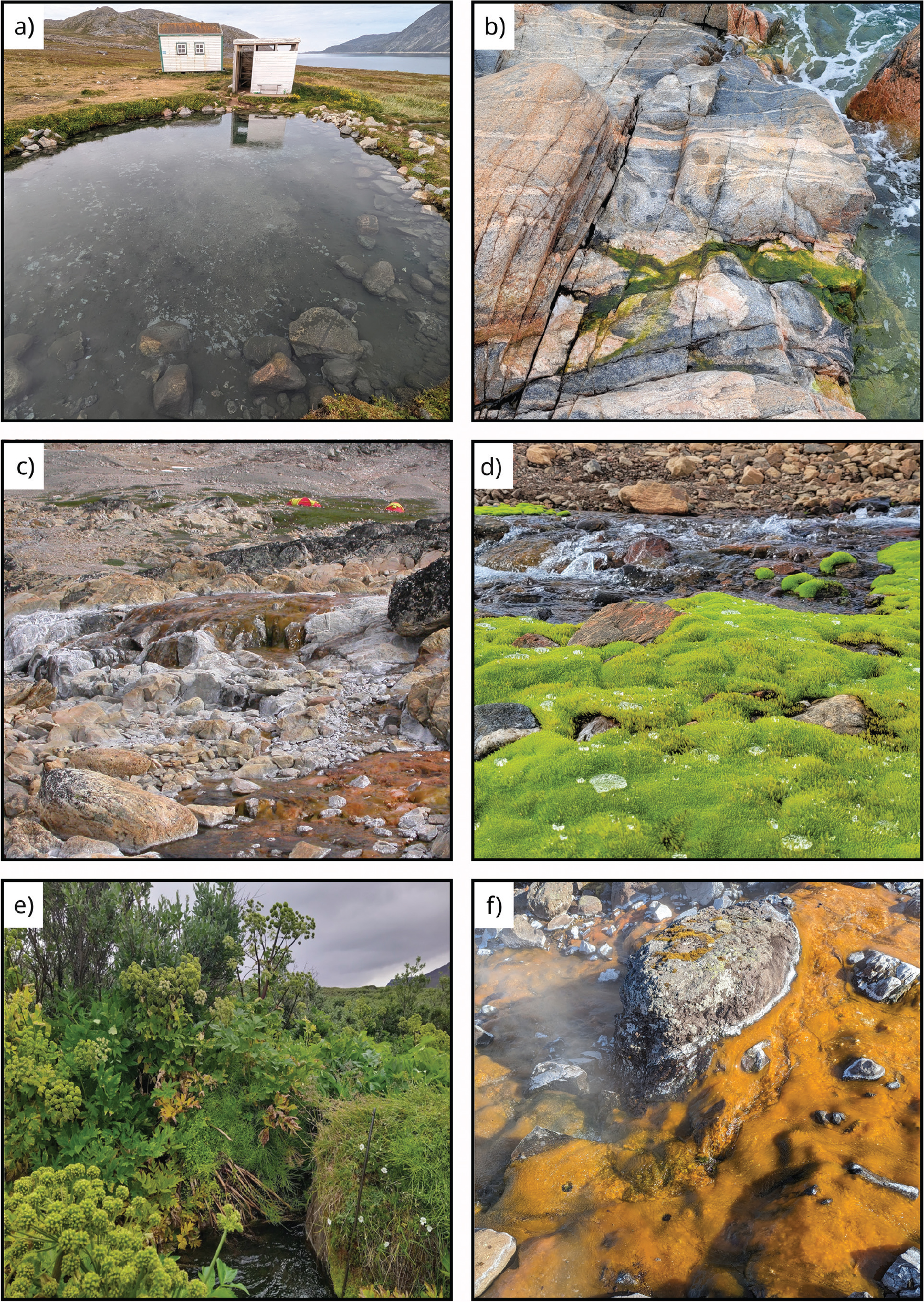
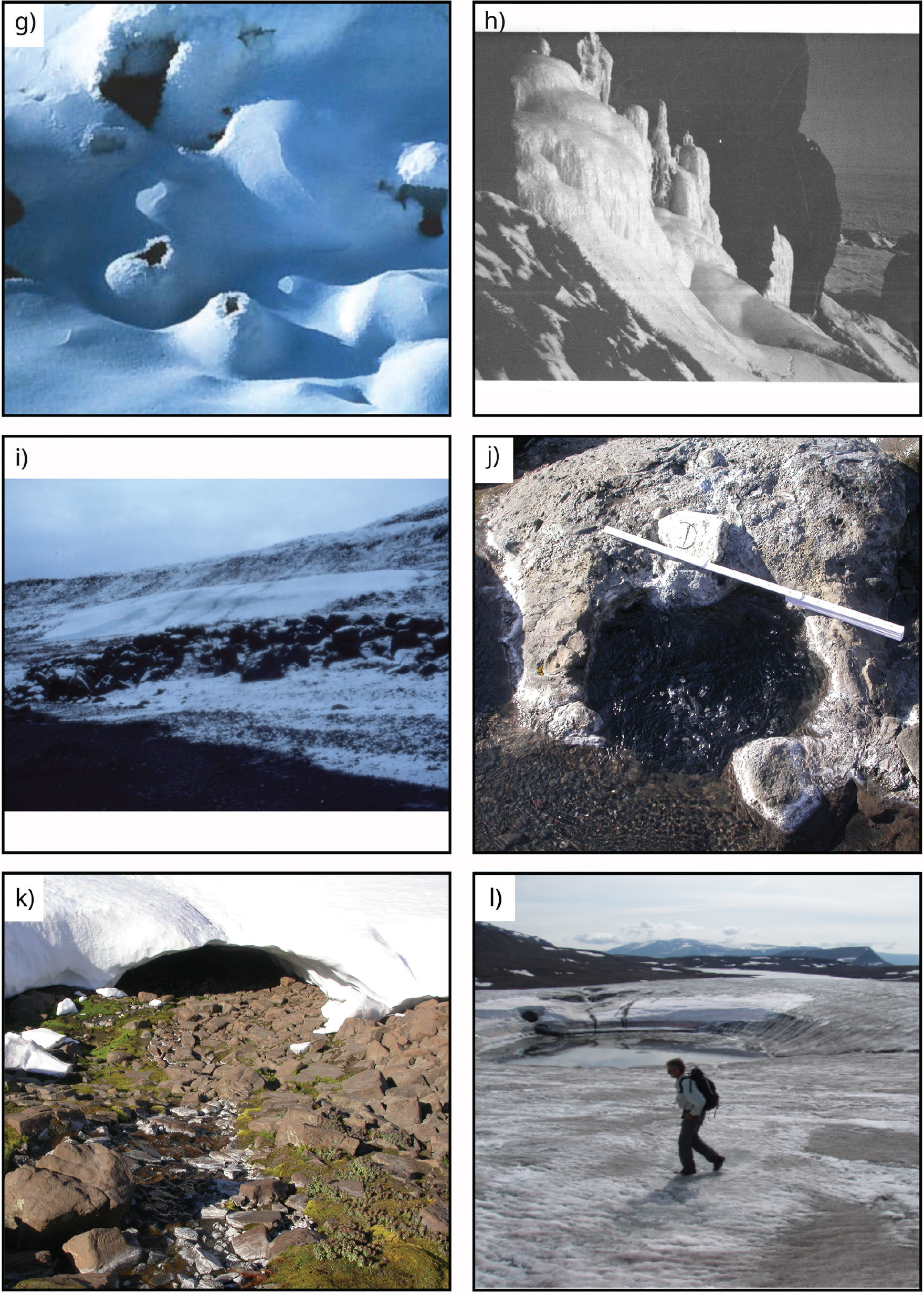
Fig. 2 Overview of spring types. (a): Uunartoq surface pool in South Greenland (Photo: Michael Kühl). (b): Spring water emerging from rock face at Uunataaji near Ittoqqortoormiit in central East Greenland (Photo: Grimur Björnsson). (c): Hot spring emerging out of a hillside in Nørrefjord in central East Greenland with mineral precipitates on the surrounding stones and with the spring bed covered by colorful bacterial mats (Photo: Michael Kühl). (d): Green moss near Ittaajimmiit cold spring in central East Greenland (Photo: Grimur Björnsson). (e): Kvan from Sullorsuaq on Qeqertarsuaq in central West Greenland (Photo: Ylva Sjöberg). (f): Cyanobacterial mats at Knighton Fjord, central East Greenland (Photo: Michael Kühl). (g): Chimney structure in snow from the Uunartorsuaq spring on Qeqertarsuaq in 2000 (Photo: Kristensen 2000). (h) and (i): Seersinneq icing in Serminnguaq on Qeqertarsuaq (Photo: Jon Feilberg). (j): Thermal spring in the intertidal zone in Qalaattiviip Kangersiva (Rømer Fjord) in central East Greenland. The spring is covered by seawater at high tide, and the effluent water contains many gas bubbles, which can also be seen reaching the seawater surface at high tide (Photo: Michael Kühl & Søren Rysgaard). (k): A hot spring emerging from under a patch of snow-cover at the coastline of Qalaattiviip Kangersiva (Photo: Michael Kühl & Søren Rysgaard). (l): Surface depressions on a small glacier at the end of Giesecke Dal on Qeqertarsuaq are hypothesised to be associated with subglacial spring (Photo: Ole Bennike).
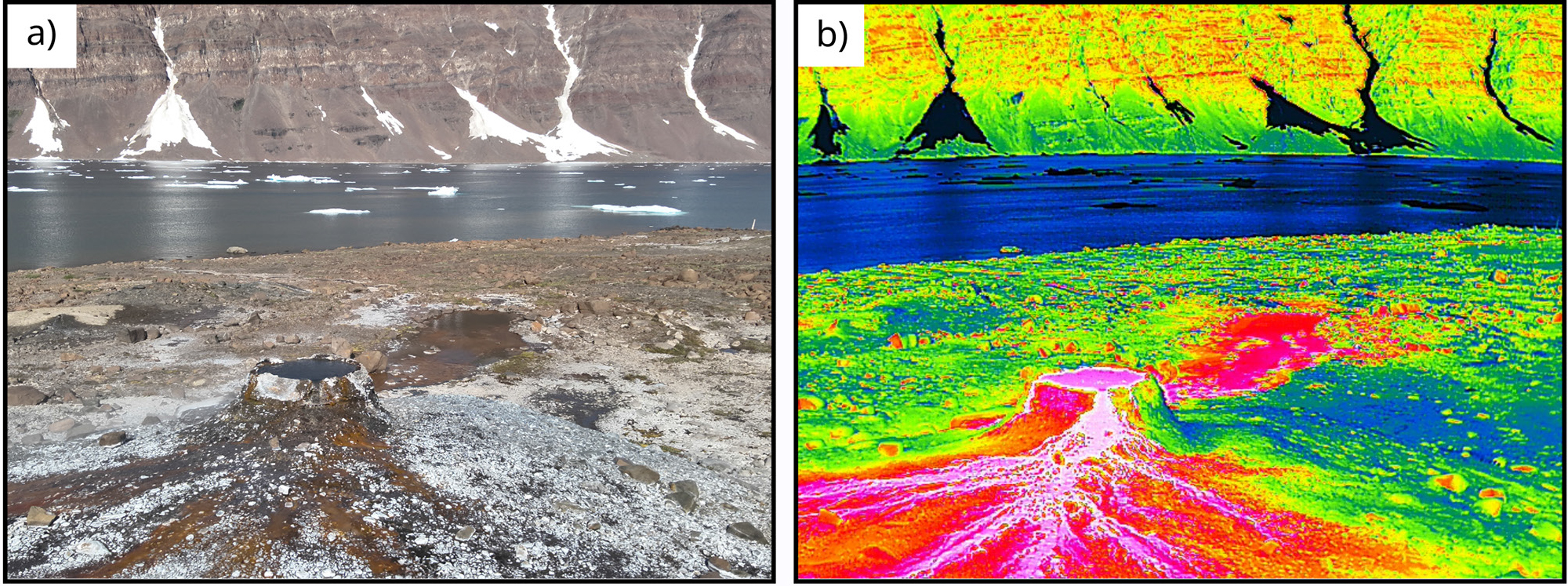
Fig. 3 A crater-like mound formed by a hot spring on the southern side of Qalaattiviip Kangersiva (Rømer Fjord), central East Greenland. (a): RGB imagery. (b): Thermal signature (Drone data: Michael Kühl).
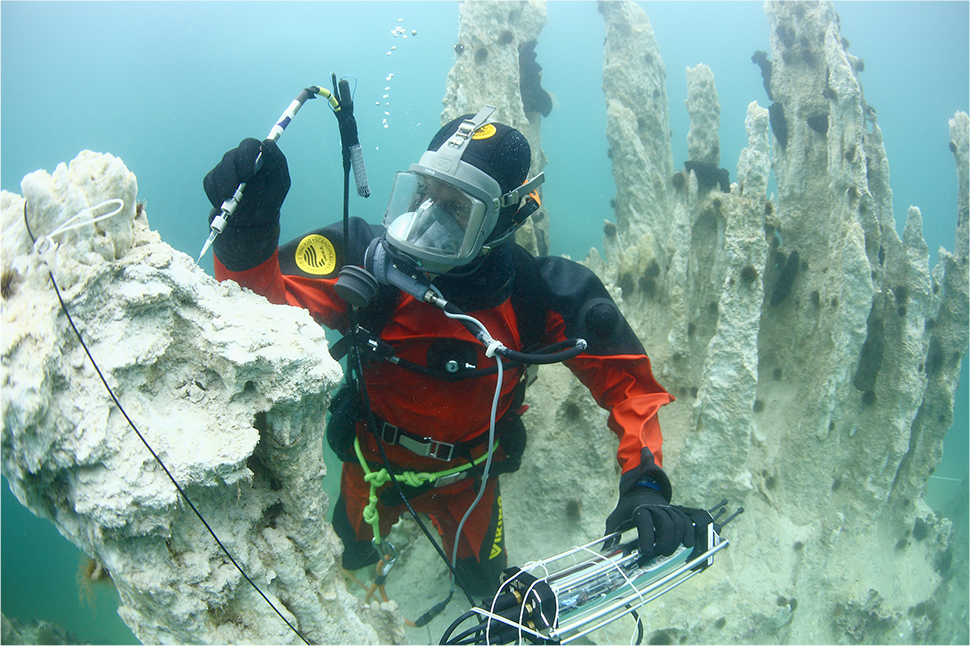
Fig. 4 Submarine springs in the Ikka fjord, South-west Greenland, form up to 20 m high ikaite tufa columns. Carbonated, high pH freshwater enriched in phosphate seeps out of the fjord bottom and reacts with cold seawater forming the hydrated calcium carbonate ikaite. Over time, this leads to the formation of columns growing upwards, as spring water flows continuously inside columns to their apex, where fresh ikaite is deposited in between microbial biofilms with abundant exopolymers, while older parts of the columns become encased by calcite and coralline red algae (Photo: Jesper Kikkenborg).
A key characteristic of many thermal springs is the distinctive vegetation hosted within pockets of elevated temperatures forming a mild microclimate around the springs. Near Ittaajimmiit in central East Greenland, vibrant green mosses thrive around the springs (Fig. 2d), and patches dominated by kvan (Angelica archangelica) are common in Sullorsuaq (Kvandalen) on the island of Qeqertarsuaq (Fig. 2e). The effluent channels of many homeothermal springs, especially the East Greenland hot springs, are often covered by colourful, thick microbial biofilms that are dominated by cyanobacteria embedded in exopolymeric substances (Fig. 2f; Kühl et al. 2004; Roeselers et al. 2007; Kühl & Colgan 2025).
Thermal characteristics vary considerably across sites. The warmest springs, like those at Nørrefjord, Uunartoq (Kap Tobin), Qalaattiviip Kangersiva and Knighton Fjord, can be identified from a distance even in summer by the steam rising from their outflows (Halliday et al. 1974; Kühl & Colgan 2025). Steam and other effects of the warm water become more prominent in colder months leading for example to persistent snow-free areas (Hjartarson & Ármannsson 2005) or chimney-like ice formations (Fig. 2g; Kristensen 2000). In contrast, colder springs with near-freezing water temperatures can produce large and often dramatic ice formations resulting from their winter discharge (Figs 2h, i; Feilberg 1985). Submarine springs (Fig. 2j) can occasionally create ice-free areas while thermal springs discharging beneath snowpacks may form distinctive surface indentations (Figs 2k, l).
The following sections explore in greater detail the diversity of structures and morphologies that define Greenland’s thermal springs.
3.1 Mounds
Several of the springs in central East Greenland have been observed emerging from well-developed craters or mounds (Halliday et al. 1974; Roeselers et al. 2007; Kühl & Colgan 2025). This occurs when mineral-rich water emerges continuously at the same point, building up layered mounds of precipitated minerals over time. An example is the southern side of Qalaattiviip Kangersiva where such precipitates form craters and other solid structures formed by mineral deposits from which the hot water emerges (Figs 3a, b; Halliday et al. 1974; Kühl & Colgan 2025). Analysis of a sample from the deposit revealed a silica–aluminium complex rich in iron and titanium, along with spinels containing magnesium, fluorine and manganese (Halliday et al. 1974).
3.2 Pingos
Occasionally, the emergence of springs that penetrate through taliks, or permafrost windows, can give rise to pingo-like structures. A pingo is a dome-shaped landform often associated with an ice lens beneath the surface. Pingos occur across Greenland (Bennike 1998), and from a spring-related perspective, open-system pingos are of importance. In open systems, groundwater, often originating from higher elevations, migrates downslope and reaches the valley floor, where the water becomes trapped beneath the permafrost and builds up pressure (Bennike 1998). Eventually, it forces its way through cracks in the permafrost, freezes near the surface and pushes the soil upward, creating the pingo (Hornum et al. 2020).
An interesting example of an open system pingo is found near Leverett Glacier (Scholz & Baumann 1997), which features an active stream emerging from the centre of the dome. Based on chemical analyses, it appears that the water in this pingo system is not primarily derived from ice-sheet meltwater, but rather from a deep subsurface origin, likely ascending through faults in the crystalline basement beneath the permafrost. Another example of an open system pingo with associated thermal spring is the Puilasoq spring on Qeqertarsuaq, which emerges from a two-metre high pingo-like structure (Hjartarson & Ármannsson 2010).
The distribution of pingo structures across Greenland has been preliminarily mapped by Bennike (1998). The spatial distribution of these pingos generally corresponds with the key areas with known thermal springs. While this spatial correlation may reflect the relative accessibility of these regions for field investigations, it also suggests the potential for discovering more pingo-associated springs through a more extensive and systematic survey of pingo structures. However, the vast majority of pingos do not have an associated spring, and our database only includes pingo structures with confirmed spring activity.
3.3 Seersinneq icing structures
Colder springs, where water can freeze upon emergence, have the potential to form persistent ice structures known as seersinneq (icing). These ice structures largely accumulate in the winter and can survive through the summer melt season. These features have been historically mistaken for small glaciers in eastern Qeqertarsuaq (Figs 2h, i; Feilberg 1985). Feilberg (1985) described these phenomena around Qaraartuaqqat, Kuannit and Kuannersuit, noticing that warmer springs do not exhibit the same behaviour. A remarkable example is the Serminnguaq formation in Kangerluk (Disko Fjord) (Fig. 2i), which in 1983 was estimated to cover an area of about 0.5 hectares and remains a permanent icing feature of the landscape (Feilberg 1985). Similarly, a pingo located further north in the Nuussuaq Basin, just north of the Aaffarsuaq river, was observed with a snow fan retained on its south-facing slope well into the summer season, long after snow and ice in the surrounding areas had melted (Christiansen et al. 2020). This persistent icing was later attributed to likely spring activity. Seersinneq, or ice structures, related to springs are also known in other parts of the world including Canada (Pollard 2005), Alaska (Yoshikawa et al. 2007; Lainis et al. 2024) and Russia (Olenchenko et al. 2023) and are also known by the German term ’aufeis’.
3.4 Submarine Springs
The most prominent and well-studied submarine springs are found in the innermost parts of the Ikka fjord in South-West Greenland, where massive ikaite tufa columns are formed (Fig. 4). Column formation is linked to meteoric water that permeates through and reacts with the surrounding carbonatite-rich rock formations in the Grønnedal-Ika complex belonging to the rift-related Proterozoic Gardar episode. During this process, it becomes highly alkaline (pH c. 10) and enriched in carbonate and phosphorus before it seeps out from springs in the innermost fjord bottom. When the spring water meets cold seawater, ikaite crystals are formed as the building blocks for the ikaite columns, initially forming small, encrusted seeps and chimneys. The columns can grow to > 20 m high if the spring water continues to flow inside the columns to the tip, where active ikaite formation takes place (Buchardt et al. 2001; Hansen et al. 2011). The spring water runs through the ikaite columns year-round, and growth rates of up to 50 cm per year have been observed. Their upper extent in the water column is primarily limited by the formation of warmer and less saline surface water in spring and summer and ice-scouring in winter (Seaman & Buchardt 2006; Hansen et al. 2011). It remains unknown how ikaite crystal formation enables the formation of the massive Ikka columns over time, but it is speculated that exopolymers, which are formed by abundant microorganisms in the porous ikaite matrix, play an important role; especially at the apex of the columns, where new ikaite is formed and deposited (Fig. 4; Seaman & Buchardt 2006; Trampe et al. 2017).
Besides the spectacular manifestations of submarine springs in the Ikka fjord, there are currently only a few observations of offshore springs in Greenland, most of which are located near the coastline and partially exposed during lowest tidal conditions. Examples include the intertidal springs at Uunartuaraq in Kangerluk (Disko Fjord) (Hjartarson & Ármannsson 2005), Ikaasattivaq near Tasiilaq (Kühl & Colgan 2025) and on the south side of Qalaattiviip Kangersiva on Blosseville Kyst (Fig. 2j), all of which only become visible at low tide. Another notable case is the coastal Uunartaaji spring, located just offshore near Ittoqqortoormiit (Bjornsson et al. 2023). Local observations suggest that submarine thermal activity is responsible for a small coastal sea ice polynya throughout the winter (Kristian Hammeken, pers. comm.). Bjornsson et al. (2023) estimated the polynya to be approximately 70 metres in length and 20 metres in width, attributing it to sustained thermal spring discharge. The study estimated that a flow of 1.2 L s-1 of 60°C thermal water equalling 301.4 kW would be required to prevent sea ice formation in winter. In the Deep Fjord Basin in North-East Greenland, Rysgaard et al. (2018) reported elevated geothermal heat flux based on temperature and salinity time series; however, subsequent analyses suggest these values may instead reflect the effect of local topography upon geothermal heat flux rather than localised submarine springs (Colgan et al. 2021). Locals from Kangerluk, on Qeqertarsuaq, have also described a persistent opening in the sea-ice by the coastline that they believe is caused by warm submarine spring (Hjartarson & Ármannsson 2005). These observations, along with other reports, indicate the presence of more submarine springs around Greenland and warrant a more dedicated survey to identify and study present and new sites.
3.5 Subglacial Springs
Thermal springs beneath glaciers or the ice sheet in Greenland have not yet been described, but subglacial springs are known from other glaciated regions, including Alaska, Ellesmere Island and Iceland (Grasby et al. 2003; Garchar et al. 2012; Jarosch et al. 2023). In Greenland, a thermal spring of 12.3°C was recently observed at Ittaajimmiit, discharging from beneath a thick perennial snowpack (Bjornsson et al. 2023). Field observations from Qeqertarsuaq have also led to speculation about the potential for subglacial thermal springs beneath local glaciers there (Ole Bennike, pers. comm.). Persistent supraglacial ponds, sometimes connected to supraglacial outlet channels and located within surface depressions on small glaciers, are difficult to explain by surface hydrology alone (Fig. 2l).
4 Database
4.1 Data streams
To develop a comprehensive and quality-assured database of known thermal springs in Greenland, we compiled information from a wide range of sources spanning more than a century. These data sources integrate both historical and recent materials, including scientific reports, botanical surveys, field observations and geospatial datasets, through a systematic process. These documents provide valuable first-hand observations of thermal spring locations, characteristics and associated landforms. Where geographic coordinates were imprecise, we georeferenced the described locations manually using the contextual descriptions, geological maps and satellite imagery. Measurements and observations from peer-reviewed literature and reports published in recent decades were used to confirm, refine or supplement older records.
In parallel, we incorporated insights from Greenlandic place names, building on previous work that demonstrated the value of place names in identifying geomorphological features (Svennevig 2019). Many Greenlandic toponyms are highly descriptive of the local landscape (Kleivan 1986; Kruse 2012). In this review, the Greenlandic place name database provided by Oqaasileriffik, The Language Secretariat of Greenland, was used. For example, the words ‘unartoq’ (meaning ‘warm spring’) and ‘puilasoq’ (meaning ‘spring’) were extracted to help identify potential thermal features. Greenlandic is a descriptive language, where one word can be a whole sentence, and the root word is often described with context. For this reason, we searched the roots ’uunar’ and ’puila’ for the broadest subset of the place-name database for subsequent site-by-site consideration of place names such as ‘uunartaajik’, ‘puilasorsuaq’ etc. Other place names searched were ‘kuannit’ (kvan) and ‘tarajornitsoq’ (salty) in Qeqertarsuaq. A limitation of this approach is the accuracy of coordinates associated with place names, which requires supplementary effort to clarify specific coordinates.
Each thermal spring entry in the database was quality assessed based on source credibility, spatial accuracy and consistency with other records. Duplicate entries were resolved through cross-comparison and prioritising sources for which there was a high level of confidence. The final dataset combines these inputs into a unified, standardised geodatabase of documented thermal springs in Greenland. Each entry includes location coordinates, source type, data origin and a confidence score reflecting the reliability of the information, as described below. This approach ensures the inclusion of historical data alongside more modern observations, with transparent metadata for all entries, producing the first comprehensive open-source thermal springs database for Greenland. The database is intended as a living resource, allowing for the continuous addition of new datapoints. Contributions can be made by following the instructions provided in the README on the database spreadsheet page 2 or by contacting the author team directly. This collaborative approach aims to ensure that the database remains up to date and continues to grow as new discoveries and observations are made.
The dataset is openly available on the GEUS Dataverse at https://doi.org/10.22008/FK2/YUWA0Y (Nielsen et al. 2025) distributed under a CC BY 4.0 license.
4.2 Data structure
The database is structured as listed in Table 1.
4.3 Metadata
We have added as much detail as possible given the sources available to us and those outlined in this paper. For springs identified through linguistic sources, the language root is noted, and the original term, along with its translation, is included in the comments. Where available, in situ measurements of temperature, salinity, pH, oxygen content and discharge are included.
We provide positional information in geographic coordinates (latitude and longitude) and subsequently converted to the NSIDC Sea Ice Polar Stereographic North projection (EPSG: 3413). The positional uncertainty for each entry is estimated to be on the order of magnitude of 0.01°, 0.001° or 0.0001° in decimal degrees. For records predating 1990, when GPS was not commonly used, an approximate accuracy of one minute (1′) is assumed. A similar level of uncertainty applies to springs identified from place-name databases. For newly documented sites, uncertainty is estimated based on the number of reported decimal places and/or personal communication. In some cases, historical or linguistically derived sites were initially mislocated (e.g. plotted offshore), and these have been manually corrected using high-resolution SPOT satellite imagery or input from personal communication. For such adjustments, a positional uncertainty of up to 5 km is assumed.
The accuracy of the location reported for each thermal spring is critical for interpolating subsequent spring properties, as well as for guiding future fieldwork. We provide a confidence matrix where the location associated with each thermal spring entry is graded from 1 to 5, with 1 being the most accurate observations. Table 2 (below) describes our different levels of confidence in location accuracy. Spring elevations are subsequently interpolated from Arctic DEM (Digital Elevation Model) version 3 (Porter et al. 2022), and the elevation is given as the height above the WGS84 ellipsoid. Lithological information in Table 1 is also subsequently interpolated from the 1:500 000-scale Geological Map of Greenland, version 2.0 (Kokfelt et al. 2023). Lastly, annual mean air temperature at a height of two metres is interpolated from the C3S Arctic Regional Reanalysis, CARRA (C3S Arctic Regional Reanalysis) (Schyberg et al. 2020).
The In situ Evidence and In situ Visit columns record whether the spring has been visited and by whom, respectively. If multiple visits have occurred, the listed individual is the one who provided the most recent coordinates. When an in situ visit is labeled ‘historical’, it means older records, for example historical visits summarised by Halliday et al. (1974). The data contributor column refers to the individual who inputted the data into the database, while the source column indicates the original provider of the information, including any relevant Digital Object Identifier (DOI) linked to the spring. Additional information and context are summarised in the comments section of each entry.
4.4 Summary statistics
The current Greenland thermal springs database comprises a total of 382 entries across Greenland. Of these, 136 entries (35.6%) are classified as Quality Rank 1, indicating high-confidence data, however 53 of these are individual springs measured within Qalaattiviip Kangersiva (Rømer Fjord) and Nørrefjord. Temperature measurements are available for 210 springs (55%), discharge measurements are available for only 20 springs (5.2%), and pH values are reported for 77 springs (20.2%; Table 3). These minority fractions highlight substantial gaps and inconsistencies in basic thermal spring observations across Greenland. Language-root data was identified for 43 entries (11.3%). Across the dataset, measured temperatures span a wide range, from near freezing (0.01°C) to 62°C, with a mean of c. 20°C, underscoring the thermal diversity of Greenland’s springs (Table 4). pH values are generally alkaline (mean 8.44), while discharge and dissolved oxygen, where available, vary substantially, reflecting strong heterogeneity in spring conditions. The elevation of the thermal springs range between just below sea level to 887.9 m, with a mean of 124 m above sea level. The spatial distribution of these springs is visualised in Fig. 5 below.
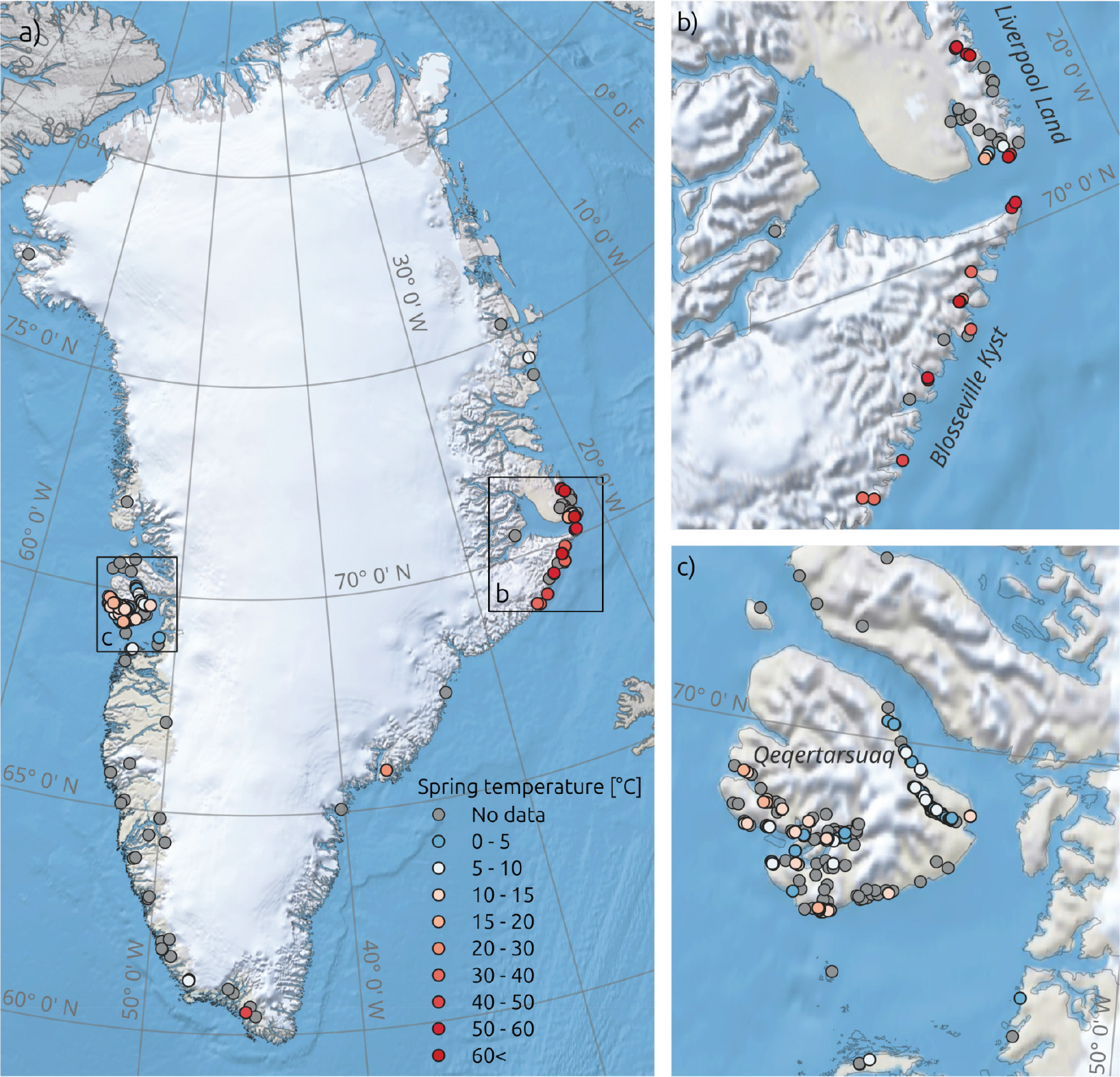
Fig. 5 Distribution of thermal springs from the database with spring water temperature for (a) Greenland, (b) Blosseville Kyst and Liverpool Land area, central East Greenland, and (c) Qeqertarsuaq area, central West Greenland. Basemap from QGreenland (Moon et al. 2023).
5 Geological setting
5.1 Central West Greenland
Qeqertarsuaq hosts the majority of Greenland’s known thermal springs, at least partly due to the comprehensive scientific investigations carried out in the area. The island’s geological basement consists of Precambrian gneiss and Cretaceous sandstone, overlain by thick sequences of Tertiary basalt flows, emplaced during volcanic activity associated with the Icelandic hotspot around 60 million years ago (Fig. 6a; Hjartarson & Ármannsson 2005). The thermal springs on Qeqertarsuaq occur in a variety of geological settings, both within and outside of major fault zones. Hjartarson & Ármannsson (2005, 2010) conclude that most thermal springs on the island emerge from basaltic lava piles, particularly near geological contacts and fault zones, suggesting that tectonic structures act as important conduits for thermal water. However, some springs are also documented in the Precambrian gneiss and Cretaceous sandstone.
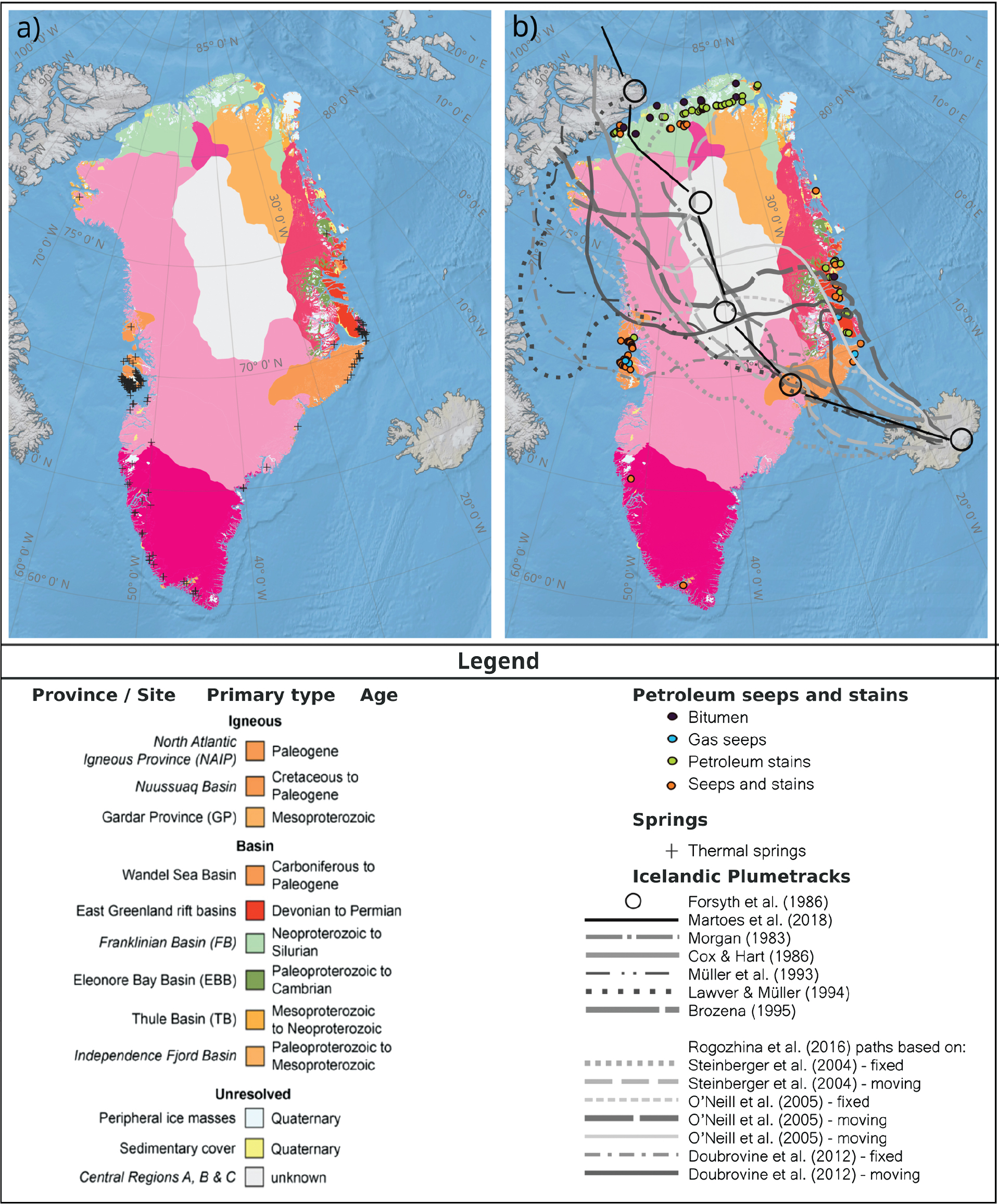
Fig. 6 Greenland subglacial geologic provinces from MacGregor et al. (2024) shown with (a) thermal springs and (b) oil seeps from Christiansen et al. (2020) and proposed Iceland plumetracks underneath Greenland from Martos et al. (2018).
In Sullorsuaq (Kvandalen) in eastern Qeqertarsuaq, springs are found at elevations up to 800 metres above sea level (Kristensen 1987), emerging from Quaternary deposits and Late Cretaceous fluvial channel sandstones. In western Qeqertarsuaq, springs occur within Cretaceous or lower Tertiary formations, often distant from dominant fault structures. One example is Puilasoq, the island’s warmest known spring, emerging from a pingo-like structure (Heide-Jørgensen & Kristensen 1999) located in Quaternary sediments but assumed to be resting on basaltic bedrock (Hjartarson & Ármannsson 2010). The springs in Uunartorsuaq in South Qeqertarsuaq emerge on the border between the basalt and the Precambrian gneiss or within landslide deposits (Hjartarson & Ármannsson 2005).
Further north, in the Nuussuaq Basin, thermal springs have been reported in association with hydrocarbon seeps (Fig. 6b; Christiansen et al. 2020). This rift basin formed during the Cretaceous–Paleocene because of extensional tectonics between Greenland and Canada. It contains a well-exposed stratigraphy of mid-Cretaceous to Palaeogene marine sediments overlain by thick volcanic sequences, especially prominent in the Disko–Nuussuaq–Svartenhuk Halvø region. In the Aaffarsuaq Valley, Christiansen et al. (2020) observed a pingo (Pingo 132) that released gas and water under pressure, resembling the activity of mud volcanoes typically linked to hydrocarbon seepage. Such association suggests a possible connection between subsurface hydrocarbon migration and spring formation.
5.2 North Greenland
Due to the arid nature of the north, springs have not been observed to date, however gossans or sulphate mounds are found in North Greenland at Citronen Fjord (Van der Stijl & Mosher 1998), Navarana Fjord (Jakobsen 1989) and Jørgen Brønlund Fjord (Troelsen 1949). Whereas the Citronen Fjord mounds are dominated by rusty iron oxide crusts resulting from the surface oxidation of massive sulfide occurrences, the Navarana Fjord and Jørgen Brønlund Fjord mounds are dominated by sulphate salts, formed during underground weathering of sulphates or sulphides, and precipitated at the surface during seasonal springs discharge. The geology of Navarana Fjord in North Greenland comprises a sequence of unmetamorphosed Lower Palaeozoic sedimentary rocks, including the coarse sandstones of the Skagen Group, dolomites of the Portfjeld Formation, and overlying shales and carbonates. The region is homoclinally folded with NE–SW-striking faults, some of which host sulphate and metal mineralisation. Postglacial oxidation of pyrite subsequently formed hydrated sulphates mounds visible today (Van der Stijl & Mosher 1998).
5.3 Central East to South-East Greenland
Liverpool Land and Blosseville Kyst in central East Greenland harbour the hottest thermal springs in the country. Liverpool Land lies on the south-eastern margin of the East Greenland Rift Basin, where Jurassic sub-basins overlie a Caledonian basement of Precambrian gneiss. This basement is cut by Palaeocene basaltic dykes associated with the opening of the North Atlantic in the Palaeocene (c. 50–60 Ma), and its complex fracture systems and overlying sediments are believed to facilitate fluid migration and geothermal activity (Bjornsson et al. 2023).
Further south, the Blosseville Kyst preserves the largest onshore remnant of the Early Tertiary basalt plateau, formed during the continental rifting in the Paleocene. The region features over 6 km of subaerial basalt flows, which have been structurally disrupted into fault-bounded blocks due to post-volcanic tectonic activity. Prominent N–S-trending faults and flexure zones along the coast likely reflect reactivated Caledonian structures (Pedersen et al. 1997), possibly playing a critical role in both the development of the rifted margin and the localisation of thermal systems in the region.
Geochemically, the springs on Liverpool Land and Blosseville Kyst are of special interest due to their release of different gases. The Qalaattiviip Kangersiva springs release significant quantities of methane (Halliday et al. 1974), while the Liverpool Land springs release significant helium concentrations (Barry 2023). These anomalies are likely related to the underlying reworked Archean, Proterozoic and Palaeozoic rocks, which are believed to contain high levels of uranium (U) and thorium (Th).
5.4 South and South-West Greenland
Uunartoq Island consists of Paleoproterozoic intrusions related to the Julianehåb batholith sequence consisting of Ketilidian migmatites, predominantly granodioritic, intruded by younger alkaline granites, with occasional gneisses and amphibolites (Persoz et al. 1972). The island’s geology is marked by a dense network of oblique, vertical and sub-horizontal fractures, enhancing permeability. These structures control spring emergence along a major fracture zone extending over 10 km. Uplifted marine terraces and glacial deposits partially cover the bedrock (Persoz et al. 1972).
Submarine springs and ikaite columns are found in the innermost parts of Ikka fjord, which is a threshold fjord, where the shallower inner part is a former hanging valley, that is surrounded by steep, c. 500 m high mountains (Seaman & Buchardt 2006). The mountains are dominated by monotonous Paleoproterozoic metasediments and gneisses, which were intruded about 1.3 Ma by the Grønnedal-Ika complex composed of high amounts of syenite and carbonatite (Emeleus 1964). The Grønnedal-Ika complex forms the catchment area for local precipitation, part of which infiltrates and reacts with the fractured carbonatite, and the high hydraulic head forces the water out under the innermost parts of the Ikka fjord, where is seeps out of springs penetrating the otherwise impermeable glaciomarine clay layer under the fjord bottom (Seaman & Buchardt 2006)
6 Thermogenesis and heat transport
The heat sources responsible for Greenland’s thermal springs vary and remain a topic of spring-by-spring investigation. Previous studies suggested that elevated temperatures may result from radiogenic heating associated with the decay of uranium and/or thorium-rich basement rocks (Persoz et al. 1972), or from anomalously steep geothermal gradients resulting from relatively recent magmatic or rifting activity (Hjartarson & Ármannsson 2010). Although exothermic chemical weathering has been shown to generate enough heat to sustain thermal spring activity in geological settings similar to those found in Greenland, for example on Ellesmere Island in the Canadian Arctic (Grasby et al. 2003), it has not yet been considered or documented for Greenland springs. Any given thermal spring in Greenland may receive its heat from one or a combination of these three processes.
6.1 Radiogenic heating
Radiogenic heating has been documented as the primary heat source for the Uunartoq thermal spring in South Greenland, as the discharge water is enriched in helium, a known byproduct of radioactive decay (Persoz et al. 1972). The temperature and the concentrations of the ions in the water such as Cl-, Ca2+, K+, Na+, F-, and SiO2 have been stable for more than 140 years, which indicate a constant heat source (M. Poulsen, unpublished data, 2025). This is consistent with radiogenic decay in the crustal rocks. There are three small pools aligned with parallel fracture lines on the island (M. Poulsen, pers. comm.). Enhanced radioactivity has also been found in several springs on Qeqertarsuaq, and Kristensen (1987) suggested that the springs at Uunartorsuaq (Engelskmandens Havn) could be linked to the ‘radioactive spring’ type, similar to the Uunartoq spring in South Greenland. This connection highlights the geological complexity behind the formation and characteristics of Greenland’s thermal springs.
6.2 Magmatic heating
Although Greenland is generally viewed as a stable Precambrian craton, recent geophysical studies suggest that residual effects from the Icelandic hotspot may still influence its lithosphere. Anomalies in geothermal heat flux, crustal thickness and magnetic data indicate an old hotspot track beneath the island, likely from the plume’s passage (Fig. 6b) around 90 million years ago (Morgan 1983; Martos et al. 2018).
Bjornsson et al. (2023) argue that the springs near Ittoqqortoormiit are a result of fault-controlled hydrothermal systems, where groundwater is heated at depth by the geothermal gradient and retained heat in basaltic formations. Tectonic activity from the Jan Mayen Microcontinent’s rifting (c. 22–24 Ma) created fault zones that enable deep water circulation and heat transport. However, as this area is dominated by basement rocks and He is present in the spring water (Barry 2023), there might also be a link to radiogenic heating. It would be valuable to measure the3He/4He isotope ratio in these springs, as this ratio can provide an indication of any magmatic contribution to the thermal waters (Stefánsson et al. 2017). On Qeqertarsuaq, thermal springs occur in Tertiary basaltic lava fields linked to the Iceland Plume. Their high permeability enables deep groundwater flow and vertical convection, like Iceland’s low-temperature geothermal systems. Hjartarson & Ármannsson (2010) argue that although Greenland’s overall heat flow is low, plume-related influences may still affect basal conditions beneath the ice sheet. However, magmatic heating is unlikely to contribute significantly, as these volcanic formations would have cooled long ago.
6.3 Exothermic reactions
An alternative explanation for some of Greenland’s thermal springs involves exothermic chemical weathering reactions, particularly olivine serpentinisation and pyrite oxidation, which are both naturally occurring processes in Greenland. Pyrite oxidation, for instance, has been documented at Citronen Fjord in Peary Land, North Greenland (Van der Stijl & Mosher 1998). Olivine (forsterite) serpentinisation can occur in mafic and ultramafic rocks such as the East Greenlandic Paleogene basalts. While weathering reactions have not yet been directly linked to spring thermogenesis in Greenland, they are considered the primary heat source sustaining thermal springs in other regions, such as the Waimangu Valley in New Zealand (Ellis & Wilson 1961) and along the Highland-Vijayan boundary in Sri Lanka (Dissanayake & Jayasena 1988). Similar processes have also been observed in a sulphur-dominated sub- to supra-glacial spring system on Ellesmere Island, Nunavut, Canada (Grasby et al. 2003).
6.4 Heat transport and hydrogeothermal circulation
While the previous sections address the various processes responsible for generating heat in Greenland’s thermal spring systems, the surface expression of Greenland’s thermal springs is largely controlled by how this heat is transported through the crust. The main mechanisms that facilitate this transport are: (1) convection and circulation of groundwater through fracture networks, (2) magma ascension from deeper magmatic or hotspot-related anomalies and (3) the underlying conductive transfer of heat from surrounding rocks.
For most springs, fracture-controlled groundwater flow is likely the dominant mechanism. Meteoric water infiltrates at higher elevations and circulates through permeable fractures, warming with depth according to the geothermal gradient (Kresic 2010).
A secondary pathway involves advective transport of heat from deeper magmatic or plume-related crustal anomalies (Kresic 2010). On Qeqertarsuaq, the permeability of the Tertiary basalts allows for deeper convection (Hjartarson & Ármannsson 2010), although any direct magmatic heating is likely minimal today due to cooling of the old volcanic formations.
Overall, these heat transport processes, working independently or in combination, play a central role in shaping Greenland’s thermal springs. Even where heat generation is modest, efficient hydrogeothermal circulation can sustain warm discharge temperatures and influence the chemical and physical characteristics of the springs.
7 Unique ecological niches
Greenland’s thermal springs support unique biological communities, which are very different from the surrounding landscape (Halliday et al. 1974; Feilberg 1985; Roeselers et al. 2007). On Qeqertarsuaq, the continuous thermal input from such springs has been observed to extend the growing season by enabling both an earlier start and a longer duration of plant growth. In certain areas, the warm microclimate even prevents the surrounding soil from freezing year-round (Feilberg 1985). Certain springs emerge from steep cliffs, leaving visible trails of moss that remain green throughout the winter, even when the surrounding ground is snow-covered (Feilberg 1985). Observations at the salty springs of Uunartorsuaq (Engelskmandens Havn), near Qeqertarsuaq, indicate higher species diversity and improved growing conditions for vascular plants compared to nearby, warmer springs (Kristensen 1987). This may be due to a localised greenhouse effect, where a thin dome of ice can form over the spring, allowing sunlight to penetrate while trapping warmth underneath (Kristensen 1987).
In general, the flora surrounding Qeqertarsuaq’s springs includes species typically found in southern Greenland (Porsild 1902; Böcher 1963). The meiofauna of Qeqertarsuaq springs has also been investigated intensively over the years, for example with > 50 species of Tardigrades recorded in the thermal springs (Kristensen 1987; Heide-Jørgensen & Kristensen 1999). However, the most spectacular finding so far has been the identification of Micrognathozoa, with its first representative found in moss samples around a spring on Qeqertarsuaq (Kristensen & Funch 2000); while initially described as a new class, it was later shown to represent a new animal phylum (Kristensen & Funch 2000).
On Liverpool Land and Blosseville Kyst, hot spring environments produce strong biological contrasts in an otherwise frozen and barren landscape (Halliday et al. 1974; Kühl & Colgan 2025). The elevated temperatures in these springs generally support dense communities of thermophilic microorganisms, including cyanobacteria, which often form gelatinous microbial mats with large amounts of exopolymeric substances embedding the cells (Halliday et al. 1974; Kühl et al. 2004; Roeselers et al. 2007; Boertmann 2017; Kühl & Colgan 2025), especially in springs with water temperatures of > 43°C preventing multicellular organisms from thriving and grazing on the microbial biomass. At these elevated temperatures, the springs can be regarded as purely prokaryotic ecosystems, while further downstream intense grazing of microbes can take place in colder parts of the effluent channels. In Knighton Fjord springs, the freshwater snail Lymnaea vahlii Møller, which is otherwise only known in South-West and South Greenland (Posselt 1898), was discovered in areas rich in cyanobacteria, for example (Halliday et al. 1974). Flies of the genus Scatella, also known from Iceland, are adapted to life in hot spring environments. They deposit eggs in air-exposed parts of the microbial biofilms, where larvae and adults graze on the microbial biomass when the water temperature is more tolerable (< 40–42°C). Such flies have been observed in high numbers on air-exposed biofilm patches in the springs in Nørrefjord, Uunartoq (Kap Tobin), Qalaattiviip Kangersiva (Rømer Fjord) and Knighton Fjord (Michael Kühl, pers. comm.; Boertmann 2017). It was also observed that hunting spiders (tentatively identified as Pirata piraticus) could foray over shallow, slow-flowing sections of the hot water to catch flies from the patches (Michael Kühl, pers. comm.). However, the functional biology of microbial grazers and food webs in the springs as well as their biogeochemistry remain almost completely unexplored.
Several hot springs in Qalaattiviip Kangersiva and Knighton Fjord on Blosseville Kyst are surrounded by lush vegetation that thrives in the mild microclimate around the running warm water (Halliday et al. 1974; Pedersen 2003; Kühl et al. 2004; Roeselers et al. 2007; Boertmann 2017; Kühl & Colgan 2025). Floristic surveys have documented several unique plant occurrences in Greenland, including the fern Ophioglossum azoricum, whose only known Greenlandic populations occur near thermal springs in Knighton Fjord and Qalaattiviip Kangersiva and which is otherwise only known from the Azorean Islands. These sites also host several other rare and/or northernmost occurrences of Greenlandic plant species (Halliday et al. 1974; Feilberg 1985; Fredskild et al. 1986; Boertmann 2017). There is a striking similarity of the flora around hot springs on Blosseville Kyst and Icelandic hot springs, which has been linked to the migration of pink-footed geese and barnacle geese to/from Greenland via Iceland, where Knighton Fjord and Qalaattiviip Kangersiva lie on their migration route (Halliday et al. 1974). This hypothesis of plant dispersion to the hot springs via bird migration remains to be confirmed in more detail, but geese droppings were frequently observed in/around the central East Greenlandic springs during fieldwork in 2003 and 2023 (Pedersen 2003; Michael Kühl, pers. comm.) indicating that these springs might function as important resting areas.
In South Greenland, the environment around the springs at Uunartoq also hosts a unique biological community, including bryophytes found nowhere else in Greenland (Helk 1965) and rare fern species (Halliday et al. 1974). The microbial composition of these springs is dominated by cyanobacteria (Pedersen 1976). Similarly, the thermal springs in Ikka fjord are surrounded by rich vegetation, like the communities observed on Qeqertarsuaq, and include abundant kvan (‘kuannit’, Angelica) and a variety of orchids (Kristensen 2012). The ikaite columns formed by submarine springs in Ikka fjord are densely covered by encrusting macroalgae and epifauna. These organisms partially graze on the endolithic microbial communities within the columns, particularly cyanobacteria and diatoms. The microbes are embedded in exopolymers that form an endolithic biofilm, which helps consolidate the apex of the columns where fresh ikaite is formed (Fig. 4; Trampe et al. 2017). Besides a special epifauna, the ikaite columns also harbour a broad range of cold, active, alkaliphilic microorganisms (Stougaard et al. 2002).
In summary, thermal springs present unique habitats across Greenland that support distinct and very localised biological communities including species that are mainly found in the mild microclimate around the springs. As such, thermal springs present an important component of Arctic biodiversity and form unique habitats in Greenland, yet they remain underexplored.
8 Conclusion and outlook
Thermal springs are key interfaces between geology, hydrology and ecology, offering insight into subsurface processes while sustaining unique biological communities providing resources of cultural and economic value. Thermal springs support the development of rich plant communities, and a diverse array of flora and microfauna, including several rare species, are associated with Greenland’s thermal springs (Feilberg 1985; Kristensen 1987). Studies of thermostable microorganisms and enzymes at the Knighton Fjord hot spring (Thøgersen et al. 2020) and microbial research on the submarine ikaite columns in Ikka fjord (Schmidt et al. 2006; Trampe et al. 2017; Thøgersen et al. 2024) have revealed microbial diversity of both ecological significance and commercial interest, including enzymes with promising biotechnological applications (Vester et al. 2014; Oliva et al. 2024). Beyond their ecological importance Greenland’s thermal springs hold growing societal relevance. For example, studies have evaluated the geothermal energy potential of Qeqertarsuaq’s springs, highlighting the need for further investigation (Hjartarson & Ármannsson 2005, 2010). Helium-rich thermal springs on Liverpool Land, central East Greenland, are currently being explored for potential commercial use, while these sites are increasingly attracting tourism. The Uunartoq spring in South Greenland, for example, is already a popular destination due to its accessibility.
Despite their ecological and societal importance, fundamental aspects of Greenland’s thermal springs remain poorly understood. The microbial diversity in most Greenlandic thermal springs remains largely unexplored (Roeselers et al. 2007; Kühl & Colgan 2025) and even their basic thermogenesis remains understudied. Aside from a few known submarine occurrences, almost all well-documented thermal springs in Greenland are subaerial. Since these subaerial springs are associated with specific lithologies, it is highly plausible that subglacial springs also exist where these formations extend beneath the ice sheet. This would have important implications for understanding the role of enhanced heat flow at the ice–bed interface in ice-sheet dynamics. Furthermore, with rising Arctic temperatures (Box et al. 2019; Alekseev et al. 2020), permafrost, normally acting as a barrier to heated groundwater reaching the surface, is expected to become increasingly discontinuous (Walvoord & Kurylyk 2016), potentially altering the distribution of thermal springs. At the same time, it remains largely unknown how these unique Arctic habitats respond to ongoing climate change.
To preserve the unique ecological and hydrological characteristics of Greenland’s thermal springs, measures are needed to limit alterations. According to the Greenland Parliament Act Number 29 of 2003, on ‘Nature Protection’, any alteration to the natural state of the Greenland thermal spring ecosystems such as damming, draining, planting, introducing freshwater, saline water or wastewater is prohibited (Nalunaarutit 2003a). The protection of saline and thermal springs represents a proactive effort to conserve Greenland’s unique wetland habitats, contributing to the objectives of both the Convention on Biological Diversity (www.cbd.int) and the Ramsar Convention (www.ramsar.org; Nalunaarutit 2003b). The need for more systematic scientific observation of Greenland’s spring systems and an increasing interest in their commercial exploitation must therefore be carefully balanced with their heightened protective status.
The thermal springs database compiled here is intended as an open and evolving resource. Researchers, local communities and other contributors are encouraged to submit new observations, updates and corrections through the database submission guidelines or directly to the author team. At present, just above half of the documented springs have temperature measurements, less than 10% of them have oxygen and discharge values, and there are even fewer data on water chemistry. Systematic sampling remains essential for collecting biological, hydrochemical, thermal and discharge data that cannot be obtained remotely, helping to improve our understanding of these systems and the thermogenesis driving their anomalies.
Given the remoteness of many springs, citizen science offers a cost‑effective way to enhance monitoring. Local residents, tour operators and other regular visitors could provide valuable contributions by recording water temperature, discharge rates, vegetation indicators and photo documentation, helping to fill observational gaps. Advances in remote sensing also offer powerful tools for discovery and monitoring. On Qeqertarsuaq, SPOT imagery has successfully detected localised vegetation anomalies associated with springs (Kristensen 2012). Expanding this approach with modern high‑resolution satellite data, combined with targeted field validation (including drone imagery), could enable a comprehensive, Greenland‑wide inventory of thermal springs and support long‑term tracking of their ecological changes.
Through sustained collaboration between researchers and local communities, Greenland’s thermal springs can be better documented, understood and protected. Such efforts will not only enrich our knowledge of thermal processes in polar environments, but also strengthen biodiversity conservation, inform climate change impact assessments and reveal the broader role of geothermal activity in shaping the Greenlandic landscape.
Acknowledgements
The authors gratefully acknowledge Stuart Watt, Ronnie N. Glud, Michele Citterio, Ole Bennike and Flemming Christiansen for their valuable contributions to the development of the database through constructive discussions. We fondly remember Christiane Leister for her passion and generosity in enabling more widespread access and sampling of thermal springs around Greenland in recent years. We would like to acknowledge all the funders listed below in the funding statement. M.K. would like to thank the following for their excellent field assistance: Hans Kristian Scoresby Hammeken, Hans Pedersen, Søren Rysgaard and Ronnie Glud during the 2003 expedition, members of the Leister Go East 2023 expedition; Jesper Kikkenborg, Jens Erik Larsen, Erik Trampe and the Arctic Command at the Naval Base Grønnedal for supporting field work in the Ikka Fjord. and, for supporting his work in the Ikka fjord, Jesper Kikkenborg, Jens Erik Larsen, Erik Trampe and the Arctic Command at the Naval Base Grønnedal. K.S.C. and R.M.K. would also like to acknowledge the Faculty of Science at the University of Copenhagen for their long-term support of research activities at the Arctic Station in Qeqertarsuaq.
Eqikkaaneq
Puilasut kissartut Kalaallit Nunaata sermersuaqanngitsuani qaqutigoortuupput kisianni assigiinngisitaarlutik, qerisinnaanngajatsuniit 60°C-t sinnerlugit kissassusilinnut. Kalaallit Nunaanni puilasut kissartut immikkuullarissunik pinngortitap uumassusililernerinik assigiinngitsorpassuarnik peqarput kissartumi tappiorannartuniit naasunut tunngasunut pisunit, issittumilu uumassusilinnut pingaaruteqarluinnartumik inissisimasuullutik. Taakku kulturikkut, pinngortitami pissuseqatigiinnikkut ilisimatusarnikkullu pingaaruteqarluinnarput, taamaattorli oqaluttuarisaanermi atuakkiani sumiiffinni ilisimatusarnermik aammalu immikkoortunik misissuinerni, inuiaqatigiit ilisimasaannik apersuinernit allattorsimaffiit siaruaqqasuullutik. Uani siullerpaamik tamakkiisumik saqqummiunneqarput misissuinerit pitsaasutsimillu nakkutigineqartumik geodatabase Kalaallit Nunaanni silaannaap pissusaanik misissuinerit, ukiuni untritilillit sinnerlugit ilisimatusarnerni oqaluttuarisaanermillu tunngaveqartunik, naasorsiuussutsikkut misissuinernit, kalaallisut nunat aqqinit, qaammataasiamit assilisanit aammalu nunami misissuinernit katersorneqarsimasut. Maannamut paasissutissaavimmi puilasut ataasiakkaat 382-usut pillugit allattorsimaffiit ilaatinneqarput, tassanilu aqqit, naleqqat (koordinaatit), geologiskimi inissisimanerit, kissassutsit pissusiannit naleqqussarnerit aammalu qularnaveeqquserneqarnerinnut metadata-t allaaserineqarlutik. Uani nassuiarneqarput nunap assinganik siammasissuseqarneri, geologiskimi inissisimaneri kiisalu kissassutsimik pilersitsisinnaanneri. Taakkulu ilagalugit radiogenimik aserorterneqarneri, magmateskimik kissassusiup sinneri kiisalu eksotermiskimik kemiimut tunngasunik aakkiartornerit. Puilasut kissartut amerlasuut qanittukkut tikinneqarsimannginneri kiisalu assinik uppernarsiisarnernik amigaateqarnerit saniatigut ataatsimoortillugit isiginiarneqarnerini pingaaruteqarpoq kissassutsinut, kemimik aammalu aniatitsinermik misissuinerni annertuumik amigaateqarnernik ersersitsinissaq, tassanimi ataqatigiissumik misissueqqisaarinissat kiisalu inuiaqatigiinnit nakkutiginninnerit pisariaqartinneqarmata. Avammut ammasumik paasissutissaaveqarnerup siunissami tunngaviusumik ilisimatusarnissamut neqeroorutigaa innarlernaveersaarnissaannut pilersaarusiornernut misissuieqqissaarineqarsinnaaneq.
Additional Information
Author contributions
Conceptualisation: EBN, WC, KS, MK; Administration: WC; Resources: MDP, KS, KBZ, KH, ÁH, GB, YS, JF, RMK, KSC, SR, MK; Methodology: WC, MK, KS; Data curation: EBN, WC, MDP, MK; Investigation: KS, KH, ÁH, GB, YS, JF, RMK, KSC, SR, MK; Visualisation: EBN; Writing – original draft: EBN, WC, MDP, DR, MK; Writing – review & editing: EBN, WC, MDP, KS, DR, KBZ, YS, MK.
Additional files
The dataset is freely available for download at https://doi.org/10.22008/FK2/YUWA0Y