 |
RESEARCH ARTICLE  |
Campanian and Maastrichtian ammonites from East and North-East Greenland
W. James Kennedy1,2, Simon R.A. Kelly3†, Simon Schneider3* 
Abstract
Newly collected ammonites from Campanian and Maastrichtian strata in East and North-East Greenland are described. An early early Campanian fauna from Hold with Hope includes Neophylloceras, Pseudophyllites, Gaudryceras (Gaudryceras) mite (Hauer 1866) and Baculites. A latest early Campanian fauna from Geographical Society Ø comprises Pseudophyllites latus (Marshall 1926), Hoploscaphites cobbani (Birkelund 1965), and Baculites sp. Late Campanian assemblages from Geographical Society Ø and Traill Ø include Hoploscaphites greenlandicus (Donovan 1953) and Hoploscaphites compressus (Roemer 1841). In the Kangerlussuaq Basin, East Greenland, an early early Maastrichtian fauna contains Acanthoscaphites (Acanthoscaphites) tridens (Kner 1848), together with Anagaudryceras politissimum (Kossmat 1895) and other taxa. A later fauna is characterised by Discoscaphites angmartussutensis Birkelund (1965). Generally, early Maastrichtian faunas of the Kangerlussuaq Basin are dominated by Diplomoceras cylindraceum (Defrance 1816), and also contain Anagaudryceras, Saghalinites, and Baculites, together with the nautiloid Eutrephoceras. Maastrichtian faunas also occur reworked into the Paleocene. Most of these taxa are reported for the first time from eastern Greenland in this study, and their occurrence supports the existing stratigraphy.
Citation: Kennedy et al. 2026: GEUS Bulletin 62. 8406. https://doi.org/10.34194/geusb.ervjrt81
Copyright: GEUS Bulletin (eISSN: 2597-2154) is an open access, peer-reviewed journal published by the Geological Survey of Denmark and Greenland (GEUS). This article is distributed under a CC-BY 4.0 licence, permitting free redistribution, and reproduction for any purpose, even commercial, provided proper citation of the original work. Author(s) retain copyright.
Received: 29 July 2025; Re-submitted: 25 Nov 2025; Accepted: 25 Nov 2025; Published: 24 Mar 2026
Competing interests and funding: None declared.
Fieldwork in Greenland was supported by CASP’s industry sponsors.
*Correspondence: simon.schneider@casp.org.uk
Keywords: Late Cretaceous, Boreal Realm, Tethys, taxonomy, palaeobiogeography
Abbreviations:
GBA: Geologische Bundesanstalt, GeoSphere Austria, Vienna
GM: Geological Museum (registration prefix for specimens stored at Natural History Museum of Denmark)
I: internal lobe
L: lateral lobe
MGUH: Museum Geologicum Universitatis Hafniensis (registration prefix for type and figured specimens stored at Natural History Museum of Denmark)
U: umbilicus/umbilical lobe
Wb: whorl breadth
WGS84: World Geodetic System 1984
Wh: whorl height
Edited by: Mads E. Jelby (Aarhus University, Denmark)
Reviewed by: Peter Alsen (GEUS, Denmark), Elena Jagt-Yazykova (University of Opole, Poland)
1 Introduction
1.1 Rationale and scope
In the present contribution, we describe Campanian and Maastrichtian (83.6–66 Ma; Cohen et al. 2013, updated) ammonites from East and North-East Greenland, which were collected between 1990 and 2005 by geologists of CASP, UK (previously Cambridge Arctic Shelf Programme). Early Cenomanian ammonites collected in the same region were described in a companion paper (Kennedy et al. 2024). The new material significantly expands our knowledge of latest Cretaceous ammonite faunas in Greenland, providing novel data on the distribution and biogeography of several of the taxa included.
1.2 Previous work
Latest Cretaceous ammonites from Greenland were first described from the central west coast of the island by Madsen (1897) and Ravn (1918). These and other early records were reviewed by Birkelund (1965) in her monograph of the ammonites from the Upper Cretaceous of West Greenland, which covered Turonian to Maastrichtian occurrences. Additional west coast Maastrichtian ammonites were described by Kennedy et al. (1999). Understanding of the west coast faunas has considerable bearing on the east coast faunas described in this paper. Previous studies relating to the ammonites and stratigraphy of the uppermost Cretaceous of eastern Greenland can be divided geographically into North-East Greenland (Hold with Hope, Geographical Society Ø and Traill Ø) and East Greenland (Kangerlussuaq Basin).
1.2.1 North-East Greenland
The youngest Cretaceous rocks of North-East Greenland crop out from Wollaston Forland to Traill Ø (Fig. 1). Macrofossils have been obtained from a limited number of levels only on the Hold with Hope peninsula (Fig. 2), and the islands of Geographical Society Ø and Traill Ø (Fig. 3). Campanian ammonites from North-East Greenland were first reported from the Scaphites Beds by Donovan (1953), who described a new species, Scaphites greenlandicus, and Scaphites nodosus Owen var. quadrangularis Meek and Hayden from Månedal in the southern Rold Bjerge, Traill Ø, which he dated as ‘Upper’ Campanian. He found further S. greenlandicus and similar forms near Laplace Bjerg, and at other sites on Geographical Society Ø (Donovan 1954, 1955). These occurrences were reviewed by Donovan (1957). On Hold with Hope, ammonites were recorded from the Knudshoved Member of the Home Forland Formation by Kelly et al. (1998, p. 1006). They were identified as Baculites cf. nugssuaquensis Birkelund (1965), Gaudryceras mite (Hauer 1866), Pseudophyllites and Phylloceras. Although originally regarded as Santonian, this fauna is now believed to be from the lower Campanian, based on palynostratigraphy by Nøhr-Hansen et al. (2019, p. 30), and is described below. More recently, Nøhr-Hansen et al. (2019) mentioned occurrences of Hoploscaphites ikorfatensis (Birkelund 1965) and H. greenlandicus (Donovan 1953) from middle and late Campanian strata on Geographical Society Ø, but did not figure any material.
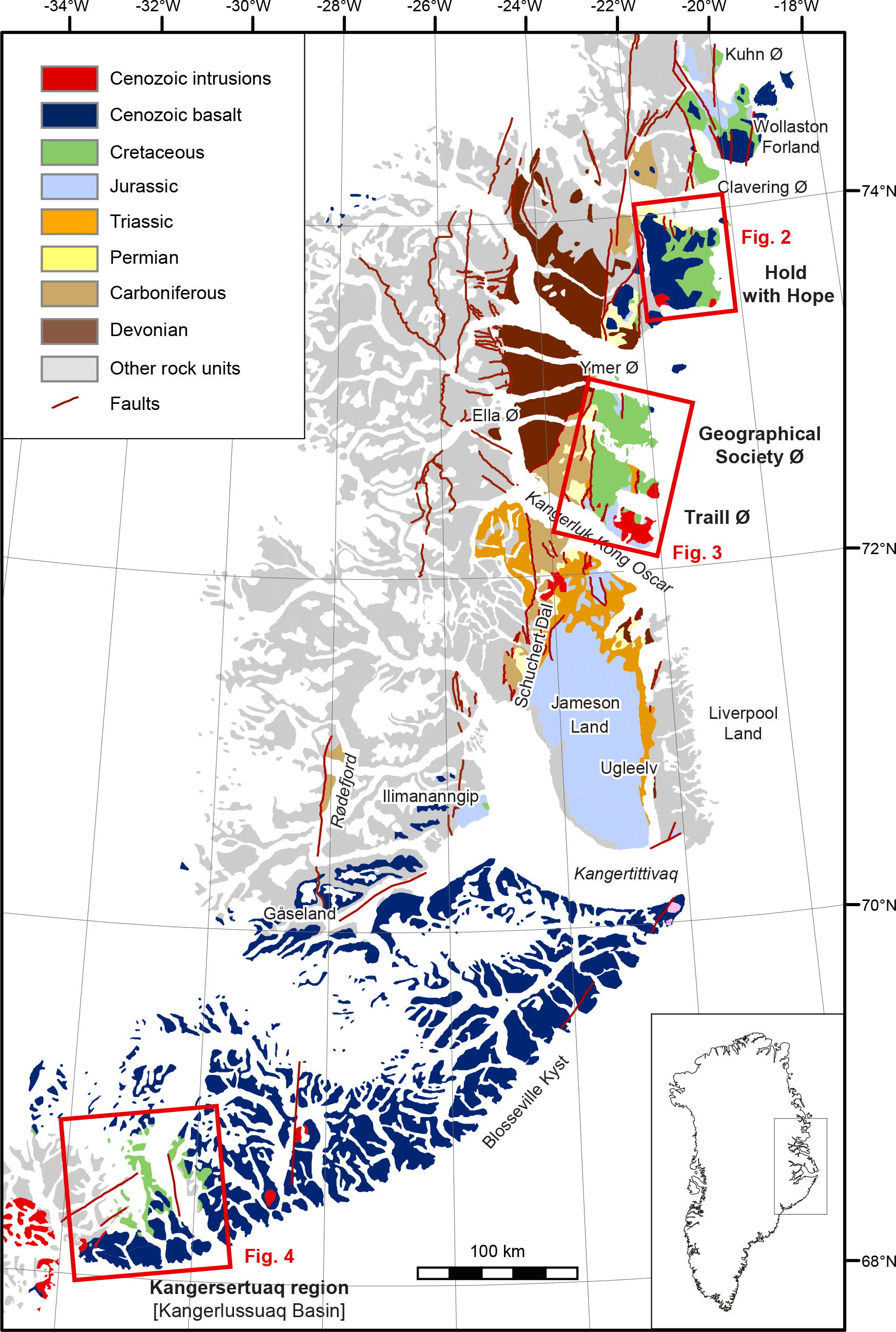
Fig. 1 Geological overview of the study area in East and North-East Greenland. The areas shown in Figs 2 to 4 are indicated by red frames. From north to south, these are Hold with Hope, Geographical Society Ø and Traill Ø, and the Kangerlussuaq Basin (Kangersertuaq region).
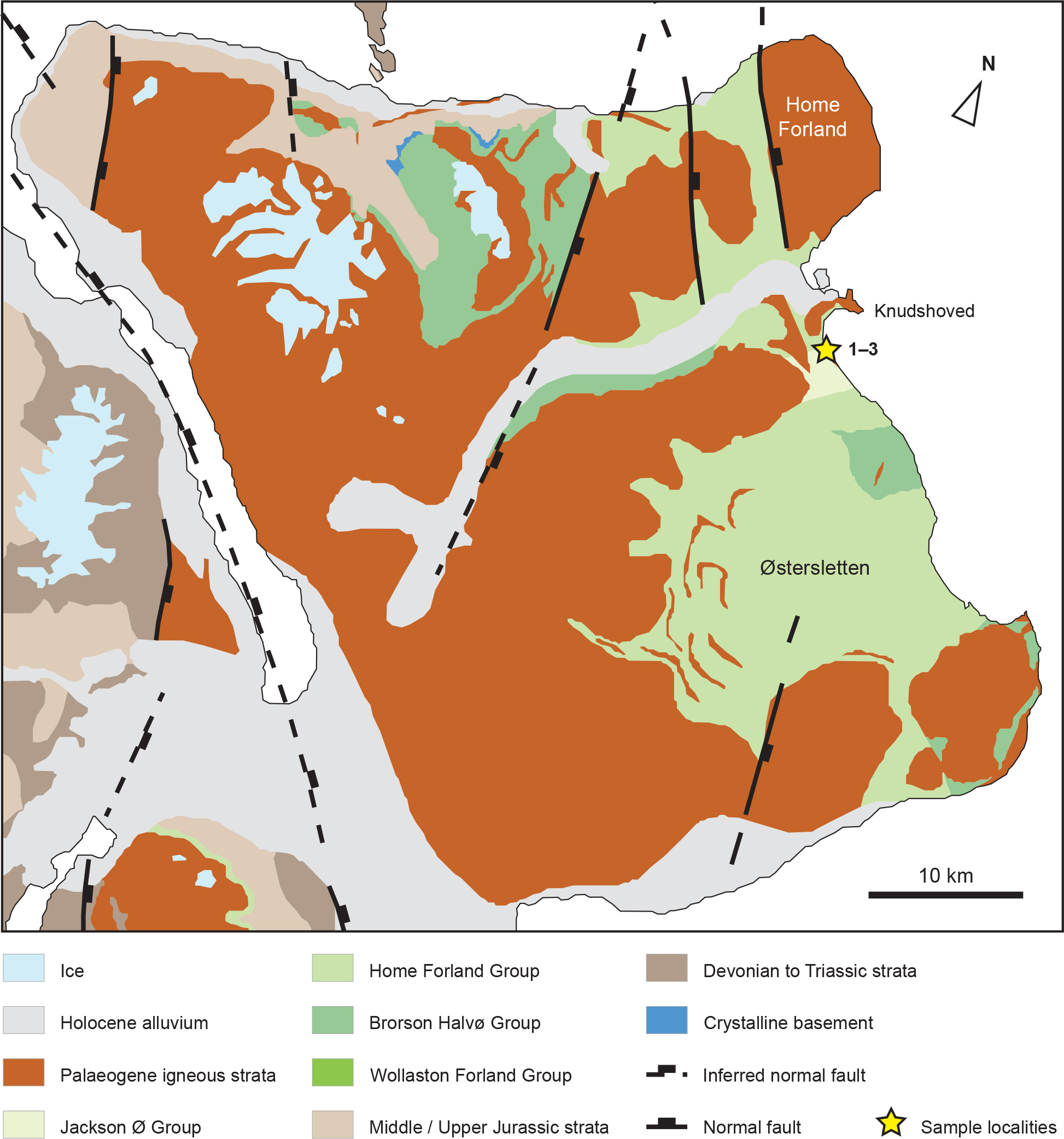
Fig. 2 Geological overview map of Hold with Hope, North-East Greenland. Localities where ammonites were collected are indicated by a yellow star and are numbered from north to south. The three localities here are too closely spaced to display them separately at scale.
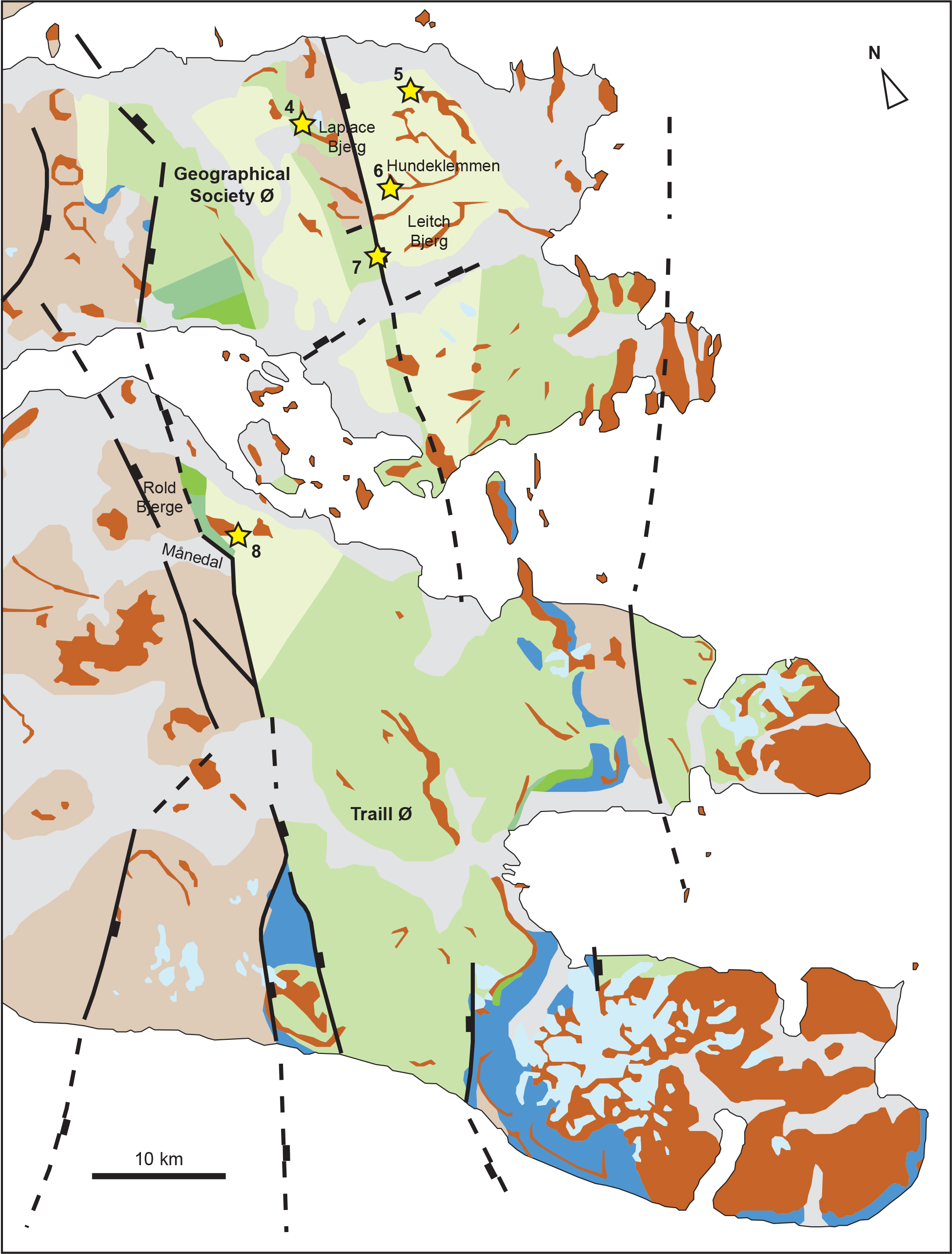
Fig. 3 Geological overview map of Geographical Society Ø and Traill Ø, North-East Greenland. Localities where ammonites were collected are indicated by yellow stars and are numbered from north to south. See Fig. 2 for legend.
1.2.2 East Greenland (Kangerlussuaq Basin)
Late Cretaceous ammonites were first recognised from the Kangerlussuaq Basin (Fig. 4) by Hancock in Soper et al. (1976, p. 89). He reported the presence of Pachydiscus (Pachydiscus) gollevillensis (d’Orbigny 1850), which was stated to be “of lower Maastrichtian or late Campanian age (probably the former)”. In fact, P. (P.) gollevillensis is a late Maastrichtian species (Kennedy 1986). Subsequently, Hoch (1983, fig. 1) figured an undetermined ammonite from Sediment Bjerge, which we believe is possibly a Maastrichtian scaphitid, and Nørgaard-Pedersen (1991) reported the presence of scaphitid ammonites at Sequoia Nunatak. Later, two Maastrichtian ammonite assemblages were listed by Larsen et al. (2005): (1) an early Maastrichtian assemblage with Acanthoscaphites tridens (Kner 1848), Jeletzkytes sp., Hoploscaphites sp. nov., Neophylloceras greenlandicum (Birkelund 1965), Saghalinites wright Birkelund 1965, Anagaudryceras cf. lueneburgense (Schlüter 1872), Pachydiscus sp., Diplomoceras cylindraceum (Defrance 1816) and Baculites sp.; and (2) a late Maastrichtian assemblage composed only of Discoscaphites aff. angmartussutensis Birkelund 1965 and Diplomoceras cylindraceum. However, none of the specimens was figured, and the material is described and illustrated here for the first time.
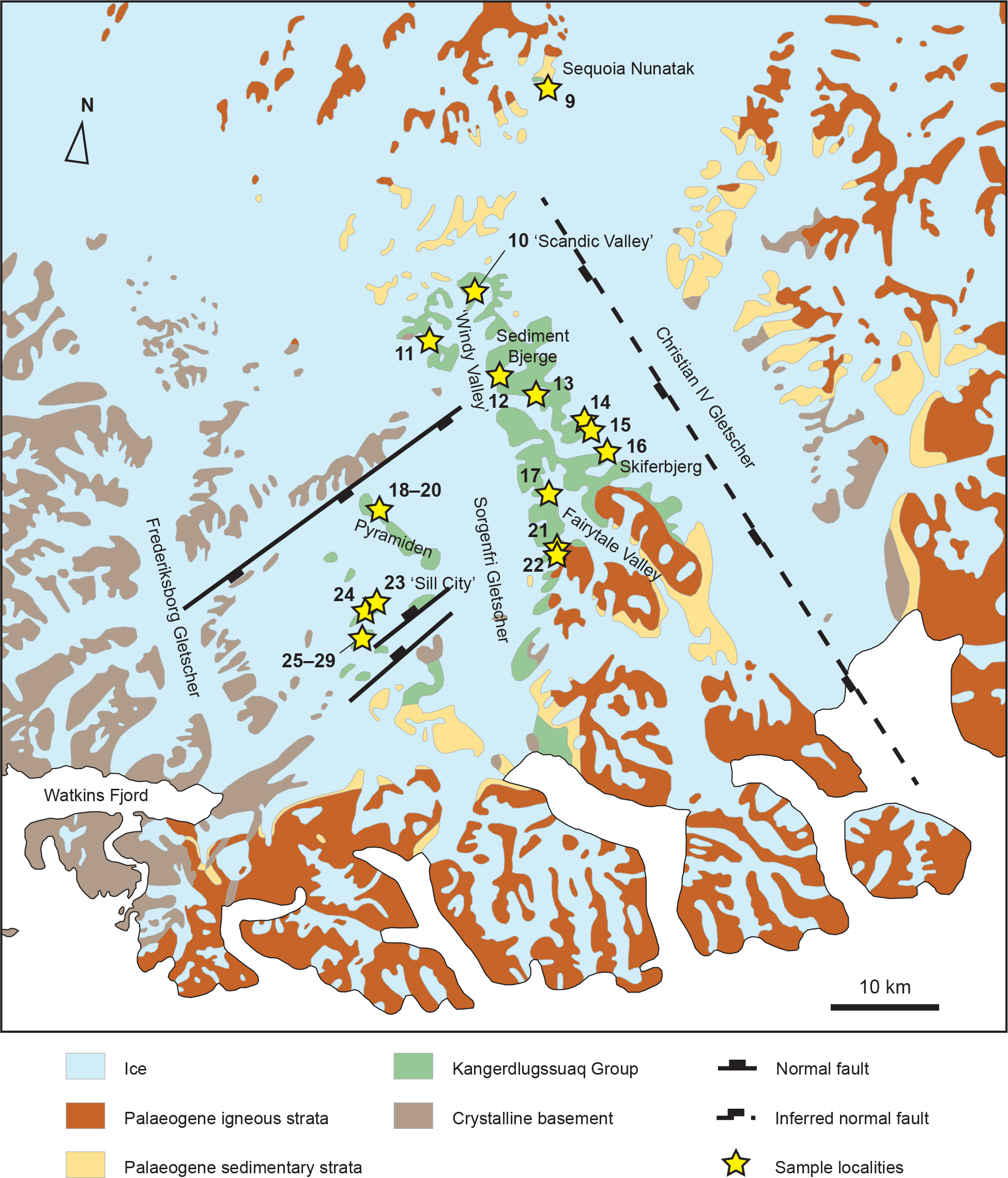
Fig. 4 Geological overview map of the Kangerlussuaq Basin (Kangersertuaq region), East Greenland. Informal place names are given in quotation marks. Localities where ammonites were collected are indicated by yellow stars and are numbered from north to south.
1.3 Stratigraphic framework
1.3.1 North-East Greenland
All lithostratigraphic units of North-East Greenland relevant to the present study belong to the Jackson Ø Group of Bjerager et al. (2020; Fig. 5). In the Hold with Hope region, this group comprises the Coniacian to basal Campanian sandstones of the Østersletten Formation and the overlying lower Campanian, mudstone-dominated Knudshoved Formation (Fig. 5; Bjerager et al. 2020). Originally established as members of the Home Forland Formation (Kelly et al. 1998), these units were both elevated to formation rank by Bjerager et al. (2020).
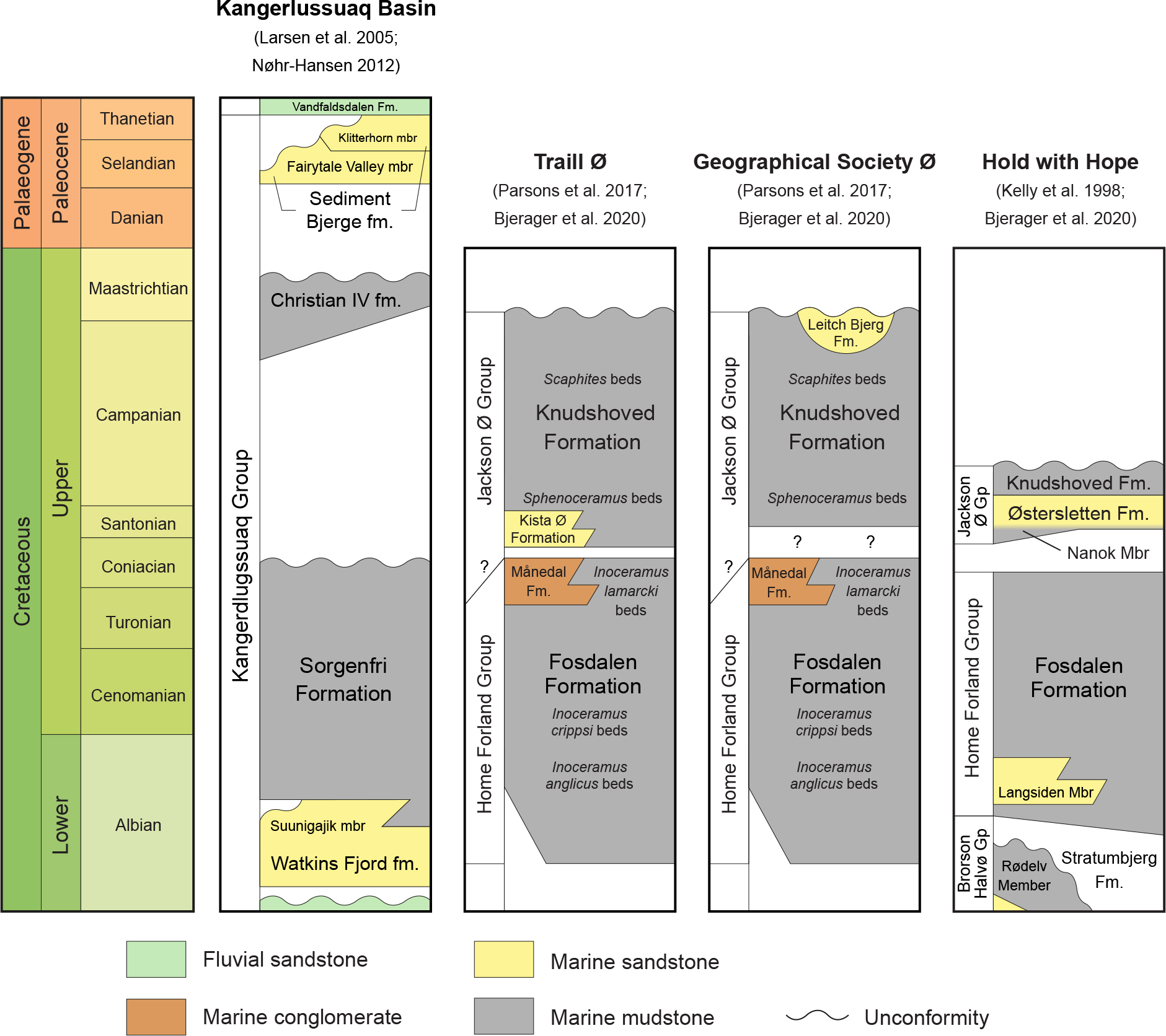
Fig. 5 Albian to Maastrichtian (Paleocene) lithostratigraphy of the Kangerlussuaq Basin, Traill Ø, Geographical Society Ø and Hold with Hope.
On Traill Ø, and locally also Geographical Society Ø, conglomerates and coarse sandstones of the Turonian–Coniacian Månedal Formation form the base of the Jackson Ø Group. In northern Traill Ø, these are followed by massive sandstones of the Coniacian to Santonian Kista Ø Formation (Bjerager et al. 2020). Both sandstone units are overlain by mudstones of the Knudshoved Formation – Campanian only on Geographical Society Ø, Coniacian to Campanian on Traill Ø, according to Bjerager et al. (2020). On eastern Geographical Society Ø, a Campanian sandstone unit, the Leitch Bjerg Formation of Bjerager et al. (2020), occurs above the Knudshoved Formation.
The occurrence of late Turonian and Coniacian macrofauna in the Fosdalen Formation of the Home Forland Group below, reported by Parsons et al. (2017), questions the position of the boundary between the Home Forland and Jackson Ø Groups, including the assignment of the Månedal Formations to the latter. In fact, Parsons et al. (2017) regarded the contact between the Fosdalen and Knudshoved Formations on Geographical Society Ø as conformable and included the respective strata in a single unit, the Home Forland Formation. As shown by Parsons et al. (2017), these strata yielded late Santonian to early Campanian inoceramids, showing that a hiatus encompassing the entire Coniacian and Santonian stages, as proposed by Bjerager et al. (2020), is untenable. Given that Bjerager et al. (2020) did not describe the contact of the Fosdalen and Knudshoved Formations, the precise relationship between these units remains unclear. The lithostratigraphic columns depicted in Fig. 5 are modified from Kennedy et al. (2024) and represent a merger of the schemes of Parsons et al. (2017) and Bjerager et al. (2020).
In all three regions, Hold with Hope, Geographical Society Ø and Traill Ø, the ammonites described here were collected exclusively from the Knudshoved Formation. The Knudshoved Formation is dominantly composed of dark grey micaceous mudstones with siderite concretions, which are punctuated by normally graded sandstone beds. On Hold with Hope, its lower boundary with the sandstones of the Østersletten Formation is conformable but sharp (Kelly et al. 1998; Bjerager et al. 2020). On Geographical Society Ø and Traill Ø, the contact with the underlying Månedal and Kista Ø Formations is not well exposed anywhere, but is assumed to be transitional; the contact with the Fosdalen Formation, where these sandstone-dominated units are absent, has not been described (Bjerager et al. 2020). The upper boundary of the Knudshoved Formation is an erosional unconformity generally overlain by Paleocene sedimentary strata or Paleogene basalts. Where the Leitch Bjerg Formation occurs, its boundary with the underlying Knudshoved Formation is erosive (Bjerager et al. 2020).
The strata of the Knudshoved Formation are interpreted as slope to basin deposits. Sedimentary structures, including lamination, sparse bioturbation and intra-formational rip-up clasts, indicate a combination of suspension settling and debris flows as the dominant depositional process (Parsons et al. 2017; Bjerager et al. 2020). The channelised sandstones of the Leitch Bjerg Formation on Geographical Society Ø are interpreted as high-energy sediment gravity flows cutting into the underlying succession (Parsons et al. 2017; Bjerager et al. 2020).
In the lower part of the unit, the Sphenoceramus Beds of Donovan (1953, 1955, 1957), only a few ammonites co-occur with bivalves of the genera Sphenoceramus and Hypoxytoma (Frebold 1934; Donovan 1953, 1954, 1955, 1957). In the upper part of the Knudshoved Formation, the Scaphites Beds of Donovan (1953, 1955, 1957), an ammonite-dominated fossil assemblage occurs, which has occasional infaunal bivalves, scaphopods and gastropods associated (Donovan 1955; this study).
1.3.2 East Greenland (Kangerlussuaq Basin)
The Kangerlussuaq Basin contains several unconformity-bound sedimentary packages of Cretaceous (Barremian to Maastrichtian) and Paleogene (Selandian to Ypresian) age, which are partly intercalated with and overlain by extensive basalts (Larsen et al. 2005; Nøhr-Hansen 2012). The Kangerdlugssuag Group, established by Wager (1934, 1947) and Soper et al. (1976), comprises four formations, according to the latest revision by Larsen et al. (2005). While published in an open-access report, the new lithostratigraphic units established by Larsen et al. (2005) are not universally recognised as formal and are thus given in lower-case notation in the present study. The Aptian to Albian sandstone-dominated Watkins Fjord Formation is overlain by the mudstone-dominated Albian to Coniacian Sorgenfri Formation. Another mudstone-rich unit, the Campanian to Maastrichtian Christian IV Formation, follows. The hiatus between the two units is generally expressed as a planar unconformity (Larsen et al. 2005). An erosional unconformity separates the overlying Paleocene (Selandian to Thanetian) Sediment Bjerge Formation, which comprises two members (Soper et al. 1976; Larsen et al. 2005). The lower, turbiditic Fairytale Valley member consists of stacked fining-upward sandstone packages with an increasing siltstone to mudstone component towards the top, but also includes mass flows and slumps of Christian IV Formation material (Larsen et al. 2005). The overlying Klitterhorn member is composed of shallow marine sandstones.
The Christian IV Formation comprises well-bioturbated sandy mudstones intercalated with subordinate decimetre-scale fine- to medium-grained sandstone beds. Calcareous concretions occur preferentially in sandier units and often contain fossils. These include the ammonites described here, which are associated with infaunal and epifaunal bivalves, gastropods, irregular echinoids, brachiopods, crustaceans and rare belemnites (Larsen et al. 2005). The overlying Fairytale Valley member is largely composed of stacked, fining-upward sandstone beds often showing classical Bouma sequences. These are intercalated with subordinate silty mudstones, which become dominant towards the top of the unit. However, proportions of sandstone and mudstone also vary laterally (Larsen et al. 2005).
The strata of the Christian IV Formation are thought to represent shallow to outer shelf deposits based on the marine fauna present, the pervasive bioturbation and the hummocky cross stratification seen in some of the intercalated sand beds (Larsen et al. 2005). The sandstones of the Fairytale Valley member are interpreted as turbiditic channel fills, based on the sedimentary structures observed. They are thought to be incised into the top of the Christian IV Formation, although this contact is nowhere well exposed (Larsen et al. 2005).
All of the studied ammonites originate from the Christian IV Formation. However, several Maastrichtian specimens were collected from Christian IV Formation material in slumps and mass flow deposits within the Fairy Tale Valley member.
2 Materials and methods
The specimens described here were collected by CASP geologists during several field seasons between 1990 and 2005, and come from four regions in North-East and East Greenland (Figs 1–4). The 29 study sites are numbered from north to south, and their approximate positions are indicated by yellow stars on Figs 2–4. In several cases, individual localities are too close to each other to be displayed separately and are thus indicated by a single star on the maps. A detailed list of localities is provided in Supplementary File 1.
Specimens were coated with ammonium chloride for photographs. All specimens from Greenland that are figured and discussed in this study are curated at the Natural History Museum of Denmark, Copenhagen, Denmark, under accession numbers MGUH 35114–35221 and GM 2025.8–2025.42.
3 Systematic palaeontology
Conventions. Dimensions are given in mm: D: diameter. Wb: whorl breadth. Wh: whorl height. U: umbilicus. Figures given in parentheses are dimensions as a percentage of diameter. The suture terminology is that of Korn et al. (2003): E: external lobe. A: adventive lobe. U1, U2 and U3: umbilical lobes. I: internal lobe. L: lateral lobe.
Repositories of specimens. GBA: Geologische Bundesanstalt, GeoSphere Austria, Vienna, Austria. MGUH, GM: Natural History Museum of Denmark, Copenhagen, Denmark.
Order Ammonoidea Zittel 1884
Suborder Phylloceratina Arkell 1950
Superfamily Phylloceratoidea Zittel 1884
Family Phylloceratidae Zittel 1884
Subfamily Phylloceratinae Zittel 1884
Genus Neophylloceras Shimizu 1934
Type species. Ammonites (Scaphites?) ramosus Meek 1858, p. 45, by original designation.
Neophylloceras groenlandicum (Birkelund 1965)
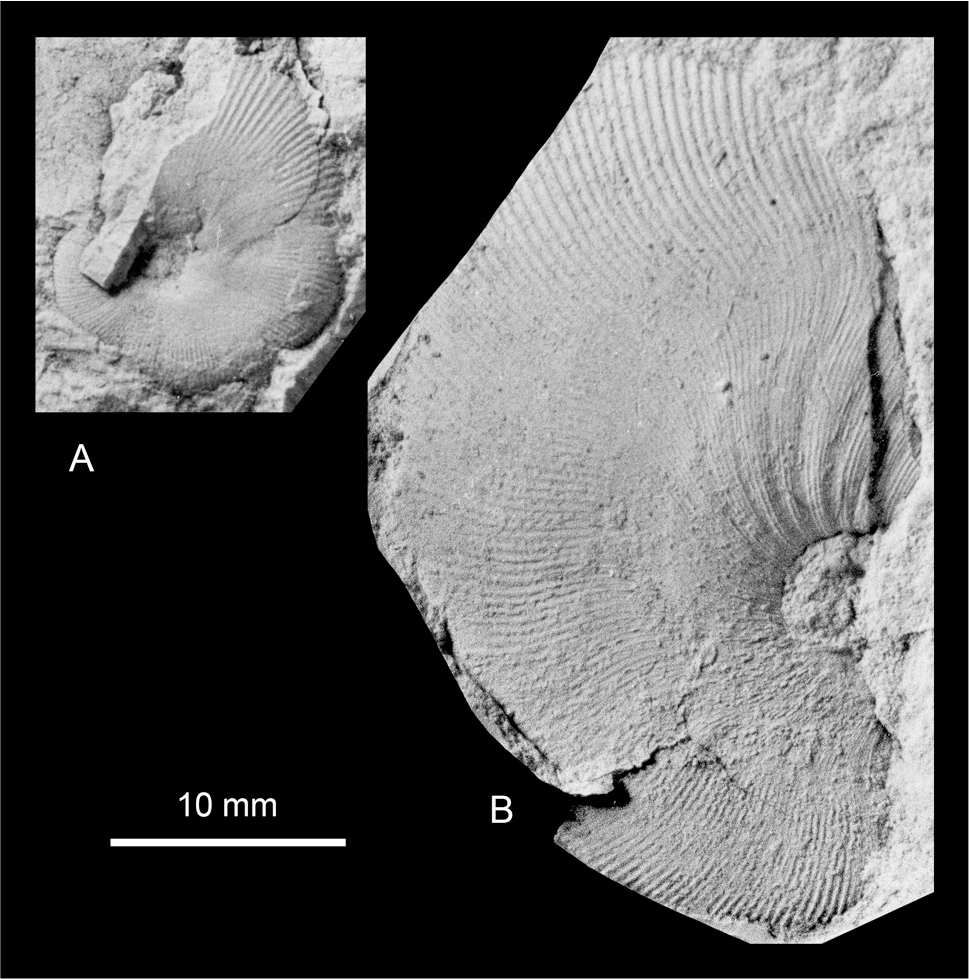
Fig. 6 A: Neophylloceras sp., MGUH 35199; Locality 1, south-east of Knudshoved Hut, Hold with Hope. B: Neophylloceras groenlandicum (Birkelund 1965), MGUH 35198; Locality 24, west of ‘Sill City’, Kangerlussuaq Basin. Both ×2.
| 1965 | Hypophylloceras (Neophylloceras) groenlandicum Birkelund, p. 23, plate 1, figs 1–4; text-figs 8–13. |
| 2009 | Neophylloceras groenlandicum (Birkelund, 1965); Klein et al., p. 99, 101 (with full synonymy). |
Type. The holotype is MGUH 9737, from a reworked Maastrichtian nodule in the Danian Oyster-ammonite Conglomerate of Nuussuaq, West Greenland.
Material. A single specimen, MGUH 35198, from Locality 24 (see Supplementary File 1), west of ‘Sill City’, Kangerlussuaq Basin.
Description. MGUH 35198 is an external mould of a specimen with an original estimated diameter of 38 mm. Only one flank is preserved. Coiling is very involute, the umbilicus comprising 8% of the diameter. The flanks are flattened and subparallel, the ventrolateral shoulders and venter broadly rounded. The umbilical wall, shoulder and innermost flank are ornamented by low, close-spaced folds that are prorsiradiate and concave, effacing by mid-flank. The whole of the shell surface is ornamented by delicate crowded ribs. These arise at the umbilical seam, are concave and prorsiradiate on the inner flank, flex back and are markedly convex across the mid-flank region, strengthen and are concave on the outer flank, projecting forwards on the outermost flank and ventrolateral shoulders.
Discussion. The specimen is referred to N. groenlandicum on the basis of the whorl section and distinctly sinuous course of the delicate ribs. GM 2025.33 and GM 2025.34 are further, specifically indeterminate phylloceratid fragments.
Occurrence. Oyster-ammonite Conglomerate, Nuussuaq, West Greenland. The present specimen is from the lower Maastrichtian of the Christian IV Formation of the Kangerlussuaq Basin, East Greenland.
Neophylloceras sp.
Material. A single specimen, MGUH 35199, from Locality 1, south-east of Knudshoved Hut, Hold with Hope.
Discussion. The present specimen is a well-preserved but specifically indeterminate juvenile Neophylloceras with a maximum preserved diameter of 16 mm, and is significantly older than those referred to N. greenlandicum above.
Occurrence. Lower Campanian of the Knudshoved Formation of Hold with Hope.
Suborder Lytoceratina Hyatt 1889
Superfamily Tetragonitoidea Hyatt 1900
Family Gaudryceratidae Spath 1927
Genus Gaudryceras de Grossouvre 1894
Subgenus Gaudryceras de Grossouvre 1894
Type species. Ammonites mitis Hauer 1866, p. 305, plate 2, figs 3, 4, by the subsequent designation of Boule et al. (1906, p. 183 (11)).
Gaudryceras (Gaudryceras) mite (Hauer 1866)
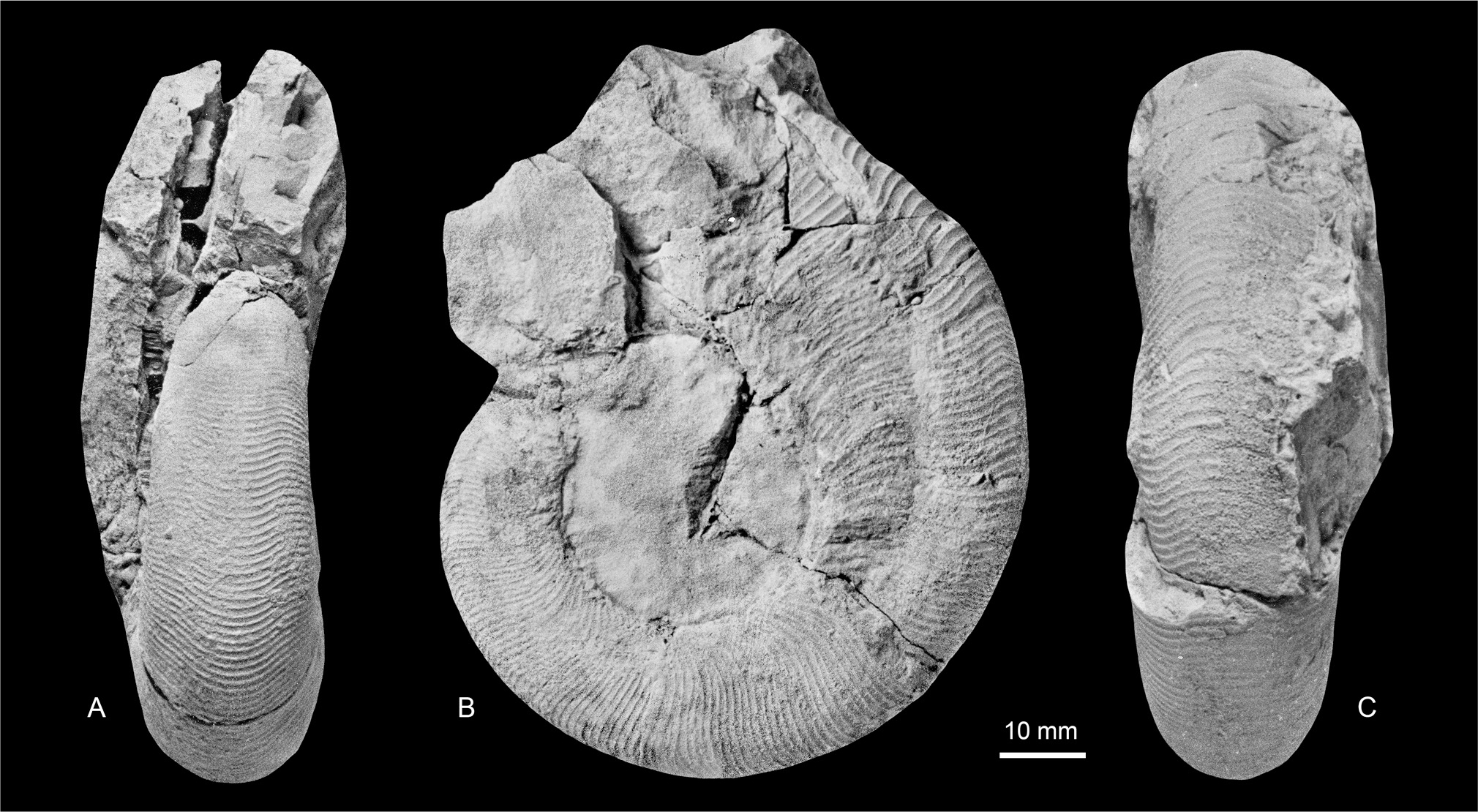
Fig. 7 A–C: Gaudryceras (Gaudryceras) mite (Hauer 1866), MGUH 35162; Locality 3, south-east of Knudshoved Hut, Hold with Hope. All ×1.
| 1866 | Ammonites mitis Hauer, p. 6, plate 2, figs 3, 4. |
| 1873 | Ammonites glaneggense Redtenbacher, p. 119, plate 27, fig. 3. |
| 1979 | Gaudryceras mite (Hauer); Kennedy & Summesberger, p. 74, plate 1, fig. 1; plate 2, fig. 1, text-fig. 1 (with synonymy). |
| 1979 | Gaudryceras glaneggense (Redtenbacher); Kennedy & Summesberger, p. 76, pls 3, 4 (with synonymy). |
| 1996 | Gaudryceras (Gaudryceras) mite (Hauer, 1866); Summesberger & Kennedy, plate 1, figs 1–4 (with synonymy). |
| 2009 | Gaudryceras mite (Hauer, 1866): Klein et al., pp. 173, 184) (with additional synonymy). |
| 2022 | Gaudryceras mite (Hauer, 1866); Summesberger et al., p. 23, plate 3, fig. 18; plate 4, fig. 1 (with additional synonymy). |
Type. The holotype, by monotypy, is the original of Hauer (1866, plate 2, figs 2, 3), from the Gosau Group possibly of Strobl/Weissenbach, Austria; Geologische Bundesanstalt Collection, GeoSphere Austria, Vienna, Austria, no. GBA 1866/001/0003; refigured by Kennedy & Summesberger (1979, plate 1, fig. 1), Summesberger & Kennedy (1996, plate 1, fig. 1) and Wright (1996, text-fig. 2.4).
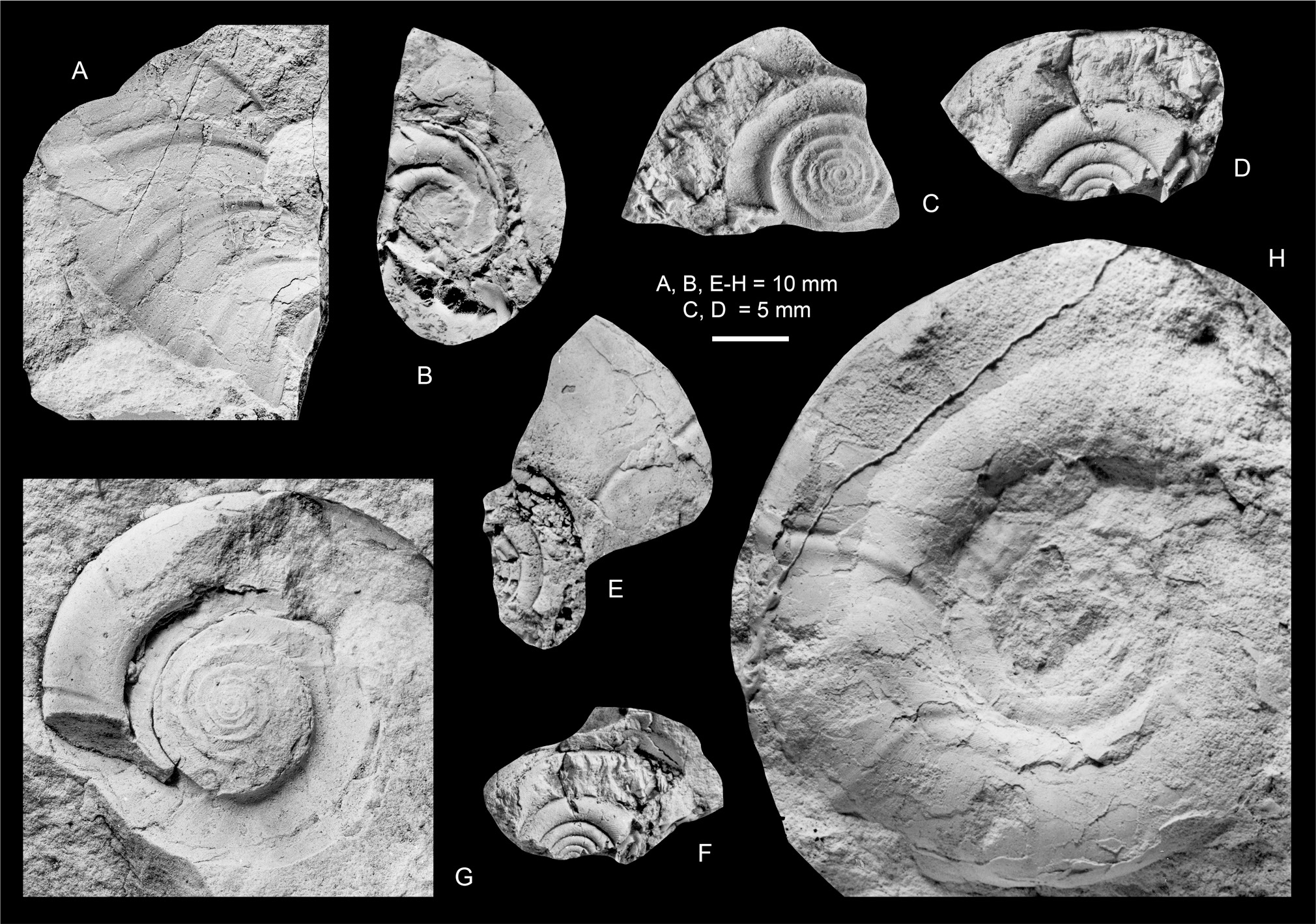
Fig. 8 A: Anagaudryceras cf. lueneburgense (Schlüter 1872), MGUH 35127; Locality 18, Pyramiden ridge, north end, Kangerlussuaq Basin. B–H: Anagaudryceras politissimum (Kossmat 1895). B. MGUH 35131 (silicone rubber cast). C–F: MGUH 35130. G. MGUH 35129. B–G from Locality 22, southern part of North Col of Apollo Glacier, Kangerlussuaq Basin. H. MGUH 35128 (silicone rubber cast); Locality 14, Sediment Bjerge east, Kangerlussuaq Basin. A, B, E–H ×1. C, D are ×2.
Material. A single specimen, MGUH 35162, from Locality 3, south-east of Knudshoved Hut, Hold with Hope.
Description. MGUH 35162 is a juvenile individual with a maximum preserved diameter of 78 mm. Coiling is very evolute, the umbilicus comprising 37–40% of the diameter. The whorl section is ovoid, the whorl breadth-to-height ratio 1.1, the flanks flattened and feebly convergent, the ventrolateral shoulders broadly rounded, the venter feebly convex. Ornament comprises delicate crowded lirae that arise at the umbilical seam either singly or in pairs. They may branch close to the umbilicus, on the umbilical shoulder or inner flanks. They are convex and prorsiradiate on the umbilical shoulder and inner flank, flexing forwards and feebly concave on the ventrolateral shoulders and very feebly convex across the venter.
Discussion. For discussion, see Kennedy & Summesberger (1979, pp. 74, 76) and Summesberger & Kennedy (1996, p. 112). The present specimen differs in no significant respects from the holotype at the same diameter.
Occurrence. Turonian to Maastrichtian of worldwide distribution. The present specimen is from scree approximately 3 m above the base of the Knudshoved Formation at Knudshoved, Hold with Hope, and is of early Campanian age.
Gaudryceras sp.
[not figured]
Material. A single specimen, GM 2025.26, from Locality 26, east of Watkins Fjord, Kangerlussuaq Basin.
Description and discussion. The specimen is a 99 mm long fragment of the outer flank and ventrolateral shoulder. The internal mould bears parts of nine ribs. They are coarse, rounded, narrower than the interspaces, rursiradiate on the flanks and feebly concave on the ventrolateral shoulder. The external mould shows the shell surface to have been covered in crowded wiry lirae. The specimen is specifically indeterminate; this type of ornament occurs in many large Late Cretaceous Gaudryceras (Matsumoto 1995), as with the holotype of Gaudryceras glaneggensis (Redtenbacher 1873) from the upper Santonian Gosau Group of Austria (a synonym of G. mite; see revision in Summesberger et al. 2022, plate 4, fig. 1).
Occurrence. Lower Maastrichtian of the Christian IV Formation of the Kangerlussuaq Basin, East Greenland.
Genus Anagaudryceras Shimizu 1934
Type species. Ammonites sacya Forbes 1846, p. 113, p. 14, fig. 9, by the original designation of Shimizu (1934, p. 67) [= Ammonites buddha Forbes (1846, p. 112, plate 14, fig. 9)].
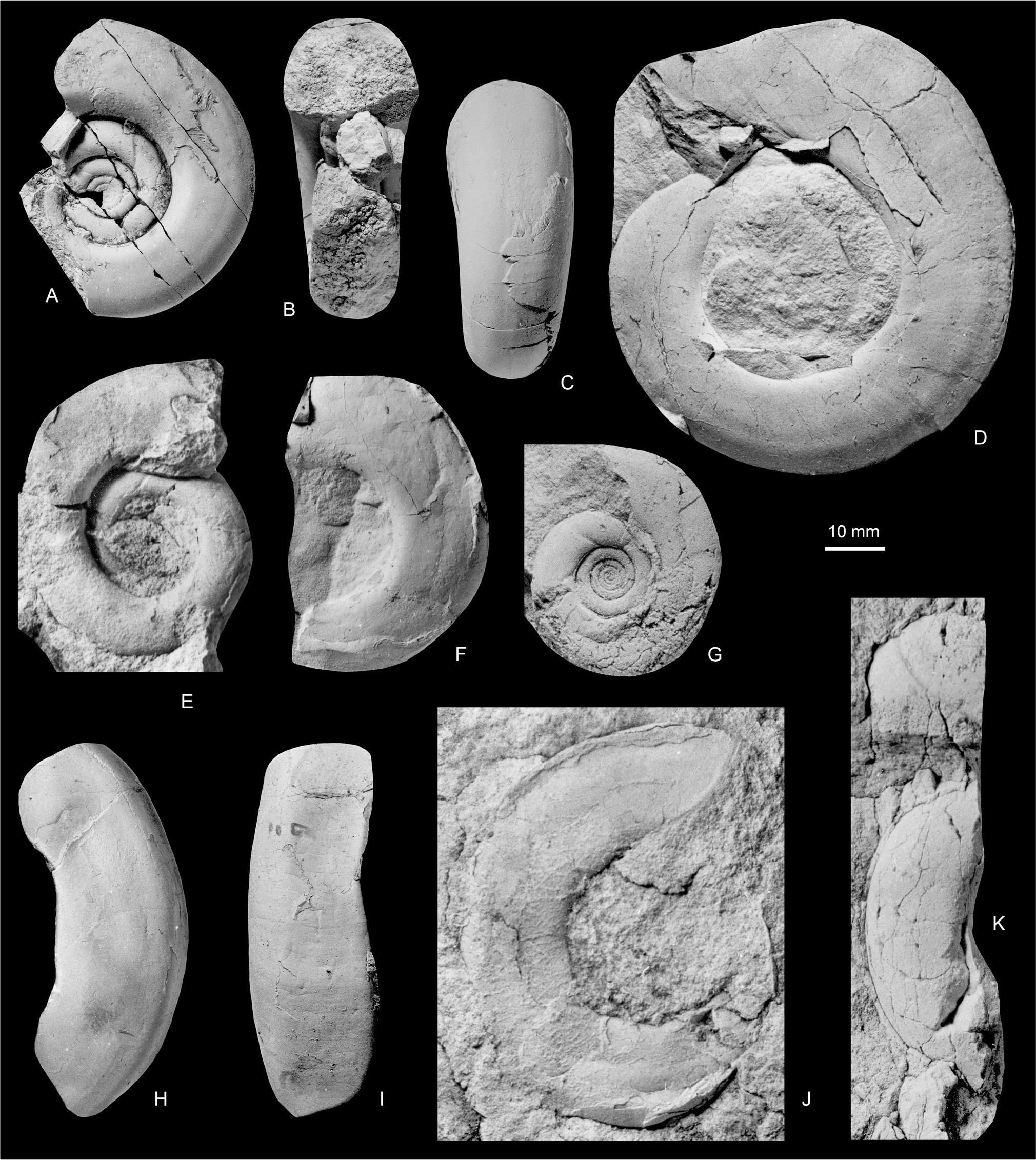
Fig. 9 A–K: Saghalinites wrighti Birkelund 1965; all from the Kangerlussuaq Basin. A–C: MGUH 35217; Locality 19, Pyramiden ridge, north end. D: MGUH 35220 (silicone rubber cast); Locality 22, southern part of North Col of Apollo Glacier. E: MGUH 35216; Locality 14, Sediment Bjerge east. F: MGUH 35221; Locality 22, southern part of North Col of Apollo Glacier. G: MGUH 35218; Locality 20, Pyramiden ridge, north end. H, I: MGUH 35219 (silicone rubber cast); Locality 22, southern part of North Col of Apollo Glacier. J: MGUH 35215; Locality 14, Sediment Bjerge east. K: MGUH 35214; Locality 14, Sediment Bjerge east. All ×1.
Anagaudryceras politissimum (Kossmat 1895)
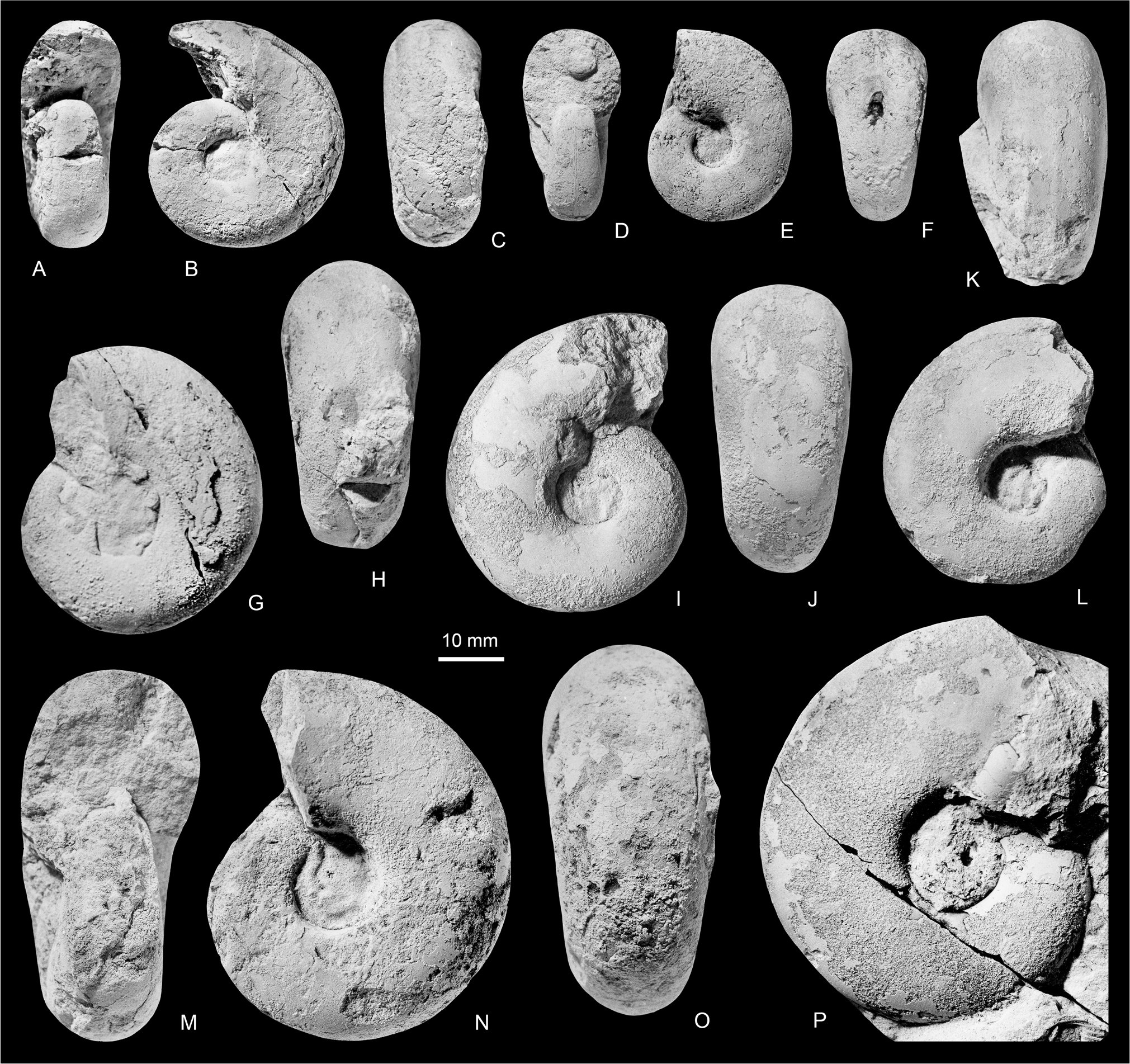
Fig. 10 Pseudophyllites latus (Marshall 1926). A–C: MGUH 35208. D–F: MGUH 35210. G, H: MGUH 35209. I, J: MGUH 35211. K, L: MGUH 35207. M–O: MGUH 35212. P: MGUH 35206. All from Locality 7, col east of Leitch Bjerg, Geographical Society Ø. All ×1.
| 1895 | Lytoceras (Gaudryceras) politissimum Kossmat, p. 128(32), plate 15(1), fig. 7. |
| 1993 | Anagaudryceras politissimum (Kossmat, 1895); Ward & Kennedy, p. 21, figs 17.9, 17.12, 19.1, 19.2, 19.6, 19.14, 19.15 (with full synonymy). |
| ?non 1995 | Anagaudryceras politissimum (Kossmat, 1895); Matsumoto, p. 70, figs 36, 37. |
| 1999 | Anagaudryceras politissimum (Kossmat, 1895); Kennedy in Fatmi & Kennedy, p. 646, figs 4.7, 4.8. |
| 2001 | Anagaudryceras politissimum (Kossmat, 1895); Klinger et al., p. 278, plate 1, figs 1–8. |
| 2009 | Anagaudryceras politissimum (Kossmat, 1895); Klein et al., pp. 157, 164 (with additional synonymy). |
Type. The holotype, by monotypy, is the original of Kossmat (1895, p. 128(32), plate 15(1), fig. 7), from the upper part of the Trichinopoly Group of Varagur, South India.
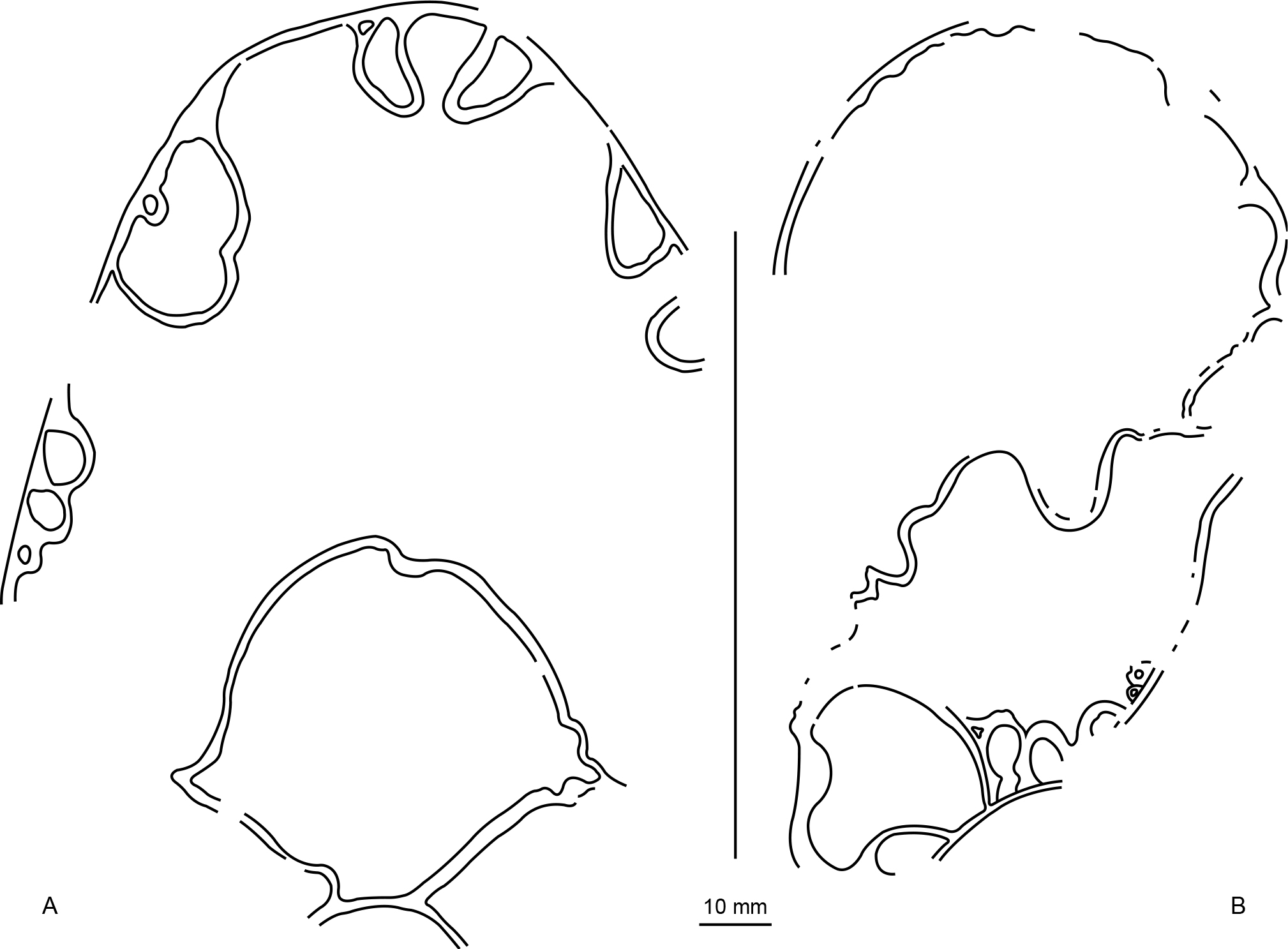
Fig. 11 Pseudophyllites sp.; camera lucida sketches of natural sagittal sections. Both sides of specimen MGUH 35213; Locality 2, south-east of Knudshoved Hut, Hold with Hope. Both ×1.
Material. A single specimen, MGUH 35128 from Locality 14, Sediment Bjerge east. A single specimen, GM 2025.11, from Locality 17, Skiferbjerg north. Five specimens, MGUH 35129–MGUH 35131, GM 2025.12, and GM 2025.13, from Locality 22, southern part of North Col of Apollo Glacier. Five specimens from east of Watkins Fiord: GM 2025.14 and GM 2025.15 from Locality 25; GM 2025.16 from Locality 27; GM 2025.17 and GM 2025.18 from Locality 29. All from the Kangerlussuaq Basin.
Description. The early growth stages to a diameter of 45 mm are well shown by specimens MGUH 35129, MGUH 35130 and MGUH 35131. Coiling is evolute, the umbilicus comprising an estimated 40% of the diameter, broad, shallow, with a low flattened wall and narrowly rounded umbilical shoulder. The whorl section is depressed subcircular, with a whorl breadth-to-height ratio of 1.1. The surface of the shell is ornamented by a dense cover of very fine lirae, visible under magnification. The lirae are strongly prorsiradiate on the flanks, convex on the umbilical shoulder and inner flank, and feebly concave on the outermost flank and ventrolateral shoulder. Periodic, widely separated constrictions are well developed on internal mould MGUH 35129 (Fig. 8G). They are convex on the umbilical shoulder and inner flank, strongly prorsiradiate, feebly concave on the outer flank, flexed forwards on the ventrolateral shoulder, and broadly convex on the venter. MGUH 35128 (Fig. 8H) is an external mould of an individual with an estimated original diameter of 85 mm; the umbilicus comprises an estimated 38% of the diameter. There are five constrictions on the outer half whorl that correspond to prominent, narrow collar ribs on the surface of the shell. These are convex across the umbilical shoulder and inner flank, strongly prorsiradiate, and feebly convex on the outer flank. Where well-preserved, the shell surface is ornamented by crowded lirae that parallel the constrictions.
Further fragments of external and internal moulds (MGUH 35131, MGUH 35130) have whorl heights of up to 34 mm, with prominent widely spaced constrictions on internal moulds (Figs 8B–F), and collar ribs on external moulds.
Discussion. See Henderson & McNamara (1985), Ward & Kennedy (1993) and Klinger et al. (2001).
Occurrence. Turonian to Santonian of south India. Santonian of Zululand, South Africa. Maastrichtian of Madagascar, Western Australia, Pakistan, and the Biscay region of France and Spain. Stinnesbeck (1986) recorded G. cf. politissimum from the Maastrichtian of Chile. The present specimens are from the lower Maastrichtian of the Christian IV Formation of the Kangerlussuaq Basin, East Greenland.
Anagaudryceras cf. lueneburgense (Schlüter 1872)
compare:
| 1872 | Ammonites Lüneburgensis Schlüter, p. 62, plate 18, figs 8, 9. |
| 2003 | Anagaudryceras lueneburgense (Schlüter, 1872); Niebuhr & Esser, p. 262, plate 1, fig. 5. |
| 2009 | Anagaudryceras lueneburgense (Schlüter, 1872); Klein et al., pp. 157, 161 (with synonymy). |
Material. A single specimen, MGUH 35127, from Locality 18, Pyramiden ridge, north end, Kangerlussuaq Basin.
Description. Specimen MGUH 35127 is an external mould of an Anagaudryceras fragment that extends to 90° of a whorl with a maximum preserved whorl height of 28 mm, lacking the ventral part of the flank and the ventrolateral shoulder. Parts of four collar ribs are preserved on the fragment. These are prorsiradiate and strongly convex on the umbilical shoulder and inner flank, and straight and rursiradiate on the remainder of the flank, so far as this is preserved.
Discussion. Close-spaced constrictions distinguish the specimen from Anagaudryceras politissimum, described above, and recall the Anagaudryceras lueneburgense of Birkelund (1993, plate 1, fig. 4).
Occurrence. Upper Campanian of Tercis, south-east France, lower and lower upper Maastrichtian of north Germany, upper/lower Maastrichtian boundary interval in Denmark, lower Maastrichtian of Neuberg, Steiermark, Austria. The present specimen is from the lower Maastrichtian of the Christian IV Formation of the Kangerlussuaq Basin, East Greenland.
Family Tetragonitidae Hyatt 1900
Subfamily Tetragonitinae Hyatt 1900
Genus Saghalinites Wright & Matsumoto 1954
Type species. Ammonites cala Forbes 1846, p. 104, plate 8, fig. 4, by original designation by Wright & Matsumoto (1954, p. 110).
Saghalinites wrighti Birkelund 1965
| 1965 | Saghalinites wrighti Birkelund, p. 30, plate 1, fig. 5; plate 2, figs 1–5; plate 3, fig. 1; text-figs 14–25. |
| 1984 | Saghalinites wrighti Birkelund; Haczewski & Szymakowska, p. 649, plate 1, fig. 2. |
| 1986 | Saghalinites wrighti Birkelund; Kennedy & Summesberger, p. 186, plate 1, figs 4, 5, 7; plate 3, fig. 4; text-fig. 3 (with synonymy). |
| 1993 | Saghalinites wrighti Birkelund, 1965; Birkelund, p. 45, plate 1, figs 6, 7; plate 2, figs 1, 3, 4, 6. |
| 1993 | Saghalinites wrighti Birkelund, 1965; Ward & Kennedy, p. 21, figs 19.3, 19.4, 19.8, 19.12, 20.1–20.3. |
| 1993 | Saghalinites wrighti Birkelund, 1965; Hancock & Kennedy, p. 153, plate 1, figs 5–7; plate 12, fig. 5. |
| 2001 | Saghalinites wrighti Birkelund; Courville & Odin, p. 531, plate 1, figs 6–9. |
| 2003 | Saghalinites wrighti Birkelund, 1965; Niebuhr & Esser, p. 263, plate 1, fig. 4. |
| non 2004 | Saghalinites wright Birkelund; Kassab et al., p. 431, text-fig. 4.6. |
| 2009 | Saghalinites wright Birkelund, 1965; Klein et al., pp. 253, 256 (with synonymy). |
Type. The holotype is MGUH 9747, from a derived concretion in the Oyster-ammonite Conglomerate, Nuussuaq, West Greenland, and of Maastrichtian age, the original of Birkelund (1965, plate 2, fig. 5).
Material. Five specimens, MGUH 35214–MGUH 35216, GM 2025.37 and GM 2025.38, from Locality 14, Sediment Bjerge east. Two specimens from Pyramiden ridge, north end: MGUH 35217 from Locality 19 and MGUH 35218 from Locality 20. Seven specimens, MGUH 35219–MGUH 35221 and GM 2025.39–GM 2025.42, from Locality 22, southern part of North Col of Apollo Glacier. All from the Kangerlussuaq Basin.
Description. MGUH 35218 (Fig. 9G) is a well-preserved juvenile 18.8 mm in diameter, with traces of replaced shell. Coiling is moderately evolute, the umbilicus comprising 37% of the diameter, shallow, with a flattened umbilical wall and narrowly rounded umbilical shoulder. The whorl section is depressed trapezoidal, with feebly convex, convergent flanks, broadly rounded ventrolateral shoulders, and a very feebly convex, broad venter. There are three strongly prorsiradiate constrictions per half whorl that flex back and are convex on the ventrolateral shoulder, and cross the venter in a very shallow convexity. MGUH 35217 (Figs 9A–C) is an internal mould 50 mm in diameter, with a 240° sector of body chamber preserved. Coiling is moderately evolute; the umbilicus comprises 41% of the diameter, the umbilical wall is flattened and outward-inclined, the umbilical shoulder narrowly rounded. The whorl section is depressed trapezoidal, with a whorl breadth-to-height ratio of 1.31, the greatest breadth just outside the umbilical shoulder. Strongly prorsiradiate constrictions are prominent on the phragmocone whorls, but absent on the body chamber. This bears well-defined spiral ridges at the umbilical shoulder, inner and outer ventrolateral and mid-ventral positions. MGUH 35219 (Figs 9H, I) has similar ventrolateral ridges, but lacks the mid-ventral one. MGUH 35220 (Fig. 9D) is the external mould of an adult specimen with an estimated original diameter of 80 mm. Outer lateral and ventrolateral spiral ridges are present, and there are crowded growth lines and striae, strongly prorsiradiate and feebly convex on the flanks, and sweeping back on the ventrolateral shoulders. Delicate ribs and incipient constrictions are present at the largest preserved diameter, indicating the specimen to be adult. Traces of the rather simple suture are preserved on MGUH 35217 (Fig. 9A).
Discussion. This suite of specimens does not differ in any significant respect from the holotype and other specimens from the Oyster-ammonite Conglomerate; see discussion in Birkelund (1965, 1993) and Ward & Kennedy (1993). Kassab et al. (2004) illustrated as their text-fig. 4.6 what they describe as Pachdiscus arkansanus (Stephenson) and Saghalinites wrighti, but all that appears to be illustrated is a pachydiscid.
Occurrence. Courville & Odin (2001, fig. 1) showed this species as first appearing in the upper Campanian at Tercis in south-west France, but the basis for this is unclear. Elsewhere, the species ranges through much of the Maastrichtian, with records from West Greenland, Germany, Austria, Denmark, the Biscay region of south-west France and north-west Spain, and the Western Carpathians. The present specimens are from the lower Maastrichtian of the Christian IV Formation of the Kangerlussuaq Basin, East Greenland.
Genus Pseudophyllites Kossmat 1895
Type species. Ammonites indra Forbes 1846, p. 105, plate 11, fig. 7, by original designation.
Pseudophyllites latus (Marshall 1926)
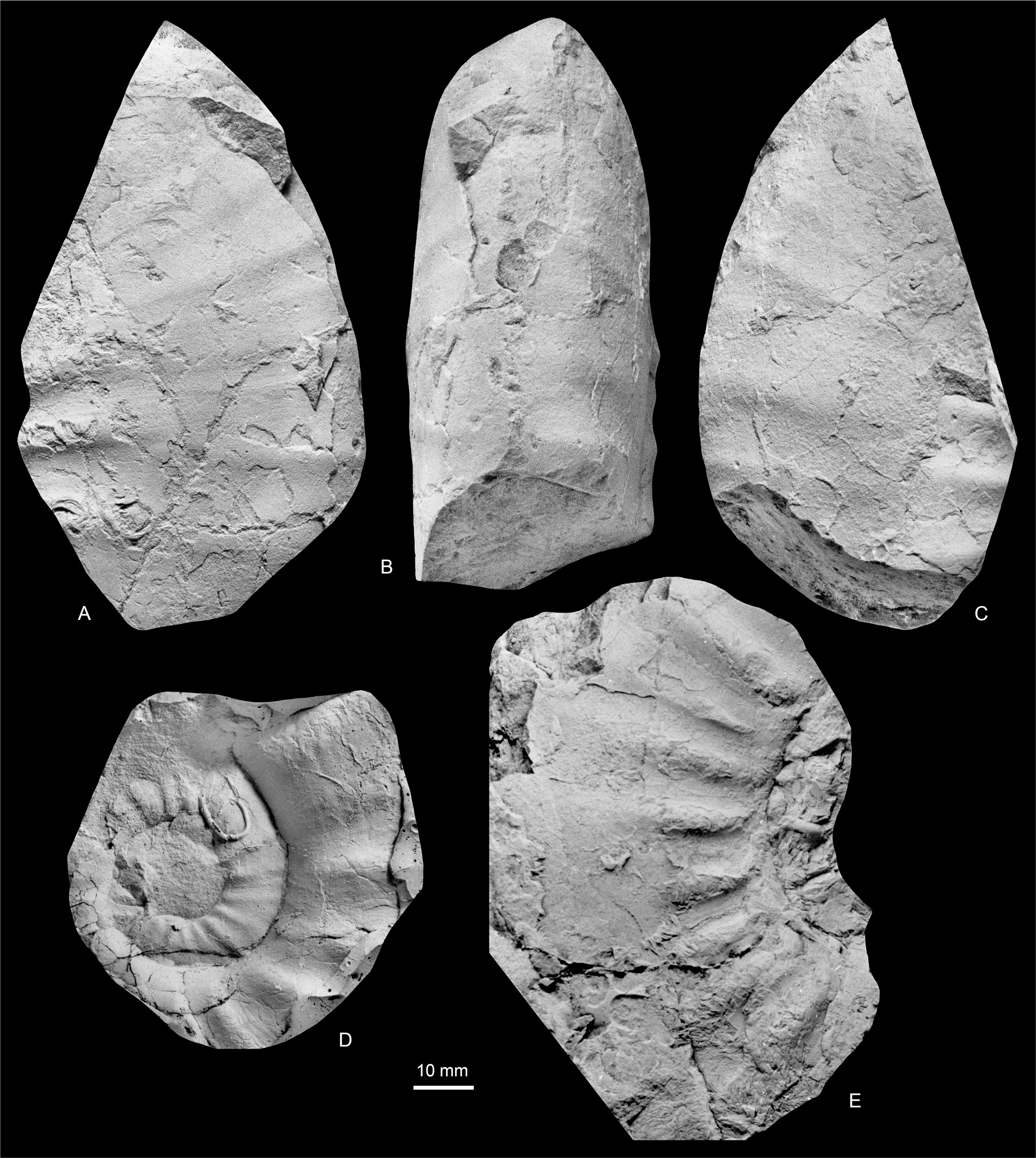
Fig. 12 Pachydiscus (Pachydiscus) sp.; all from the Kangerlussuaq Basin. A–C: MGUH 35202; Locality 14, Sediment Bjerge east. D: MGUH 35203; Locality 15, Sediment Bjerge east. E: MGUH 35204; Locality 18, Pyramiden ridge, north end. All ×1.
| 1926 | Pseudophyllites indra Kilian & Reboul; Marshall, p. 152, plate 20, fig. 1; plate 29, figs 3–5. |
| 1926 | Tetragonites latus Marshall, p. 149, plate 20, fig. 6; plate 32, figs 1, 2. |
| 1926 | Pseudophyllites whangaroaensis Marshall, p. 152, plate 20, fig. 2; plate 21, fig. 11; plate 32, figs 5, 6. |
| 1965 | Pseudophyllites skoui Birkelund, p. 37, plate 3, figs 2–6; text-figs 26–33. |
| 1970 | Pseudophyllites latus Henderson, p. 12, plate 1, fig. 10; plate 2, fig. 3; text-fig. 4a–c. |
| 1977 | Pseudophyllites latus (Marshall, 1926); Kennedy & Klinger, p. 190, figs 25, 26. |
| 2009 | Pseudophyllites latus (Marshall, 1926); Klein et al., pp. 248, 251 (with additional synonymy). |
Type. The lectotype, designated by Henderson (1970, p. 14), is the original of Marshall (1926, plate 32, fig. 1), from the Mata Series (Campanian) of New Zealand.
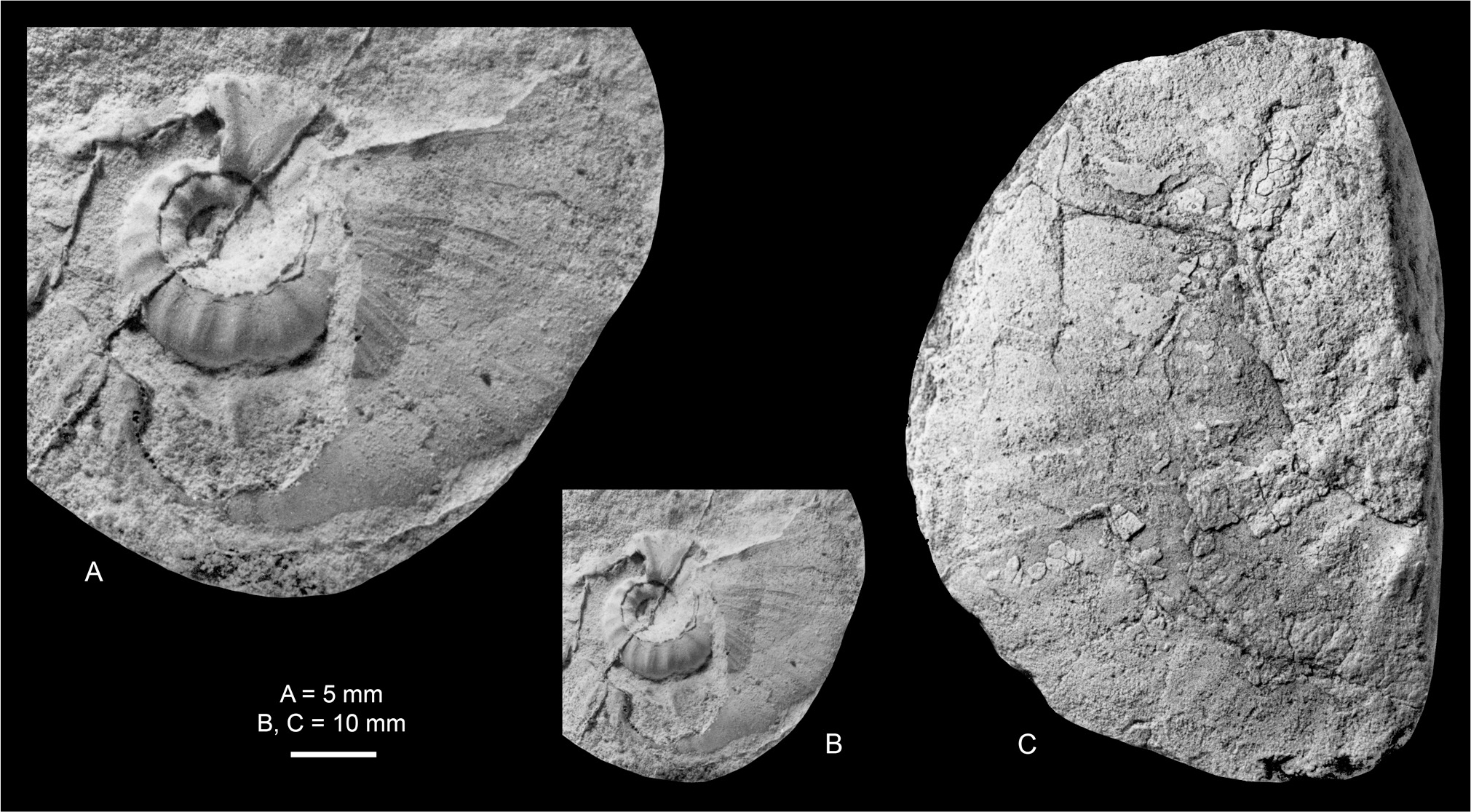
Fig. 13 Pachydiscidae incertae sedis; both from the Kangerlussuaq Basin. A, B: MGUH 35201; Locality 23, Sill City. C: MGUH 35200; Locality 12, ‘Windy Valley’ south-east. A is ×2. B, C are ×1.
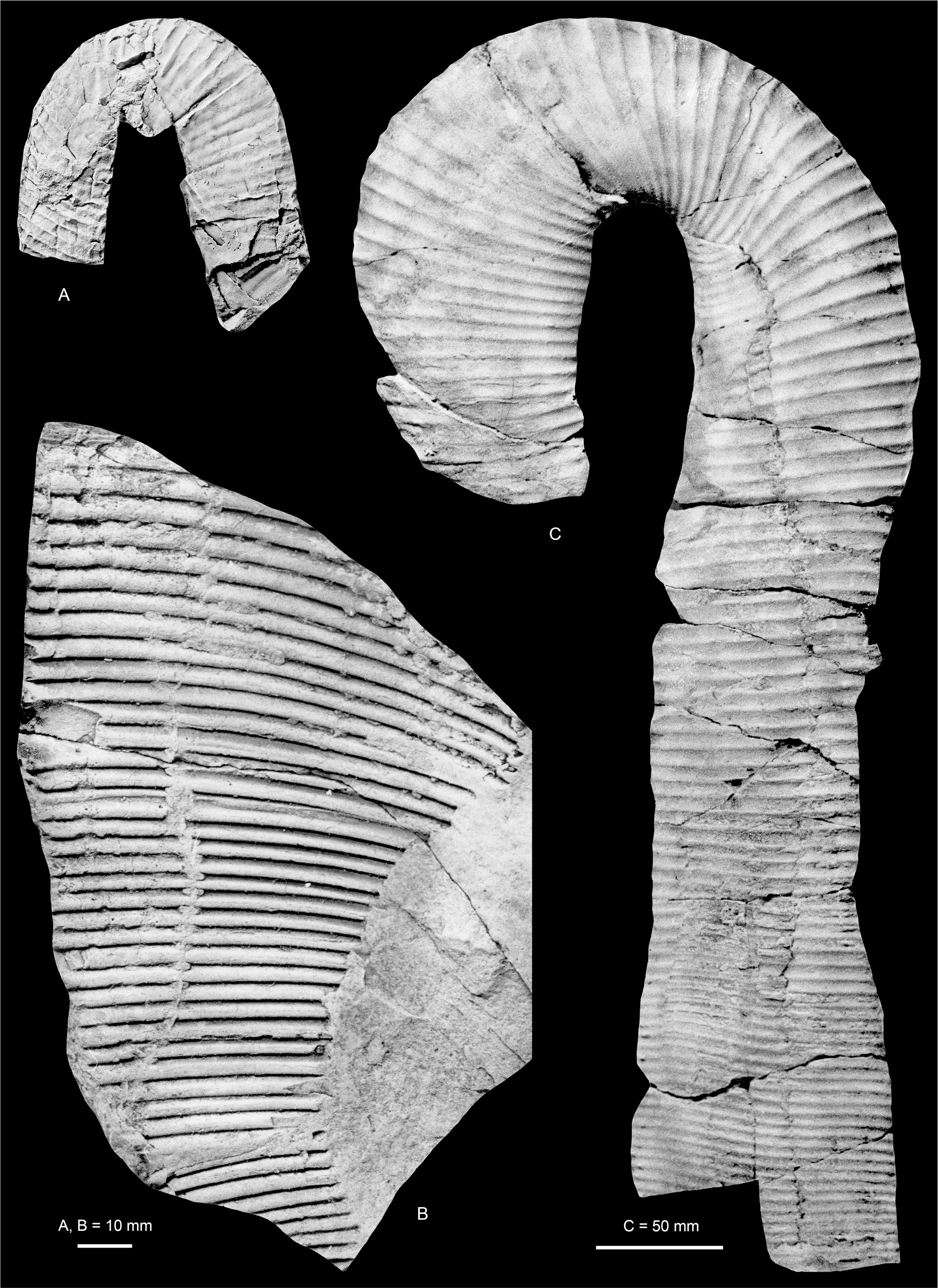
Fig. 14 Diplomoceras cylindraceum (Defrance 1816); all from the Kangerlussuaq Basin. A: MGUH 35145; Locality 21, north side of North Col of Apollo Glacier. B: MGUH 35146; Locality 22, southern part of North Col of Apollo Glacier. C. MGUH 35141; Locality 14, Sediment Bjerge east. A, B are ×1. C is approximately ×0.45.
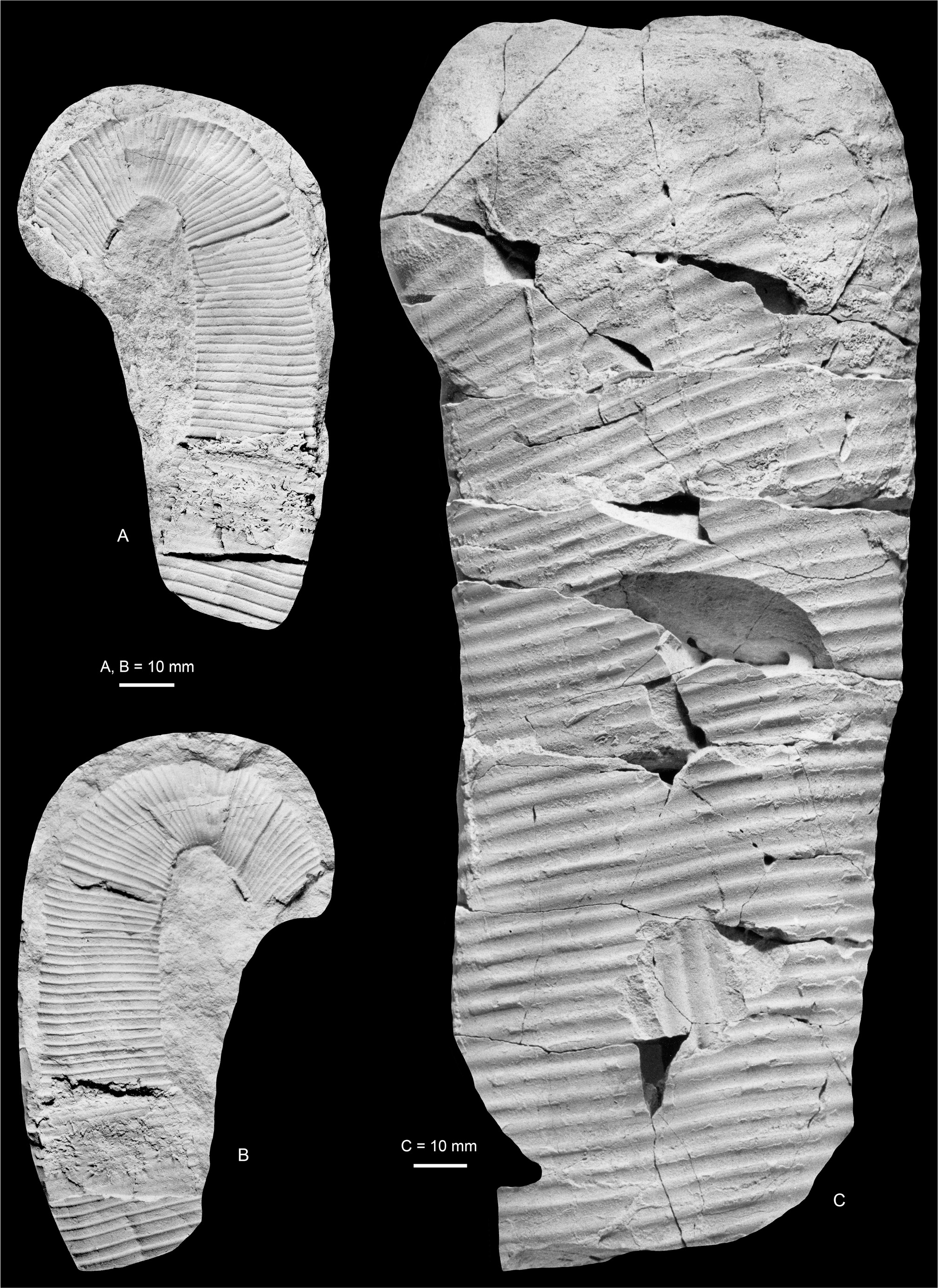
Fig. 15 Diplomoceras cylindraceum (Defrance 1816); both from the Kangerlussuaq Basin. A, B: MGUH 35138 (B = silicone rubber cast); Locality 13, Sediment Bjerge central. C: Flank of MGUH 35143; Locality 14, Sediment Bjerge east. A, B are ×1. C is ×0.92.
Material. Numerous specimens from Locality 7, col east of Leitch Bjerg, Geographical Society Ø, of which the eight best-preserved ones, MGUH 35206–MGUH 35212 and GM 2025.35, have been selected for this study.
Dimensions.
| Collection no. | D | Wb | Wh | Wb:Wh | U |
| MGUH 35210 | 30.5 (100) | 16.7 (52.8) | 15.0 (49.1) | 1.1 | 7.6 (24.9) |
| MGUH 35208 | 32.2 (100) | 16.6 (51.5) | 15.9 (49.3) | 1.04 | 9.0 (27.8) |
| GM 2025.35 | 59.1 (100) | 28.3 (47.9) | 27.8 (47.0) | 1.02 | 15.5 (26.2) |
| D, Wb, Wh, U in mm.-: not measurable | |||||
Description. Specimens range from 13–61 mm in diameter, and retain recrystallised shell. Coiling is moderately involute, the umbilicus comprising 25–28% of the diameter, of moderate depth, with a flat wall. The whorl section is slightly depressed, the umbilical shoulder narrowly rounded, the flanks subparallel, and feebly convex. The ventrolateral shoulders are broadly rounded, and the broad venter very feebly convex. The surface of the recrystallised shell is very poorly preserved, and most specimens lack all trace of ornament. Some bear a delicate, low, siphonal ridge, with flanking shallow grooves (MGUH 35210, Fig. 10F). The sutures are not or poorly exposed.
Discussion. Pseudophyllites latus differs from P. indra (Forbes 1846; see revision of the type material in Kennedy & Henderson 1992, p. 398, plate 3, figs 7–9, 13–27; plate 4, figs 1–3) in having a flattened, subvertical umbilical wall, producing a cylindrical, rather than conical umbilicus, a depressed rectangular rather than more rounded whorl section, and a lower expansion rate. Pseudophyllites teres (van Hoepen 1920; see revision in Kennedy & Klinger 1977, p. 187, figs 23a, b, 24a, b) has a much higher expansion rate. See Henderson (1970) and Macellari (1986) for additional discussion.
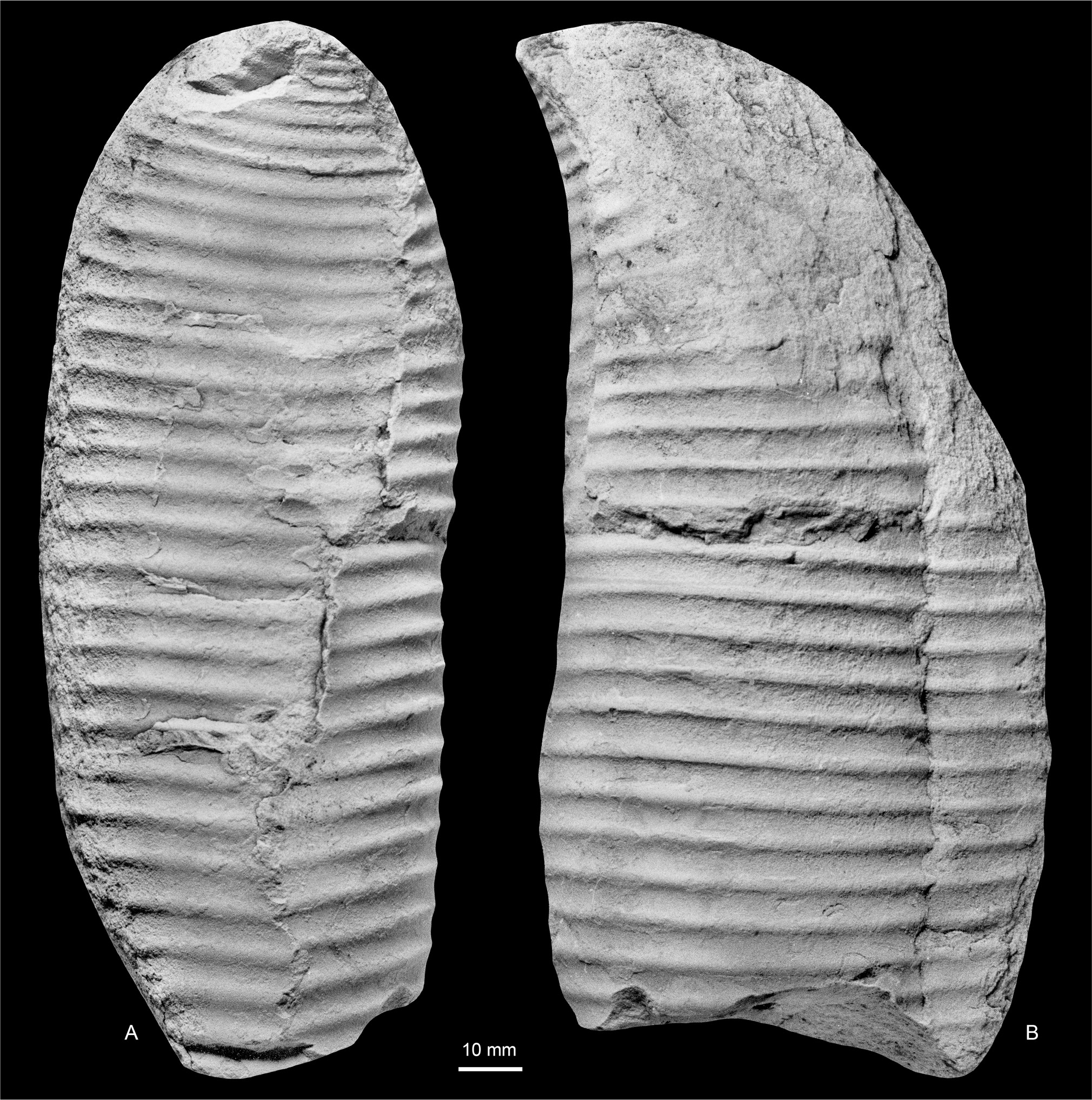
Fig. 16 Diplomoceras cylindraceum (Defrance 1816). Dorsum (A) and flank (B) of MGUH 35139; Locality 14, Sediment Bjerge east. Both ×1.
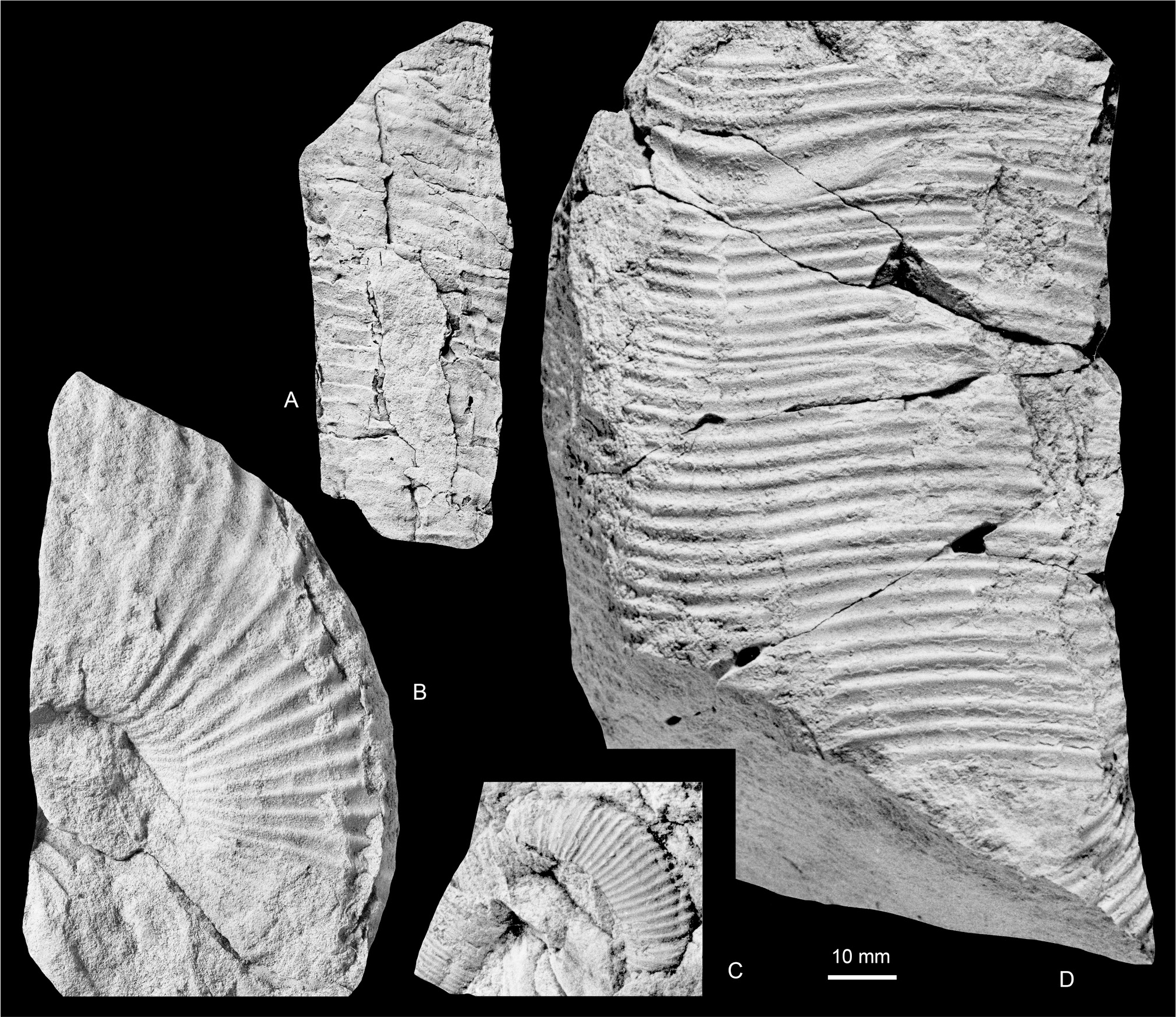
Fig. 17 Diplomoceras cylindraceum (Defrance 1816); all from the Kangerlussuaq Basin. A: MGUH 35144; Locality 21, north side of North Col of Apollo Glacier. B: MGUH 35137; Locality 10, ‘Scandic Valley’. C: MGUH 35140; Locality 14, Sediment Bjerge east. D: MGUH 35142; Locality 14, Sediment Bjerge east. All ×1.
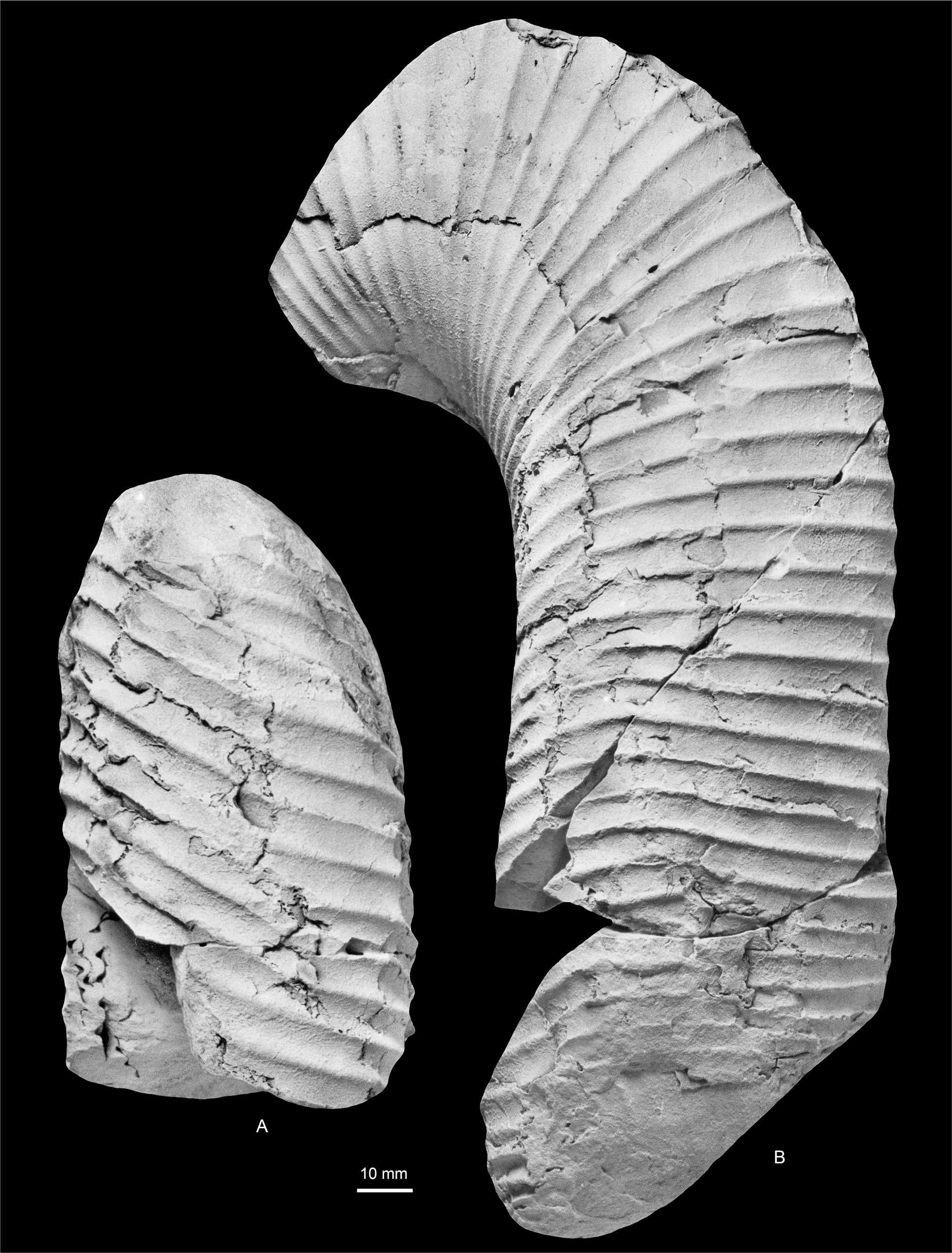
Fig. 18 Diplomoceras cylindraceum (Defrance 1816). Flanks (A, B) of two parts of MGUH 35147; Locality 28, east of Watkins Fjord, Kangerlussuaq Basin. Both ×1.
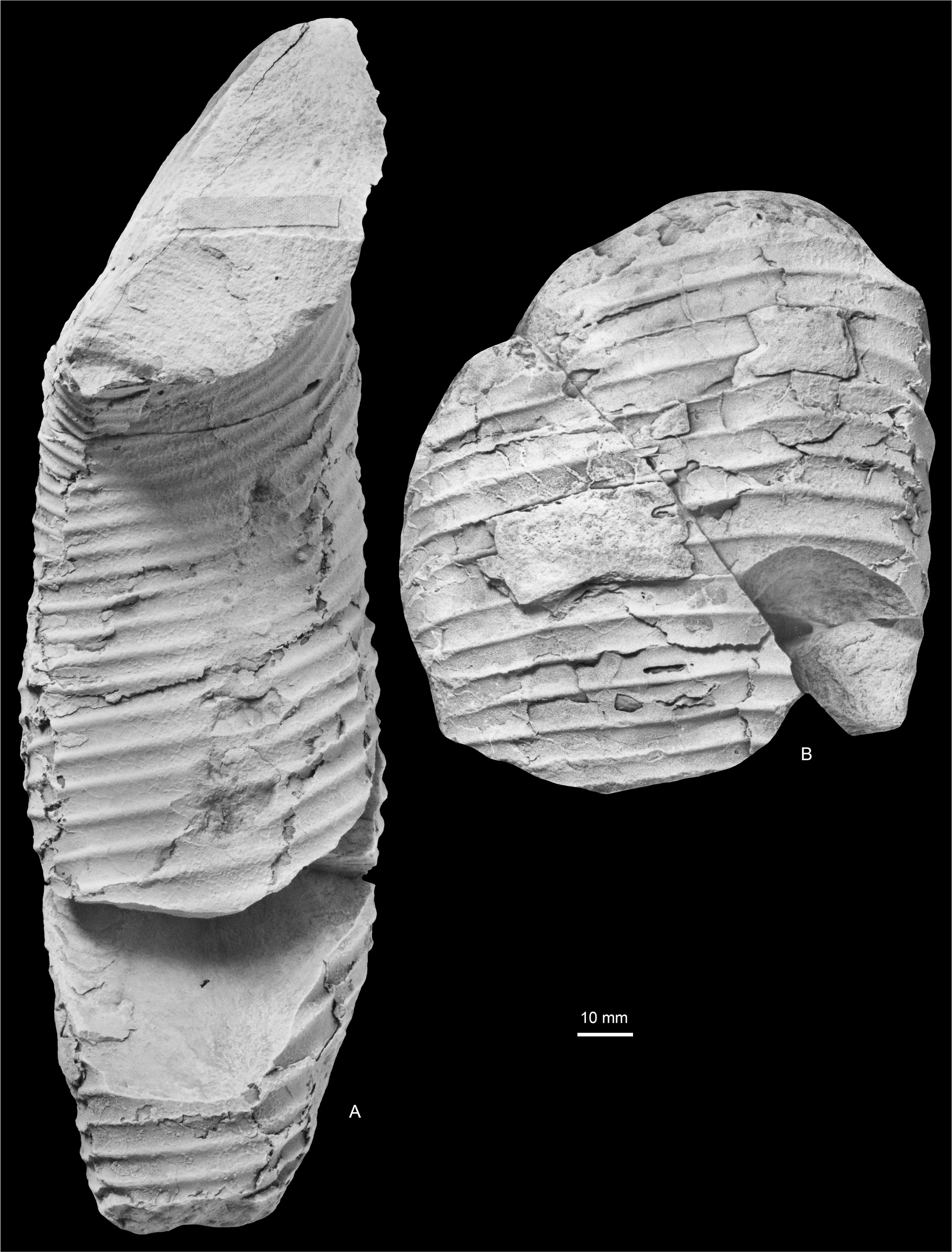
Fig. 19 Diplomoceras cylindraceum (Defrance 1816). Dorsum (A) and venter (B) of the same parts of MGUH 35147 illustrated in Fig. 18. Both ×1.
Occurrence. Campanian of New Zealand and Zululand. In Greenland in the lower Campanian of the Knudshoved Formation on Geographical Society Ø.
Pseudophyllites sp.
Material. Two specimens, MGUH 35213 and GM 2025.36, from Locality 2, south-east of Knudshoved Hut, Hold with Hope.
Description. MGUH 35213 is a portion of a large individual with an original diameter in excess of 320 mm, which is septate at a whorl height of 125 mm and estimated width of 120 mm; GM 2025.36 is another fragment, possibly of the same individual.
Discussion. These specimens are very much larger than those described above from Leitch Bjerg.
Occurrence. Both specimens were collected loose at the base of a section exposing the lower Campanian Knudshoved Formation on Hold with Hope.
Suborder Ammonitina Hyatt 1889
Superfamily Desmoceratoidea Zittel 1895
Family Pachydiscidae Spath 1922
Genus Pachydiscus Zittel 1884
Subgenus Pachydiscus Zittel 1884
Type species. Ammonites neubergicus Hauer 1858, p. 12, plate 2, figs 1–3, non plate 3, figs 1, 2, by the subsequent designation of de Grossouvre (1894, p. 177).
Pachydiscus (Pachydiscus) sp.
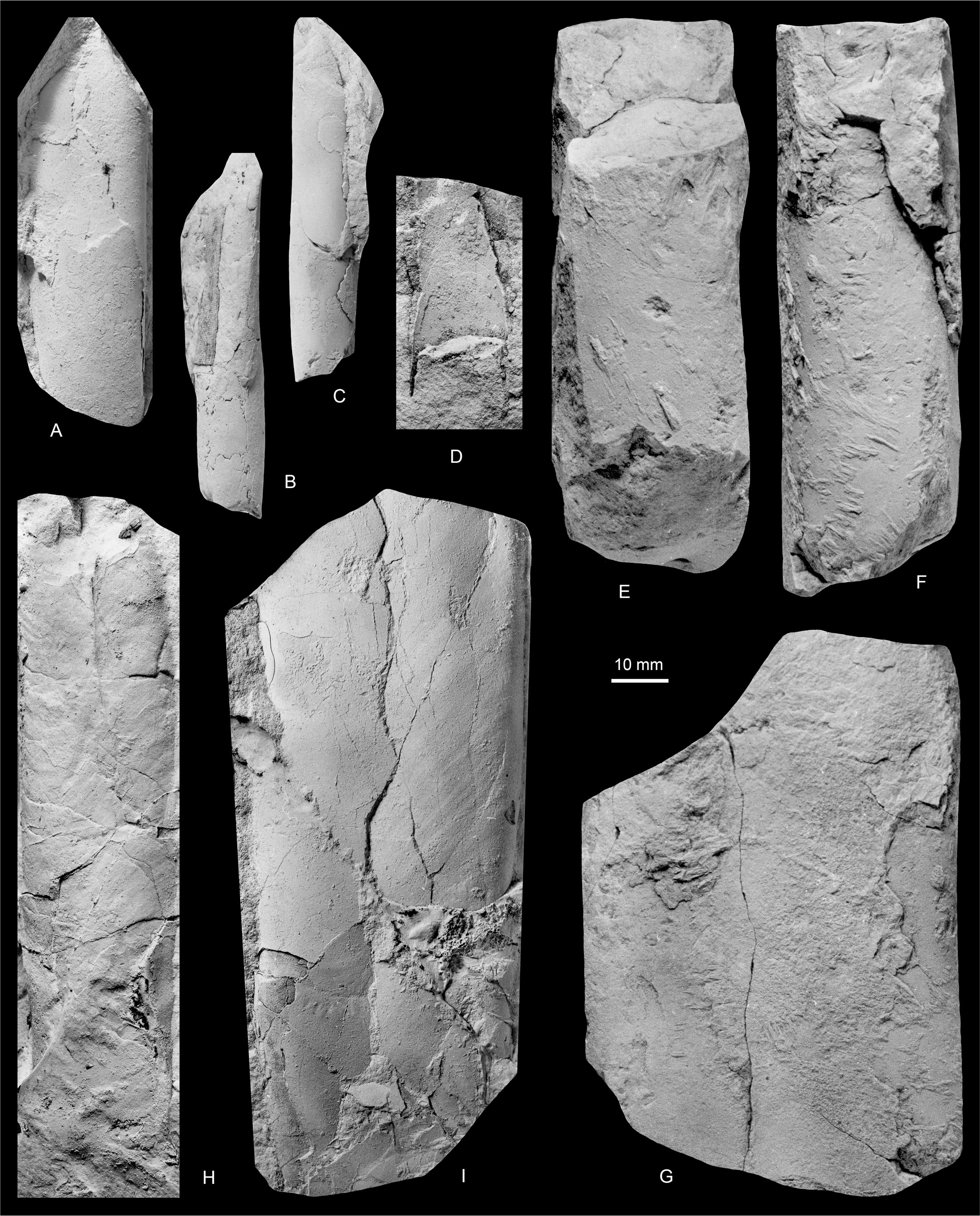
Fig. 20 Baculites sp. A–C: MGUH 35135 (C = silicone rubber cast); Locality 14, Sediment Bjerge east, Kangerlussuaq Basin. D: MGUH 35133; Locality 5, 4 km east of Laplace Bjerg, Geographical Society Ø. E–G: MGUH 35134; Locality 14, Sediment Bjerge east, Kangerlussuaq Basin. H: MGUH 35132 (silicone rubber cast); Locality 2, south-east of Knudshoved Hut, Hold with Hope. I: MGUH 35136 (silicone rubber cast); Locality 20, Pyramiden ridge, north end, Kangerlussuaq Basin. All ×1.
Material. Two specimens from Sediment Bjerge east: MGUH 35202 from Locality 14; MGUH 35203 from Locality 15. One specimen, MGUH 35204, from Locality 23, Pyramiden ridge, north end. All from the Kangerlussuaq Basin.
Description. MGUH 35203 (Fig. 12D) is the external mould of the umbilical region of a pachydiscid with a shallow umbilicus, the umbilical wall flattened and inclined outwards. Twenty primary ribs per whorl arise from the umbilical seam, and are feebly bullate or not. They are coarse, straight, and prorsiradiate on the flanks. MGUH 35204 (Fig. 12E) preserves part of the flank of what appears to be the same species. It is a 120° sector of body chamber with a maximum preserved whorl height of 50 mm. The umbilicus is of moderate depth, the umbilical wall flattened and outward-inclined, the umbilical shoulder broadly rounded. The whorl section is compressed, rounded-trigonal, with a whorl breadth-to-height ratio of 0.85, the greatest breadth below mid-flank. The inner flanks are broadly rounded, the outer flanks are converging to the broadly rounded ventrolateral shoulders and venter. The specimen bears eight coarse, incipiently bullate primary ribs on the inner flank that begin to efface on the mid-flank region. MGUH 35202 (Figs 12A–C) is a further body chamber fragment, lacking the umbilical region and inner flank. It is linked to MGUH 35204 by the trigonal whorl section and bears primary ribs that efface across the flank, with short single ribs intercalating on the outer flanks, ventrolateral shoulders and venter.
Discussion. These fragments are specifically indeterminate. The trigonal whorl section and coarse ribbing recalls that of Pachydiscus (Pachydiscus) egertoni (Forbes 1846) (see revision in Kennedy & Henderson 1992, p. 424, plate 12, figs 1–6, 13–15, 19–26; plate 13, figs 1–3; text-fig. 4b), but the rib density is higher, and the ribs coarser in the present specimens.
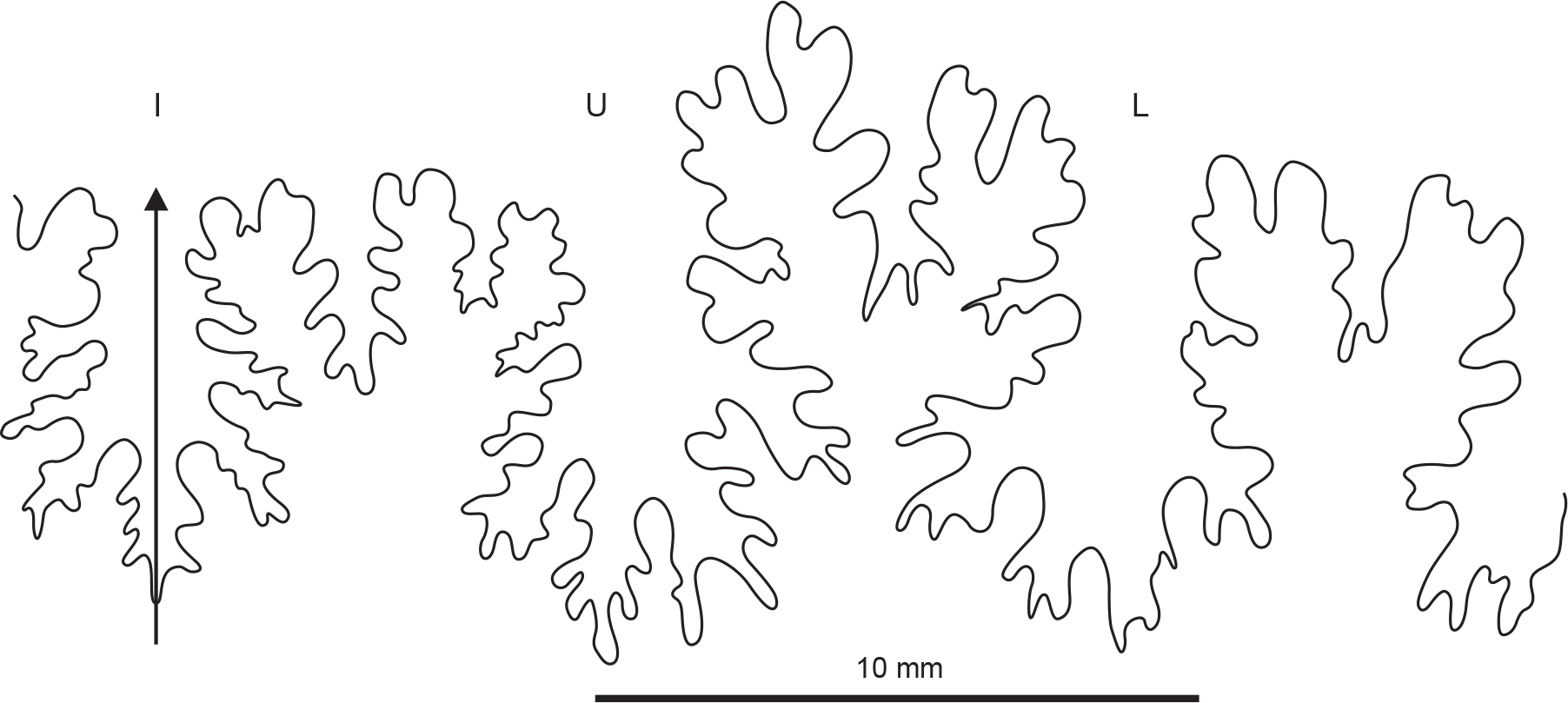
Fig. 21 Partial suture line of Baculites sp., MGUH 35135 (see also Figs 20A–C); Locality 14, Sediment Bjerge east, Kangerlussuaq Basin.
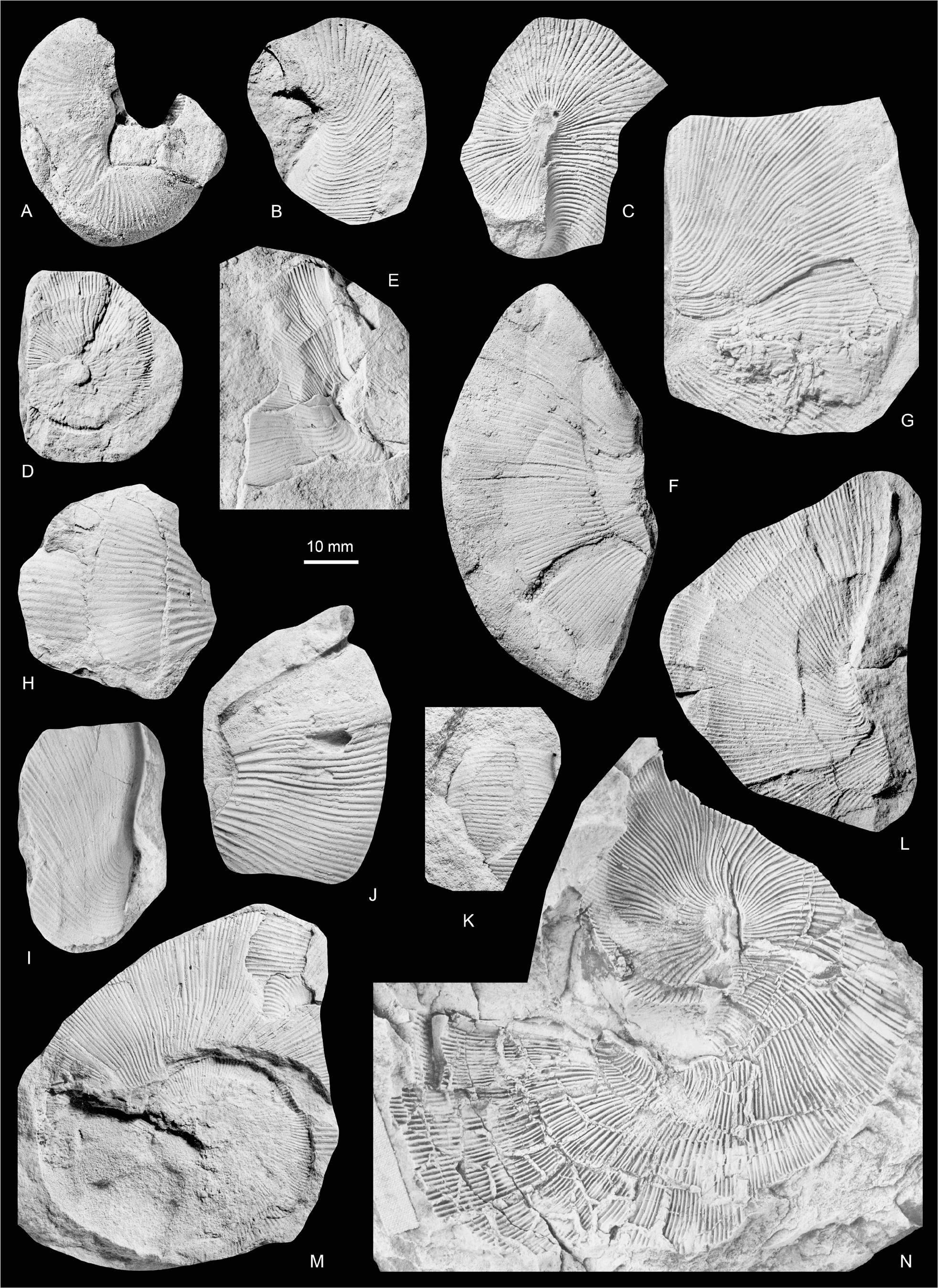
Fig. 22 Hoploscaphites greenlandicus (Donovan 1953). A: MGUH 35183, a microconch. B: MGUH 35180. C: MGUH 35182. D: MGUH 35181. E: MGUH 35173. F: MGUH 35177. G: MGUH 35174. H: MGUH 35190. I: MGUH 35179. J: MGUH 35176. K: MGUH 35191. L: MGUH 35178. M: MGUH 35175. N: MGUH 35184. A, C: Locality 6, Hundeklemmen, Geographical Society Ø. B, D–G, I, J, L, M: Locality 5, 4 km east of Laplace Bjerg, Geographical Society Ø. H, K: Locality 8, Månedal, southern Rold Bjerge, Traill Ø. N: Locality 7, col east of Leitch Bjerg, Geographical Society Ø. All ×1.
Occurrence. The specimens were collected from the Christian IV Formation of the Kangerlussuaq Basin.
Pachydiscidae incertae sedis
Material. Two specimens from the Kangerlussuaq Basin: MGUH 35200 from Locality 12, ‘Windy Valley’ south-east; MGUH 35201 from Locality 23, ‘Sill City’.
Description. MGUH 35201 (Figs 13A, B) is an external mould of a nucleus an estimated 16 mm in diameter, and part of the succeeding whorl. The nucleus is moderately evolute, with a relatively broad, deep umbilicus. The umbilical shoulder is quite narrowly rounded; the whorl section appears to have been depressed reniform. Very coarse, blunt ribs, nine per half whorl, arise at the umbilical seam and are straight and prorsiradiate across the flanks, declining progressively and effacing on ventrolateral shoulders and venter. At the largest diameter preserved, this ornament is already weakening. The outer whorl of the specimen is represented by an external mould of parts of half a whorl, with a maximum preserved whorl height to 19 mm. Ornament is reduced to delicate straight, prorsiradiate growth lines, riblets and striae. MGUH 35200 (Fig. 13C) is a composite mould of one flank, lacking the ventral region; themaximum incomplete whorl section preserved is 47 mm high. Delicate umbilical bullae give rise to groups of delicate prorsiradiate riblets, which increase by branching and intercalation on the flanks.
Discussion. These two enigmatic specimens may not even belong to the same taxon. The coarse simple ribs of the nucleus of MGUH 35201 have a pachydiscid-like appearance, while the effaced ornament of the outer whorl resembles that of some Menuites Spath 1922 (Kennedy & Henderson 1992, plate 14, figs 1–15), but for the absence of umbilical bullae. The larger fragment, MGUH 35200, would, on this interpretation, be a part of a macroconch. Macroconch Menuites are, however, typically coarsely ribbed; the fine ornament of this specimen recalling, rather, certain feebly ribbed Pachydiscus (Pachydiscus), as with P. (P.) ootacodensis (Stoliczka 1865), as illustrated by Jones (1963, plate 29, fig. 16). The true affinities of the material remain enigmatic.
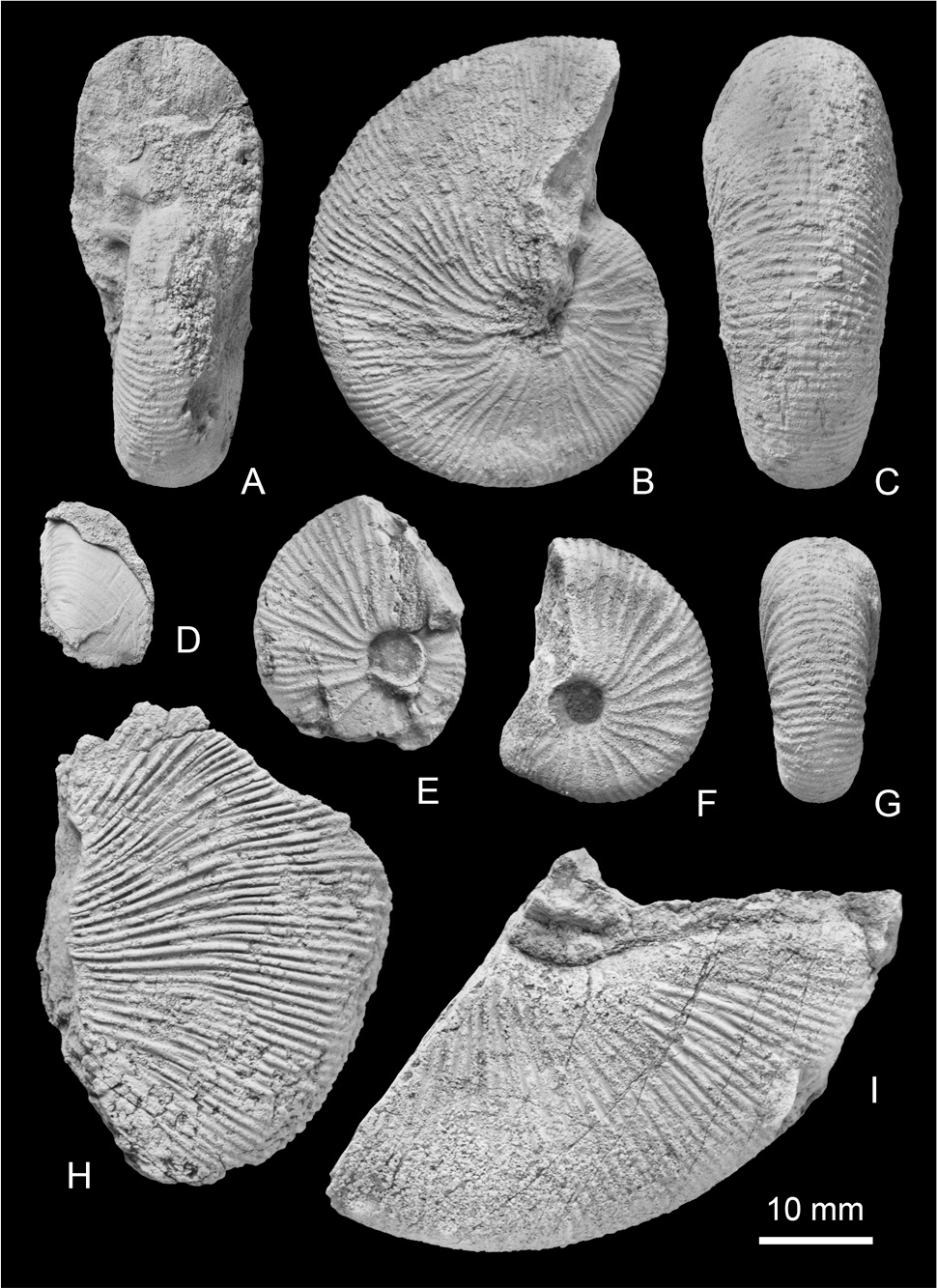
Fig. 23 Hoploscaphites greenlandicus (Donovan 1953). A–C: MGUH 35185. D: Praestriaptychus, MGUH 35205. E: MGUH 35186. F, G: MGUH 35187. H: MGUH 35188. I: MGUH 35189. All from Locality 7, col east of Leitch Bjerg, Geographical Society Ø. All ×1.
Occurrence. Both specimens were collected from the Christian IV Formation of the Kangerlussuaq Basin.
Suborder Ancyloceratina Wiedmann 1966
Superfamily Turrilitoidea Gill 1871
Family Diplomoceratidae Spath 1926
Subfamily Diplomoceratinae Spath 1926
Genus Diplomoceras Hyatt 1900
Type species. Baculites cylindracea Defrance 1816, p. 160, by original designation by Hyatt (1900, p. 571).
Diplomoceras cylindraceum (Defrance 1816)
Figs 14A–C, 15A–C, 16A, B, 17A–D, 18A, B, 19A, B
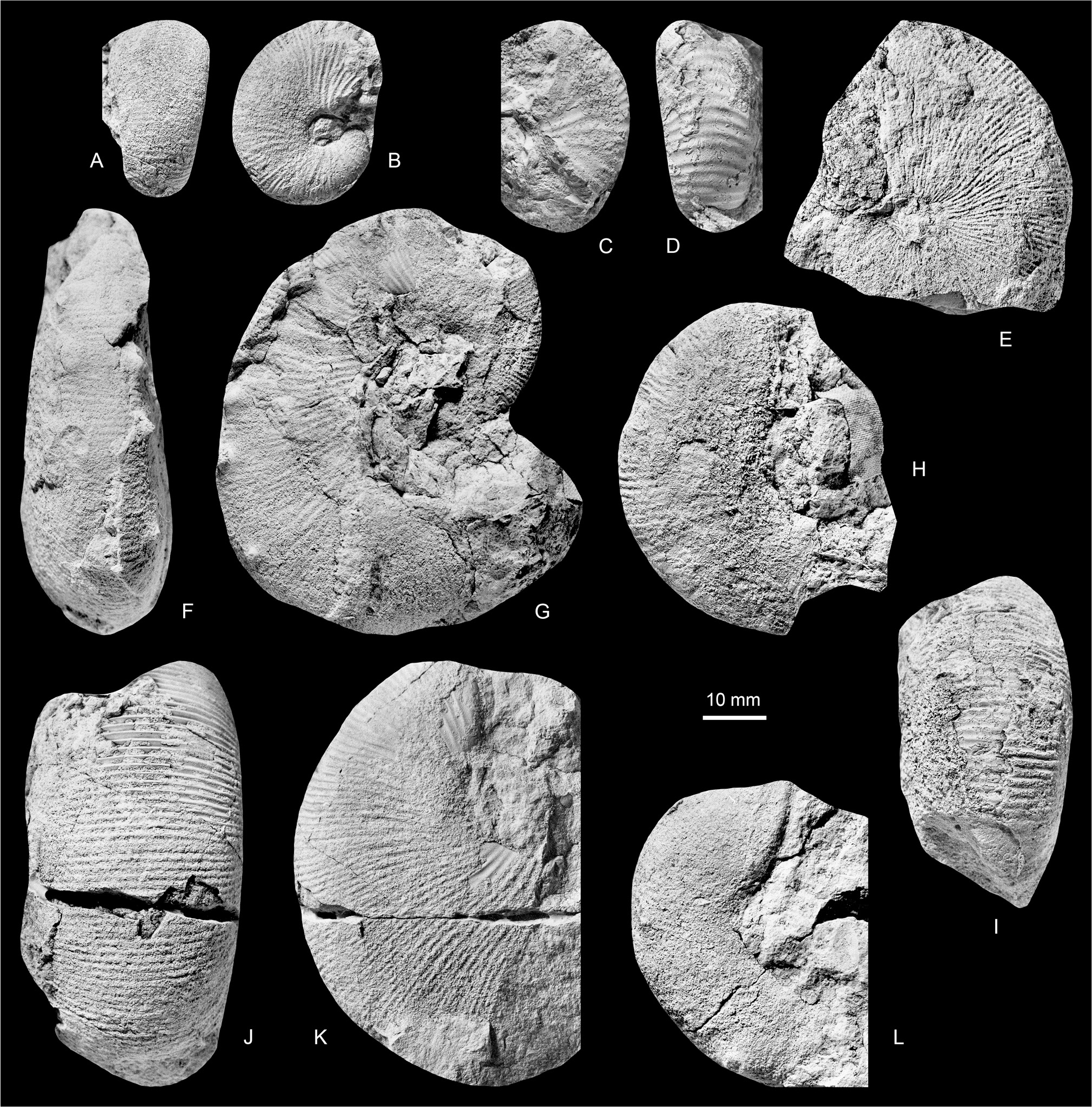
Fig. 24 Hoploscaphites cobbani (Birkelund 1965). A, B: MGUH 35163. C, D: MGUH 35169. E: MGUH 35168. F, G: MGUH 35165. H, I: MGUH 35164. J, K: MGUH 35166, a microconch. L: MGUH 35167. All from Locality 7, col east of Leitch Bjerg, Geographical Society Ø. All ×1.
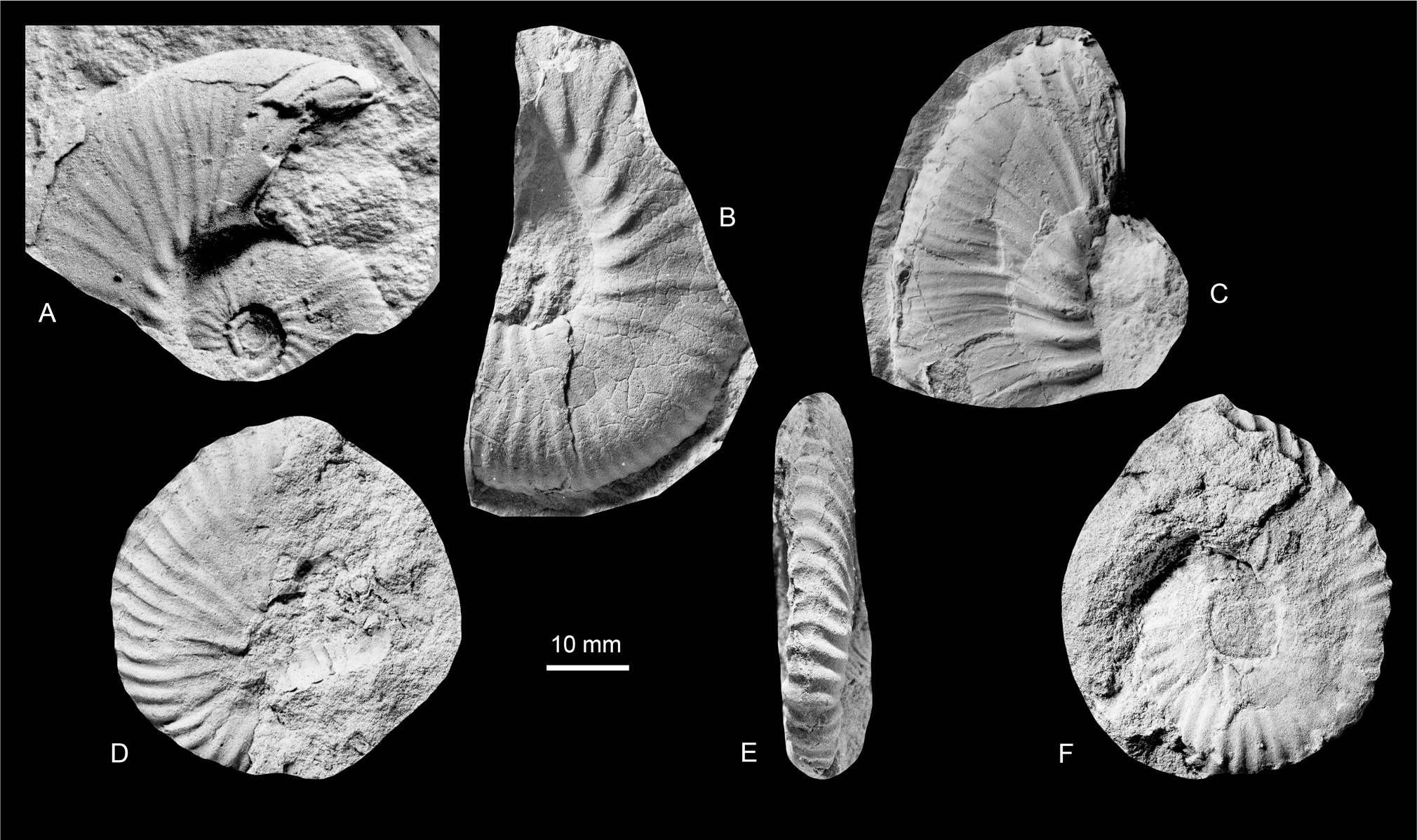
Fig. 25 Hoploscaphites sp. nov.; all from the Kangerlussuaq Basin. A: MGUH 35197; Locality 29, east of Watkins Fjord. B: MGUH 35196; Locality 24, west of ‘Sill City’. C: MGUH 35195. D–F: MGUH 35194; Locality 9, Sequoia Nunatak southwest. All ×1.
| 1816 | Baculites cylindracea Defrance, p. 160. |
| 2015 | Diplomoceras cylindraceum (Defrance, 1816); Kennedy, p. 147, plate 85, figs 10, 14 (with full synonymy). |
Type. The neotype, designated by Kennedy (1987, p. 183, plate 24, figs 1–3), is no. 10293 (and not 10511 as mentioned in the text on p. 183) in the collections of the Institut Royal des Sciences Naturelles de Belgique, and from the Kunrade Limestone in the eastern part of southern Limburg according to Jagt in Machalski (2012, p. 104).
Material. Numerous specimens from several localities in the Kangerlussuaq Basin, of which the best-preserved ones were selected for this study. One specimen, MGUH 35137, from Locality 10, ‘Scandic Valley’. One specimen, MGUH 35138, from Locality 13, Sediment Bjerge central. Five specimens, MGUH 35139–MGUH 35143, from Locality 14, Sediment Bjerge east. Two specimens, MGUH 35144 and MGUH 35145 from Locality 21, north side of North Col of Apollo Glacier. Three specimens, MGUH 35146, GM 2025.20 and GM 2025.21 from Locality 22, southern part of North Col of Apollo Glacier. Two specimens, GM 2025.22 and GM 2025.23, from Locality 23, ‘Sill City’. One specimen, MGUH 35147, from Locality 28, east of Watkins Fjord.
Description. All of the material is fragmentary, but an overall shell form of three shafts at minimum is indicated, the shafts subparallel, and linked by narrowly curved sectors (Figs 14A, C, 15A, B, 17B, C). The smallest specimen has a whorl height of 50 mm. This and other small individuals are preserved as either external or composite moulds, where the ornament is strong and well-preserved, or internal moulds, where it is weak to absent (MGUH 35138, Figs 15A, B). The rib index is 12–16, the ribs narrower than the interspaces, feebly prorsiradiate on straight shafts, but changing briefly to rursiradiate on curved sectors linking the shafts. Some specimens bear occasional constrictions, succeeded by a strengthened collar rib. Fragments of adult body chambers (Figs 14B, C, 15C, 16, 17D, 18, 19) have whorl heights in excess of 110 mm, and rib indices of 15 (Fig. 16) to more than 23 (Figs 14B, 17D). On straight shafts, the ribs are transverse to very feebly concave on the dorsum, sweeping forwards and concave on the umbilical shoulder, transverse to feebly prorsiradiate on the flanks, and transverse on the venter. The ribs are much narrower than the interspaces, with steep symmetrical adapical and adapertural faces, and rounded tops. Rib direction varies from prorsiradiate to rursiradiate around the final sectors. MGUH 35142 (Fig. 17D) is a very distorted fragment with a higher rib density than the other material referred to the species. It also has a marked constriction at the adapertural end, and may be from close to the adult aperture. MGUH 35138 shows traces of the deeply incised suture (Fig. 15B).
Discussion. Diplomoceras cylindraceum has been described in detail by Kennedy (1986, 1987), Ward & Kennedy (1993), and Klinger & Kennedy (2003a, 2003b). Kennedy (2015, p. 148) provided a discussion of the relationship between cylindraceum and Diplomoceras maximum Olivero & Zinsmeister 1989 (p. 629, figs 2.5, 4.1–4.4, 5.1–5.4) and interpreted them as end members of a peramorphocline. The present material falls well within the variability described by previous authors. See Jagt-Yazykova et al. (2024) for a recent discussion of the species, notably records from the North-West Pacific Province.
Occurrence. Diplomoceras cylindraceum first appears in the lower Campanian of England (Kennedy 2015), occurs in the upper Campanian of England and Poland (Machalski 1996) and ranges to the top of the Maastrichtian. The lower Campanian record of Diplomoceras notabile Whiteaves (a synonym) in Alabushev & Wiedmann (1997) may not even be a Diplomoceras. The geographic distribution extends from East Greenland to England, south-eastern France, northern Spain, Belgium, The Netherlands, Germany, Denmark, Poland, Austria, Ukraine (Crimea), Bulgaria, KwaZulu-Natal in South Africa, Madagascar, Pakistan, South India, Western Australia, possibly New Zealand, the Antarctic Peninsula, Chile, Argentina, Brazil, Japan, California, Alaska, British Columbia, and easternmost Russia (for the last mentioned occurrence, see Jagt-Yazykova et al. 2024).
Family Baculitidae Gill 1871
Genus Baculites Lamarck 1799
Type species. Baculites vertebralis Lamarck 1801, p. 103, by the subsequent designation of Meek (1876, p. 391).
Baculites sp.
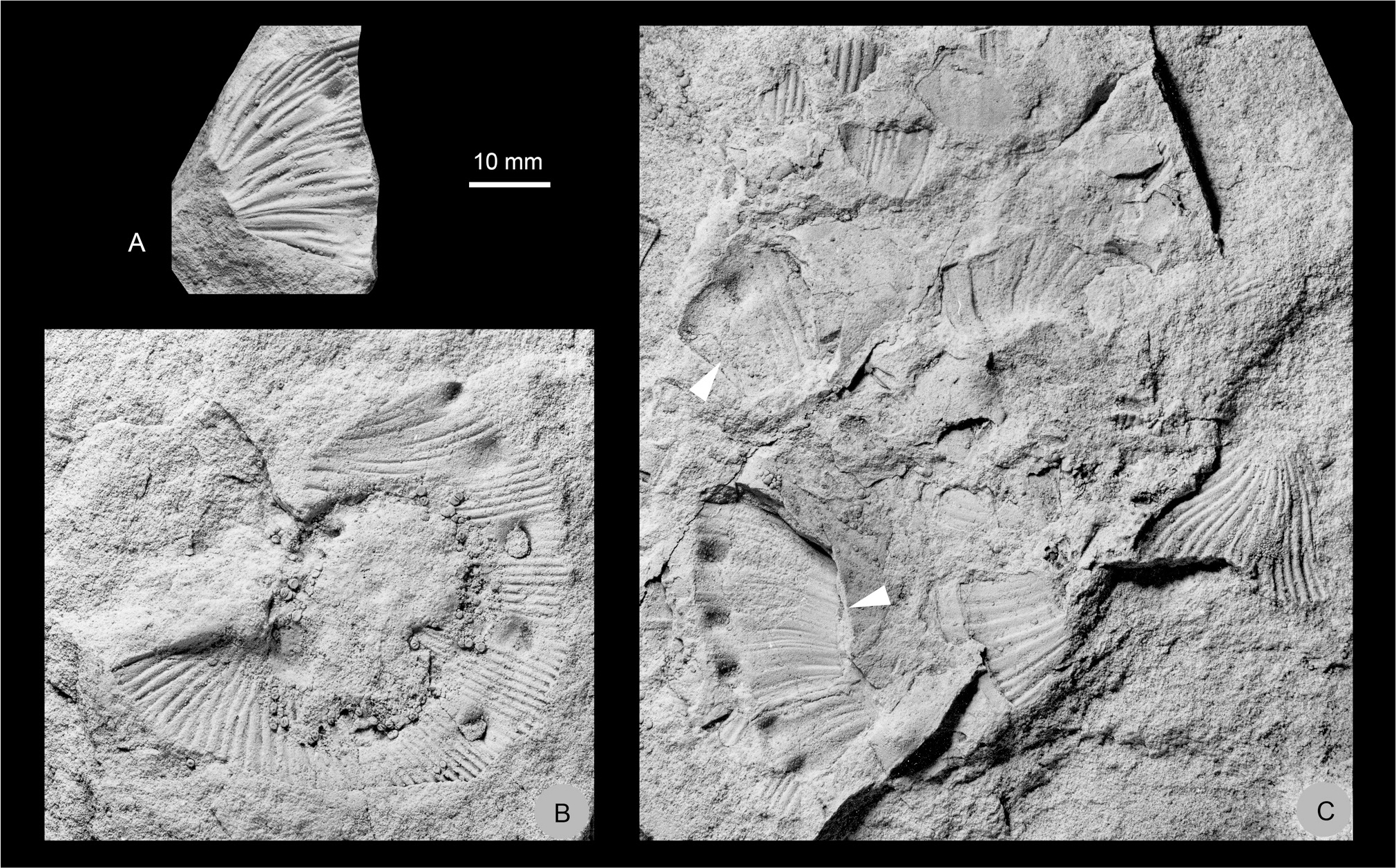
Fig. 26 Hoploscaphites compressus (Roemer 1841). A: MGUH 35171. B: MGUH 35170, a microconch. A, B: Both from Locality 8, Månedal, southern Rold Bjerge, Traill Ø. C: Fragments of Hoploscaphites compressus (Roemer 1841) (white arrows) and Hoploscaphites greenlandicus (Donovan 1953), MGUH 35172; Locality 4, west flank of Laplace Bjerg, Geographical Society Ø. All ×1.
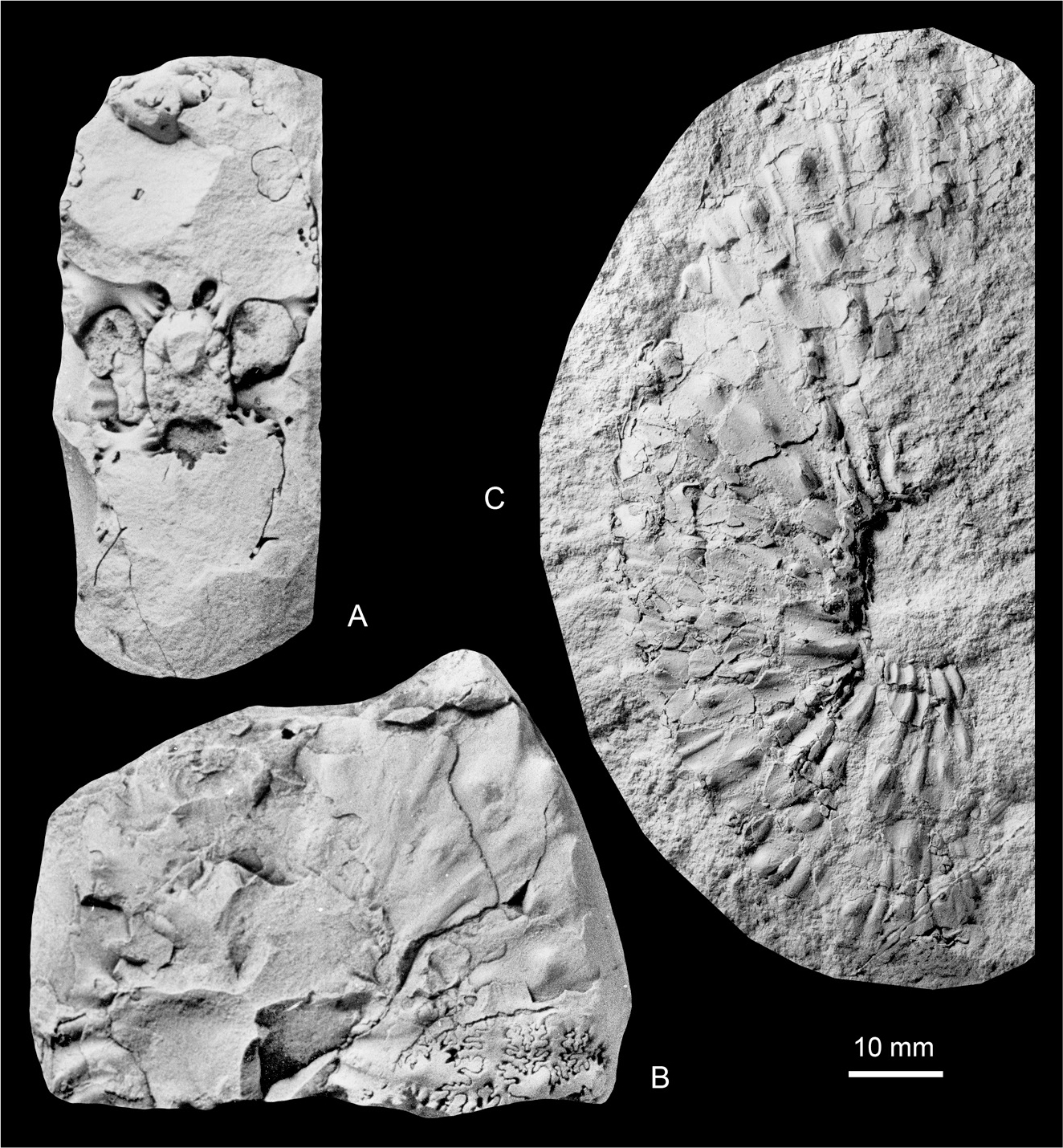
Fig. 27 Hoploscaphites sp. (multituberculate); both from the Kangerlussuaq Basin. A, B: MGUH 35193; Locality 23, ‘Sill City’. C: MGUH 35192 (silicone rubber cast); Locality 18, Pyramiden ridge, north end. All ×1.
Material. One specimen, MGUH 35132, from Locality 2, south-east of Knudshoved Hut, Hold with Hope. One specimen, MGUH 35133, from Locality 5, 4 km east of Laplace Bjerg, Geographical Society Ø. One specimen, GM 2025.19, from Locality 11, Sediment Bjerge north, Kangerlussuaq Basin. Two specimens, MGUH 35134 and MGUH 35135, from Locality 14, Sediment Bjerge east, Kangerlussuaq Basin. One specimen, MGUH 35136 from Locality 20, Pyramiden ridge, north end, Kangerlussuaq Basin.
Description. The smallest specimen, MGUH 35135 (Figs 20A–C) is an internal mould of three camerae and part of a juvenile body chamber. The whorl height is 20 mm at the adapertural end of the phragmocone. The whorl breadth-to-height ratio is 0.65, the dorsum very feebly convex, the dorsolateral margins broadly rounded, flanks broadly and evenly convex, converging to a venter that is more narrowly rounded than the dorsum. The surface of the mould is smooth. GM 2025.19 (not figured) is a further short fragment of an internal mould of a body chamber with a maximum preserved whorl height of 30 mm, and a whorl breadth-to-height ratio of 0.63, with flattened subparallel flanks, a feebly convex dorsum, and more narrowly rounded venter. The largest internal mould is MGUH 35134 (Figs 20E–G), a crushed specimen with a maximum preserved whorl height of 66 mm, and lacking ornament. Two external moulds show the surface of the shell to have been ornamented by growth lines only. MGUH 35136 (Fig. 20I) preserves part of the flank of a crushed individual. The growth lines are concave, defining a short dorsal and longer ventral rostrum to the transient aperture. The growth lines curve back and are convex on the ventrolateral margin. MGUH 35132 (Fig. 20H) preserves part of the dorsum and flank ornamented by comparable growth lines only on the shell surface. The suture is preserved in MGUH 35135 (Fig. 21); the lobes and saddles are bifid, and moderately incised.
Discussion. Only one named European Baculites, B. knorrianus Desmarest 1817 (Kennedy & Summesberger 1987, p. 32, plate 4, figs 4–6; plate 5, figs 1–14; text-fig. 2) reaches a size comparable to these specimens. It is known from crushed composite moulds that do not retain the original whorl proportions; the whorl section appears to have been ovoid, rather than with flattened subparallel flanks as in the present specimens, while some individuals have distinctive outer flank, ventrolateral shoulder and ventral ribbing (Kennedy & Summesberger 1987, plate 5, figs 11, 12). Of North American taxa, Baculites eliasi Cobban 1958 (p. 663, plate 91, figs 1–11; text-figs 1f–g, i–j) shows the same ontogenetic changes in whorl section, a suture line with similarly proportioned elements, and generally lacks ornament, but the present material is too poor to be assigned to any existing named species with any degree of confidence.
Fragments of a smooth Baculites also occur in the Campanian of Hold with Hope and Geographical Society Ø (Fig. 20D) but are equally indeterminate to species level.
Occurrence. Lower Campanian of the Knudshoved Formation on Hold with Hope and Geographical Society Ø; Lower Maastrichtian of the Christian IV Formation in the Kangerlussuaq Basin.
Superfamily Scaphitoidea Gill 1871
Family Scaphitidae Gill 1871
Subfamily Scaphitinae Gill 1871
Genus Hoploscaphites Nowak 1911
Type species. Ammonites constrictus J. Sowerby 1817, p. 189, plate A, fig. 1, by the original designation of Nowak (1911, p. 183).
Hoploscaphites greenlandicus (Donovan 1953)
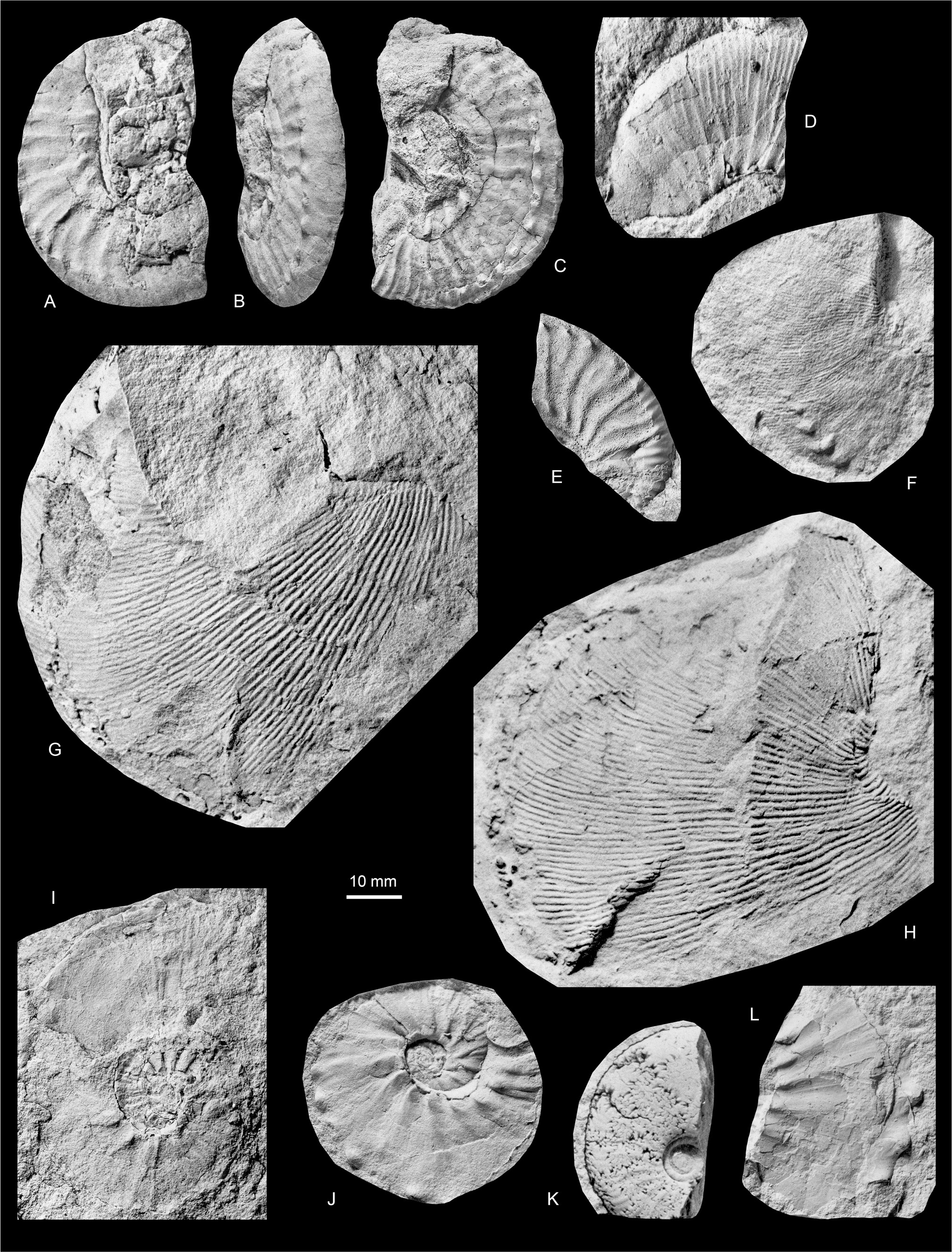
Fig. 28 Discoscaphites angmartussutensis Birkelund 1965; all from the Kangerlussuaq Basin. A–E: All microconchs. A–C: MGUH 35148; Locality 9, Sequoia Nunatak southwest. D: MGUH 35160; Locality 29, east of Watkins Fjord. E: MGUH 35158; Locality 22, southern part of North Col of Apollo Glacier. F: MGUH 35152, a small macroconch. G: MGUH 35153, a large macroconch; Locality 22, southern part of North Col of Apollo Glacier. H: MGUH 35154, a large macroconch; Locality 22, southern part of North Col of Apollo Glacier. I: MGUH 35149; Locality 13, Sediment Bjerge central. J: MGUH 35150, a microconch; Locality 13, Sediment Bjerge central. K: MGUH 35159; Locality 24, west of ‘Sill City’. L. MGUH 35151; Locality 14, Sediment Bjerge east. All ×1.
| 1897 | Scaphites Roemeri d’Orbigny; Madsen, p. 49, plate, figs 1–3. |
| 1953 | Scaphites greenlandicus Donovan, p. 121, plate 24, figs 9, 10. |
| 1954 | Scaphites greenlandicus Donovan; Donovan, p. 7 (pars), plate 2, fig. 6, non plate 2, fig. 4 (? = Hoploscaphites ikorfatensis Birkelund 1965); text-figs 1a–e. |
| 1957 | Scaphites greenlandicus Donovan; Donovan, p. 154. |
| 1965 | Scaphites (Hoploscaphites) greenlandicus Donovan; Birkelund, p. 110, plate 28, figs 2–3; plate 29, fig. 2; plate 30, figs 1–3; plate 31, figs 1, 2; plate 32, fig. 1; plate 33, fig. 1; text-figs 64–66, 98–100, 121(6). |
| 1965 | Scaphites (Hoploscaphites) ravni Birkelund, p. 106 (pars), plate 28, fig. 1; plate 29, fig. 1; text-figs 100 (pars), 121, 5 (pars). |
| 1997 | Hoploscaphites greenlandicus (Donovan, 1953); Kennedy & Kaplan, p. 67, plate 10, fig. 2; plate 78, figs 2–6, 8–11; plate 79, figs 1–3, 6–9, 11, 12; text-fig. 2. |
| 2015 | Hoploscaphites greenlandicus (Donovan, 1953); Kennedy, p. 190, plate 58, figs 1–4, 8–100; text-fig. 91a, b, e–i (with synonymy). |
| 2016 | Hoploscaphites greenlandicus (Donovan, 1953); Klein, pp. 105, 115. |
Type. The holotype is MGUH 1745, from the upper Campanian of Niaquornat, Nuussuaq, Greenland.
Material. Ten specimens, MGUH 35173–MGUH 35181 and GM 2025.27, from Locality 5, 4 km east of Laplace Bjerg, Geographical Society Ø. Two specimens, MGUH 35182 and MGUH 35183, from Locality 6, Hundeklemmen, Geographical Society Ø. Six specimens, MGUH 35184–MGUH 35189, from Locality 7, col east of Leitch Bjerg, Geographical Society Ø. Three specimens, MGUH 35190, MGUH 35191 and GM 2025.28, from Locality 8, Månedal, southern Rold Bjerge, Traill Ø.
Description. The best-preserved, uncrushed specimens are MGUH 35184–MGUH 35189 (Figs 23A–C, E–I). The coiled part of the phragmocone is represented by MGUH 35185 (Figs 23A–C ), 38 mm in diameter; MGUH 35186 (Fig. 23E) is a phragmocone 21 mm in diameter, MGUH 35187 (Figs 23F, G) another phragmocone 22 mm in diameter, and MGUH 35188 (Fig. 23H) a fragment with a maximum preserved whorl height of 28 mm. Coiling is very involute, the umbilicus comprising 14–17% of the diameter in the smaller specimens (Figs 23E–G), but virtually closed in the largest phragmocone (Fig. 23B). The whorl section is compressed, with whorl breadth-to-height ratios of 0.77 to 0.81, the flanks very feebly convex, the ventrolateral shoulders broadly rounded, the venter feebly convex. Ornament is of crowded, wiry ribs that are feebly flexuous, and increase by branching and intercalation. MGUH 35189 (Fig. 23I) is a fragment from the adapertural end of the body chamber with a maximum preserved whorl height of 29 mm, the apertural constriction well-preserved.
The bulk of the material comprises a series of very crushed and fragmentary internal and external moulds. MGUH 35181 (Fig. 22D) is a phragmocone 28 mm in diameter; MGUH 35177 and MGUH 35175 (Fig. 22M) are part and counterpart of an adult macroconch phragmocone with an original estimated diameter of over 60 mm. The remaining specimens are fragments of body chamber, with parts of the adult aperture preserved in MGUH 35179 and MGUH 35176 (Figs 22I, J). MGUH 35184 (Fig. 22N) is a near-complete adult macroconch, an estimated 90 mm long, with markedly flexuous ribbing, concave on the inner flank, and convex on the outer. Ornament on the phragmocone comprises fine, even, densely crowded ribs only. They are concave across the umbilical shoulder, strengthen across the inner flanks, where they are straight and prorsiradiate, flexing back and feebly convex on the mid-flank, and straight to feebly concave on the outer flank. They increase by branching and intercalation both low and high on the flank. Body chamber ornament also comprises fine, dense, even, crowded ribs. These are concave on the umbilical wall of the shaft, straight and markedly prorsiradiate on the flanks, increasing by branching and intercalation both low and high on the flank, and increasing in strength across the flanks. They cross the venter near-straight (Fig. 22H). Some specimens show a coarsening of ribs towards the aperture (Fig. 22B), the margin of which is markedly thickened (Figs 22I, J). Two rather better preserved specimens are a microconch body chamber 47 mm long, (MGUH 35183, Fig. 22A), and an external mould of a somewhat larger individual (MGUH 35182, Fig. 22C).
At Locality 7, the well-preserved H. greenlandicus are associated with a complete aptychus 10 mm long (Fig. 23D), which we assign to the form genus Praestriaptychus.
Discussion. Dense, crowded, wiry ribbing, and a total lack of tubercles characterise the present material. Hoploscaphites greenlandicus is based on a macroconch holotype. It differs from the somewhat older Hoploscaphites ikorfatensis (Birkelund 1965) (p. 102, plate 24, figs 1–4; plate 25, figs 1, 2; plate 20, fig. 1; text-figs 59, 93, 121(3) in that the latter usually has a row of 3–10 ventrolateral tubercles on the body chamber, with nodeless individuals rare. Hoploscaphites ravni Birkelund 1965 is based on microconchs; the holotype (Birkelund 1965, plate 27, fig. 1) is from the same horizon as the type material of H. ikorfatensis, of which it is a synonym (Kennedy & Kaplan 1997, p. 71). Birkelund also referred microconch specimens to ikorfatensis that co-occurred with typical macroconch greenlandicus, ravni of Birkelund (1965) thus encompassing microconchs of both H. greenlandicus and H. ikorfatensis.
Occurrence. Upper Campanian, minor/polyplocum Zone in Germany (Niebuhr 1996; Kaplan & Röper 1997), polyplocum and donezianum Zones in Poland. In Greenland, the species is restricted to the upper Campanian of Geographical Society Ø and Traill Ø.
Hoploscaphites cobbani (Birkelund 1965)
| 1965 | Scaphites (Scaphites) cobbani Birkelund, p. 89, plate 19, fig. 4; plate 20, figs 1–4; plate 21, fig. 1; plate 22, fig. 1; text-figs 62, 63, 69, 79–88, 121(1), 122. |
| 1965 | Scaphites (Scaphites) rosenkrantzi Birkelund, p. 97, plate 21, figs 2–3; plate 22, figs 2–3; plate 23, figs 1–3; text-figs 58, 68, 89–82, 121(2). |
| 1975 | Scaphites cobbani Birkelund, 1965; Schmid & Ernst, p. 329, plate 3, fig. 2. |
| 2016 | Jeletzkytes cobbani (Birkelund, 1965); Klein, pp. 133, 135. |
Type. The holotype is MGUH 9800, from the Campanian of Nuussuaq, Greenland, the original of Birkelund (1965, plate 21, fig. 1, text-fig. 81).
Name of the species. Schmid & Ernst (1975, p. 329) noted that Scaphites cobbani Birkelund 1965 and Scaphites rosenkrantzi Birkelund 1965 were microconch and macroconch of a dimorphic pair, and selected the name cobbani for the species.
Material. Seven specimens, MGUH 35163–MGUH 35169, from Locality 7, col east of Leitch Bjerg, Geographical Society Ø.
Description. The specimens are mostly fragments, and usually poorly preserved. There are both fine and coarse ribbed nuclei (Figs 24A–D). MGUH 35166 (Figs 24J, K) is the most complete macroconch fragment, and preserves the adapertural part of the body chamber and aperture. The whorl section is relatively broad, the surface of the shell ornamented by crowded wiry ribs that increase by branching on intercalation. MGUH 35165 (Figs 24F, G) is the best-preserved microconch, 69 mm long, with traces of five ventral tubercles on the body chamber.
Discussion. When compared to Hoploscaphites greenlandicus, the present material has a broader whorl section, coarser ribs, and ventrolateral tubercles.
Occurrence. Lower Campanian of West and North-East Greenland (Knudshoved Formation of Geographical Society Ø). Upper lower Campanian of Lower Saxony, Germany.
Hoploscaphites sp. nov.
Material. Four specimens, GM 2025.29–GM 2025.31 and MGUH 35194, from Locality 9, Sequoia Nunatak southwest. One specimen, MGUH 35195, from Locality 14, Sediment Bjerge east. One specimen, MGUH 35196, from Locality 24, west of ‘Sill City’. Two specimens, MGUH 35197 and GM 2025.32, from Locality 29, east of Watkins Fjord. All from the Kangerlussuaq Basin.
Description. Phragmocones vary from 13–42 mm in diameter. All are crushed to varying degrees. Coiling is moderately involute, the umbilicus comprising up to 23% of the diameter, the umbilical wall flattened, the umbilical shoulder narrowly rounded. The original whorl section cannot be established, but appears to have been compressed, with flattened subparallel flanks, broadly rounded ventrolateral shoulders and a feebly convex venter. Coarse, crowded primary ribs arise at weak to incipient umbilical bullae either singly or in pairs. They are prorsiradiate to mid-flank, where they flex back, and may bifurcate, with additional ribs intercalating, all ribs coarsening over the ventrolateral shoulders and venter. There are a total of 20–22 ribs per half whorl at the ventrolateral shoulder in MGUH 35194 at a diameter of 42 mm (Figs 25D–F).
MGUH 35196 (Fig. 25B) is an external mould of the adapertural part of the spire and part of the short shaft of an adult microconch body chamber. The phragmocone is ornamented by crowded narrow primary ribs, concave across the umbilical wall and shoulder, straight and prorsiradiate on the inner flank, flexed back and feebly convex at mid-flank, and feebly concave on the outer flank. The primary ribs may bifurcate low on the flanks and on the ventrolateral shoulder, where additional short ribs intercalate. On the inner flank region of the shaft the primary ribs are widely separated, concave on umbilical wall and shoulder, and incipiently bullate. They become increasingly prorsiradiate in an adapertural direction. MGUH 35195 (Fig. 25C) is an external mould of the adapertural end of the shaft and part of the final recurved sector of what appears to be the same species. Umbilical bullae, prorsiradiate and well-developed at the adapical end of the fragment, decline progressively. They give rise to groups of riblets and striae at the adapical end; these flex back at mid-flank and are convex, sweeping back to pass straight across the ventrolateral shoulders and venter. Towards the adapertural end, these striae are replaced by groups of narrow ribs that increase by bifurcation and intercalation. MGUH 35197 (Fig. 25A) is an external mould of a phragmocone and the adapertural part of the body chamber of a further comparable individual.
Discussion. This distinctive group of specimens are linked by their coarse ribs, crowded on the phragmocone, very strongly prorsiradiate on the shaft of the body chamber, and totally lacking tubercles. Lack of tubercles alone distinguishes them from the overwhelming majority of Maastrichtian scaphites; tubercles are absent in Hoploscaphites felderi Kennedy 1987 (p. 203, plate 27, fig. 1; plate 33, figs 1–15; plate 34, figs 7–11, 9–17; text-fig. 13c) and absent or few in number in the Campanian Hoploscaphites greenlandicus (Donovan 1953) (see above), but these species have an ornament of very fine, wiry ribs, quite unlike the ornament of the present material, which appears to represent a previously undescribed taxon. However, the available material is insufficiently preserved for a formal description.
Occurrence. Lower Maastrichtian of the Christian IV Formation of the Kangerlussuaq Basin.
Hoploscaphites compressus (Roemer 1841)
| 1841 | Scaphites compressus Roemer, p. 91, plate 15, fig. 1. |
| 1997 | Jeletzyktes compressus (Roemer, 1841); Kennedy & Kaplan, p. 74, plate 79, fig. 7; plate 80, figs 1, 4–7; plate 81, figs 1–3, 5–7; plate 82, figs 9, 11–13 (with full synonymy). |
| 2015 | Hoploscaphites compressus (Roemer, 1841); Kennedy, p. 195, plate 61, figs 1–15; text-figs 63a, 94 (with synonymy). |
| 2016 | Jeletzkytes compressus (Roemer, 1841); Klein, pp. 133, 136. |
Types. Roemer (1841, p. 91, plate 15, fig. 1) based his Scaphites compressus on material from Ahlten. The type material was reillustrated by Frech (1915, p. 566, text-fig. 14), who noted that this figure was based on a composite of two individuals. The material is now lost. Błaszkiewicz (1980, p. 38) noted that “…. the specimen, illustrated by F. Frech (1915, p. 567, fig. 14) and representing a later part of the coil, is interpreted by the present writer as a type specimen”. This does not in our view constitute a lectotype designation; furthermore, Frech states the material he figures to be from Lemförde, rather than Ahlten, the type locality according to Roemer. The specimens figured by Frech, notably the body chamber, which has a constricted aperture not shown in Roemer’s figure, may thus not be the basis of Roemer’s figure. Neotype designation is desirable.
Name of the species. See Kennedy (2015, p. 196).
Material. One specimen, MGUH 35172, from Locality 4, west flank of Laplace Bjerg, Geographical Society Ø. Two specimens, MGUH 35170 and MGUH 35171, from Locality 8, Månedal, southern Rold Bjerge, Traill Ø.
Description. MGUH 35170 (Fig. 26B) is an external mould of one flank of a body chamber of a microconch, extending to the adult aperture. Fine, crowded, wiry ribs arise in groups at the umbilical shoulder at the adapical end of the fragment, beyond which the umbilical margin is not preserved. The flanks bear crowded prorsiradiate ribs that are convex across the flanks, and increase by intercalation, coarsening markedly on the final hook. Five coarse ventrolateral tubercles are preserved on the specimen; the ribs link in groups to these tubercles, or intercalate between. MGUH 35171 (Fig. 26A) is a much smaller fragment, probably from the final hook, with fine wiry ribs and well-developed ventrolateral tubercles. MGUH 35172 (Fig. 26C) is a mass of scaphitid fragments, preserved as moulds, some with strong tubercles, belonging to Hoploscaphites compressus, some with ribs only, belonging to H. greenlandicus.
Occurrence. Upper Campanian, North-East Greenland (Knudshoved Formation of Geographical Society Ø and Traill Ø), Northern Ireland, and Norfolk, England; specimens from the Haldem area (Germany) are dated to the polyplocum Zone (Kaplan & Röper 1997). In the Chalk successions of Hannover (north Germany) it occurs in the minor/polyplocum and langei zones (Niebuhr 1995). There are also records from Poland (donezianum Zone: Błaszkiewicz 1980) and Biggs Farm, Delaware, USA (Kennedy & Cobban 1994).
Hoploscaphites sp. (multituberculate)
Material. One specimen, MGUH 35192, from Locality 18, Pyramiden ridge, north end. One specimen, MGUH 35193, from Locality 23, ‘Sill City’. Both from the Kangerlussuaq Basin.
Description. MGUH 35193 (Figs 27A, B) is a poorly preserved fragment of a nucleus with the last camera of the phragmocone and adapical part of the body chamber. The whorl section at the end of the phragmocone is compressed, with flattened, subparallel flanks, broadly rounded ventrolateral shoulders, and a relatively broad, feebly convex venter. Narrow, straight primary ribs bear weak umbilical, inner and outer lateral bullae, small conical inner, and conical to feebly clavate outer ventrolateral tubercles. One or more shorter intercalated ribs separate the primaries, and bear weak or no inner ventrolateral tubercles, plus an outer ventrolateral row.
MGUH 35192 (Fig. 27C) is an external mould of one flank of what appears to be the phragmocone whorls of a macroconch. The specimen is 90 mm in diameter. The umbilicus is small. Numerous straight prorsiradiate primary ribs arise on the umbilical wall and strengthen across the flanks, developing into small bullae perched on the umbilical shoulder. There are inner and outer lateral bullae, and conical inner and outer ventrolateral tubercles. One or more intercalated ribs separate the primaries, and are mostly weaker than the primaries and lack tubercles.
Discussion. Although poor and fragmentary, these two specimens indicate the presence of a multituberculate Hoploscaphites in the Maastrichtian faunas of East Greenland.
Occurrence. Lower Maastrichtian of the Christian IV Formation of the Kangerlussuaq Basin.
Genus Discoscaphites Meek 1871
Type species. Ammonites conradi Morton 1834, p. 39, plate 16, fig. 3, by the original designation of Meek (1871, p. 429).
Discoscaphites angmartussutensis Birkelund 1965
| 1965 | Scaphites (Discoscaphites) waagei Birkelund, p. 117, plate 35, figs 1, 2; plate 36, figs 1–3; plate 37, figs 1, 2; plate 38, fig. 1; text-figs 67, 71, 101–105, 121(7). |
| 1965 | Scaphites (Discoscaphites) angmartussutensis Birkelund, p. 124, plate 38, fig. 2; plate 39, fig. 1; plate 40, figs 1, 2; plate 41, fig. 1; plate 42, fig. 1; plate 44, figs 1, 2; text-figs 60, 110–113, 121(8). |
| 1993 | Scaphites (Discoscaphites) angmartussutensis Birkelund; Landman & Waagé, p. 160, figs 110d–f. |
| 2016 | Hoploscaphites angmartussutensis (Birkelund, 1965); Klein, pp. 104, 106. |
| 2016 | Hoploscaphites waagei (Birkelund, 1965); Klein, pp. 106, 125. |
Name of the species. Landman & Waage (1993, p. 159) recognised waagei Birkelund 1965, as the microconch, and angmartussutensis Birkelund 1965, as the macroconch of a single species, for which they selected the name angmartussutensis as first revising authors.
Type. The holotype is MGUH 9846, the original of Birkelund (1965, plate 39, figs 1a–c, plate 40, fig. 1) from the Oyster-ammonite Conglomerate, Nuussuaq, West Greenland, and of Maastrichtian age.
Material. One specimen, MGUH 35148, from Locality 9, Sequoia Nunatak southwest. Two specimens, MGUH 35149 and MGUH 35150, from Locality 13, Sediment Bjerge central. One specimen, MGUH 35151, from Locality 14, Sediment Bjerge east. One specimen, MGUH 35152, from Locality 16, Skiferbjerg north. Six specimens, MGUH 35153–MGUH 35158, from Locality 22, southern part of North Col of Apollo Glacier. Two specimens, MGUH 35159 and GM 2025.24, from Locality 24, west of ‘Sill City’. One specimen, MGUH 35160, from east of Watkins Fjord, from Locality 29. All from the Kangerlussuaq Basin.
Description. MGUH 35159 and GM 2025.24 are fragmentary phragmocones of microconchs with short sectors of the adapical body chamber attached. MGUH 35159 has a maximum preserved whorl height of 21 mm (Fig. 28K). Coiling is involute with a small, shallow umbilicus, the umbilical wall low and feebly convex, the umbilical shoulder narrowly rounded. The whorl section is very compressed, with flattened subparallel flanks, broadly rounded ventrolateral shoulders and flattened, very feebly convex venter. Crowded delicate primary ribs are prorsiradiate on the flanks, concave on umbilical shoulder and innermost flank, and convex at mid-flank, where they increase by branching and intercalation. Secondary and intercalated ribs are delicate and feebly concave on the outer flank, and project forwards on the ventrolateral shoulder. GM 2025.24 has coarser ribbing in similar style.
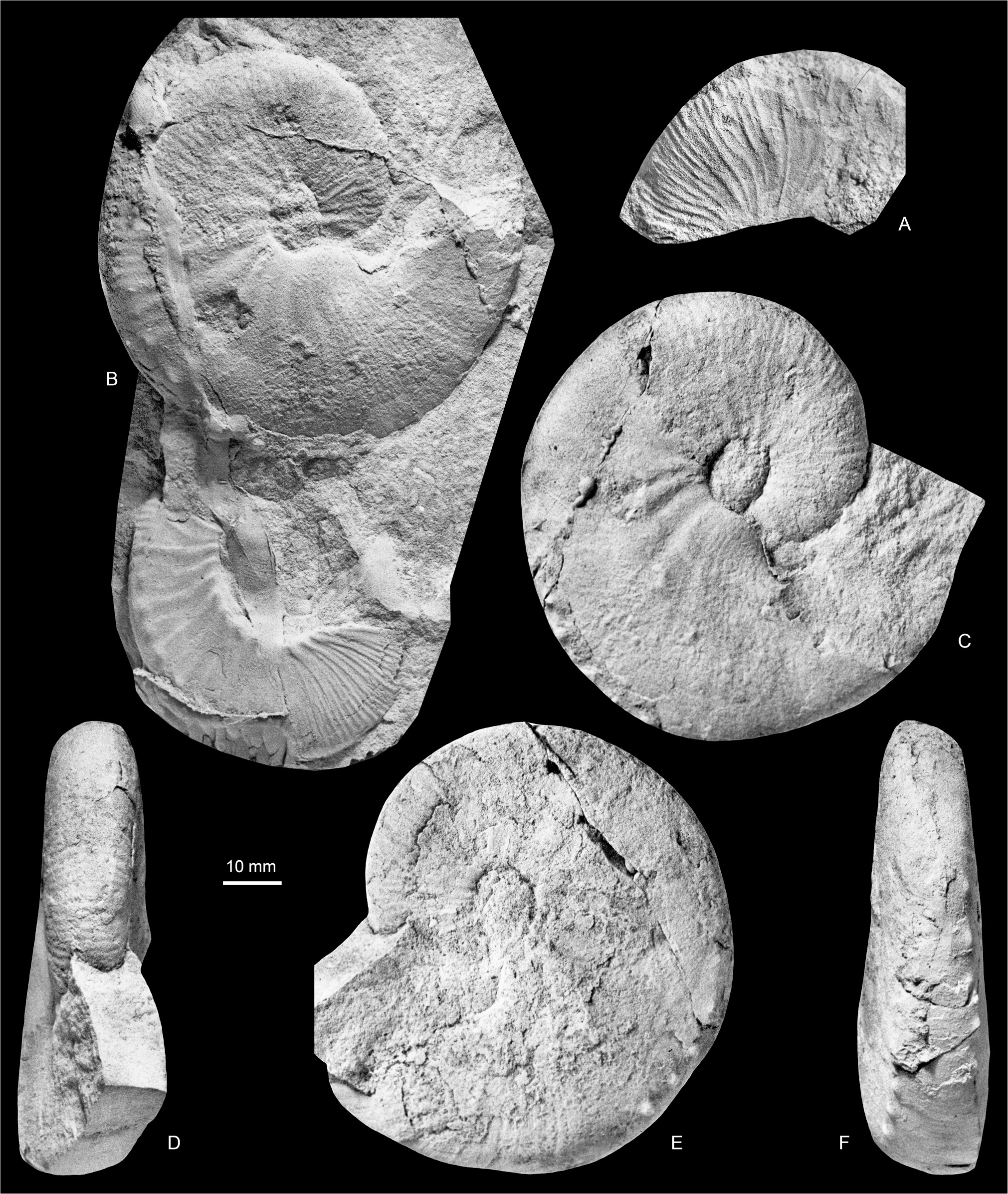
Fig. 29 Discoscaphites angmartussutensis Birkelund 1965; all from Locality 22, southern part of North Col of Apollo Glacier, Kangerlussuaq Basin. A: MGUH 35155, a doubtful specimen. B (upper specimen, silicone rubber cast), C–F: MGUH 35156, a small macroconch. B (lower specimen). MGUH 35157, a microconch (silicone rubber cast). All figures are ×1.
MGUH 35150 (Fig. 28J) has an even more sparsely and distantly ribbed phragmocone, and the adapical end of the body chamber preserved; it is interpreted as a microconch. There are 15–16 bullae on the outer whorl that strengthen and then decrease progressively on the adapertural part of the phragmocone and apical end of the body chamber. The bullae give rise to one or two prorsiradiate primary ribs, which bifurcate on the flanks of the phragmocone, with additional ribs intercalated between. On the body chamber, the ribs efface at mid-flank, and break down into bundles of delicate riblets and striae which link to strong ventral clavi and intercalate between. MGUH 35149 (Fig. 28I) is crushed to a mere film, but appears to be a complete microconch of a very feebly ornamented variant of the species, 51 mm long. The adapertural part of the body chamber lacks tubercles, and is ornamented by delicate riblets and striae only.
MGUH 35148 (Figs 28A–C) is a further crushed microconch fragment, including most of the shaft and terminal recurved sector of the body chamber. Weak umbilical bullae give rise to blunt prorsiradiate primary ribs, with additional ribs intercalating on the flank. All ribs except the most adapertural ones bear a small ventrolateral clavus. The clavi are linked across the venter by a single coarse rib at the adapical end of the fragment, but on most of the shaft these are replaced by delicate striae.
MGUH 35157 (Fig. 29B, lower specimen) is an external mould of a body chamber and the adapertural part of the phragmocone of a microconch with a maximum preserved length of 56 mm. The shaft of the body chamber bears eight small, strong prorsiradiate umbilical bullae. These give rise to single narrow, widely separated markedly prorsiradiate ribs that bifurcate on the flanks, where additional ribs intercalate. The ribs flex back and are convex at mid-flank and concave on the outer flank, linking to well-developed ventral clavi. These are linked over the venter by two or three narrow convex ribs, with additional intercalated ribs separating the groups. The ribbing weakens markedly on the succeeding curved sector. The umbilical bullae weaken and efface, and the ventral tubercles are lost, leaving an ornament of flexuous prorsiradiate wiry ribs. They are straight on the inner flank, convex at mid-flank, concave on the outer flank, flexing forwards over the ventrolateral shoulder to cross the venter in a broad convexity.
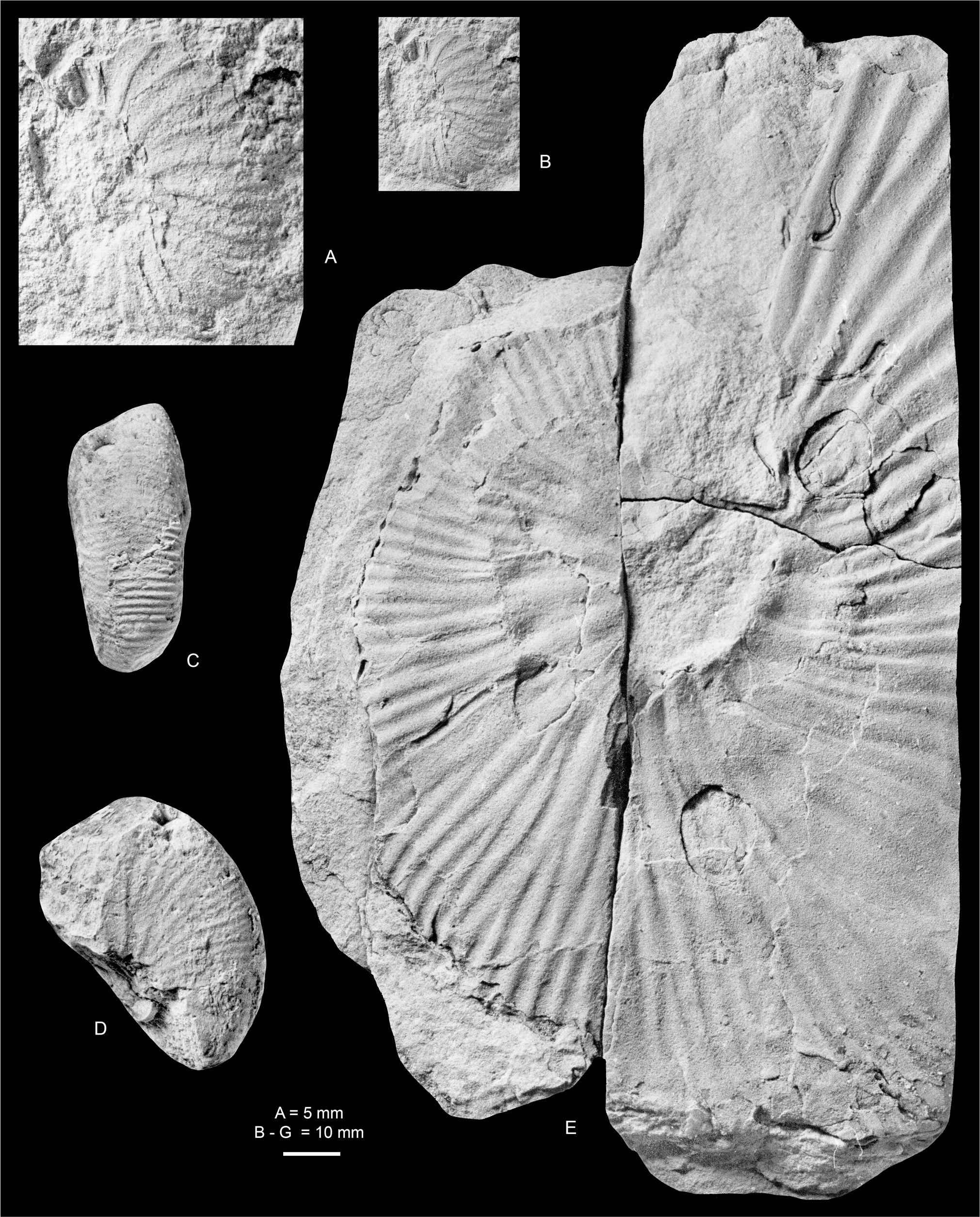
Fig. 30 Acanthoscaphites (Acanthoscaphites) tridens (Kner 1848); all from the Kangerlussuaq Basin. A, B: MGUH 35119; Locality 14, Sediment Bjerge east. C, D: MGUH 35125; Locality 22, southern part of North Col of Apollo Glacier. E: MGUH 35114, a macroconch; Locality 13, Sediment Bjerge central. A is ×2. B–E are ×1.
MGUH 35156 (Figs 29B–F, upper specimen in B) is a small macroconch, 79 mm long, associated with the previous microconch. The phragmocone is an estimated 53 mm in diameter. Coiling is very involute, the whorl section compressed, with a whorl breadth-to-height ratio of 0.6, the flanks flattened and subparallel, the ventrolateral shoulders broadly rounded, the venter very feebly convex. Ornament is poorly preserved. Crowded, weak primary ribs arise singly or in groups from tiny umbilical bullae, and increase by branching and intercalation low and high on the flanks, and on the ventrolateral shoulder. They are narrow, prorsiradiate, flexuous, concave on the umbilical shoulder, convex across the middle of the flanks, concave on the outer flanks and projected on the ventrolateral shoulder to cross the venter in a broad convexity. The ribs strengthen and develop into broad swellings on the inner flanks of the adapical part of the broad, high-whorled part of the body chamber. Ornament is effaced (or poorly preserved?) on the outer flanks at this stage. Small ventral clavi appear, and are present on most of the shaft. They are linked across the venter by groups of very fine convex ribs, with additional nontuberculate ribs intercalating between. The ventral tubercles disappear abruptly on the final curved sector of the body chamber, which is ornamented by delicate riblets and striae that cross the venter in a broad shallow convexity.
MGUH 35152 (Fig. 28F) is a fragment of a further small microconch. Two fragments of much larger macroconchs, MGUH 35153 and MGUH 35154 (Figs 28G, H), are from the adapertural part of the adult body chamber. They are ornamented by crowded, very fine, wiry ribs, and lack all trace of ventral tubercles.
Discussion. The material is poor. The best-preserved microconch (Fig. 29B, lower specimen) compares well with the original of Birkelund (1965, plate 36, fig. 2). The best-preserved macroconch (Figs 29B–F, upper specimen in B) compares well with her plate 38, fig. 2. The larger macroconch fragments (Figs 28G, H) find a match in Birkelund’s plate 39 and plate 40, fig. 1.
Occurrence. Lower Maastrichtian of West and East Greenland (Kangerlussuaq Basin). Machalski (2005) recorded Hoploscaphites ex gr. angmartussutensis from the upper Maastrichtian of the Netherlands, Poland, and Denmark.
Genus Acanthoscaphites Nowak 1911
Subgenus Acanthoscaphites Nowak 1911
Type species. Scaphites tridens Kner 1848, p. 10, plate 2, fig. 1, by the subsequent designation of Diener (1925, p. 205).
Acanthoscaphites (Acanthoscaphites) tridens (Kner 1848)
Figs 30A–E, 31, 32A–E, 33A–F, 34A, B, D–F
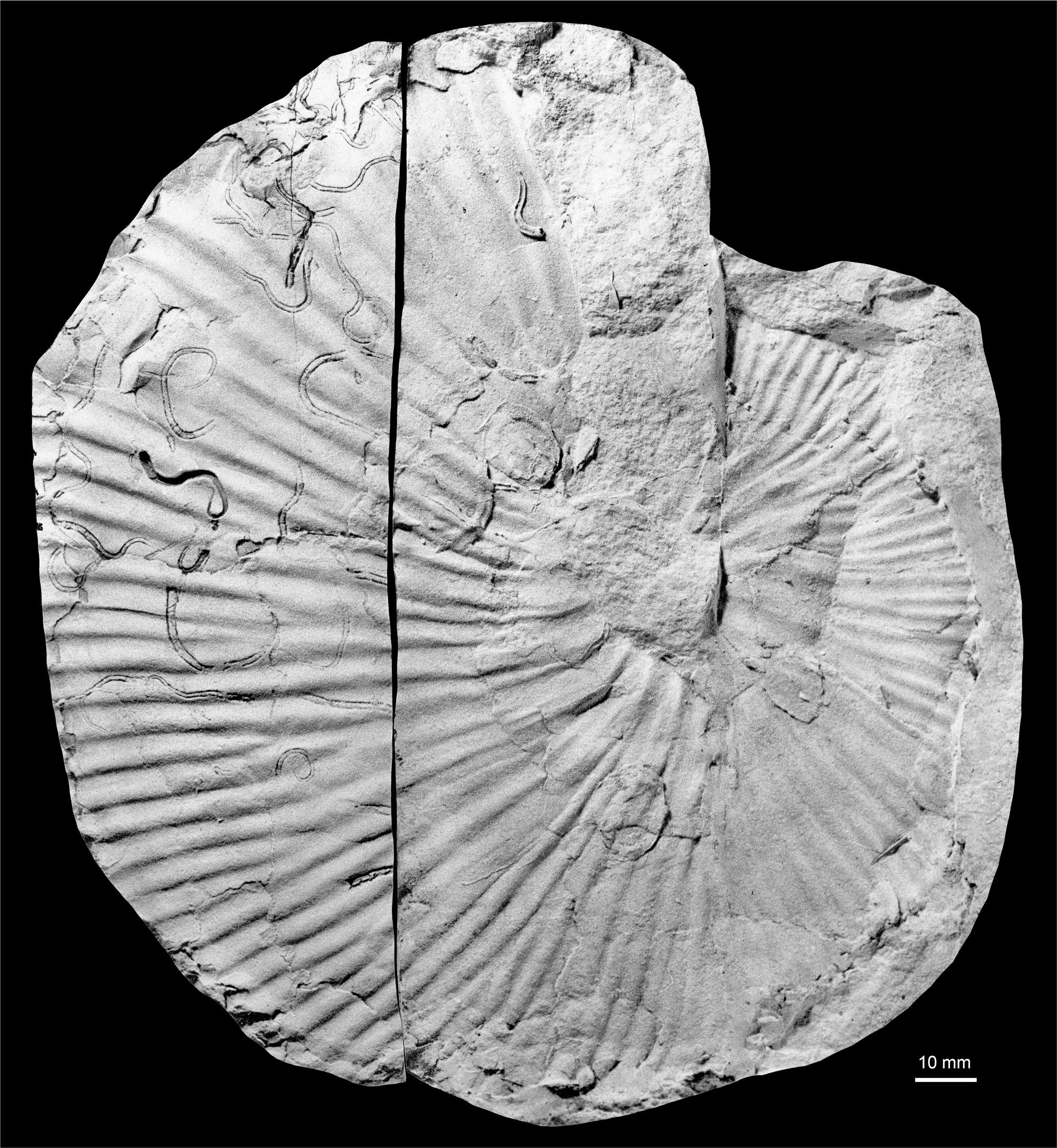
Fig. 31 Acanthoscaphites (Acanthoscaphites) tridens (Kner 1848). MGUH 35114, a macroconch; the right-hand part is a silicone rubber cast taken from the external mould shown in Fig. 30E; ×1.
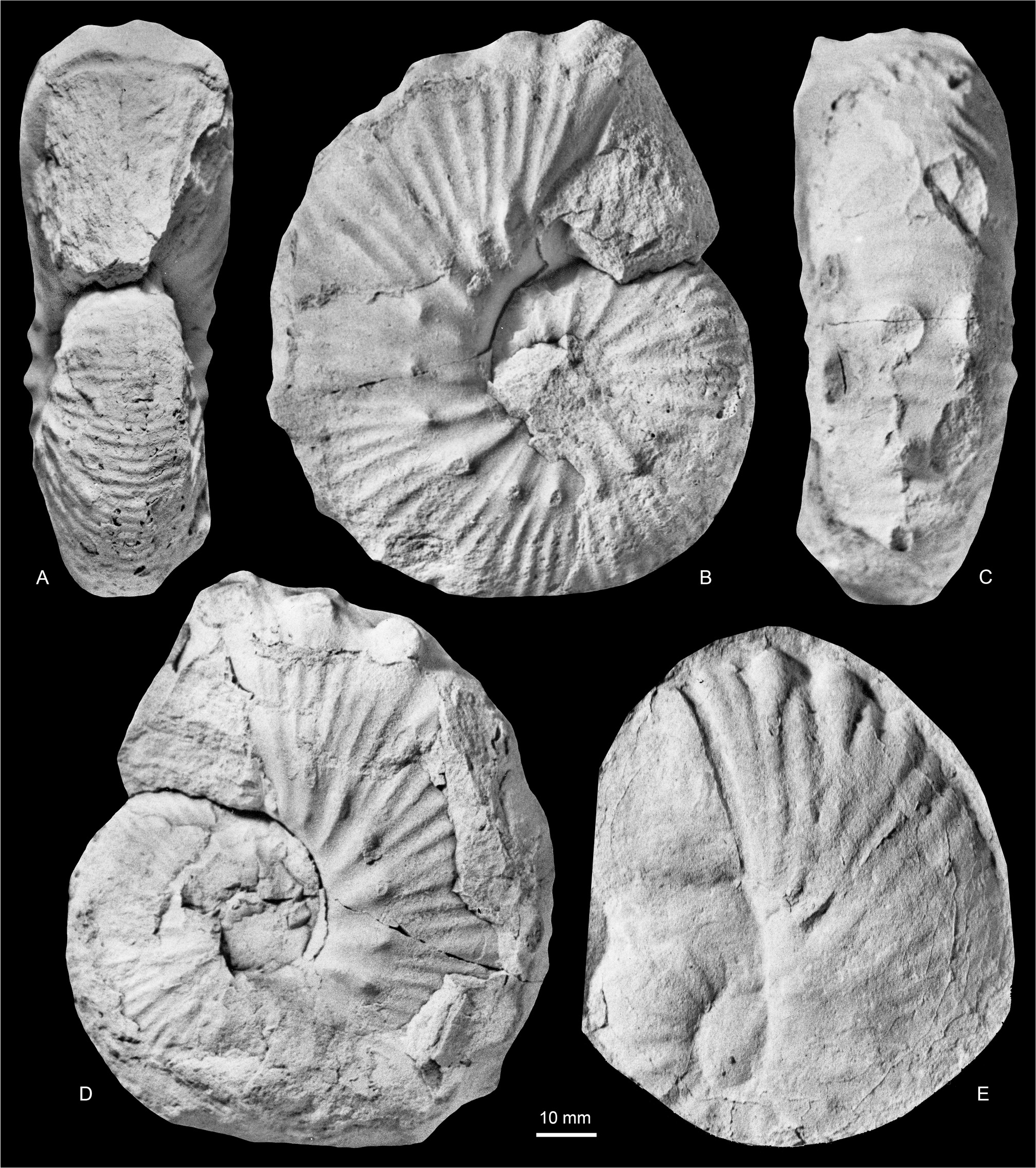
Fig. 32 Acanthoscaphites (Acanthoscaphites) tridens (Kner 1848), microconchs; both from Locality 14, Sediment Bjerge east, Kangerlussuaq Basin. A–D: MGUH 35120. E: MGUH 35121 (silicone rubber cast). All ×1.
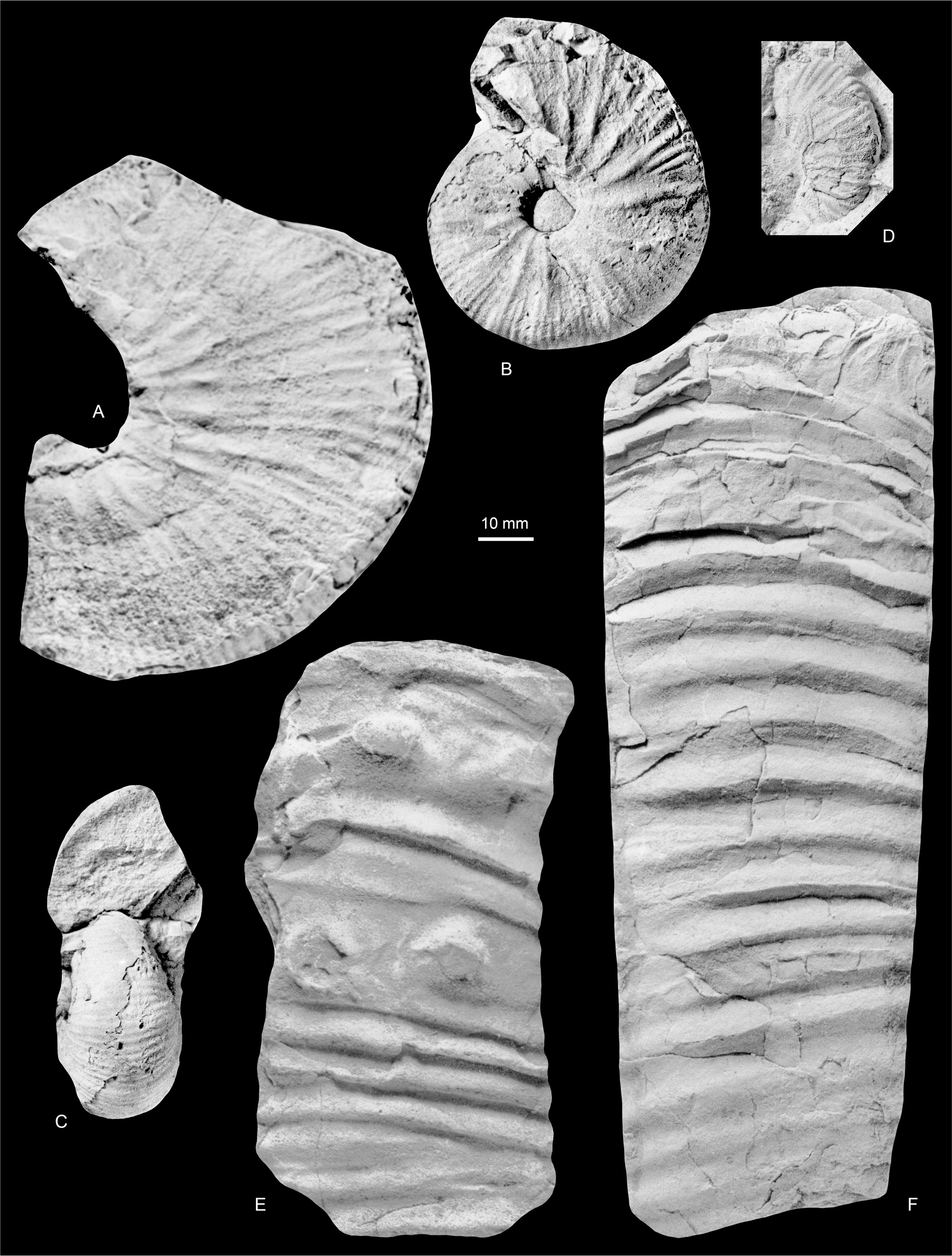
Fig. 33 Acanthoscaphites (Acanthoscaphites) tridens (Kner 1848); all from the Kangerlussuaq Basin. A–C: MGUH 35122–35123, a microconch; Locality 14, Sediment Bjerge east. A: MGUH 35122. B, C: MGUH 35123. D: MGUH 35124; Locality 22, southern part of North Col of Apollo Glacier. E: MGUH 35116, a macroconch; Locality 13, Sediment Bjerge central. F: MGUH 35115, a macroconch; Locality 13, Sediment Bjerge central. All ×1.
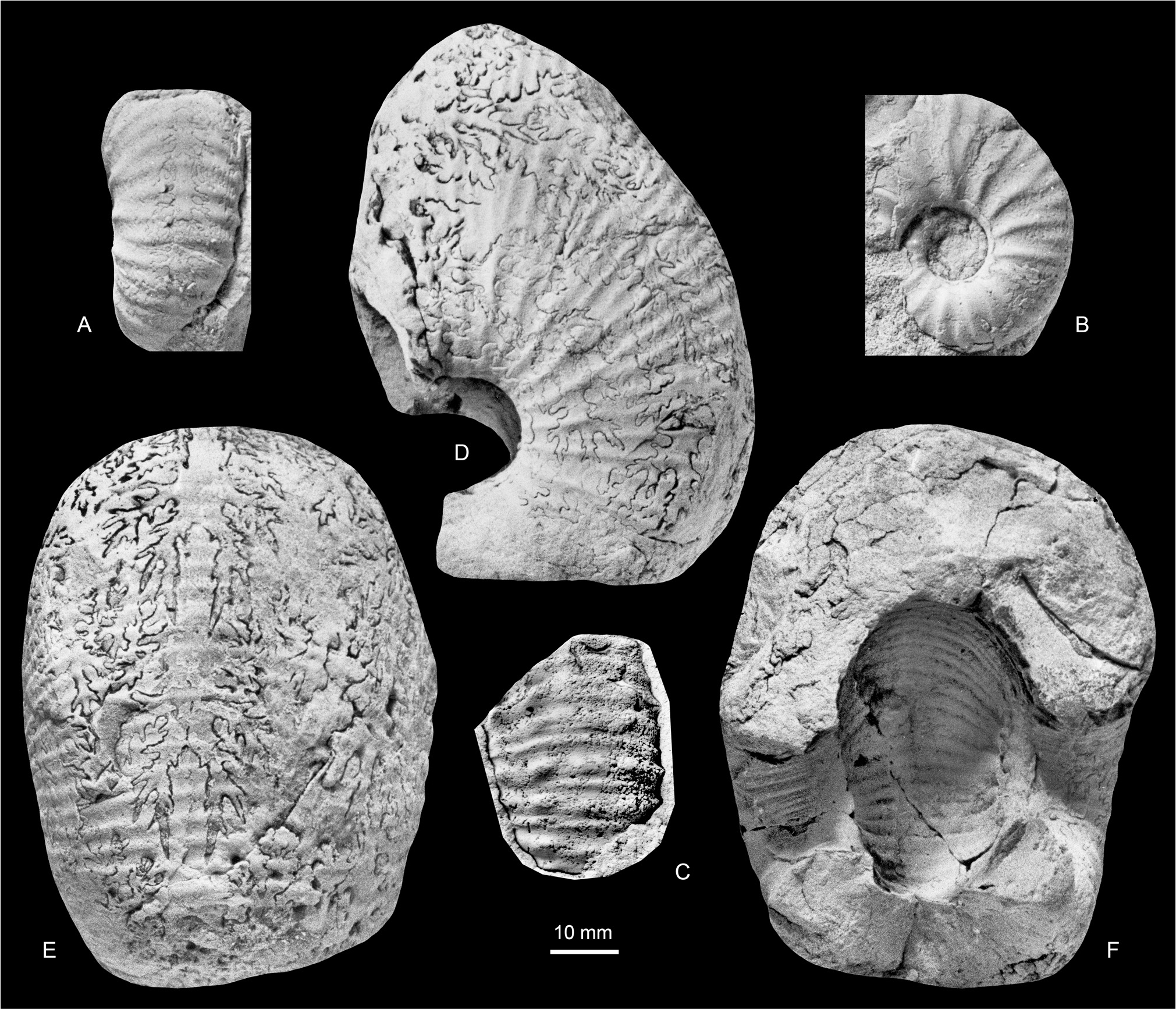
Fig. 34 A, B, D–F: Acanthoscaphites (Acanthoscaphites) tridens (Kner 1848). A, B: MGUH 35118; Locality 14, Sediment Bjerge east, Kangerlussuaq Basin. C: Acanthoscaphites (Euroscaphites?) sp., MGUH 35126; Locality 22, southern part of North Col of Apollo Glacier, Kangerlussuaq Basin. D–F: MGUH 35117, a macroconch (?) phragmocone; Locality 14, Sediment Bjerge east, Kangerlussuaq Basin. All ×1.
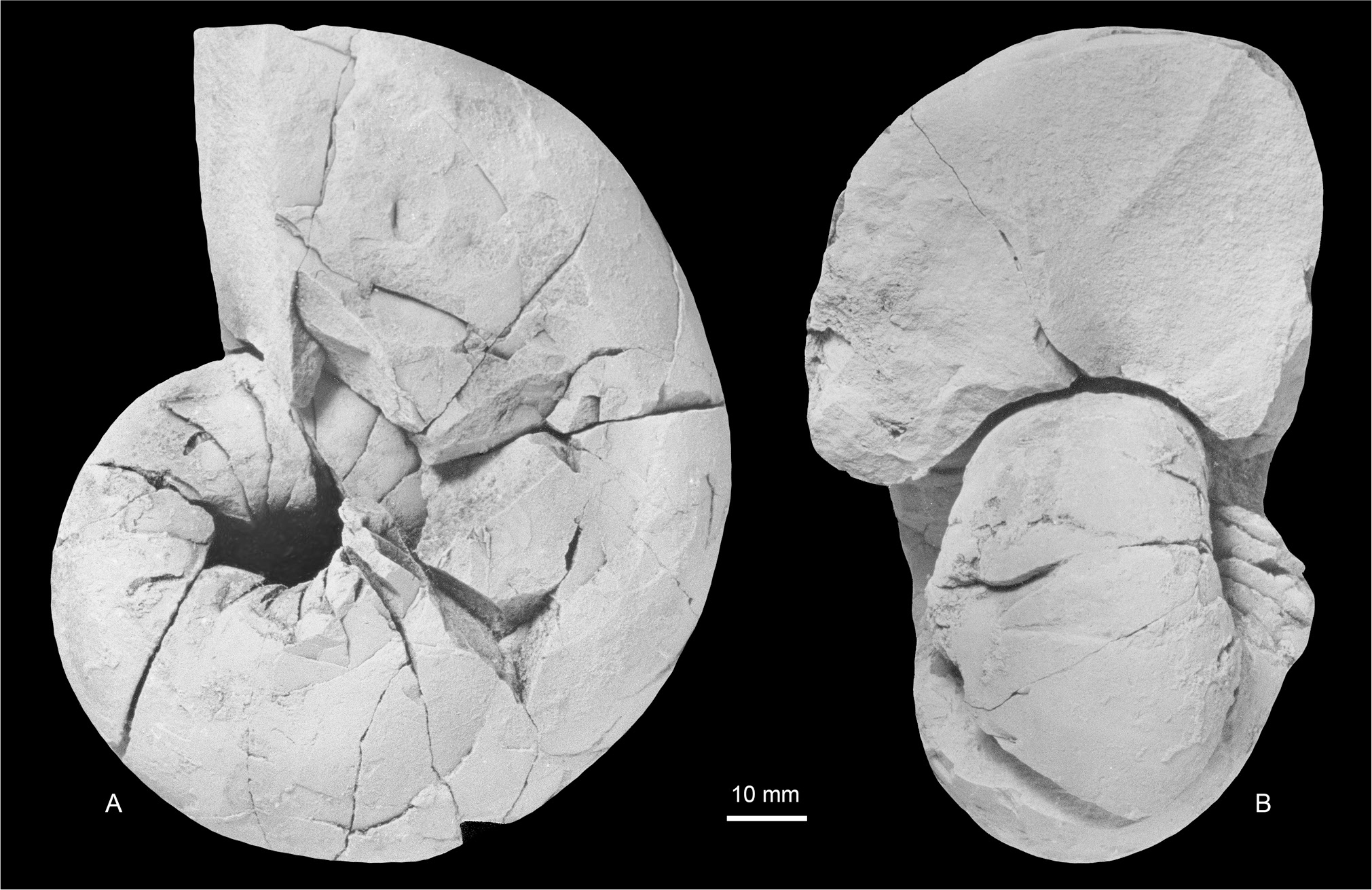
Fig. 35 A, B: Eutrephoceras sp. MGUH 35161; Locality 14, Sediment Bjerge east, Kangerlussuaq Basin. Both ×1.
| 1848 | Scaphites tridens m. Kner, p. 10, plate 2, fig. 1. |
| 1848 | Scaphites trinodosus Kner, p. 11, plate 2, fig. 2. |
| 1849 | Scaphites quadrispinosus Geinitz, p. 116, plate 7, fig. 2; plate 8, fig. 2. |
| 1911 | Acanthoscaphites tridens bispinosus n.v. Nowak, p. 577, plate 32, figs 1–3; text-fig. 14. |
| 1974 | Acanthoscaphites innodosus Naidin, p. 178, plate 62, fig. 1. |
| 1987 | Acanthoscaphites tridens (Kner, 1848); Kennedy & Summesberger, p. 36, plate 4, figs 1–3; plate 6, figs 1–5, 25–28; plate 7, figs 1–5; plate 8, figs 1–5; plate 9, figs 1–4; plate 10, figs 1, 2; plate 11, figs 1, 2; plate 12, figs 1, 2; plate 13, figs 1, 3, 4; plate 14, figs 1–3; plate 15; plate 16, figs 1–6 (with full synonymy). |
| 1993 | Acanthoscaphites (Acanthoscaphites) tridens Kner; Birkelund, p. 55, plate 8, figs 2–4; plate 9, fig. 2. |
| 1999 | Acanthoscaphites (Acanthoscaphites) tridens (Kner, 1848); Jagt et al., p. 134, pls 1, 2; text-figs 1, 2. |
| 2002 | Acanthoscaphites tridens (Kner, 1848); Reich & Frenzel (2002), plate 24, fig. 4. |
| 2002 | Acanthoscaphites sp., Reich & Frenzel (2002), plate 24, fig. 1. |
| 2003 | Acanthoscaphites (Acanthoscaphites) tridens (Kner, 1848) forma trispinosus (M) – trinodosus (m); Niebuhr & Esser, p.270, plate 5, figs 1–9; plate 6, fig. 1. |
| 2003 | Acanthoscaphites (Acanthoscaphites) tridens (Kner, 1848) forma innodosus (M), Niebuhr & Esser, p. 272, plate 7, fig. 1. |
| 2010 | Acanthoscaphites (Acanthoscaphites) tridens (Kner, 1848) formae trispinosus-innodosus-trinodosus; Kin, p. 39, text-figs 19l, 20a–o, 21a–j, 22a–h, 23a–I, 24a–e). |
| 2016 | Acanthoscaphites (Acanthoscaphites) tridens (Kner, 1848); Klein, p. 45 (with additional synonymy). |
Types. The present whereabouts of Kner’s types is unknown. Kennedy & Summesberger (1987, p. 36) indicated that the original of Kner’s plate 2, fig. 1 should be designated lectotype if found.
Material. One specimen, GM 2025.8, from Locality 9, Sequoia Nunatak southwest. Four specimens, GM 2025.9 and MGUH 35114–MGUH 35116, from Locality 13, Sediment Bjerge central. Seven specimens, MGUH 35117–MGUH 35123, from Locality 14, Sediment Bjerge east. One specimen, GM 2025.10, from Locality 20, Pyramiden ridge, north end. Two specimens, MGUH 35124 and MGUH 35125, from Locality 22, southern part of North Col of Apollo Glacier. All from the Kangerlussuaq Basin.
Description. Both coarse and fine-ribbed nuclei are referred to the species. MGUH 35118 (Figs 34A, B) is 22 mm in diameter. Coiling is involute, the deep umbilicus comprising 27% of the diameter, with a convex wall. The whorl section is rounded-reniform. Eighteen primary ribs arise at the umbilical seam, and are incipiently bullate on the flank, prorsiradiate, and feebly flexuous. They may bifurcate, while additional ribs intercalate around mid-flank. All ribs cross the venter in a very feeble convexity. MGUH 35125 (Figs 30C, D) is interpreted as a compressed nucleus, with fine ornament, also seen in MGUH 35124 (Fig. 33D) and MGUH 35119 (Figs 30A, B).
MGUH 35122, MGUH 35123 (Figs 33A–C) is a microconch. It is a juvenile, consisting of a septate nucleus (Figs 33B, C) 56 mm in diameter and an outer whorl, preserved to a whorl height of 55 mm (Fig. 33A). There are 18–20 primary ribs on the outer whorl of the nucleus. They arise at the umbilical seam and strengthen across the umbilical wall shoulder and inner flank, developing into small inner lateral bullae pairs of delicate ribs, with additional ribs intercalating, so there are many more ribs on the outer flanks, ventrolateral shoulders and venter, which they cross in a feeble convexity. This style of ornament extends onto the larger fragment, the ribs on the outer flank varying from straight to very feebly convex.
MGUH 35120 (Figs 32A–D) is a well-preserved adult microconch with a maximum preserved diameter of 95 mm. At the adapical end of the outer whorl, narrow, widely spaced primary ribs bear small umbilical bullae, from which secondary ribs arise in groups of two or three, with additional ribs intercalated on the outer flank and venter. Two or more ribs link at small rounded-clavate ventrolateral tubercles, which are in turn linked over the venter by two or three ribs. There are from one to five ribs between successive tuberculate groups on the ventrolateral shoulders and venter. An estimated 200o sector of the outer whorl is body chamber. Coiling is eccentric. There are 10 primary ribs on the adapertural half whorl of body chamber, with umbilicolateral bullae that strengthen progressively before declining markedly close to the adult aperture. The bullae give rise to groups of ribs: up to five may be clearly or tenuously linked to a bulla, with additional ribs intercalating between. The ribs loop in groups of three or more to rapidly strengthening massive siphonal clavi, with one or more nontuberculate ribs intercalating between. The adult apertural margin is markedly prorsiradiate and marked by a strong constriction and succeeding minor flare (Figs 32A, B). MGUH 35121 (Fig. 32E) is a worn external mould of a slightly larger microconch. The aperture is constricted, with the succeeding flare well-preserved.
MGUH 35117 (Figs 34D–F) is a phragmocone, probably of a macroconch. It has a whorl height of approximately 50 mm (the specimen is distorted), and a whorl breadth-to-height ratio of 1.18. The small deep umbilicus has a high, feebly convex wall; the umbilical shoulder is quite narrowly rounded, the whorl section reniform. Primary ribs arise at the umbilical seam, and are narrow, wiry and straight, branching at weak umbilicolateral bullae on the lower flank; intercalated ribs arise at varying points on the flank, and many bifurcate on the outer flank. The ribs are near-straight across the flanks, and cross the venter in a very feeble convexity.
MGUH 35114 (Figs 30E, 31) is a very crushed adult macroconch preserved to an estimated diameter of 190 mm, lacking the ventral region. Narrow, wiry, primary ribs arise as weak bullae at the umbilical shoulder, both singly and in pairs, and increase by branching and intercalation on the middle and outer flank. They are straight and prorsiradiate on the flanks, flexing slightly forwards and feebly convex on the outermost flank and ventrolateral shoulder. Two further fragments, MGUH 35115 (Fig. 33F) and MGUH 35116 (Fig. 33E) preserve the ventral region of adult specimens. The former has poor indications of the presence of large ventrolateral and siphonal tubercles on the last-preserved rib. The latter has three rows of tubercles well-preserved. The deeply and intricately subdivided suture line is partially preserved in MGUH 35117.
Discussion. The adult specimens, with tuberculation, show these specimens to be macroconch (Figs 30E, 31, 33E, F) and microconch (Figs 32A–E) of Acanthoscaphites (Acanthoscaphites) tridens (Kner 1848). The larger phragmocone and associated inner whorls match well with juvenile phragmocones figured by Kennedy & Summesberger (1987) and Jagt et al. (1999). Coarse ribbed nuclei (MGUH 35118: Fig. 34A, B) appear very different but resemble nuclei associated with the species at Nagoryany (Kennedy & Summesberger 1987, plate 6, figs 2, 3).
Niebuhr & Esser (2003) noted that the wide interpretation of intraspecific variation of Kennedy & Summesberger (1987), who referred specimens with and without siphonal tubercles on the adult body chamber to the single species tridens, may be an oversimplification. They note that forms with siphonal tubercles occur in northern and western Germany (Aachen, Kronsmoor and Lüneberg), to which East Greenland can now be added. Specimens from Poland lack siphonal tubercles; accordingly, they divide the material into A. (A.) tridens forma trispinosus (macroconch) – trinodosus (microconch) with siphonal clavi, and forma bispinosus (macroconch) – quadrispinosus (microconch). In a detailed analysis of 36 specimens from Hrebenne in southeast Poland, Kin (2010, p. 39, text-figs 19l, 20a–o, 21a–j, 22a–h, 23a–I, 24a–e) recognised three formae within tridens: trispinosus, innodosus and trinodosus, and regarded Acanthoscaphites (A.) quadrispinosus (Geinitz 1849) as a separate species, of which A. (A.) bispinosus (Diener 1925) was a synonym. A broad interpretation of the species is followed here; see Machalski (2010) and Kin (2011) for further discussion.
Occurrence. Lower Maastrichtian: European records were carefully analysed by Niebuhr & Esser (2003), who showed the species to be restricted to the lower Maastrichtian Belemnella lanceolata to B. sumensis Zones. In contrast, Kin (2010) regarded it as ranging from the upper Belemnella obtusa Zone into the Belemnella sumensis Zone. There are records from Ukraine, Poland, northern Germany, southern Netherlands, and northeastern Belgium. The present specimens are from the lower Maastrichtian of the Christian IV Formation of the Kangerlussuaq Basin.
Subgenus Acanthoscaphites (Euroscaphites) Jagt et al. 1999
Type species. Scaphites varians Łopuski 1911, p. 120, plate 4, figs 1–3, by original designation.
Acanthoscaphites (Euroscaphites?) sp.
Material. A single specimen, MGUH 35126, from Locality 22, southern part of North Col of Apollo Glacier, Kangerlussuaq Basin.
Description. MGUH 35126 consists of a 25 mm long and 19 mm wide part and counterpart of a fragment of ventrolateral shoulders and venter. Parts of seven narrow, feebly prorsiradiate ribs are present on the ventrolateral shoulders. Of these, four bear small tubercles in an inner and outer ventrolateral position, the latter linked across the venter by one or a pair of narrow transverse ribs, in some cases bearing a transversely ornamented siphonal tubercle. Where two ribs are present, only one bears a siphonal tubercle. A further rib has similar but weaker tubercles, and one is weaker still and lacks tubercles. There is also a shorter intercalated rib, so that the ventral ornament is irregular, comprising 11–12 ribs in total at mid-venter.
Discussion. The presence of irregular ribbing, inner and outer ventrolateral tubercles suggest comparison with Ammonites verneuilianus d’Orbigny 1841 (see revision in Kennedy 1986, p. 74, plate 16, figs 15–17; text-fig. 10c), tentatively referred to Euroscaphites by Jagt et al. (1999).
Occurrence. Lower Maastrichtian of the Christian IV Formation of the Kangerlussuaq Basin.
Subclass Nautiloidea Agassiz 1847
Order Nautilida Agassiz 1847
Suborder Nautilina Agassiz 1847
Superfamily Nautiloidea de Blainville 1825
Family Nautilidae de Blainville 1825
Genus Eutrephoceras Hyatt 1894
Type species. Nautilus dekayi Morton 1834, p. 33, plate 8, fig. 4; plate 13, fig. 4, by the original designation of Hyatt (1894).
Eutrephoceras sp.
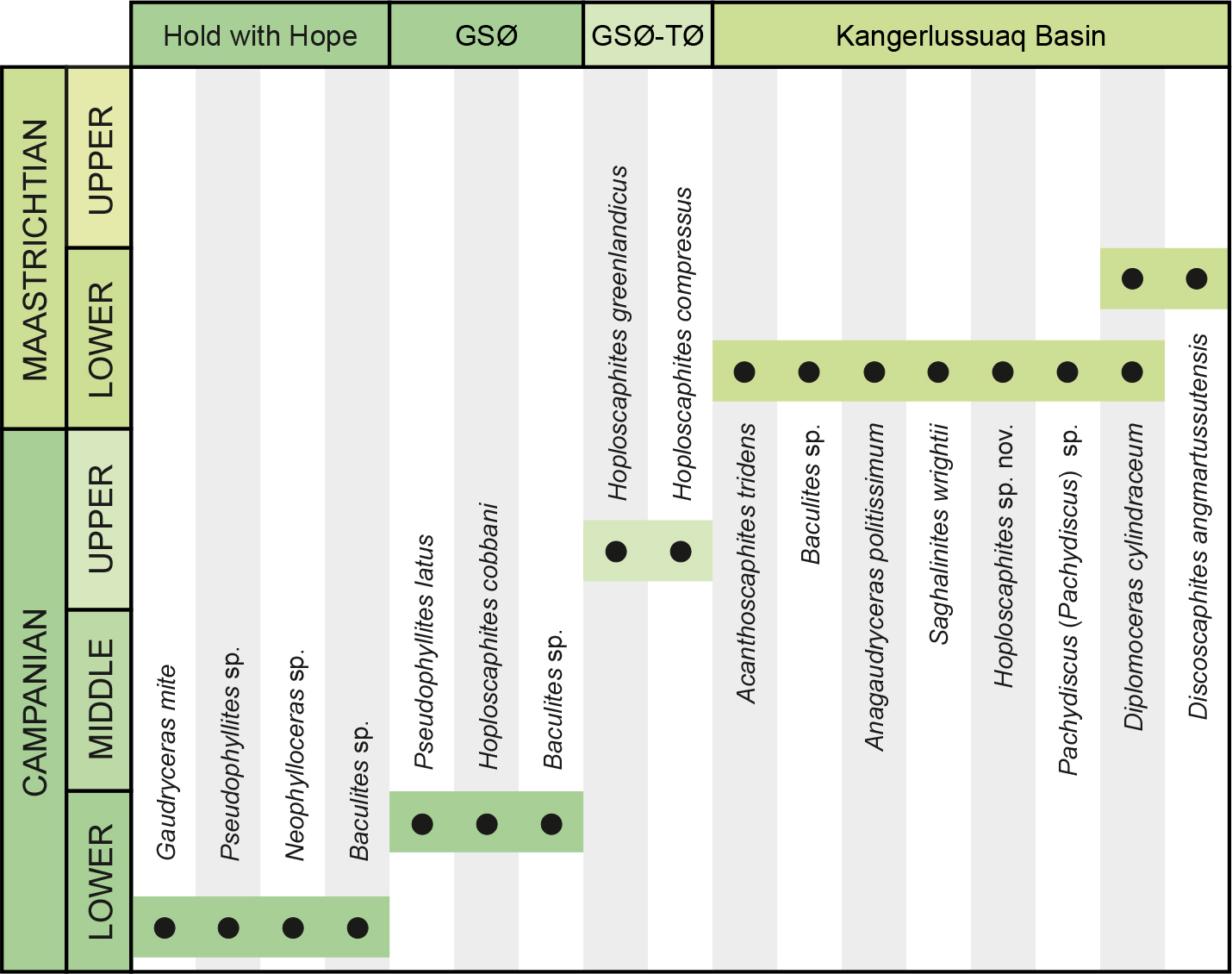
Fig. 36 Approximate stratigraphic distribution of the studied ammonite assemblages in East and North-East Greenland. Abbreviations: GSØ: Geographical Society Ø. TØ: Traill Ø.
Material. A single specimen, MGUH 35161, from Locality 14, Sediment Bjerge east, Kangerlussuaq Basin.
Description. MGUH 35161 is an internal mould of a Eutrephoceras with an original diameter in excess of 160 mm, partially or wholly phragmocone. Coiling is involute, with a tiny, deep umbilicus, broadly rounded umbilical shoulder and a depressed reniform whorl section with a whorl breadth-to-height ratio of 1.44. The surface of the replaced shell, where preserved, is smooth. The suture is only slightly sinuous; the siphuncle lies in an extreme dorsal position.
Occurrence. Lower Maastrichtian of the Christian IV Formation of the Kangerlussuaq Basin.
4 Discussion
4.1 Age of the faunas and correlation with the European succession
Correlation of the East Greenland Campanian and Maastrichtian faunas with the succession in Europe is based on the common presence of a limited number of ammonite species, supplemented by occasional evidence from associated inoceramid bivalves (see Supplementary File 1). The zonal schemes commonly used in Europe are based on either ammonites or belemnites (see Gale et al. 2025 for a summary) whose index species do not occur in Greenland, making correlation with these schemes impossible. Similar to western Greenland (see Birkelund 1965, tables 1 and 2), many of the ammonites documented from the study region are either long-ranging or, in the case of the Scaphitidae, their ranges are overlapping or insufficiently known. Moreover, their occurrences are too widely spaced, stratigraphically, to support a stand-alone Greenland ammonite zonation.
The recognition of the Campanian/Maastrichtian boundary is particularly problematic. The Global Stratotype Section for the base of the Maastrichtian Stage is in the abandoned quarry at Tercis-les-Bains, Landes, in south-east France; the locality is comprehensively documented by Odin (2001). The base of the stage (Odin & Lamaurelle 2001) is an arithmetic mean of 12 biohorizons defined by ammonites, dinoflagellate cysts, planktic and benthic foraminifera, inoceramid bivalves, and calcareous nannofossils. The stage boundary lies at the 115.2 m level, 0.9 m below the lowest occurrence of Pachydiscus neubergicus (Hauer 1858) and Hoploscaphites constrictus (J. Sowerby 1817) and several metres below the first occurrence of Diplomoceras cylindraceum (Defrance 1816) at or below the 111 ± 3 m level. It can be argued that a boundary based on an arithmetic mean rather than an organism or event can only be recognised at Tercis. Of the ammonites noted, the first occurrence of P. (P.) neubergicus is diachronous across Europe (Christensen et al. 2000), and neither this species nor H. constrictus is known from East and North-East Greenland. Diplomoceras cylindraceum does occur in Greenland, but the species first appears in the Campanian, with records from the lower Campanian of Yorkshire, UK (Kennedy 2015), and, possibly, Sakhalin (Alabushev & Wiedmann 1997; but see Jagt-Yazykova et al. 2024), and from the upper Campanian of Norfolk, UK, and Poland (Machalski 2012). The only ammonite present in East Greenland that helps in the placement of the base of the Maastrichtian is Acanthoscaphites (Acanthoscaphites) tridens (Kner 1848), which occurs at five closely adjacent localities in the Kangerlussuaq Basin (Localities 9, 13, 14, 20 and 22; Fig. 4). In Europe, this species ranges from the Belemnella lanceolata Zone to the (upper) Belemnella sumensis Zone according to Jagt et al. (1999; see also Niebuhr & Esser 2003). Consequently, A. (A.) tridens indicates an early Maastrichtian age, but provides no further clues where the Greenland localities lie within the substage. The base of the Maastrichtian is thus undefined in ammonite terms in East and North-East Greenland.
The following ammonite and inoceramid species known from Europe occur in East and North-East Greenland, and serve to place the faunas present in their relative positions in the early Campanian to early Maastrichtian interval:
Sphenoceramus patootensiformis (Seitz 1965): late Santonian and early Campanian (Walaszczyk & Dhondt 2005).
Hoploscaphites cobbani (Birkelund 1965): latest early Campanian, gracilis/mucronata Zone of Lower Saxony (Schmid & Ernst 1975).
Hoploscaphites greenlandicus (Donovan 1953): late Campanian, Bostrychoceras polyplocum Zone (Niebuhr 1996; Kennedy & Kaplan 1997).
Hoploscaphites compressus (Roemer 1841): late Campanian, Bostrychoceras polyplocum Zone (Kennedy & Kaplan 1997).
Acanthoscaphites (Acanthoscaphites) tridens (Kner 1848): early Maastrichtian, Belemnella lanceolata to B. sumensis zones (Niebuhr & Esser 2003).
Spyridoceramus tegulatus (Hagenow 1942): early early Maastrichtian to early late Maastrichtian (Jagt & Jagt-Yazykova 2018).
4.2 Biostratigraphic summary
Five principal ammonite associations occur in strata of Campanian to Maastrichtian age of East and North-East Greenland, and their approximate stratigraphic positions are indicated in Figure 36. In stratigraphic order, from oldest to youngest, these are composed as follows:
Neophylloceras sp., Pseudophyllites sp., Gaudryceras mite and Baculites sp. occur in the lower Campanian of Hold with Hope.
Pseudophyllites latus, Hoploscaphites cobbani and Baculites sp. occur in the upper lower Campanian of Geographical Society Ø.
Hoploscaphites greenlandicus and Hoploscaphites compressus occur in the upper Campanian of Geographical Society Ø and Traill Ø.
Anagaudryceras politissimum, A. cf. luenebergense, Saghalinites wrighti, Diplomoceras cylindraceum, Acanthoscaphites (Acanthoscaphites) tridens, Pachydiscus (P.) sp., Hoploscaphites sp. and Baculites sp. occur in the lower Maastrichtian of the Kangerlussuaq Basin.
Discoscaphites angmartussutensis occurs in the lower Maastrichtian of the Kangerlussuaq Basin.
Numerous localities in the Kangerlussuaq Basin did not yield any age-indicative taxa, but the ammonites collected at these outcrops are presumably also early Maastrichtian in age.
4.3 Regional implications
Most of the ammonite material described in this study is new to eastern Greenland and falls into three principal groups. First is an early Campanian assemblage of Neophylloceras, Pseudophyllites, Gaudryceras and Baculites from Knudshoved, Hold with Hope, North-East Greenland, which occurs in association with the late Santonian to early Campanian Sphenoceramus patootensiformis (e.g. Seitz 1965; Zakharov et al. 2002) in the uppermost Sphenoceramus beds of Donovan (1953), now assigned to the Knudshoved Formation, Jackson Ø Group of Bjerager et al. (2020). The Sphenoceramus beds of Hold with Hope were dated as early Campanian by the occurrence of palynomorphs characteristic of the Aquilapollenites Subzone of the Aquilapollenites Zone of Nøhr-Hansen et al. (2019, p. 30). In the absence of indicative macrofauna, the relative position of the ammonite horizons within the Sphenoceramus beds supports this age.
The second group comprises assemblages of Pseudophyllites and Hoploscaphites, from the upper Campanian Scaphites beds of Geographical Society Ø and Traill Ø, which include the late Campanian Hoploscaphites greenlandicus. The Scaphites beds correspond to a higher part of the sandy mudstone-dominated Knudshoved Formation, representing also the higher portion of the Aquilapollenites Zone of Nøhr-Hansen et al. (2019). Hoploscaphites greenlandicus had been known from this region before (Donovan 1953, 1954, 1955, 1957; Nøhr-Hansen et al. 2019), and the addition of Hoploscaphites compressus to the fauna does not provide further stratigraphic constraints.
The third group comes from the hitherto very poorly known, but well-exposed Kangerlussuaq Basin of southern East Greenland whose Cretaceous rocks were discovered by Wager (1934). This basin contains the youngest Cretaceous rocks exposed in eastern Greenland including strata of Campanian and Maastrichtian age (Larsen et al. 1999, 2005; Nøhr-Hansen 2012, 2024). The Maastrichtian Stage is well represented in these faunas, which occur in the Christian IV Formation of Larsen et al. (2005; = lower Ryberg Formation of Soper et al. 1976), or are derived from this unit and reworked into the Paleocene Fairytale Valley member of the Watkins Fjord Formation. Given that no ammonites of definite late Campanian age are recorded, the downward extent of the Christian IV Formation into the latest Campanian, based on palynomorphs now assigned to the Cerodinium diebelii Zone of Nøhr-Hansen (2012, 2024; see also Larsen et al. 1999 and Williams et al. 2025), remains unconfirmed by macrofauna.
The new ammonite finds support the previous palaeoenvironmental interpretations of the Campanian to Maastrichtian succession of eastern Greenland. The strata of the Knudshoved Formation were regarded as slope to basin deposits by Kelly et al. (1998) and Bjerager et al. (2020), which may explain the relatively low abundance of macrofauna. In turn, the shallower depositional environment of the Christian IV Formation on the outer shelf (Larsen et al. 2005) may be partly responsible for the greater abundance of ammonites in these strata.
Acknowledgements
Andrew H. King (Geckoella, Watchet, UK), Caroline S. Pickles (Ithaca Energy, Aberdeen, UK) and the late Andrew G. Whitham (CASP, Cambridge, UK) collected part of the material studied herein. Early stages of this study benefited from discussions of geology and biostratigraphy with Peter Alsen (GEUS, Copenhagen, Denmark), the late William Braham (Chronos, Hemel Hampstead, UK), the late Walter Kegel Christensen (University of Copenhagen, Denmark), John Gregory (PetroStrat, Conwy, UK), Michael Larsen (INEOS, Switzerland) and Ireneusz Walaszczyk (University of Warsaw, Poland). We thank David Sansom (Department of Earth Sciences, Oxford, UK), Eliza Howlett (Oxford University Museum of Natural History, UK) and Benoit Vautravers (CASP, Cambridge, UK) for technical assistance. Arden R. Bashforth (Natural History Museum of Denmark, Copenhagen, Denmark) kindly assisted with collection numbers. Insightful reviews by Elena Jagt-Yazykova (University of Opole, Poland) and Peter Alsen (Geological Survey of Denmark and Greenland, Copenhagen, Denmark) helped to improve this study and are gratefully acknowledged.
Additional information
Author contributions
WJK: Designed the study, performed taxonomy and wrote most of the text; took most of the photographs; systematic palaeontology is by WJK only.
SRAK: Simon Kelly passed away in May 2023, prior to the completion of this publication. Besides collecting most of the specimens treated here, he had cleaned, prepared and studied the material. Acknowledging the scientific importance of these ammonite faunas, Simon Kelly initiated the present study and had approved major parts of the figures and text before his passing.
SS: Compiled sample data and artwork, wrote part of the introduction and the materials section, and contributed to the remainder of the text; took additional photographs.
Additional files
Supplementary File S1 (a PDF file) lists localities where ammonites were collected, numbered from north to south, with CASP locality numbers in parentheses and established and additional locality names.
Supplementary File S2 (an .xls file) contains sample metadata, including a full list of sample names, locality names, geographical coordinates and geological setting. Both files are available at: https://doi.org/10.22008/FK2/I8QZ64