 |
RESEARCH ARTICLE  |
The limitations of nitrate-sensitive zoning for groundwater protection from pesticides in Denmark
Denitza D. Voutchkova*1  , Ingelise Møller2 , Lærke Thorling1 , Anders R. Johnsen3
Abstract
Pesticides and degradation products are a major challenge for groundwater management in Europe, and in Denmark where drinking water relies entirely on groundwater. To protect drinking water resources, local Danish authorities must take groundwater-protective measures in areas designated as sensitive to pollution; however, official zonation for pesticides is lacking. Nitrate-sensitive groundwater abstraction areas have been used instead. The goal of our study was to test the appropriateness of this groundwater protection strategy. We used Køge municipality (Denmark) as a focus area and tested how our findings upscale to the national level. The data for Køge municipality included 1070 individual groundwater samples, analysed for at least one of 366 pesticide compounds during the period 2012–2022, which were aggregated at the well-screen level by the median. Four pesticide compounds (2,6-dichlorobenzamide (BAM), desphenylchloridazon (DPC), N,N-dimethylsulphamide (DMS), 1,2,4-triazole) and three pesticide groups (phenoxyalcanoic acids, triazines and dimethachlor and its metabolites) were found with the highest detection frequency in the study area. We found that groundwater pollution with pesticide compounds was not limited to nitrate-sensitive areas in Køge municipality or in Denmark as a whole. Therefore, nitrate-sensitive areas can only be used partially for identifying pesticide-sensitive groundwater abstraction areas. The management implication is that placing protective measures only within nitrate-sensitive areas would be insufficient to fully address the risk of future groundwater pesticide pollution. We identified knowledge gaps and discussed a potential way forward with a more integrated management of groundwater protection in Denmark.
Citation: Voutchkova et al. 2025: GEUS Bulletin 59. 8390. https://doi.org/10.34194/mg1sjj69
Copyright: GEUS Bulletin (eISSN: 2597-2154) is an open access, peer-reviewed journal published by the Geological Survey of Denmark and Greenland (GEUS). This article is distributed under a CC-BY 4.0 licence, permitting free redistribution, and reproduction for any purpose, even commercial, provided proper citation of the original work. Author(s) retain copyright.
Received: 06 Jan 2025; Revised: 19 May 2025; Accepted: 16 Jun 2025; Published: 28 Aug 2025
Competing interests and funding: The authors have no relevant financial or non-financial interests to disclose.
This work was part of research project “Prioritization – investigation of the use of nitrate sensitive areas (NSA) for measures related to pesticides,” an initiative under the Partnership for Sustainable Water Supply, funded by the Region Sjælland and the branch-organization Danske Vandværker.
*Correspondence: dv@geus.dk
Keywords: pesticides, nitrate-sensitive areas, pesticide sensitive areas, groundwater vulnerability, groundwater protection
Abbreviations:
BAM: 2,6-dichlorobenzamide
DMS: desphenylchloridazon
DMSA: dimethylsulfamic acid
DPC: desphenylchloridazon
EU: European Union
GKO: national groundwater mapping
LOD: limit of detection
m.b.t: metres below terrain
NSA: Nitrate-sensitive area
OW: other well
PSA: pesticide-sensitive area
PW: pollution well
RBMP: River Basement Management Plan
WW: waterworks well
Edited by: Adam Hambly (DTU, Denmark)
Reviewed by: Niels Peter Arildskov (WATSONC, Denmark) and one anonymous reviewer
1. Introduction
Groundwater is a critical resource for public water supply in the European Union (EU), where it accounts for 65% of the total water abstracted for public water supply (European Environment Agency 2023). Pollution with pesticide residues is a main cause of failure to achieve good chemical status for groundwater in the EU (see ‘Regulatory context’ section), only second to nitrate (European Environment Agency 2018).
Pesticide substances are a major groundwater management challenge in Denmark as well. According to the latest status report (Thorling et al. 2024), pesticides or their degradation products were detected in 67.6% of the well screens in the national monitoring network (GRUMO, n = 1049 for 2020–2022) and 40.5% of the public waterworks well (WW) screens used for drinking water production (n = 6386 for 2018–2022; Thorling et al. 2024). More importantly, the groundwater quality standard of 0.1 μg/L was exceeded at 33.0% of the GRUMO wells and 10.8% of the WW screens used for drinking water (Thorling et al. 2024). This has major implications for the Danish drinking water supply, which relies entirely on groundwater. Most of it undergoes only simple treatment (aeration and sand filtration), so the overall pesticide status of the treated drinking water is comparable to that of the untreated groundwater (Voutchkova et al. 2021).
Danish environmental policy is based on prevention and source protection (Pedersen et al. 2016), which is aligned with the EU principles that groundwater quality should be protected by restricting polluting activities in sensitive recharge areas (European Environment Agency 2023). In Denmark, the local authorities (98 municipalities) must take measures to protect the groundwater in areas sensitive to pollution, including pesticides (Pedersen et al. 2016). However, national zonation guidelines for pesticide sensitivity are lacking. Consequently, some Danish municipalities have used nitrate-sensitive areas (NSAs, see Section 2) as proxies for groundwater abstraction areas sensitive to pesticide leaching. The rationale was that NSAs have high infiltration rates, which are assumed to also increase the risk of pesticide leaching (Miljøstyrelsen 2000). Furthermore, the main source of diffuse groundwater pollution with both nitrate and pesticides is agriculture. There are, however, major differences in their leaching. The most common pesticide compounds in Danish groundwater were the persistent transformation products N,N-dimethylsulphamide (DMS), desphenylchloridazon (DPC), 4-bis-amido-3,5,6-trichlorobenzenesulphonate (R471811) and 2,6-dichlorobenzamide (BAM; Thorling et al. 2024). In contrast to nitrate, these compounds do not degrade at the redox front. Furthermore, the parent compounds of DMS (tolylfluanide and dichlofluanide), and R471811 (chlorothalonil) have also been used as biocides in paint and building materials in urban areas. Therefore, we posit that because of differences in the pollution source and geochemical behaviour, the assumption that NSAs can be used for groundwater protection from pesticides is problematic.
The aim of this research was therefore to test whether the current groundwater management strategy – using NSAs as proxies for abstraction areas sensitive to pesticides – is appropriate for protecting Danish drinking water resources from pesticides. Our working hypothesis was that not only NSAs, but also areas outside an NSA can be sensitive to pesticides. We tested our hypothesis for a municipality in Denmark with exceptionally high data density and quality, and detailed mapping of nitrate vulnerability and NSAs. To determine whether our findings upscale, we performed the analysis at the national level as well. Finally, we identified knowledge gaps and discussed different strategies for groundwater protection from pesticides, which is urgently needed in Denmark and potentially in other EU countries where drinking water supply depends on groundwater.
2. Regulatory context
2.1. Legal definition and threshold for pesticides
The EU Groundwater Directive (European Commission 2006) defines ‘pesticides’ as active substances in plant protection products and biocidal products, as well as their metabolites, degradation products and reaction products. In many EU countries, there is furthermore a distinction between relevant and non-relevant pesticide metabolites in drinking water (Council of the European Union 2020), and the EU drinking water thresholds apply only to the former (Laabs et al. 2015). A pesticide metabolite is classified as relevant “if there is reason to consider that it has intrinsic properties comparable to those of the parent substance in terms of its pesticide target activity or that either itself or its transformation products generate a health risk for consumers” (Council of the European Union 2020). The distinction between relevant and non-relevant metabolites is applied to groundwater by many EU member states. However, in Denmark and in this study, there is no such distinction – the EU threshold applies to all pesticide compounds in groundwater. Laabs et al. (2015) stated that Denmark holds a unique position in EU in this regard, but this is in line with the precautionary principle.
2.2. Pesticides in EU groundwaters
Integrated management at the river basin level is key to ensuring the sustainability of groundwater resources in the EU (European Environment Agency 2023). The groundwater chemical status in EU is assessed as part of the River Basement Management Plans (RBMPs), which are the key tool for implementing the Water Framework Directive (European Commission 2000). Groundwater fails to achieve good chemical status with respect to pesticides, if the EU standard of 0.1 μg/L for individual pesticide compounds or 0.5 μg/L for the sum of pesticide compounds is exceeded (European Commission 2006).
Pesticides are the second-most common reason for failing good chemical status for groundwater. According to the 2nd RBMP (2015–2021), 6.5% by area of the European groundwater bodies failed to achieve good status due to pesticides; moreover, 1.4% by area had an upward concentration trend (European Environment Agency 2018). The latest assessment (3rd RBMP) showed that 7.5% of the 2050 Danish groundwater bodies failed to achieve good status because of pesticides, equivalent to 17% by volume (Nilsson et al. 2021). These figures show that groundwater protection from pesticides is a major challenge not only in Denmark, but also in the EU.
2.3. Nitrate-sensitive areas
The Danish groundwater abstraction areas designated as NSAs, are management areas with a particular sensitivity to nitrate pollution. They are designated under the Danish Water Supply Act (Miljøministeriet 2022), made public with a Ministerial Order (Miljøministeriet 2023) and available online (Miljøstyrelsen 2023a). NSAs are not the nitrate-vulnerable zones from the Nitrates Directive (Council of the European Union 1992). The nitrate- vulnerable zones are defined as areas of land that drain into polluted waters or waters at risk of pollution and which contribute to nitrate pollution (European Commission 2023), while NSAs focus only on groundwater in the abstraction areas. A similar distinction between NSAs and nitrate-vulnerable zones was made in the UK (Cook 1999; Osborn & Cook 1997). The difference is, however, that Denmark is exempt from designating nitrate-vulnerable zones, because it has established and applies nationwide action programmes, according to Article 3.5 of the Nitrates Directive (Council of the European Union 1992).
The main criteria for NSA mapping are the aquifer vulnerability to nitrate and the groundwater recharge (Fig. S1; Miljøstyrelsen 2000, 2023b; Naturstyrelsen 2014). NSAs are situated within areas classified as particularly valuable for drinking water abstraction, or within the catchment areas of the WW fields (Miljøstyrelsen 2023b). The Danish nitrate-vulnerability mapping is based on the characteristics of the aquifer material and the overlaying layers, as well as the groundwater quality (Table S1; Miljøstyrelsen 2023b). Figure 1 illustrates how nitrate vulnerability of the aquifer and the NSA zonation relate. Around 17% of Denmark (7466 km2) is designated as an NSA.
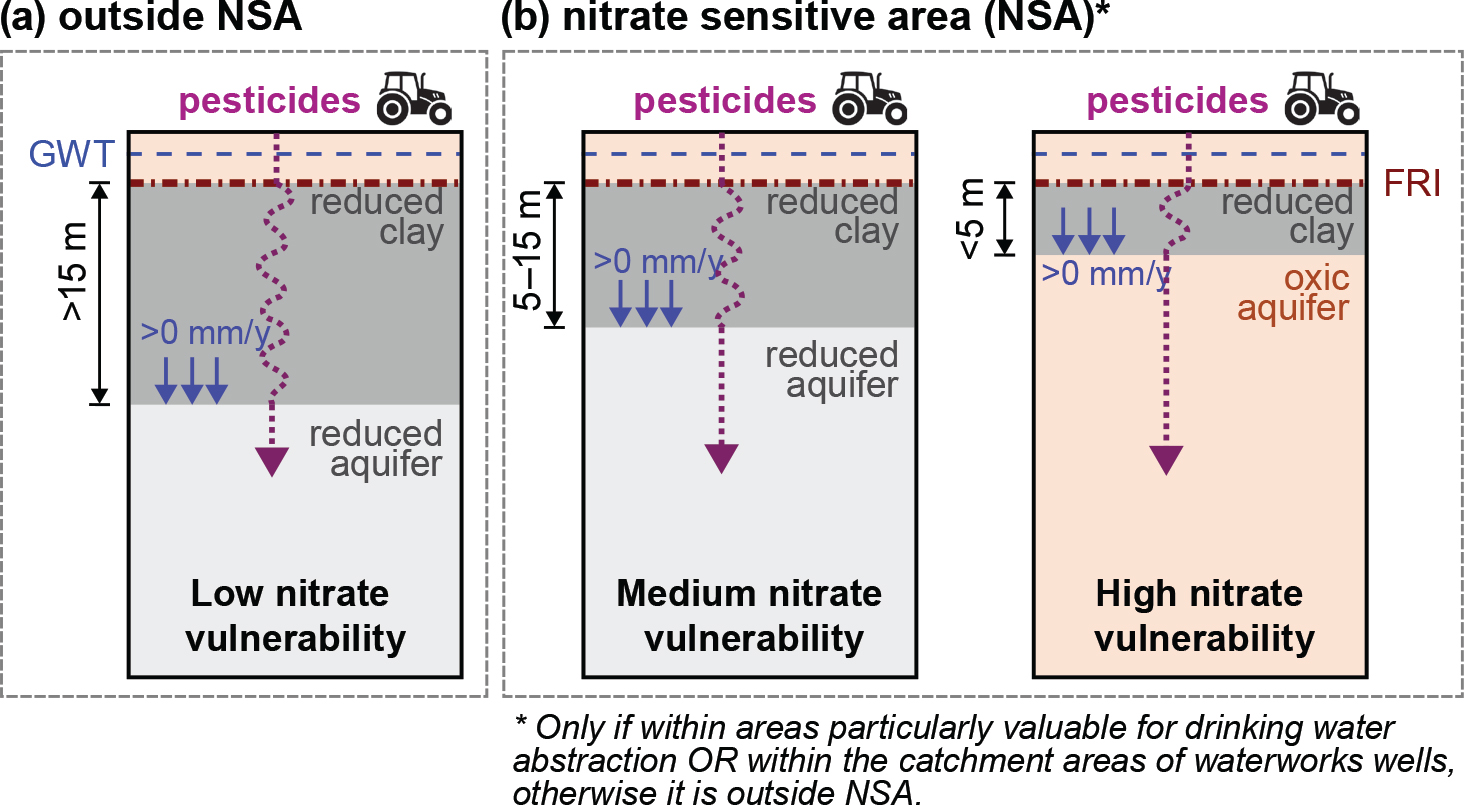
Fig. 1 Illustration of the principles for designation of a groundwater abstraction area as a nitrate-sensitive area (NSA) in Denmark (including aquifer vulnerability and redox state in the aquifer, thickness of reduced clay layer and positive recharge) and potential leaching of persistent pesticide compounds to the aquifer. Purple dotted lines indicates potential leaching pathways to the aquifer. GWT: groundwater table (blue dashed lines). FRI: first redox interface (red dashed lines).
2.4. Pesticide-sensitive areas and pesticide vulnerability
We define pesticide-sensitive areas (PSAs) as those where leaching of pesticides to the groundwater has been observed regardless of the time of application. The pollution with pesticides may result from their application within the entire groundwater catchment area, and not only close to the well head. The historical leaching (their detection in groundwater) is therefore used as a proxy for the areas with inherent pesticide sensitivity. The concentration levels in groundwater, on the other hand, reflect the risk management (e.g. the regulations on dose or time of application) and do not necessarily reflect the inherent pesticide sensitivity. Here we do not assess the pesticide sensitivity of large nature areas, where pesticides have not been applied. Another inherent limitation is that we cannot test for overlap between NSAs and PSAs where the groundwater is recharged pre-1960s, when use of the pesticides in question started. Though the pesticide approval procedure has been improved over the years, it still cannot fully prevent leaching of pesticide compounds from approved pesticides, either because the leached degradation products were not identified during the pesticide approval, or because the approval models did not adequately cover real-life conditions. Some recent examples are leaching of DMS and DMSA from application of cyazofamid (Badawi et al. 2024), leaching of TFA from tri-fluorinated pesticides (Albers & Sültenfuss 2024; Johnsen et al. 2024) and leaching of propyzamide in very high concentrations (Badawi et al. 2025).
The official zonation guidelines (Miljøstyrelsen 2023b) do not include national PSA designation, but provide a reference (Naturstyrelsen 2015), building on the concept by Nygaard et al. (2005). This concept uses the soil clay, silt and humus content to evaluate if areas are more sensitive than the preconditions for approving pesticides (Nygaard et al. 2005). The concept cannot be applied to soils with >10% clay, wetlands and non-agricultural land (Naturstyrelsen 2015). The zonation, therefore, applied to 41.2% of the Danish territory, most of which was not sensitive to pesticide leaching. Just 0.2% of the land was classified as particularly sensitive, 0.6% as potentially sensitive and 1.2% had a low sensitivity to pesticide leaching (Naturstyrelsen 2015). This PSA designation had very little practical relevance for the local authorities. Pedersen et al. (2016) stated that there are no methods for PSA zonation suitable for public administration purposes. According to them, vulnerability to pesticides, should be based on identifying areas with large groundwater recharge, and thus higher risk of pollution, and frequently such areas are also those with sandy soils and sediments, which are also more vulnerable to nitrate leaching (Pedersen et al. 2016).
3. Methods
3.1. Study site
Køge municipality (255 km2) is situated in the eastern part of Denmark on the island of Sjælland (Fig. 2a). Agriculture is the dominant land use (49.4% intensive and 5.4% extensive agriculture); forests cover 20%, while the built-up areas cover 8.4%, and the industry and technological activities take up less than 2% (Levin 2019).
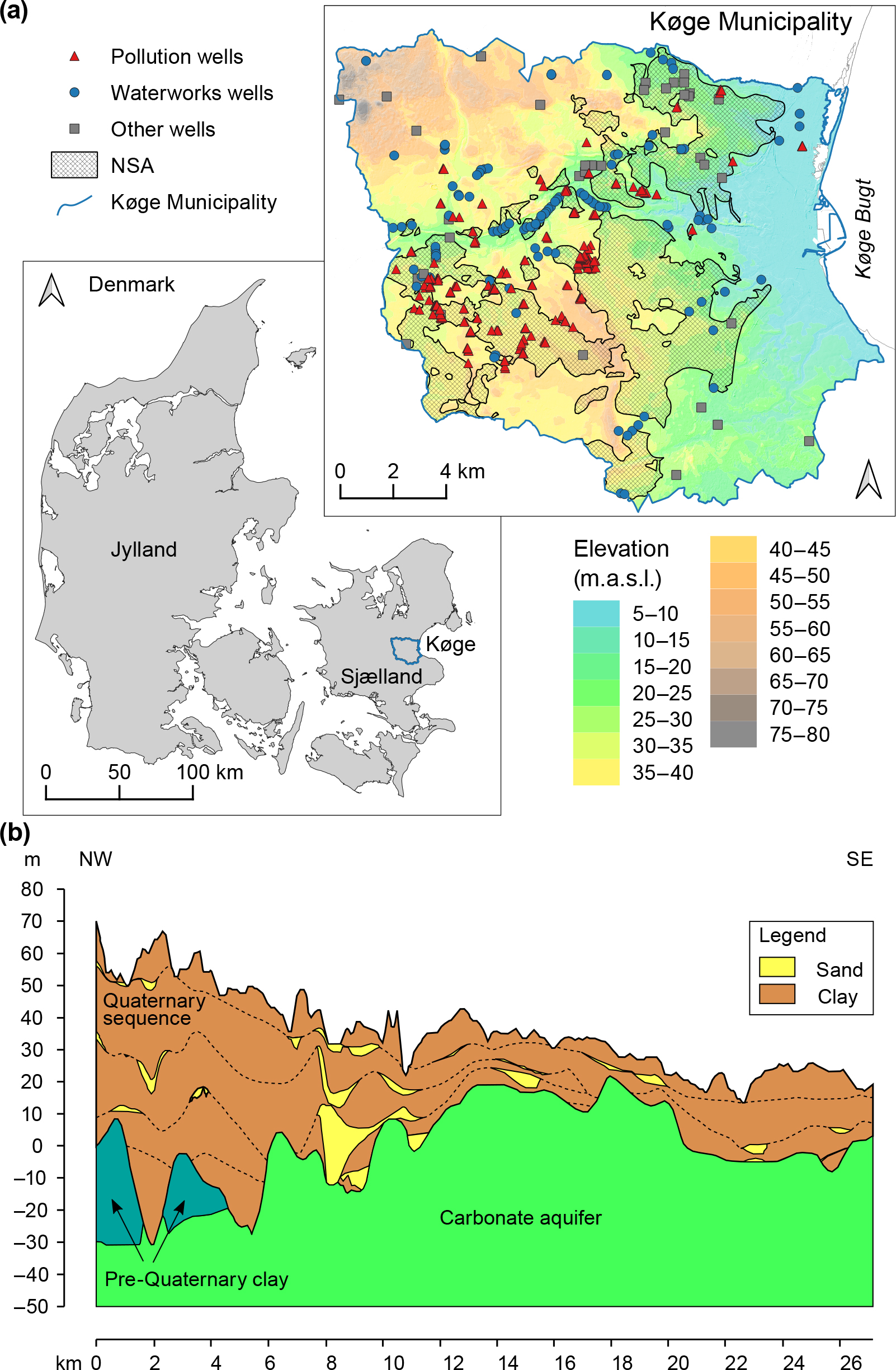
Fig. 2 Overview of the Køge municipality study site. a: Location of Køge municipality in Denmark. The groundwater abstraction areas officially designated as nitrate-sensitive areas (NSAs) and well locations and types are also shown. Elevation in metres above sea level (m.a.s.l). b: Conceptual hydrostratigraphic model for the study area.
Figure 2b shows the conceptual hydrostratigraphic model of the study area (NW–SE cross-section), based on Stisen et al. (2020). The Pre-Quaternary carbonate deposits consist of greensand, bryozoan limestone and chalk from Neogene, Maastrichtian and Campanian; they are depicted collectively as a ‘carbonate aquifer’ in the hydrostratigraphic model of the area (Fig. 2b; Stisen et al. 2020). The depth to the carbonate aquifer is on average 26 ± 19 m (±1 SD) below terrain (m.b.t) and in the range 0–103 m.b.t (Fig. S2a). The overlying Quaternary succession (Fig. 2) consists primarily of clayey till and sandy meltwater deposits (COWI 2005; Jacobsen 2022), formed during the last three glaciations in the Pleistocene and impacted by erosion, deposition and deformation. Glaciotectonic deformations are expected where the Quaternary glacial sequence is thicker, while in the areas with thinner deposits, the clayey till is potentially fractured (COWI 2005; Jacobsen 2022).
Most of the glacial landscape is characterised by till plains with hummocky terrain in places. Marginal moraines, erosion valleys, eskers and kames are found as well. There are two buried valleys, eroded into both the glacial sequence and the carbonate aquifer, which were consequently filled with sandy and clayey glacial deposits (Sandersen & Jørgensen 2016, 2017). The glacial deposit thickness varies from c. 10 m to >100 m, and the thickness of the accumulated clay overlying the carbonate aquifer is on an average 23 ± 19 m and varies from 0 to 102 m (Fig. S2b).
The nitrate-vulnerability assessment and the NSA mapping (Rambøll 2018) were extended with priority action areas which were: (1) within areas of particular drinking water interest and with a high or medium vulnerability, (2) outside forests or natural areas and (3) within the 50-year-catchment zones of the WWs (Køge Kommune 2022). This extended version is used here in this study (Fig. 2). Within the NSA in the area, the carbonate aquifer depth was on average 15 ± 4 m.b.t. (range 1.3–42.5 m.b.t), while the accumulated clay overlying the carbonate aquifer was on average 13 ± 4 m thick (range 0–34 m). The land use inside and outside NSAs can be found in Supplementary Table S2.
3.2. Data
3.2.1. Pesticide data
The data were downloaded from the nationwide open-access well database, Jupiter (Hansen & Pjetursson 2011) on 10 May 2022. Accredited labs upload all chemical analyses of drinking water and groundwater to Jupiter. The data extraction was limited geographically to Køge municipality, and temporally to samples from the period 2012–2022, and covered 626 different pesticide compounds. The raw data were quality assured (see Supplementary Text 1) and aggregated at the well-screen level. Only the compounds that were analysed at more than one well screen were retained in the dataset. The cleaned dataset included data from 1070 individual samples analysed for at least one of 366 compounds, representing 452 well screens in 436 wells (some wells have multiple well screens).
We focused our analyses on four pesticide compounds and three groups of pesticide compounds, which had the highest detection frequency in the area and were, therefore, of high importance (Table 1).
| Pesticide compounds | CAS RN | No. of well screens | |||
| Total | Detected | Exceeded | |||
| BAM | 2,6-dichlorobenzamide | 2008-58-4 | 443 | 116 (26.2%) | 59 (13.3%) |
| DPC | Desphenylchloridazon | 6339-19-1 | 375 | 99 (26.4%) | 42 (11.2%) |
| DMS | N,N-dimethylsulphamide | 3984-14-3 | 298 | 127 (42.6%) | 34 (11.4%) |
| 1,2,4-triazole | 288-88-0 | 300 | 50 (16.7%) | 17 (5.7%) | |
| Phenoxyalcanoic acids (sum) | - [1] | 444 | 90 (20.3%) | 64 (14.4%)[4] | |
| Triazines (sum) | - [2] | 443 | 58 (13.1%) | 27 (6.1%)[4] | |
| Dimethachlor + transformation products (sum) | - [3] | 274 | 52 (19.0%) | 27 (9.9%)[4] | |
| CAS RN is a unique identification number for every chemical substance (registration number assigned by the Chemical Abstracts Service). [1] The group includes 12 compounds, including seven transformation products, see Table S3. [2] The group includes 20 compounds, including 12 transformation products, see Supplementary Table S4. [3] The group includes dimethachlor and seven of its transformation products, see Supplementary Table S5. [4] The exceedance is calculated based on the sum of the compounds in the specific group for a sample; 0.1 μg/L is used here, even though it is the standard for individual compounds. The 0.5 μg/L standard applies to the sum of all pesticide compounds, so it was not used here. | |||||
BAM is a transformation product from the herbicides dichlobenil and chlorthiamide, used in orchards and on paved areas, and from the agricultural fungicide fluopicolide. DPC is a transformation product from the agricultural herbicide chloridazon. DMS is a transformation product from the fungicides tolylfluanide and dichlofluanide, used in orchards and production of berries, but DMS also leaches from the biocide use of these parent compounds in outdoor paint and wood protection in urban areas (Albers et al. 2023). DMS is furthermore a degradation product from the agricultural fungicide cyazofamid (Badawi et al. 2024). 1,2,4-triazole is a transformation product from a range of triazole-fungicides used in agriculture and as biocides in outdoor paint. 1,2,4-triazole may furthermore be used as a nitrification inhibitor, though this usage is very limited in Denmark. The three compound groups (Table 1) were represented by their sum in each sample. The groups were the agricultural phenoxyalcanoic acids plus their transformation products but excluding the chlorophenols, as they may have other origins, the triazine herbicides and their transformation products that are mostly of agricultural origin and the agricultural herbicide dimethachlor and its transformation products.
Before aggregation at the well-screen level, the values below the limit of detection (LOD) were substituted with 0 μg/L. The aggregation was then based on the median concentration for the period 2012–2021. For the three groups, first a sum at a sample level was calculated, after which the median was used to aggregate at the well-screen level. In addition, for each well screen a maximum concentration based on all 366 compounds (max366) was calculated. This was done to ensure that all well screens with detections were identified and included in the analyses even when the seven focus parameters were all <LOD.
3.2.2. Auxiliary data
Metadata, including well-screen identification number, elevation, well depth, depth to screen top and bottom, X and Y coordinates, lithology within the well screen, groundwater body, were also extracted from the Jupiter database together with the pesticide data. The nationwide dataset used for the upscaling analysis was also from Jupiter database. Its preparation was similar to that for Køge municipality, methodology details are reported elsewhere (Thorling et al. in press).
Various spatial datasets were also used. The shape files with NSA designations for Denmark were downloaded on 24 March 2022 from Miljøstyrelsen (2023a). These NSAs were supplemented with additional polygons representing priority action areas, provided by Køge municipality. The land-use map is a raster in 10 m resolution, which was based on 2018 data (Levin 2019). The depth to the carbonate aquifer and the thickness of accumulated clay is from the National Water Resource Model, version 2019 (Stisen et al. 2020; Ondracek 2022).
3.3. Study design
3.3.1. Segregation by well type
The pesticide data originate from different investigations and monitoring campaigns, reflecting different sampling purposes, and following different analytical programs. Based on the purpose of sampling, the well screens were classified as well screens used for: (1) drinking water abstraction (i.e. WWs); (2) characterisation of point-source pollution (i.e. pollution wells, PWs); (3) other purposes, (i.e. other wells, OWs). The OW type included: (1) GRUMO well screens (Thorling et al. 2024); (2) wells used for the national groundwater mapping (GKO), including the national nitrate-vulnerability mapping and (3) wells from many other types of investigations, including past WWs currently out of use or used for monitoring purposes only.
We segregated our assessment by well-screen type (WW, PW, OW), so specific characteristics and biases were accounted for. For example, the PW screens are shallower and shorter than WW screens (Table 2).
GRUMO wells (included in the OW type) have short screens (c. 1–2m) and are usually shallower than WWs, but deeper than PW screens. The analytical programme is the same for most GRUMO well screens, which gives a relatively homogeneous subset if only GRUMO data are used; however, impacts from point-source pollution and urban pollution are underrepresented. There were only five GRUMO well screens (12.5% of OWs) in Køge municipality, but this well type has a major importance in the national data set used for upscaling of our findings.
We enriched the data analysis by accounting for the specific known biases caused by differing data origin. This topic is further discussed in detail with respect to Køge municipality, but the biases and considerations of representativity are also valid at the national scale.
3.3.2. Statistics and software
The pesticide status of each well screen (<LOD, detected, exceeding 0.1 μg/L) was mapped and visualised on 1D depth profile, considering both the well type and whether the well is inside or outside NSAs. In addition, these sub–data sets were compared based on empirical cumulative distribution functions. We used max. median, which was calculated as the highest value of: (1) the medians of the seven priority pesticides or groups of pesticides (for the period 2012–2022) or (2) the max366 (Section 3.2.1).
The working hypothesis was tested first by comparing the percentage of well screens with at least one sample with detection (or exceedance of 0.1 μg/L) of the seven pesticides or groups of pesticides inside versus outside NSAs. Then, we also tested the concentration distributions for well screens inside versus outside NSAs for statistical differences. All statistical tests were performed segregated for well type. To make these two comparisons, a spatial join between the locations of the well screens and the NSA polygons was made.
The data were not normally distributed, so non-parametric tests were used at the 95% confidence level. The difference in the concentration distributions was tested with Kruskal–Wallis rank sum test (Hollander & Wolfe 1973) and post-hoc pairwise Wilcoxon rank sum test (Hollander & Wolfe 1973) with adjusted p-values for multiple comparisons of the ‘fdr’ parameter in R, which controls for false discovery (Benjamini & Hochberg 1995). Summary statistics and statistical tests were handled in the software R v.4.2.1. (R Core Team 2022). All GIS analyses and mapping were done in QGIS v. 3.22 (QGIS Development Team 2021).
4. Results and discussion
4.1. Pesticides in groundwater in the Køge municipality
4.1.1. Groundwater status: detection and exceedence
Figure 3 shows the well screens with detections or exceedance of the groundwater quality criterion for pesticides (0.1 μg/L). The well screens were unevenly distributed, as most were located in the south-west, central and north-eastern parts of the municipality. At depth, pesticides were detected down to 39 m.b.t in WW screens, 28 m.b.t in PW screens and 26 m.b.t in OW screens (Fig. 3; based on well-screen top). The depth-penetration is most probably underestimated because it is based on the depth to top of the well screen and on the max. median concentration.
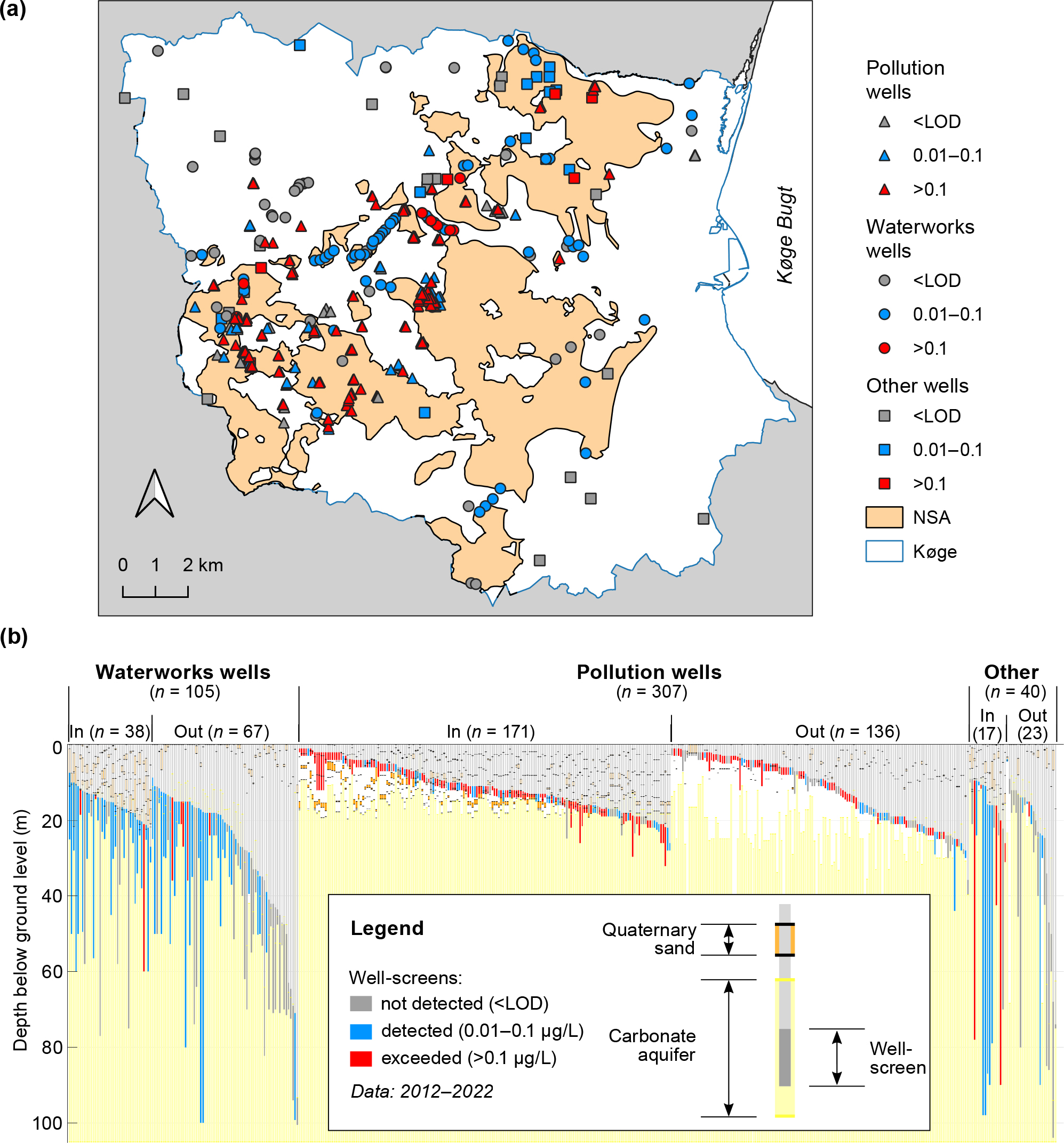
Fig. 3 Pesticide status of well screens in Køge municipality. a: shown on a map of the municipality along with groundwater abstraction areas officially designated as nitrate-sensitive area (NSAs). LOD: limit of detection. b: 1D depth profiles of the well screens, ordered by depth to screen top. In: inside NSA, out: outside NSA. n: number of well screens. The entire well-screen length is colour shaded according to the pesticides categories (dark grey, blue, red, as in the legend). Some well screens do not reach the carbonate aquifer, in this case there is no colour (white shading).
The priority pesticide compounds (BAM, DPC, DMS, 1,2,4-triazole) and groups (phenoxyalcanoic acids, triazines, dimethachlor + metabolites) were detected both inside and outside NSAs (Table 3, Fig. 3). The frequency of detection was higher inside than outside NSAs for almost all well-screen types and parameters, except for DPC in WW screens, 1,2,4-triazole and dimethachlor + metabolites in PW screens and DPC and DMS in OW screens.
Groundwater status, in relation to drinking water supply and potential compliance issues, is usually assessed based on WW data alone (Table 3). All priority compounds and groups were detected in WW screens, both inside and outside NSAs, except for 1,2,4-triazole which was not detected outside NSAs (detected in 2.9% of WW screens inside NSAs). The WW screens had no exceedances for 1,2,4-triazole and the phenoxyalcanoic acids, irrespective of location. The exceedance frequency was larger inside NSAs for WW screens, except for DPC which had no exceedances inside NSAs, but 4.7% exceedances outside.
Pesticide detections in WWs provide important insights on the state of groundwater because they represent larger volumes of the aquifer due to long screens and large abstraction. This is especially the case in carbonate aquifers, such as the Køge municipality, where the median length for WW screens was 16.2 m (Table 2). Abstracted groundwater, thus, represents a mixture of groundwaters from different depths, including in some cases near-surface-polluted GW mixed with deeper unpolluted or lightly polluted groundwater. However, the frequency of exceedance is lower for WW screens and has less importance here, because of (1) mixing and dilution and (2) closure of polluted WWs by the waterworks. The bias in detections and exceedances at WW screens due to well closures is valid for the pesticides that have been monitored for many years (e.g. BAM, phenoxyalcanoic acids, and triazines), and possibly valid for the pesticides added to the analytical programme more recently (e.g. DMS, DPC, 1,2,4-triazole). Due to the longer well screens and large abstraction volumes, it is assumed that the pesticides detected in WW screens reflect the pesticide pollution in the well catchment area, not only locally in proximity to the well screen. Many of the WW screens are outside NSAs, but their catchments cover areas both within and outside the NSA (Supplementary Fig. S3). All these characteristics complicate their use for addressing our hypothesis. Therefore, it was necessary to include data from other types of well screens.
We assumed that both point sources and diffuse sources could cause pesticide pollution of the aquifer, so the PW data were also included in this assessment. PWs are established specifically for characterising point-source pollution and are usually located near the point source. Pollution plumes with pesticides and other micropollutants from point sources in Denmark are relatively short (< 250 m), due to dilution from dispersion (Bjerg et al. 2021). PWs have relatively short intakes (median 2 m, Table 2) and only small volumes of water are pumped for the sampling, so it is assumed that the PW data are representative of the leaching and transport of pesticides to the geologic layer where the well screen is located. The PW data contributed to our assessment with information about the spread of pesticides in the near-surface Quaternary sediments, overlying the carbonate aquifer. However, some of the PW screens also reached the carbonate aquifer (Fig. 3). The PW subset is biased towards high concentrations (see Section 4.1.2.), usually for multiple pesticides at a time, high frequency of detections (e.g. up to 48.5% for DMS inside NSAs, Table 3) and high frequency of exceedances (e.g. up to 30.4% for the phenoxyalcanoic acids in NSAs, Table 3). Parent compounds are found more often than in the other well types. Exceedances were found in PW screens both inside and outside NSAs. The frequency of exceedances was larger inside NSAs except for dimethachlor and its metabolites, for which 14.3% of the PW screens outside NSAs were with exceedances versus 11% inside NSAs (Table 3).
In this study, we also used data from OWs, which is a heterogeneous group, as mentioned in Section 3.3.1. The GKO wells (n = 10) misrepresent the groundwater status with respect to ‘newly found’ pesticide compounds (e.g. DPC, DMS and 1,2,4-triazole) as most of the samples were taken before those compounds were introduced into the mandatory list for monitoring of drinking water (Miljøministeriet 2023). All parameters, except the triazines, were detected in OW screens, but OWs had no exceedances for DPC, 1,2,4-triazole and the triazines inside or outside NSAs. The exceedance frequency for the rest of the parameters was larger inside than outside NSAs (Table 3).
4.1.2. Concentration distributions
Pesticide concentrations were overall higher inside than outside NSAs (Fig. 4a). This difference was most pronounced for PW screens, which are the dominant type in the municipality (n = 307, 68%). The concentration differences inside or outside NSAs for PW screens could be biased because there were more PW wells inside (56%) than outside NSAs (44%), which could reflect the focus of the point-source pollution investigations. The concentrations in the WWs and OWs were three orders of magnitude lower than PWs.
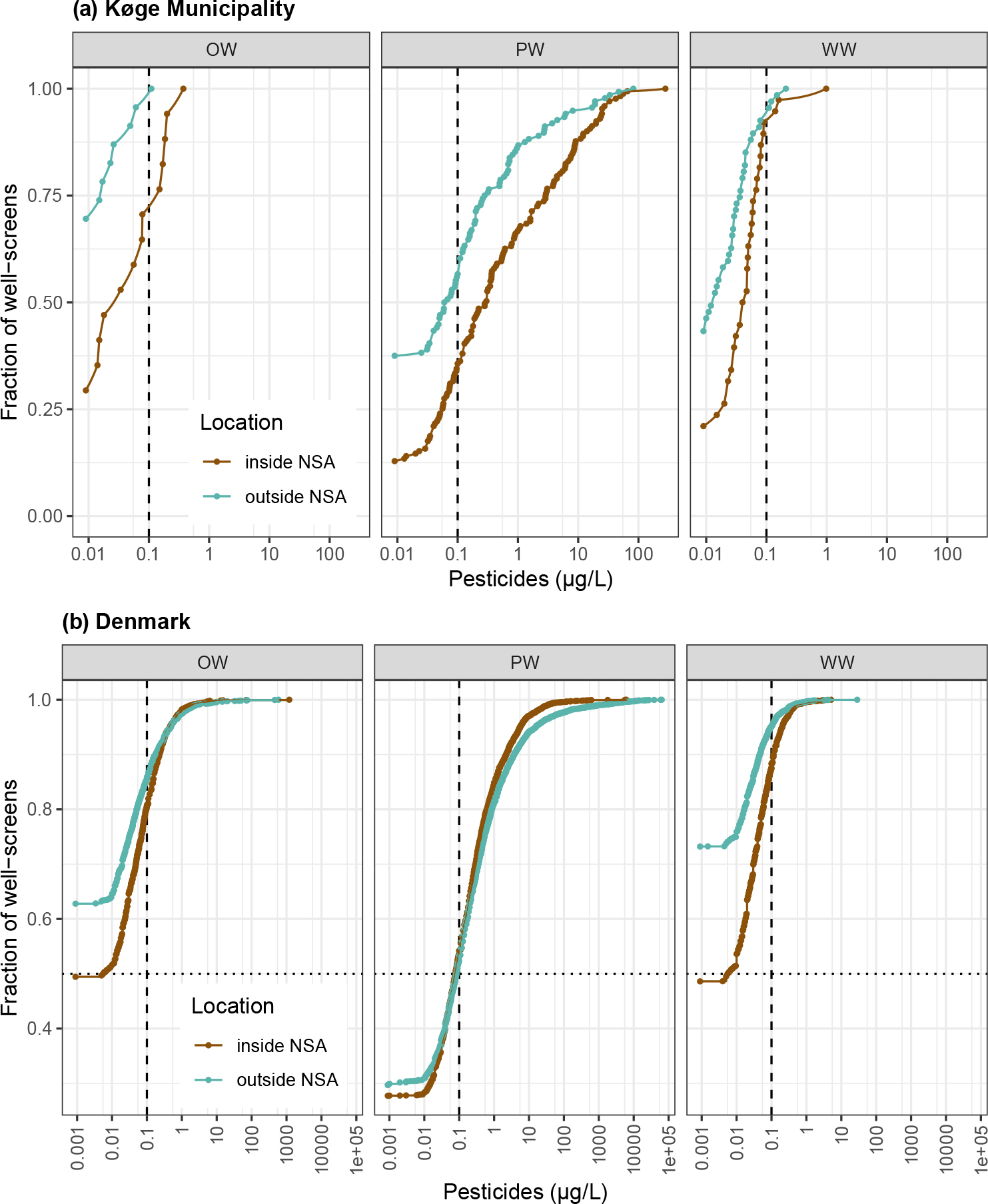
Fig. 4 Cumulative distribution of pesticide concentrations by well type inside and outside of a groundwater abstraction area officially designated as a nitrate-sensitive area (NSA). a: Køge municipality. b: Denmark (Thorling et al. in press). Note that in b, the y-axis does not start at 0 for visualisation purposes; x-axis is log10-transformed, so the values <LOD (0 μg/L) are visualised here as 0.009 μg/L. Screen types are as follows: OW: other well; PW: pollution well; WW: waterworks well.
The pairwise Wilcoxon rank sum test showed that the distributions (inside and outside NSAs) were significantly different for all three well types (Supplementary Table S6). These statistical differences could be caused by different hydrogeological conditions inside versus outside NSAs. For example, the difference in accumulated clay thickness (Supplementary Fig. S2b) can delay the transport of pesticides. The accumulated clay layer in NSAs is thinner, which could result in a quicker pesticide transport to the carbonate aquifer, if inside the recharge zone. There was also a difference in the land use (Supplementary Table S2), where the intensive agriculture was 56.2% inside NSAs and 46.4 % outside NSAs. However, it is not possible to attribute these differences to land-use differences based solely on the data presented here. There could also be other nuances in the hydrogeology. For example, the heterogeneity of glacial deposits is not necessarily reflected in the groundwater models. The usual modelling assumption is that clayey glacial deposits can be represented as homogeneous clay layers in the model, when they could be a mixture of clayey, sandy and silty sediments (in different proportions). Moreover, the model resolution is too coarse, and as most operational models are layered (not voxel models), the small-scale heterogeneities in the sediment characteristics cannot be captured. The differences in the distributions for each of the focus pesticides or pesticide groups can be seen in Supplementary Figs S4 and S5. However, formal statistical tests were not performed due to data limitations (small sub-sets when considering well-screen type, with a high proportion of censored data).
4.2. Significance
First, the significance of our findings from Køge municipality is discussed with respect to the local, regional, national and international scales. Then, in Section 4.3., we discuss knowledge gaps (barriers) and possible future directions.
4.2.1. Local scale
Our assessment showed that groundwater pollution with pesticide compounds is widespread in Køge municipality (Table 3; Figs 3, 4). Based on the evidence presented here, we confirm our working hypothesis and conclude that while NSAs are sensitive to pesticide leaching, they are not the only PSAs in the municipality. This has major implications for groundwater management locally, as the carbonate aquifer is the main drinking water resource. The local authorities and the public water supplies, which are responsible for protecting the drinking water resources and ensuring safe drinking water, cannot fully address the pesticide issue by applying regulation measures within NSAs, as those do not include all PSAs. The recommended PSA zonation method developed by Nygaard et al. (2005; see Section 2.4.) is not applicable in Køge municipality either, as the carbonate aquifer is mostly overlayed by a sequence of clayey layers.
4.2.2. Regional scale
Drinking water resource protection with respect to diffuse pesticide pollution requires trans-boundary cooperation at the regional level within Denmark. The 100 year catchment areas of WW screens in Køge municipality (Supplementary Fig. S3) extend outside the administrative border of the municipality. Efficient protective measures would target the entire well-catchment zones (i.e. recharge zones) and would not be limited by local administrative borders. To the best of our knowledge there is no existing research focusing on this in Denmark. As far as point-source pollution with pesticides is concerned, however, the monitoring and remediation of the polluted sites is handled by the Danish Regions, even though the impact of the point-source pollution is usually quite local.
4.2.3. National scale
Pesticide pollution of groundwater is an issue not only in Køge municipality, but also in Denmark as a whole (see Sections 1 and 2.1). To determine if our findings from Køge municipality upscale to the national level, we applied the same methodology on a nationwide data set (Thorling et al. in press). The results showed that pesticides were found both inside and outside NSAs throughout the entire country, irrespective of well-screen type (Table 4). The frequency of detections and exceedances for PW screens inside and outside NSAs was very similar, while for WWs and OWs the frequencies were higher inside than outside NSAs.
| Max. median | Well type | Køge municipality | Denmark [1] | ||
| Inside NSA | Outside NSA | Inside NSA | Outside NSA | ||
| Well screens (n) | Pollution | 171 | 136 | 4943 | 6093 |
| Waterworks | 38 | 67 | 3238 | 3450 | |
| Other | 17 | 23 | 1980 | 2607 | |
| Detected | Pollution | 87% | 62% | 72% | 70% |
| Waterworks | 79% | 57% | 51% | 27% | |
| Other | 71% | 30% | 51% | 37% | |
| Exceeded 0.1 μg/L | Pollution | 64% | 43% | 46% | 47% |
| Waterworks | 8% | 8% | 12% | 5% | |
| Other | 6% | 22% | 19% | 14% | |
| Median ± MAD (μg/L) | Pollution | 0.30 ±0.30 | 0.06 ±0.06 | 0.08 ±0.08 | 0.08 ±0.08 |
| Waterworks | 0.04 ±0.02 | 0.01 ±0.01 | 0.01 ±0.01 | 0 ±0 | |
| Other | 0.03 ±0.04 | 0 ±0 | 0.01 ±0.01 | 0 ±0 | |
| Q90 (μg/L) | Pollution | 14.00 | 2.72 | 2.20 | 3.76 |
| Waterworks | 0.09 | 0.07 | 0.12 | 0.05 | |
| Other | 0.19 | 0.04 | 0.23 | 0.18 | |
| Summary statistics are based on the max. median concentration. MAD: median absolute deviation. [1] Data source: Thorling et al. in press. | |||||
The concentration distributions inside and outside NSAs were significantly different for OW and WW screens, but not for PW screens (Fig. 4b). This could be explained by the well-screen depth of PWs, which are shallower than the other well types. Because of the relatively young groundwater in those wells and since they are usually located in proximity to point sources of pollution, they can be expected to be at risk of pesticides pollution irrespective of their location inside or outside an NSA. The WW and OW screens outside NSAs should generally have older groundwater ages because of the thicker protective clay layers (according to their definition; Fig. 1) delaying the groundwater infiltration (and pesticide transport). However, the reasons for the differences in concentration distributions need further in-depth investigation.
The overall conclusion from the national assessment is that PSAs are found both inside and outside NSAs throughout all of Denmark. A major difference is, however, that while the target aquifer in Køge municipality is composed of fractured carbonate rocks, there are three other major aquifer types in Denmark: (1) Quaternary sand, (2) pre-Quaternary sand and (3) various older geological units on the island of Bornholm (Baltic Sea). Therefore, it can be concluded that irrespective of aquifer type, groundwater protective measures against pesticide pollution placed only within NSAs would be insufficient in Denmark as a whole. More detailed studies are required to assess the significance of this finding at the local scale throughout Denmark.
4.2.4. International scale
Pesticides are a major groundwater pollution issue in the EU (Section 2.2), even though Europe’s pesticides regulation is currently one of the most stringent in the world (Robinson et al. 2020). Foster & Custodio (2019) discussed the need for a paradigm shift in water resource management for conserving groundwater in areas under pressure from intensive agriculture, specifically discussing legacy pollutants (nitrate and pesticides). They suggested that groundwater protection requirements need to be incorporated in land-use planning “with zonal restrictions being imposed to reduce risk of pollution according to local conditions” (Foster & Custodio 2019). However, they did not refer to specific methods for the delineation of groundwater conservation zones, and only stated that those are “well established”. Different methods for mapping groundwater vulnerability to pesticides have been applied internationally. Pavlis et al. (2010) compared those specific to plant protection products. However, to the best of our knowledge, scientific literature on pesticide-sensitive groundwater abstraction zonation is lacking.
It is not possible to directly compare our study with other countries and discuss its international significance in detail, because the peer-reviewed literature on NSAs is limited (Osborn & Cook 1997; Cook 1999; Foster & Custodio 2019). In England, NSAs were replaced by the nitrate-vulnerable zones in accordance with the EU Nitrate Directive in 1996 (Foster & Custodio 2019). From these literature sources, it was unclear, however, if this only applied to the voluntary or mandatory nature of the measures or also to the spatial zonation.
4.3. Future directions
4.3.1. Identified knowledge gaps
PSA zonation is a complex groundwater management issue, which cannot be simplified to the assumption that PSAs are the same as NSAs. We demonstrated this not only locally in the Køge municipality, but also at the national scale for Denmark. The different behaviour of nitrate and pesticides in the subsurface could explain why this is the case. As mentioned in Section 2.3, delineating NSAs is based on a vulnerability assessment of the aquifer to nitrate pollution (Fig. 1), which is dependent on the redox conditions in the aquifer and the overlaying geological layers (Supplementary Table S1). Details on redox conditions and architecture in Denmark are provided in Supplementary Text 2.
The importance of groundwater redox conditions for pesticides is more varied than for nitrate. Pesticide compounds are a large and heterogeneous group of organic compounds with very different biogeochemical behaviour with respect to degradation potential and mobility. Most pesticide compounds are degraded efficiently under oxic conditions. However, some degradation processes such as dehalogenation may take place under strongly reduced conditions. The most frequently detected pesticide compounds (e.g. DMS and DPC) were found both in oxic and reduced groundwater within the Køge municipality and throughout Denmark, probably because they are persistent with DT50 >100 days (Kerle et al. 1996; EFSA 2006, 2007) irrespective of redox conditions. For persistent pesticide compounds, there may only be a time-horizon – a lag from the application to their detection in aquifers (Fig. 1).
There is limited knowledge on the sorption and degradation processes of pesticides in the aquifers, so to better map PSAs, it is necessary to fill this knowledge gap. The persistence and sorption data are usually from the topsoil, which are not relevant for groundwater and where there is generally lower organic matter content and reactivity. The largest degradation potential for pesticides is in the plough layer, where there is high biological activity and diversity, ensuring microbial degradation of a large proportion of the applied pesticides. The capability of the soil to adsorb pesticide compounds is determined by the soil organic matter, clay minerals and metal oxides (Pavlis et al. 2010). The potential to leach to groundwater is also affected by the soil permeability, which is controlled to some extent by the organic matter, and also by soil texture, water fluctuation and water content (Pavlis et al. 2010). In soils with high potential for degradation, pesticide compounds could still escape through preferential flow paths like bio-pores and fractures. Those are largely unmapped but could explain how pesticides reach the carbonate aquifer in the Køge municipality (Fig. 3). A discussion on hydrostratigraphic heterogeneity and uncertainty and the scale at which different geochemical and hydrogeological processes can be resolved with respect to pesticides is also needed. The model resolution and type (layered or voxel) would affect the level of detail to which the inherent sub-surface heterogeneity can be represented. In addition, the representation of geochemical processes would differ depending on the modelling scale and overall framework.
4.3.2. Integrated groundwater management
There is a need for a nationwide discussion that also includes local groundwater managers, on the practical relevance of ‘one size fits all’ nationwide guidelines for PSA zonation. It may be more relevant to adopt a more integrated groundwater protection approach instead of focusing on one pollutant group at a time. However, while such a discussion is necessary, we also urgently need solutions. Local managers need to know where to place groundwater-protective measures to safeguard our drinking water resources from future pesticide pollution.
Pedersen et al. (2016) proposed that mapping vulnerability to pesticides should be based on identifying areas with large groundwater recharge, usually sandy soils and sediments, which are also more vulnerable to nitrate leaching (Pedersen et al. 2016). However, we demonstrated here that clayey areas can also be sensitive to pesticide pollution. Moreover, sandy (oxic) sediments favour the degradation and sorption of some pesticides. A recommendation needs to be specific to be practically relevant, thus it is necessary to define what is considered ‘large recharge’. Should groundwater-protective measures be applied in the entire WW catchment or in the 100 year or 50 year catchment zones? For Køge municipality, the modelled 100 year catchment zones of WWs (Supplementary Fig. S3) covered 63% of the municipality and extended beyond its boundaries. It is unclear, if designating all that area as PSA would be the optimal solution, due to the lack of uncertainty assessment of the modelled 100 year catchment zones and their relevance when most of the frequently found pesticides have only been used in the past 60 years, but have the potential to persist beyond 100 years. The relevance must also be discussed with respect to pesticide retardation in the sub-surface and the target window for groundwater protection.
The zonation efficacy should most probably also be discussed with respect to specific protective activities. For example, Malaguerra et al. (2012) found that on Sjælland (west Denmark), WWs located in urban areas were more vulnerable to BAM and phenoxyalcanoic acids contamination, while non-urban area wells were more often contaminated with bentazon (not included here). Urban areas are characterised by a different type of application patterns and source densities in comparison to predominantly agricultural land use. Thus, targeting only agricultural areas and different agricultural practices would most likely be insufficient as well.
While there has not been an adequate nationwide guidance (a top-down initiative) on how to map PSAs or how to apply groundwater management measures locally to address the pesticide pollution, a bottom-up initiative for establishing ‘Groundwater parks’ (in Danish: Grundvandsparker) is gaining popularity. Groundwater Parks are designated areas aimed at groundwater protection, crucial for Denmark’s supply of drinking water, but also having a more integrated function involving ecological restoration, afforestation, promoting organic farming, enhancing both nature conservation and climate adaptation efforts (Danmarks Naturfredningsforening 2021). Groundwater Parks should typically be established in sensitive groundwater abstraction and recharge areas. In a report for The Danish Water and Wastewater Association (DANVA), Refsgaard (2022) outlined some principles for their designation, suggesting using 50 year catchment zones at the 95% confidence level. The ongoing project for establishing Groundwater Parks in Aarhus municipality, however, focuses on 100 year catchment zones of public WWs (VPU & Aarhus Vand 2023). The plan is to establish three Groundwater Parks in the vicinity of Aarhus (c. 330 000 population), converting 4000 ha agricultural land to either nature or forest areas, which would protect 50% of the groundwater recharge areas of the public waterworks (VPU & Aarhus Vand 2023). The rest of the groundwater recharge is from urbanised areas, where other protection measures are placed by Aarhus municipality. The aim of Groundwater Parks is also to reach other environmental goals for biodiversity and (re)establishment of natural areas (including afforestation and wild self-managed grassland; VPU & Aarhus Vand 2023). Such goals for afforestation are also placed at the national level (‘Skovplan’, establishing 250 000 ha of forest). Further, the new EU Nature Restoration Law set an overall target that restoration measures should be put in place for at least 20% of the EU’s land area and 20% of its sea areas by 2030; and by 2050, such measures should be in place for all ecosystems that need restoration (Directorate-General for Environment 2024).
5. Conclusions
The lack of a generally accepted method for pesticide sensitivity mapping in a European context is a challenge for local authorities when they need to implement groundwater protective measures, illustrated here for Denmark. We showed that the NSAs do not cover all areas of groundwater currently polluted with pesticides. Pesticide pollution is widespread both inside and outside of NSAs, not only in Køge municipality, but throughout all of Denmark. We conclude that while NSAs are also PSAs, not all PSAs are NSAs. Placing protective measures within NSAs, as in some Danish municipalities, will therefore be insufficient to address future pesticide pollution of drinking water. The practical implementation of PSAs is impeded by knowledge gaps on groundwater-relevant physicochemical properties of approved pesticide compounds. Considering the current lack of knowledge, we provide an example of a potential groundwater management alternative, focusing on more integrated approach to safeguarding this sole drinking water resource in Denmark.
Acknowledgements
This work was part of research project ‘Prioritization – investigation of the use of nitrate sensitive areas (NSA) for measures related to pesticides’, an initiative under the Partnership for Sustainable Water Supply, funded by Region Sjælland and the branch organisation Danske Vandværker. The authors acknowledge the project workshop participants from DTU-Sustain (Danish Technical University, DTU), Region Sjælland, Køge municipality, the Danish EPA and Danske Vandværker, who provided valuable local knowledge, data and discussions. Thanks are due also to Niels Claes (Aarhus Vand) for critically reading the manuscript and providing an update on Groundwater Parks initiative. The authors also thank the two reviewers for their comments, which improved the manuscript.
Additional information
Author contributions
All authors contributed to the study conception and design. Data preparation and formal analysis were performed by DDV. IM, LT, and ARJ provided input on interpretation of results. The first draft of the manuscript was written by DV. IM, LT, and ARJ commented and revised the manuscript. All authors read and approved the final manuscript.
Additional files
The following three supplementary files are available at https:doi.org/10.22008/FK2/YXMRLC: Supplementary File S1: A .docx file containing Tables S1–S6, Figs S1–S5, Supplementary Text 1: Data pre-processing and Supplementary Text 2: Redox architecture in Denmark. Supplementary File S2: Aggregated pesticide data set as a CSV file Supplementary File S3: National (Denmark) pesticide data set as a CSV file
Data availability statement
The two data sets described in this paper are supplied as supplementary files S1 and S2.