MONOGRAPH
Lithostratigraphy of the Neogene succession of the Danish North Sea
Erik Skovbjerg Rasmussen1*  , Karen Dybkjær1 , Jørgen Christian Toft2 , Ole Bjørslev Nielsen3 , Emma Sheldon1 , Finn Mørk1
1Geological Survey of Denmark and Greenland, Øster Voldgade 10, DK-1350, Copenhagen, Denmark; 2TotalEnergies, Amerika Pl. 29, 2100, Copenhagen, Denmark; 3Department of Geoscience, Aarhus University, Høegh-Guldbergs Gade 2, 8000 Aarhus, Denmark
Citation: Rasmussen et al. 2025: GEUS Bulletin 61. 8368. https://doi.org/10.34194/0nydbt40
Copyright: GEUS Bulletin (eISSN: 2597-2161) is an open access, peer-reviewed journal published by the Geological Survey of Denmark and Greenland (GEUS). This article is distributed under a CC-BY 4.0 licence, permitting free redistribution, and reproduction for any purpose, even commercial, provided proper citation of the original work. Author(s) retain copyright.
Received: 26 Jan 2024; Re-submitted: 15 Jul 2025; Accepted: 3 Sep 2025; Published: 26 Dec 2025
Competing interests and funding: The authors declare no competing interests.
Maersk Oil, now TotalEnergies, funded biostratigraphic analysis of a number of North Sea wells and provided seismic data for the study. In addition, GEUS and Maersk Oil funded the sedimentology, the seismic study and the sequence stratigraphic interpretations.
*Correspondence: esr@geus.dk
Keywords: Neogene, Miocene, Pliocene, North Sea, lithostratigraphy, palaeogeography
Abbreviations
BCU: Base Cretaceous Unconformity
bKB: below Kelly Bushing
DGU: Dansk Geologisk Undersøgelse (Geological Survey of Denmark)
MCO: Miocene Climatic Optimum
MD: measured depth
MMCT: Middle Miocene Climate Transition
MMU: mid-Miocene Unconformity
MRS: maximum regressive surfaces
NSB: North Sea Benthic
PETM: Paleocene–Eocene Thermal Maximum
RMS: root mean square
TL: Top Lark
Edited by: Jon Ineson (Geological Survey of Denmark and Greenland)
Reviewed by: Ole Rønø Clausen (Aarhus University, Denmark) and Dirk K. Munsterman (Geological Survey of the Netherlands)
Abstract
The Neogene of the Danish North Sea is more than 1200 m thick. Despite being penetrated by numerous wells, formal lithostratigraphic subdivision of this succession has previously been restricted to the lowermost part. This monograph presents a comprehensive lithostratigraphy of the offshore Neogene of Denmark, in part extending recognised onshore units into the offshore realm. The mainly Lower Miocene deltaic deposits are referred to the Ribe Group, which is subdivided into six formations: the Klintinghoved, Bastrup, Arnum, Odderup, Dany (new) and Nora (new) Formations. The lowermost Miocene Vejle Fjord and Billund Formations known from the onshore lithostratigraphy are absent in the offshore wells. The dominantly fully marine Middle and Upper Miocene sediments are referred to the Måde Group, subdivided into the Hodde, Ørnhøj, Gram, Marbæk and Luna (new) Formations; the Luna Formation includes the Lille John Member (new). The Pliocene deltaic deposits are referred to the Eridanos Group (new), which is subdivided into the Vagn (new), Emma (new) and Elin (new) Formations.
The depositional history of the Neogene of the Danish North Sea sector is presented based on a detailed reconstruction of subsurface morphology by the mapping of stratigraphical surfaces dated by biostratigraphy. During the Early Miocene, deposition in the Danish North Sea was dominated by progradation from Scandinavia; large deltas built out into the Danish onshore area from the north and north-east. West of the main deltas, muddy contourites periodically accumulated on the slope, accentuating shelf progradation. The Middle and Late Miocene period was mostly characterised by fully marine conditions and deposition of mud. By the end of the Miocene, progradation of delta systems from Scandinavia into the North Sea resumed, and the shoreline reached the westernmost part of the Danish North Sea sector. During the Pliocene, new source areas in central and eastern Europe, such as the Carpathian Mountains, were activated and a huge delta system, the so-called Eridanos Delta, began to fill the North Sea Basin from the east and the south-east. Due to increased subsidence of the basin associated with the loading of sediments of the Eridanos Delta, the northern systems were flooded. Although the Danish North Sea thus mainly received sediments from central Europe during the Pliocene, progradation from Scandinavia resumed at the end of the Pliocene.
1 Introduction
In 2010, the lithostratigraphy of the onshore Upper Oligocene – Miocene sedimentary succession in Denmark was comprehensively revised (Rasmussen et al. 2010). Although founded on previous definitions of lithostratigraphic units (Sorgenfrei 1940, 1957; Larsen & Dinesen 1959; Rasmussen 1961; Koch 1989; Christensen & Ulleberg 1973; Heilmann-Clausen 1997), the acquisition of a large amount of new information including high-resolution seismic data, boreholes that penetrated the entire Neogene succession, and particularly the development of a robust biostratigraphy (Dybkjær & Piasecki 2010), demanded a redefinition of the existing lithostratigraphy.
Since then, interest in the Neogene succession offshore has increased due to the abandonment of certain oil fields, additional hydrocarbon exploration, potential storage of CO2 in Neogene aquifers and the need to test the rock properties associated with the construction of offshore windmill parks. To support such future studies, the lithostratigraphic framework of Rasmussen et al. (2010) is expanded here to include the offshore Neogene succession in the North Sea (Fig. 1).
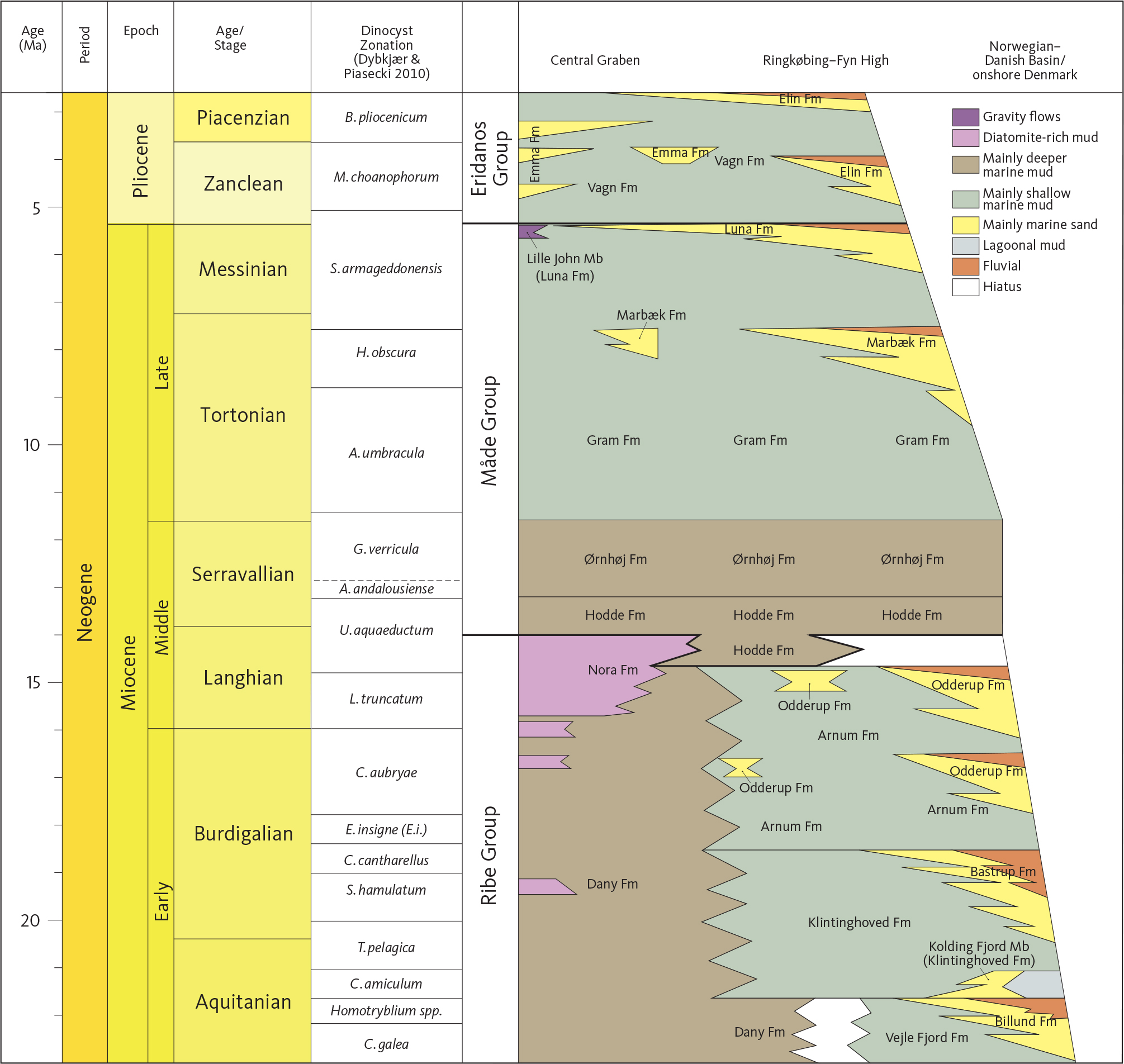
Fig. 1 The lithostratigraphy of the Neogene succession of on- and offshore Denmark, the former modified from Rasmussen et al. (2010).
The Neogene lithostratigraphic subdivision presented here (Fig. 1) is based on a multidisciplinary study incorporating seismic stratigraphy, log data and biostratigraphy. The study area, seismic data and wells and boreholes included in the text or figures are shown in Fig. 2. The age relationships of the lithostratigraphic units defined herein are based on previously published biostratigraphic studies, including Michelsen et al. (1998), Laursen & Kristoffersen (1999), Schiøler (2005), Schiøler et al. (2007), Dybkjær & Rasmussen (2007), Dybkjær & Piasecki (2010), Dybkjær et al. (2012, 2021) and Sheldon et al. (2025). These references, together with a number of unpublished biostratigraphic data sets and reports, have been used in order to refer the lithostratigraphic units to biozones and to describe their fossil content.
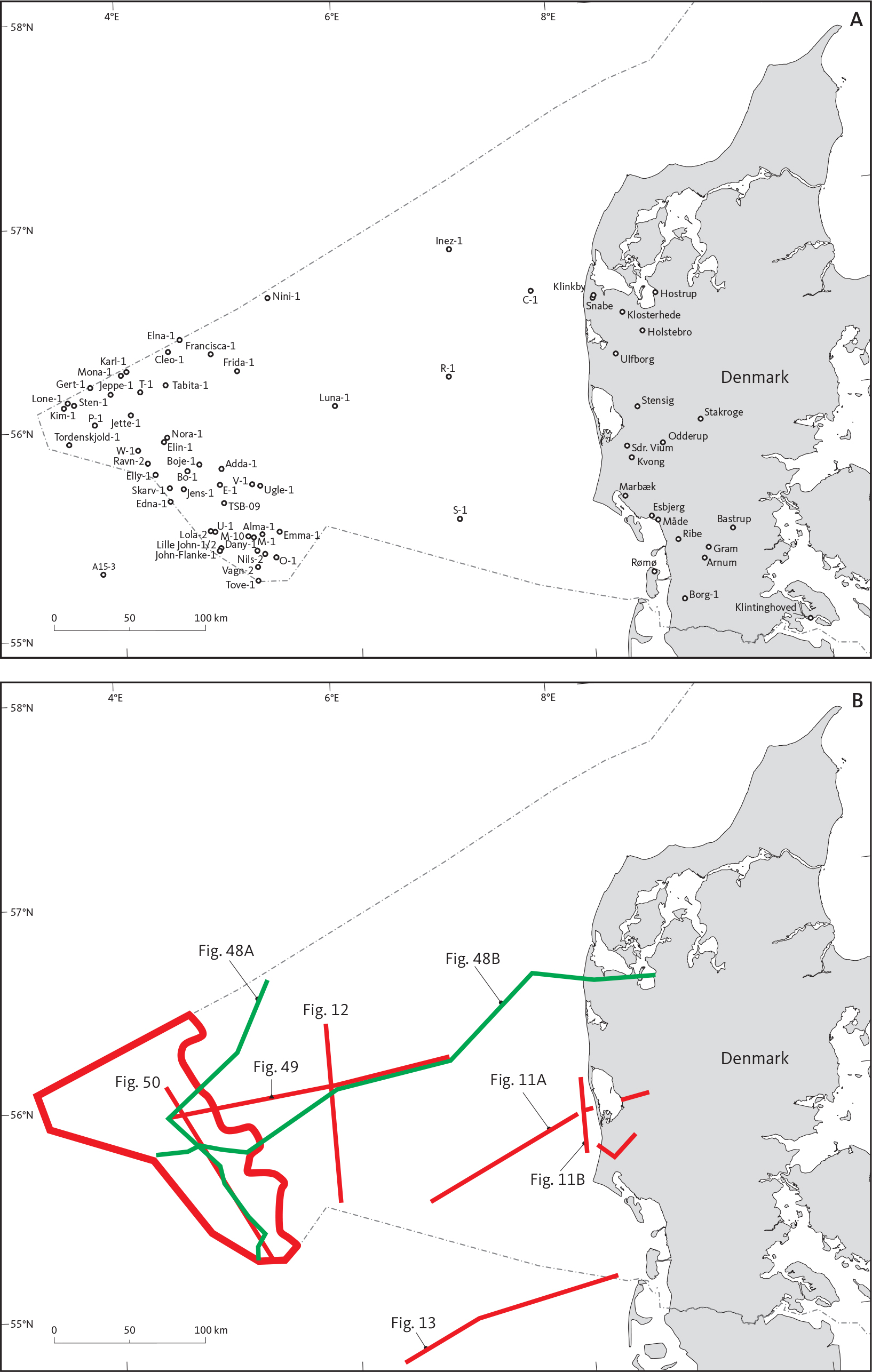
Fig. 2 Map showing the study area, wells, seismic sections coverage and local names. (A): Location of boreholes, wells, outcrops, villages and other locations mentioned in the text. (B): Location of seismic key sections and the 3D seismic survey covering the Central Graben area are shown in red and well correlation panels in green.
Detailed analyses of the climate have been undertaken for the Miocene succession in Denmark (Larsson et al. 2011 and references therein; Herbert et al. 2020; Śliwińska et al. 2024) and the Pliocene climate is well known from Germany (Utescher et al. 2009). These studies of the palaeoclimate combined with the distribution of the deposits onshore documented by Rasmussen et al. (2010) allow us to reconstruct the detailed palaeogeography, including the palaeobathymetry, of the Neogene in the Danish sector of the North Sea.
The aim of this study is to establish a lithostratigraphy for the Neogene succession in the offshore Danish North Sea sector and to reconstruct the palaeogeography in the study area. This new lithostratigraphy should form a robust framework for future studies such as mapping of aquifers for wastewater, CO2 storage or to ensure proper base maps for the foundation of windmill constructions in the North Sea area.
2 Geological setting
2.1 Tectonic framework
The basement of the North Sea was mainly formed during the Caledonian Orogeny in the Late Ordovician – Early Devonian (Coward et al. 2003; Pharaoh et al. 2010; Phillips et al. 2016 and references therein). The compressional tectonic regime was followed by orogen-scale extension by reactivation of pre-existing structures (Caledonian collapse; Gee & Stephens 2020 and references therein). The final phase of the formation of Pangea (the Variscan Orogeny), during the Late Devonian – Carboniferous, was succeeded by an extensional phase during the Carboniferous – Early Permian, which led to the formation of major horst and graben structures in the North Sea area, for example the Norwegian–Danish Basin, the Ringkøbing–Fyn High and the North German Basin (Fig. 3). Subsequent post-rift thermal subsidence resulted in the development of the North and South Permian Basins (Ziegler 1982, 1990).
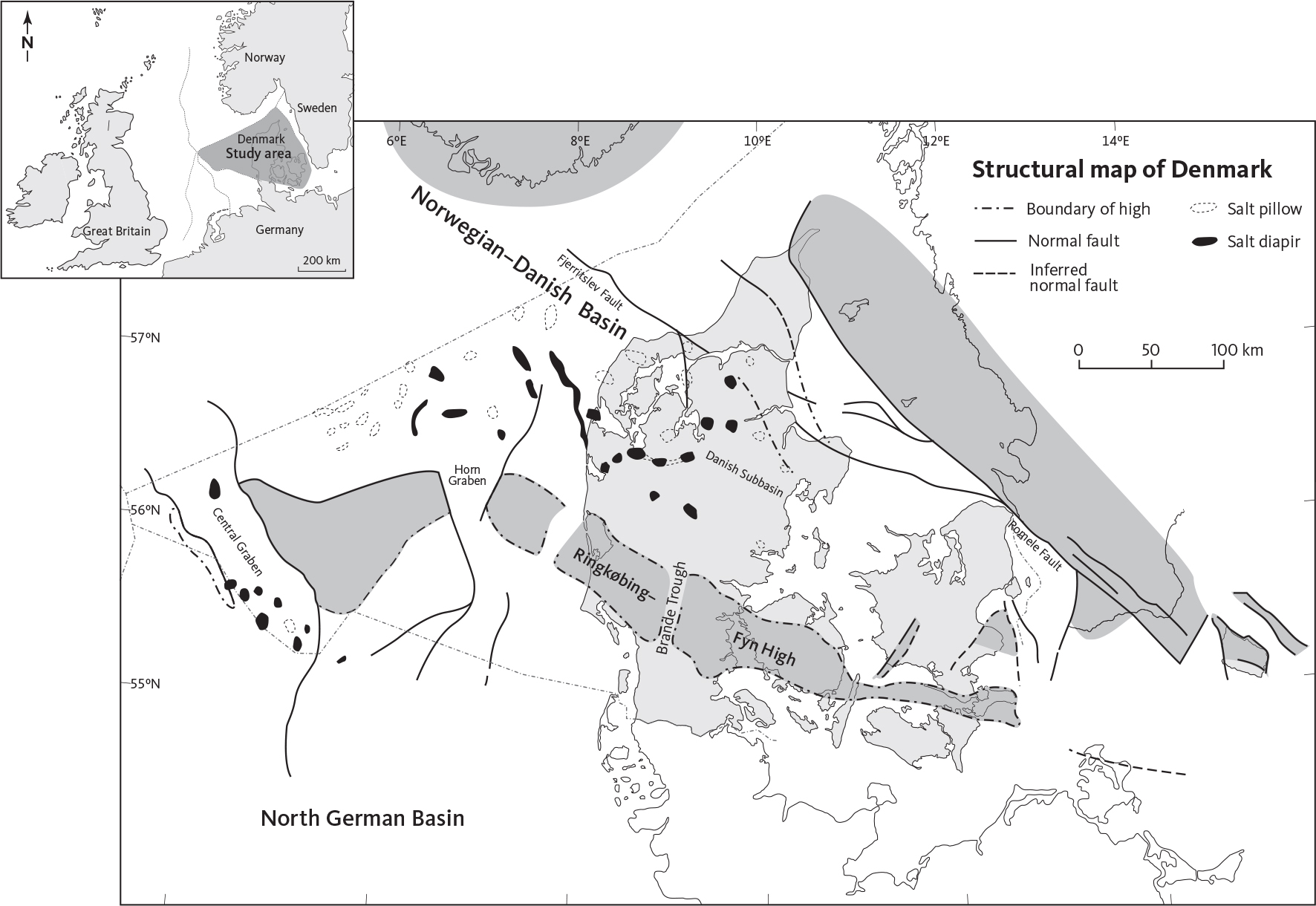
Fig. 3 Structural elements of the Danish area. Most of the elements were formed during the Carboniferous and Permian but also active during the Mesozoic. Reactivation of some of the structures, for example inversion, occurred during the Cenozoic. From Bertelsen (1978).
The Mesozoic was characterised by extension during the Late Permian – Early Triassic, resulting in the formation of the Horn Graben, the Brande Trough and initial rifting in the Central Graben area along N–S-trending faults (Møller & Rasmussen 2003; Nøttvedt et al. 2008). Renewed rifting occurred during the Late Jurassic – Early Cretaceous, but this time along NNW–SSE-striking fault systems; this was the main phase of the formation of the Central Graben (Møller & Rasmussen 2003). The last throes of this rift phase during the earliest Early Cretaceous resulted in rotation of fault blocks, local inversion (Rasmussen 1994) and the development of a major regional unconformity (the Base Cretaceous Unconformity, BCU). During the remainder of the Cretaceous, basin development was dominated by thermal subsidence centred on the Central Graben area; regional subsidence was interrupted by post mid-Cretaceous inversion tectonism (Vejbæk & Andersen 2002; Vejbæk et al. 2006).
Ongoing post-rift thermal subsidence since mid-Cretaceous times, progressive opening of the northern Atlantic Ocean, and African-European collision drove the Cenozoic development of the North Sea Basin. Inversion of former graben structures and reactivation of salt structures occurred periodically but was most pronounced in the Selandian (Ziegler 1982; Liboriussen et al. 1987; Mogensen & Jensen 1994; van Wees & Cloething 1996 Clausen et al. 1999; Rasmussen et al. 2008) and in the Early Miocene (Rasmussen 2004a, 2009a, 2013; Green et al. 2018). These inversion phases were caused by compression associated with the Alpine orogeny (Ziegler 1982; Rasmussen 2009a, 2013). The Oligocene and Miocene were also periods of increased volcanism in NW Europe (Mayer et al. 2013). During the Middle Miocene, accelerated subsidence of the basin commenced. The cause of this change in subsidence rate is not clear, but it coincides with the formation of major inversion structures in the North Atlantic (Løseth & Henriksen 2005; Doré et al. 2008; Stoker et al. 2010) and thus probably resulted from a change in tectonic stress regime in NW Europe. This may have led to relaxation of former basin segments that were under compression during the Alpine phase, for example the Norwegian–Danish Basin. Neogene uplift associated with the Iceland plume and its branches, for example under southern Norway, has also received interest in recent years (Rickers et al. 2013; François et al. 2018). The tectonic evolution of the Miocene succession in Denmark shows a remarkable correlation with V-shaped ridges around Iceland that are attributed to changes in mantle convection (Jones et al. 2002; Rasmussen 2009a).
During the Quaternary, marked tilting of the basin occurred, resulting in very high sediment accumulation in the centre of the North Sea Basin and erosion on the flanks (Japsen 1993; Rasmussen et al. 2005; Ottesen et al. 2018). The cause of this tilting is strongly debated (Japsen et al. 2002; Nielsen et al. 2009; Gabrielsen et al. 2010; Chalmers et al. 2010), and no clear mechanisms or combination of processes have so far been found.
2.2 Cenozoic climate
The Paleogene and Neogene climate in NW Europe was generally warm temperate and humid (Utescher et al. 2000; King 2006; Larsson et al. 2011; Śliwińska et al. 2024). An extreme, transient warm period, the so-called Paleocene–Eocene Thermal Maximum (PETM) occurred at the Paleocene–Eocene boundary (e.g. Crouch 2001; Zachos et al. 2005; Sluijs et al. 2006; Westerhold et al. 2009; McInerney & Wing 2011; DeConto et al. 2012; Jones et al. 2019; Kender et al. 2021; Mariani et al. 2024). After a warm Eocene period, cooling at the Eocene–Oligocene boundary marked the change from Mesozoic – early Cenozoic greenhouse climate to the late Cenozoic icehouse climate that persists to the present (Miller et al. 1991; Zachos et al. 1996, 2001). Despite the overall late Cenozoic icehouse climate, the Late Oligocene and Early Miocene periods were relatively warm and humid. Local studies reveal that the Late Oligocene and Early Miocene were characterised by a warm temperate climate with a mean annual temperature of c. 19˚C, and with precipitation in the order of 1300–1500 mm per year (Fig. 4; Śliwińska et al. 2024). By the end of the Early Miocene, the warm climate peaked in the so-called Miocene Climatic Optimum (MCO) (Utescher et al. 2000, 2011; Zachos et al. 2001; Larsson et al. 2011; Śliwińska et al. 2024). At the end of the Middle Miocene, a distinct climatic deterioration, the Middle Miocene Climate Transition (MMCT) commenced, which resulted in one of the most marked global sea-level falls in pre-Quaternary time (John et al. 2011); the sea-level fall was in the order of 70 m. During the Late Miocene, the equable climate, characteristic of a greenhouse period, ultimately shifted to the modern world climate with strong equator to pole temperature gradients (Herbert et al. 2016). Sea-surface temperatures of the eastern North Sea were relatively high during the late Aquitanian to early Tortonian, varying between 23 and 28˚C, and peaking during the MCO (Fig. 4; Herbert et al. 2020). A strong cooling phase in both the terrestrial and marine signals from the southern North Sea Basin was recorded during the late Tortonian (Donders et al. 2009). Minor ice caps probably formed in Greenland around 7 Ma (Larsen et al. 1994; Fronval & Jansen 1996), and during the Messinian a significant sea-level fall was associated with the build-up of ice caps in both the southern and the northern hemispheres (DeConto et al. 2008; Ohneiser et al. 2015). The Early Pliocene saw a transient warming of c. 2˚C in northwest Europe (Crampton-Flood et al. 2018, 2020), but otherwise the Pliocene climate was comparable to the modern world climate.
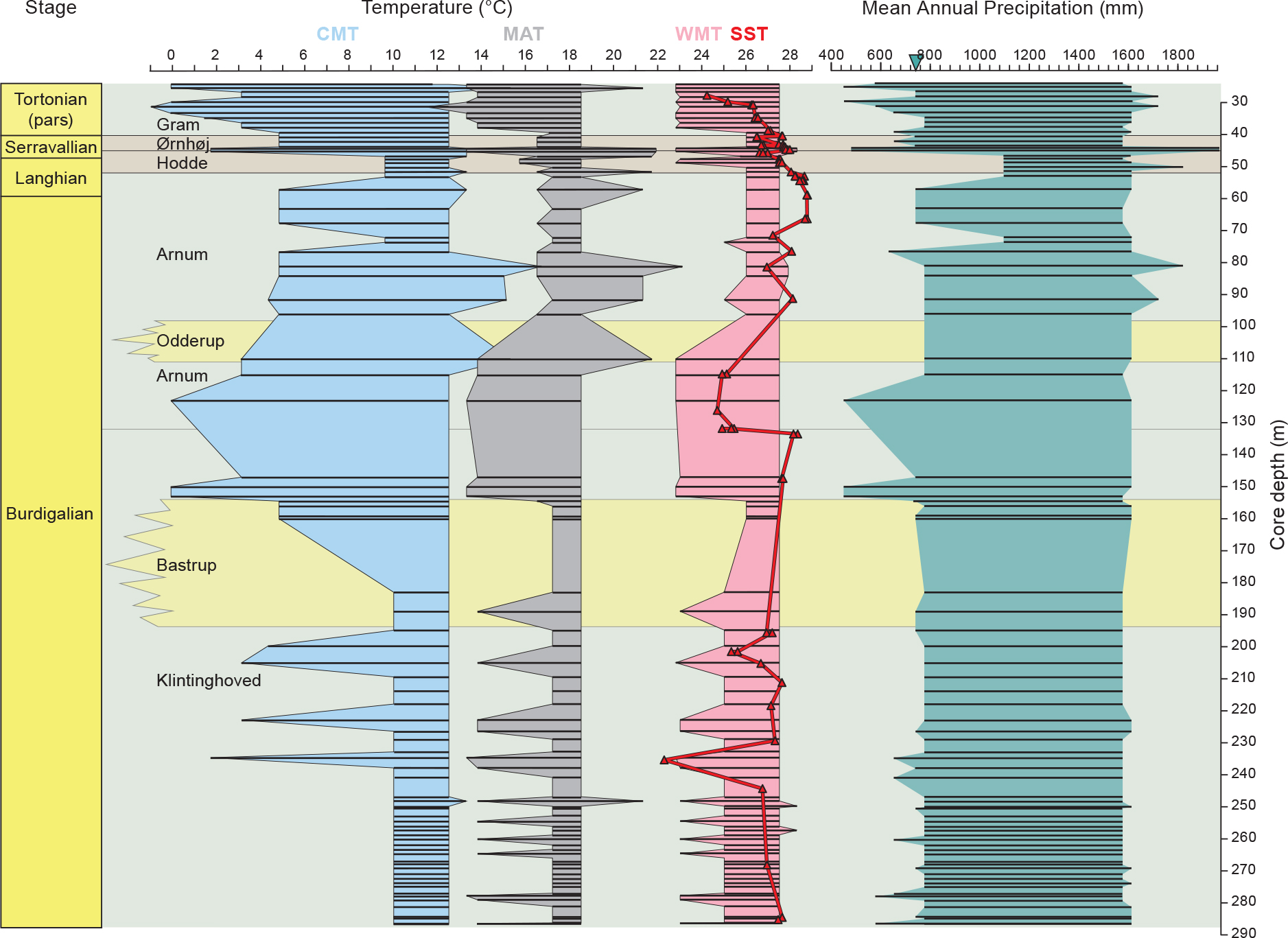
Fig. 4 Reconstruction of the climate during the Miocene based on the Sdr. Vium core (modified from Sliwinska et al. 2024). To the left: land temperature (CMT: coldest month temperature. MAT: mean annual temperature. WMT: warmest month temperature) and to the right: sea surface temperature (SST) and precipitation. The green arrow on the precipitation scale indicates the mean annual precipitation in Denmark, 1981–2020.
2.3 Cenozoic sedimentation
Sediment influx to the North Sea Basin during the Cenozoic was strongly influenced by uplift of terranes around the North Sea Basin. During the Paleocene and Eocene, uplift of the Atlantic margin associated with volcanic activity and opening of the North Atlantic, resulted in high sediment supply to the northern part of the basin from the Shetland Platform, the Grampian High (UK) and Scandinavia, for example via Sognefjorden and Storfjorden in Norway (Knox et al. 2010; Sømme et al. 2013). Most of the basin was dominated by pelagic and hemipelagic deposition and a significant proportion of the succession in the Central North Sea Basin consists of clay transformed from volcanic ash (Nielsen et al. 2015; Rasmussen 2019), sourced from the North Atlantic and Greenland (Larsen et al. 2003). In the southern part of the basin, delta progradation is represented by the Geiseltal, Profen and Borna Formations in the Netherlands (Knox et al. 2010).
During the Oligocene and Early Miocene, uplift of Scandinavia (Rohrmann & van der Beek 1996; Rasmussen 2004a; 2013; 2019; Rundberg & Eidvin 2005; Japsen et al. 2007; Rickers et al. 2013; Sømme et al. 2013; François et al. 2018) resulted in a new and marked sediment influx into the eastern North Sea Basin (Fig. 5A; Schiøler et al. 2007; Rasmussen et al. 2010). The new source area in Scandinavia covered present-day southern Norway, including Jotunheim and central Sweden (Olivarius 2014). Coarse-grained clastic sediments were shed into the eastern North Sea Basin and formed delta systems across present-day Denmark. West of the deltas, plastered contourites draped the slope of the prograding shelf (Fig. 6), while the central part of the North Sea area was still dominated by hemipelagic deposition. In the northern part of the North Sea, delta progradation continued off the Shetland Platform during the Neogene. Density-flow deposits were laid down in the basinal areas. The southern North Sea was characterised by a paralic depositional environment with significant brown-coal formation (Schäfer et al. 2005; Standke 2006; Munsterman et al. 2019; Deckers & Louwye 2020; Deckers & Munsterman 2020).
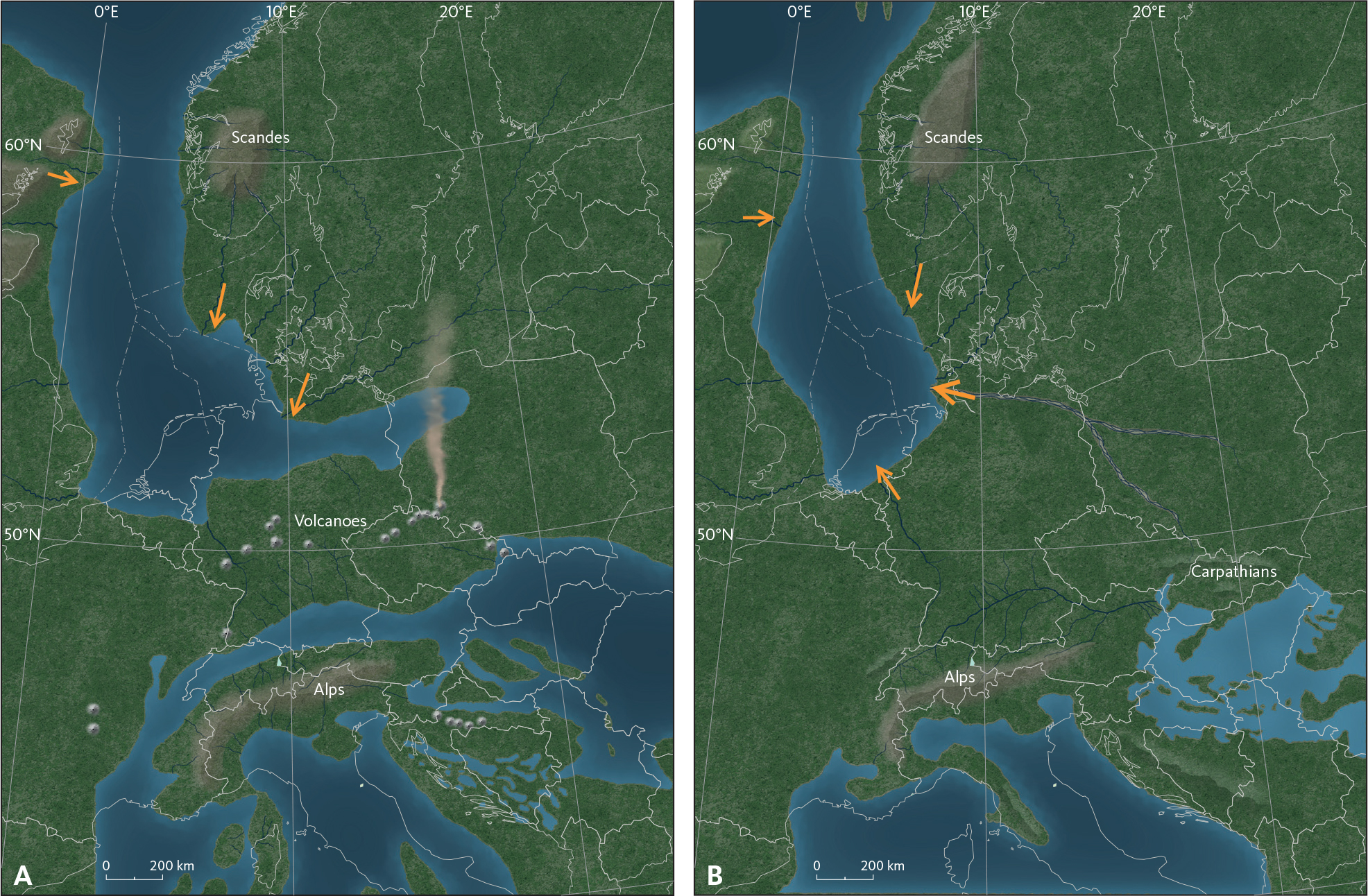
Fig. 5 Palaeogeography of NW Europe during the Early (A) and Late Miocene (B); the arrows illustrate the dominant sediment transport directions. Note that during the Early Miocene, the Shetland Platform was the main source of sediments in the northern part of the North Sea whereas Scandinavia sourced the eastern portion of the North Sea; the Alps were disconnected from Central Europe at this time due to both an arm of the northern Tethys and uplift linked to volcanism. This pattern changed during the Late Miocene. Based on Kuhlemann (2007) and Rasmussen et al. (2008).
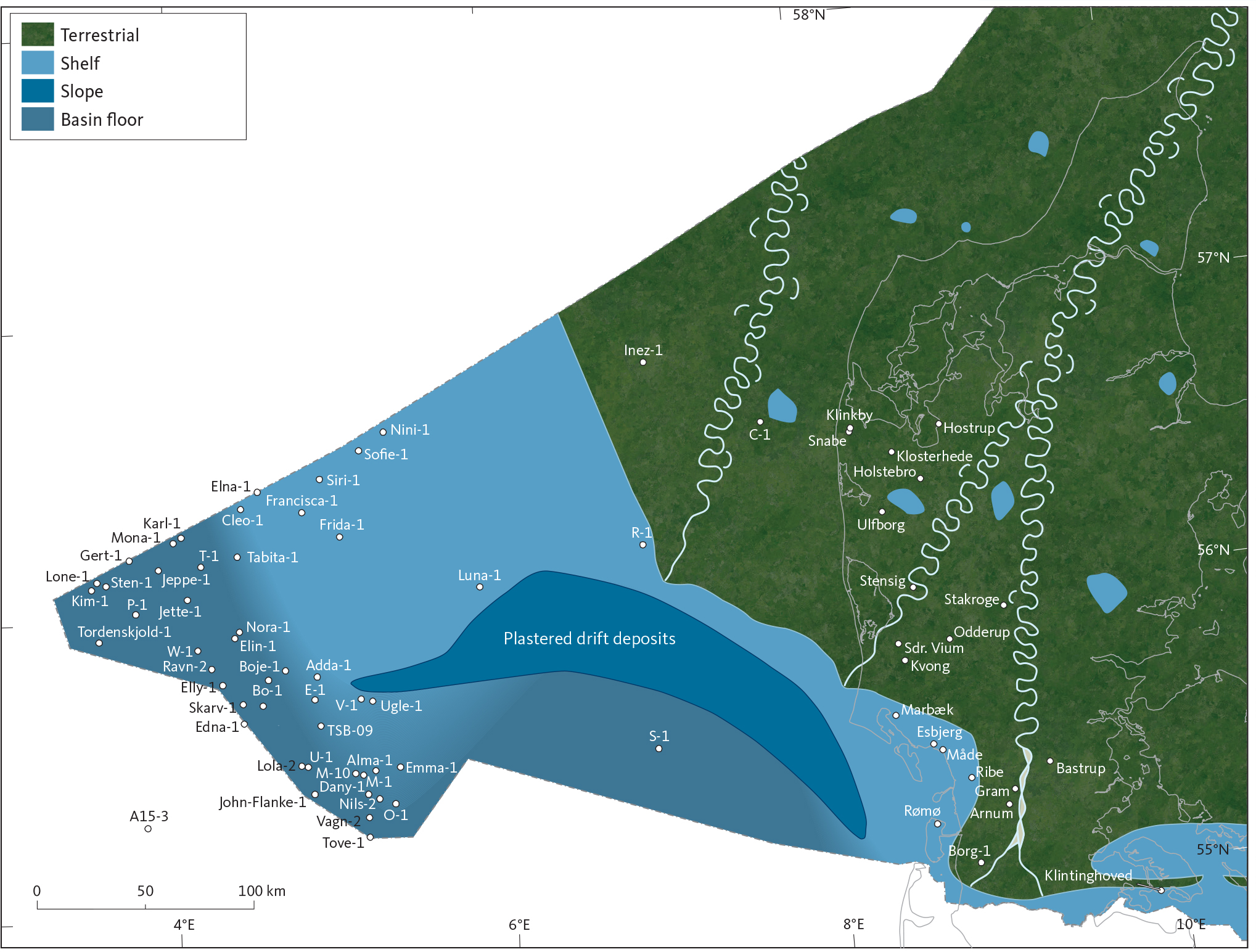
Fig. 6 Palaeogeographic reconstruction of the Lower Miocene delta systems in the eastern North Sea. Note that the main delta system was located across Jylland and the eastern portion of the North Sea, and that the associated contourite system predominates west of the main delta system.
Most of the Middle Miocene was characterised by sediment starvation due to increased subsidence of the basin (Rasmussen 2004a; Rasmussen & Dybkjær 2014; Munstermann et al. 2019), resulting in the development of a condensed section. Within the central and deeper portions of the basin, hemipelagic sedimentation occurred (Rasmussen et al. 2005). Diatom ooze was deposited locally (Koch 1989; Rasmussen 2004a; Sheldon et al. 2018, 2025).
The rise of the Carpathian and Jura mountains and filling of the Alpine Foreland Basin during the Middle and Late Miocene (Oszczypko 2006; Kuhlemann 2007; Kalifi et al. 2020) created a new significant source area in central Europe (Fig. 5B). After the Middle/Late Miocene transition, the Rhenish Massif uplift instigated progradation in Germany and in the south-eastern Netherlands of the proto-Rhine fluvio-deltaic Inden Formation (Schäfer et al. 2005; Utescher et al. 2021) and the overlying latest Tortonian Kieseloölite Formation (Munsterman et al. 2019; Deckers & Louwye 2020). Huge fluvio-deltaic systems developed, such as the palaeo-Elb in eastern Germany (Eissmann 2002) and later the palaeo-Rhine-Meuse system (Schäfer 2005; Munsterman et al. 2019; Deckers & Louwye 2020), and a significant portion of the southern North Sea Basin was filled with siliciclastic deposits. The palaeo-Elb delta system, commonly referred to as the Baltic River system or the Eridanos Delta system (Bijlsma 1981; Overeem et al. 2001; Knox et al. 2010; Gibbard & Lewin 2016), dominated the southern and central realm of the North Sea during the Late Miocene, Pliocene and early Pleistocene (Fig. 7; Kuhlmann et al. 2006a, b; Noorbergen et al. 2015; Donders et al. 2018).
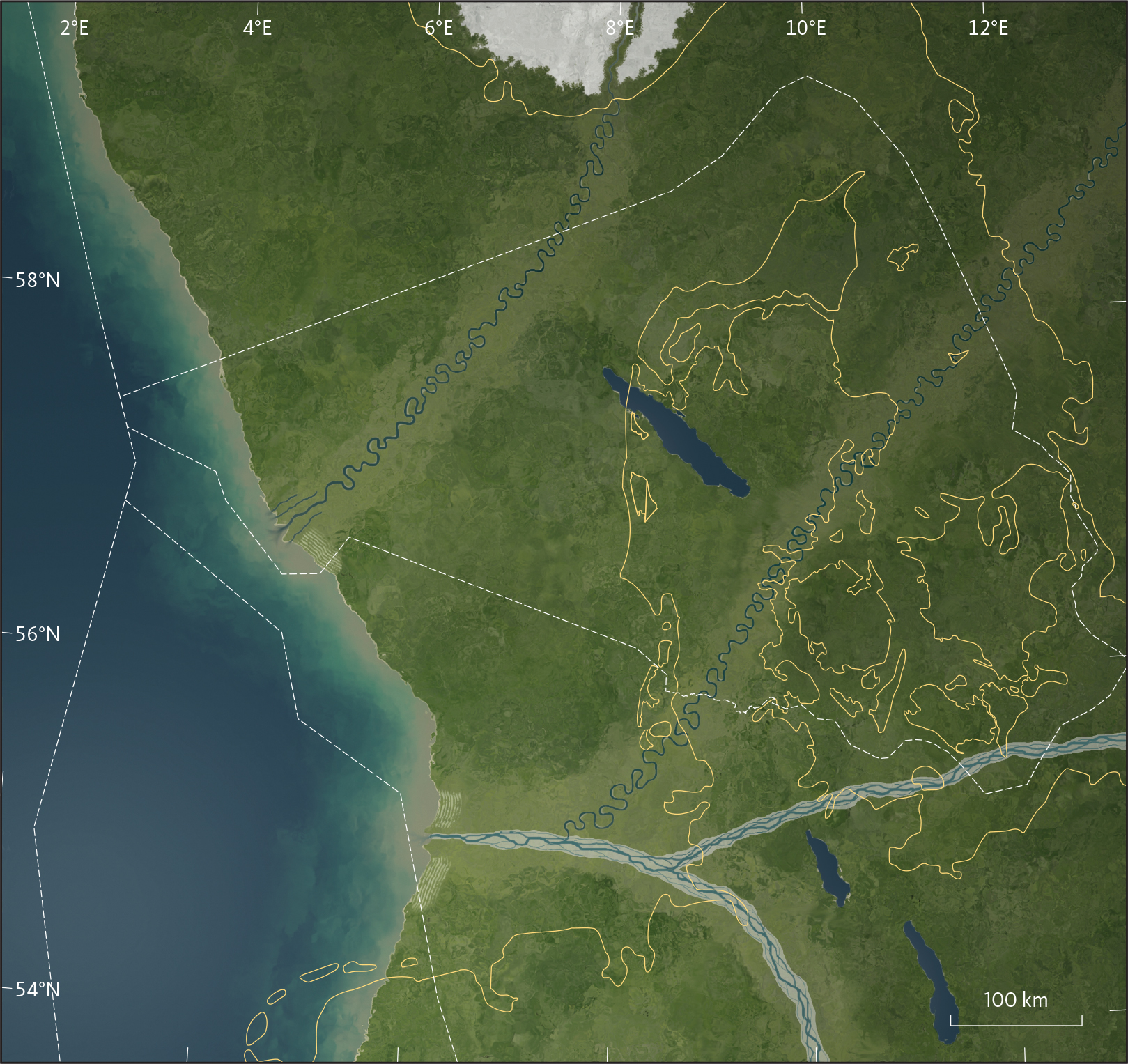
Fig. 7 Palaeogeographic reconstruction of the Pliocene Eridanos delta. The development of delta systems in Central Europe was strongly associated with the Alpine Orogen. Note snow in Scandinavia. The indicated locations of rivers and lakes are arbitrary.
3 Previous work
The offshore Neogene succession of the Danish North Sea sector has not previously been formally subdivided into lithostratigraphic units in the detail presented here. Kristoffersen & Bang (1982) subdivided the entire post-chalk succession into seven informal units: Cen-1 to Cen-7. Parts of Cen-3 and the Cen-4 and Cen-5 units together correspond to the Neogene section studied here (Fig. 8). Schiøler et al. (2007) referred the Lower and lower Middle Miocene to the upper Lark Formation, which was originally defined in the British and Norwegian sectors of the North Sea by Knox & Holloway (1992).
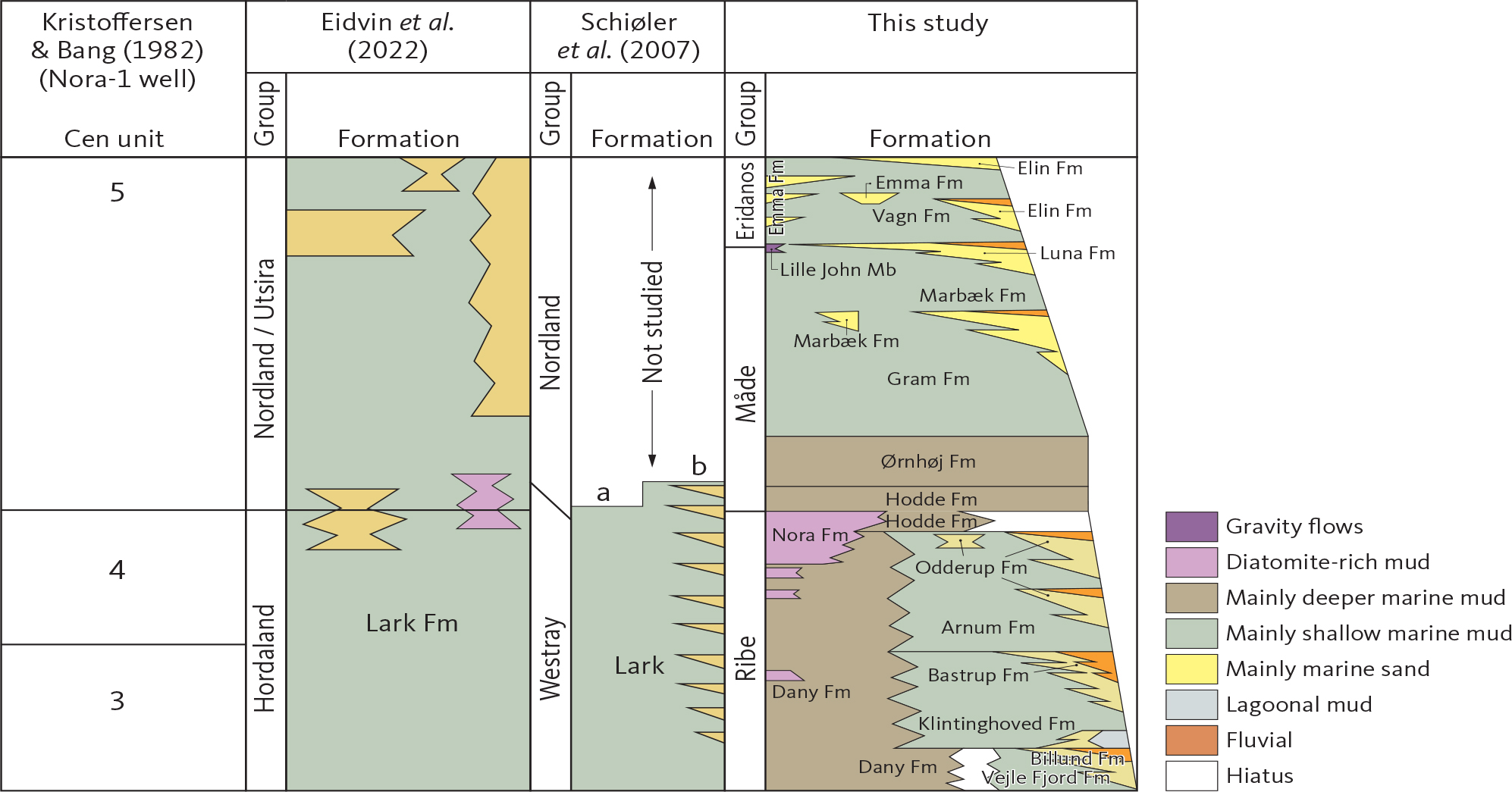
Fig. 8 Figure showing the relationship of the new lithostratigraphy presented here with the previous stratigraphic schemes of Kristoffersen & Bang (1982), Schiøler et al. (2007) and Eidvin et al. (2022). Note an inconsistency in the scheme of Schiøler et al. (2007) concerning the definition of the top of the Lark Formation: (a): Boundary inferred from the log pick in their fig. 51 at a marked shift towards higher gamma-ray readings; this log motif corresponds to the base of the Hodde Formation (see Rasmussen et al. 2010). (b): Boundary placed at the top of the Hodde Formation in their stratigraphic scheme (their fig. 2).
The comprehensive work of King (2016) presents a review of the literature on the Palaeogene and Neogene stratigraphy and a revised unified biostratigraphic/lithostratigraphic framework for the three areas: (1) The North Sea Basin (excluding southern England), (2) onshore areas of southern England and the eastern English Channel area and (3) the North Atlantic margins.
Different approaches of applying sequence stratigraphy to the offshore Danish Neogene succession have been presented by a group at the University of Aarhus (e.g. Michelsen 1994; Michelsen et al. 1995, 1998; Sørensen et al. 1997; Huuse & Clausen 2001; Gołędowski et al. 2012). The most detailed of these is the study of Michelsen et al. (1998), which is based on a sequence stratigraphic study including well logs and biostratigraphy. Michelsen et al. (1998) subdivided the Cenozoic succession into seven units. The section studied here corresponds to most of their unit 5 and all of their units 6 and 7. Rasmussen et al. (2005) subdivided the Middle–Late Miocene and Pliocene into five sequences.
Eidvin et al. (2014a) correlated the sequence stratigraphic framework of the Danish Neogene succession, including the onshore studies of Rasmussen (1996, 2004b, 2009b) and Rasmussen & Dybkjær (2005) and the offshore subdivision of Rasmussen et al. (2005), with the Norwegian sector (Fig. 8). This correlation was based on the biostratigraphic studies of Dybkjær & Piasecki (2010) and Eidvin et al. (2014a) and provided a much higher stratigraphic resolution than previously reported. In addition to the new biostratigraphy, Sr-isotope data were introduced by Eidvin et al. (2014b, 2020) which led to a very high confidence of both age assignments and regional correlation of the Neogene succession in the eastern and northern North Sea, especially for the Lower Miocene succession.
Dybkjær et al. (2021) recently presented a stratigraphic framework for the Neogene succession offshore Scandinavia based on a combination of dinocyst stratigraphy and seismic data. Documentation of the dinocyst biostratigraphy, both onshore and offshore Denmark, combined with seismic mapping in the offshore sector has facilitated correlation with the Neogene of Germany, Belgium and the Netherlands (e.g. Köthe 2007; Knox et al. 2010; Utescher et al. 2012; Thöle et al. 2014; Munsterman et al. 2019; Deckers & Louwye 2020).
4 Data and methodology
4.1 Core and cuttings description
The lithological and sedimentological interpretations in the present study are based on well and borehole data from onshore and offshore Denmark. Most of these data are based on ditch cuttings samples, but a few sections from North Sea wells have been cored: Dany-1 (1429.95–1421.90 m), E-8 (1266–1249.70 m), Lille John-2 (1249.70–1179 m). Onshore, in the westernmost part of Denmark, the entire borehole of Sdr. Vium (0–282 m) has been cored. Cuttings from selected wells and boreholes have been described under a binocular microscope. Cored sections have been measured and described. Core photos and advanced photo processing techniques have supported the descriptive process.
4.2 Biostratigraphy
As outlined above, only few, stratigraphically very restricted cored sections exist from the Miocene–Pliocene in the Danish North Sea sector. Biostratigraphic data from a cored section in the E-8 well representing the upper Langhian – lower Serravallian (Middle Miocene; Quante & Dybkjær 2018) and from a core in the Lille John-2 well representing the uppermost Tortonian –lowermost Zanclean (Upper Miocene – lowermost Pliocene; Sheldon & Dybkjær 2015) are included here. No macrofossils have been described from these cores.
Fortunately, a new comprehensive multidisciplinary microfossil study (Sheldon et al. 2025) on core samples covering most of the Lower and Middle Miocene succession in the Valhall–Hod area in the southernmost Norwegian North Sea sector has provided a solid age relationship for the new Danish lithostratigraphic units as these are readily identified in the Norwegian wells.
Data from the cored onshore borehole Sdr. Vium were used for correlating between the onshore and offshore sections (Kellner et al. 2025). The fossil content in the onshore Denmark lithostratigraphic units is described in Rasmussen et al. (2010).
A number of microfossil groups, including dinocysts, foraminifera, nannofossils and diatoms, have been analysed from wells in the Danish offshore North Sea sector and used to date the Neogene succession and to guide correlations. However, only minor parts of these studies have been published and the majority of these are based on dinocyst stratigraphy. The published biostratigraphic studies are outlined in the following.
King (1983, 1989) studied the foraminifera assemblages in a number of offshore wells in the North Sea, including the Danish R-1, S-1 and U-1 wells, and defined a zonation scheme that has subsequently been widely used. In the sequence stratigraphic study of Michelsen et al. (1998), biozonations are presented for a number of Danish North Sea wells. The biostratigraphy is mainly based on foraminifera, while nannoplankton and dinocysts are included in a few wells. Laursen & Kristoffersen (1999) presented a detailed study of the foraminifera assemblages in the Danish onshore Miocene lithostratigraphic units as defined at that time.
Schiøler (2005) presented a detailed study of dinocysts in the Oligocene – Lower Miocene succession in the Alma-1 well and identified a series of last occurrences of dinocysts and acritarchs with potential for a detailed subdivision of the succession. In a subsequent study by Schiøler et al. (2007), unpublished biostratigraphic data from 29 wells were re-assessed, and new data from 11 additional wells were produced for that study. The results are presented as biostratigraphic events and biozonations, and correlated with the chronostratigraphy and with the Palaeogene – Middle Miocene lithostratigraphic units defined in the study.
The dinocyst stratigraphy of the Oligocene–Miocene boundary section in the Frida-1 well was studied by Dybkjær & Rasmussen (2007). In a later study by Dybkjær et al. (2012) that includes dinocysts, foraminifera and nannofossils, the succession was correlated in detail with the Italian Stratotype Section and Point for the base of the Miocene. The dinocyst zonation of Dybkjær & Piasecki (2010) was defined based on analysis of more than 2000 sediment samples from outcrops and more than 50 wells/boreholes, most of which were drilled onshore Denmark. However, data from four offshore wells (Frida-1, Lone-1, S-1 and Tove-1) were also included in the definition of this zonation. Quante & Dybkjær (2018) presented a study of the dinocyst assemblage in a cored section covering the upper Langhian – lower Serravallian (Middle Miocene) in the E-8 well. Dybkjær et al. (2021) presented dinocyst data from three Danish North Sea wells (Nora-1, Tove-1 and Vagn-2) and illustrated the applicability of the dinocyst zonation of Dybkjær & Piasecki (2010) in a larger area. Based on a combination of the dinocyst zonation and seismic data, a robust stratigraphic framework for the Neogene succession offshore Denmark was established. This framework was also applied to provide a more precise dating of the Norwegian Molo Formation, located on the continental shelf in the eastern Norwegian Sea than was previously possible.
The most recent biostratigraphic study is that by Sheldon et al. (2025), a comprehensive study that includes a multidisciplinary study of the Miocene succession in six wells located in the Valhall–Hod area in the southernmost Norwegian North Sea. In addition to this literature, biostratigraphic data from several unpublished studies are included in the data set used here.
The chronostratigraphy of the formations, as presented in this monograph, are mainly based on dinocyst stratigraphy, but are supported by data from the other microfossil groups. Furthermore, the variations in the microfossil assemblages have provided information about changes in the depositional environment, for example water depths, salinity and sea-surface temperatures.
The biozonations identified in the lithostratigraphic units, as outlined in the following for each unit, comprise the North Sea foraminifera zonation, NSB (North Sea Benthic) of King (1983, 1989), the more proximal foraminifera zonation of Laursen & Kristoffersen (1999), the dinocyst zonation of Dybkjær & Piasecki (2010) and the composite North Sea (NS-) zonation (including agglutinating, calcareous benthic and planktonic foraminifera) of King (2016). Correlation between these zonations and with the global nannofossil zonation of Martini (1971) is presented (Fig 9.), in addition to correlation of the new Neogene lithostratigraphy defined in this study with the dinocyst zonation of Dybkjær & Piasecki (2010; Fig. 1). The dinocyst zonation of Dybkjær & Piasecki (2010) was correlated with the Geological Timescale of Gradstein et al. (2004) but has in Fig. 9 been calibrated to the Neogene Geological Timescale of Raffi et al. (2020). Dinocyst taxonomy follows Fensome et al. (2019).
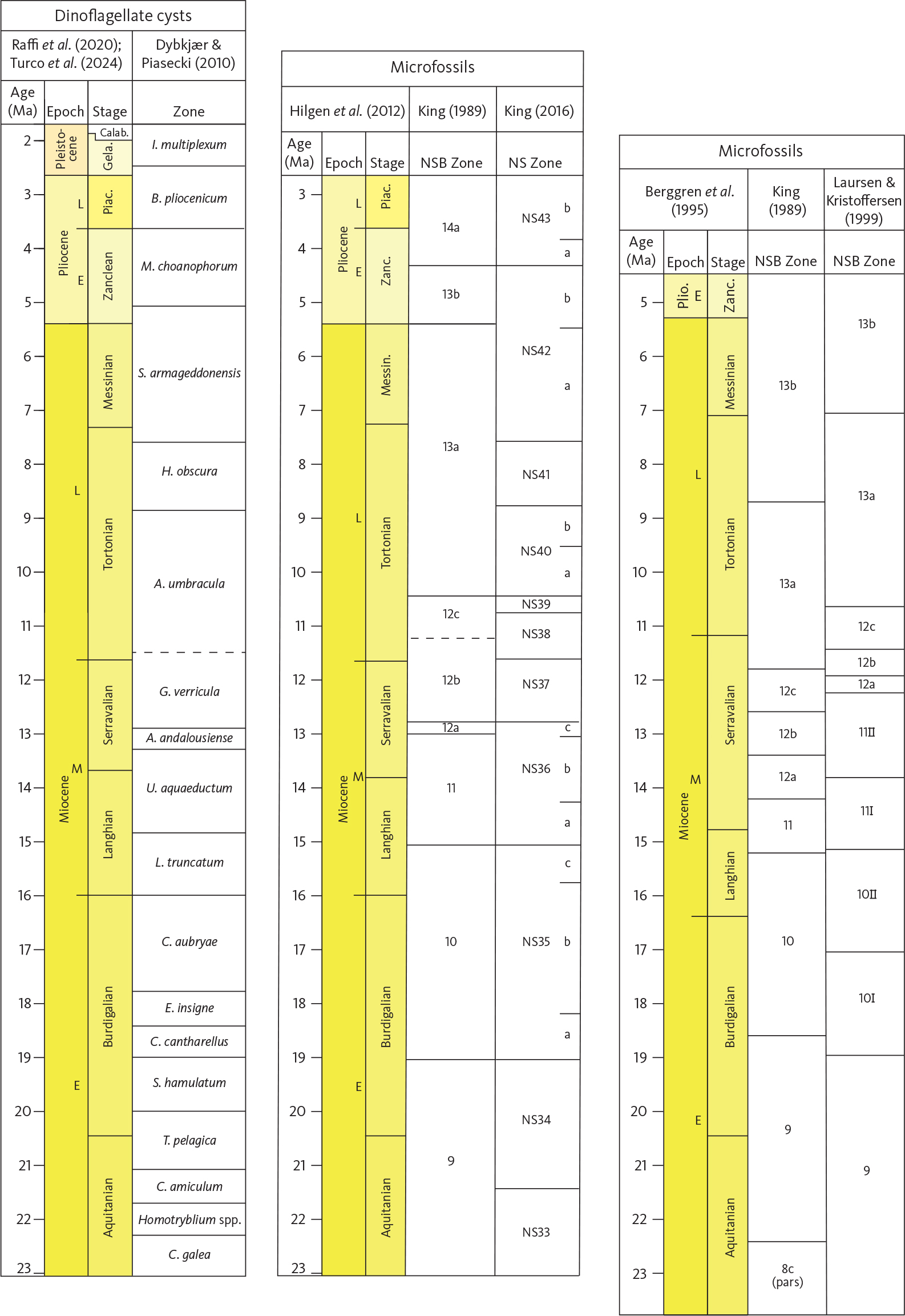
Fig. 9 Dinocyst zonation and foraminifera zonations for the Miocene and Pliocene succession offshore Denmark. Modified from Dybkjær & Piasecki (2010) and King (2016). The chronostratigraphy is based on the cited sources. The ages of the stage boundaries in the dinocyst zonation are from Raffi et al. (2020) combined with Turco et al. (2024). The correlation of benthic foraminifera zones for the North Sea (King 1989) and onshore Denmark is from Laursen & Kristoffersen (1999).
It has also been attempted to describe the general abundance and diversity of the microfossil groups for each lithostratigraphic unit. However, it is important to note that each unit is often only represented by a few wells and that these wells are not necessarily representative for all of the Danish North Sea area. The abundance and diversity of the microfossil groups often varies from proximally to distally located settings due to changes in factors such as water depth, salinity and nutrient supply. In addition, depositional and post-depositional effects, such as sorting due to variations in energy-level and dissolution of calcareous microfossils, may influence the abundance and diversity of the microfossils. Therefore, the descriptions of the microfossil content should be seen as a generalised picture based on a restricted database.
4.3 Seismic data
The seismic study is based on multichannel 2D data: Da94, -95, -96; GR97, -98; UGCE-96/97; NP-85; CGD-85; NDBT-94; HG-97; DK13; PSEUDO-3D-2013 and the merged Angelina-MRD2010 3D survey (Fig. 2B). The seismic data are processed in reverse polarity using a zero-phase wavelet, where a hard kick represents a negative (black) reflection (trough), and a soft kick represents a positive (white) reflection (peak). The seismic interpretation was conducted on both Landmark and Petrel workstation systems. Stratigraphic surfaces separating different seismic facies, commonly the maximum regressive surface, have been mapped regionally. In addition, selected surfaces representing marked unconformities, either local or regional, and surfaces characterised by marked amplitude anomalies are also mapped. On the 3D survey, horizons of special interest were tracked manually every 10 inlines and subsequently auto-tracked. This was followed by extraction of seismic attributes, for example RMS (root mean square) attributes in the Petrel software packet.
4.4 Petrophysics
The logs plotted for each of the wells in Plates 1–12 (Supplementary Files) are the gamma-ray and sonic-log readings, together with the bulk density and neutron porosity plotted together. The sonic curve is available in all the wells for the whole sequence from the base of the Dany Formation to the top of the Vagn Formation.
The bulk density and neutron porosity logs are only available in the lower part of the succession because the wells were drilled in two sections/steps. The top part is the 16-inch hole down to about 1219 m (4000 ft) bKB (below Kelly Bushing) just above the top of the overpressured shale in the lower part of the Gram Formation, using seawater and bentonite mud. The next part involves drilling a 12.25-inch hole into the underlying overpressured formations using heavier mud. The shift can be seen in Karl-1 (Supplementary Files, Plate 1) where the gamma-ray log shows a gap just around 1219 m (4000 ft) bKB. Due to the large hole size in the upper part of the succession, the bulk density and the neutron logs are seldom run because of the difficulty of obtaining good contact with the formation required by these logging tools.
4.5 Palaeobathymetry
The construction of seascape topography (bathymetry; Fig. 10) is based on the following steps: (1) Extrapolation of palaeo-sealevel from delta plain gradient/relief assuming a very low relief/gradient. (2) Add the water depth at the shelf break, here assumed to be in the order of 100–150 m supported by biofacies. (3) Add the thickness of the slope deposits (equal to the height of the slope clinoforms) based on isochore maps.

Fig. 10 Conceptual figure showing the key parameters used in reconstructing palaeobathymetry: water depth, based on biofacies; isochore thickness of clinoforms.
5 Lithostratigraphy
5.1 Introduction to the lithostratigraphic subdivision
The Neogene succession of the North Sea has traditionally been subdivided into two groups separated by a regionally mappable seismic reflector/unconformity commonly referred to as the ‘mid-Miocene Unconformity’ (MMU; Deegan & Scull 1977; Hardt et al. 1989; Knox & Holloway 1992; Schiøler et al. 2007). However, there is some confusion about the age and origin of this surface. In some parts of the North Sea, this reflector represents a hiatus in the sedimentary record, especially in UK, German and Dutch waters and in the northern part of the Norwegian sector of the North Sea. In other parts of the North Sea, including the Danish sector, this reflector represents a distinct intra-Langhian flooding surface identified by a marked lithological change but without any detectable regional hiatus (Dybkjær & Piasecki 2010; Rasmussen & Dybkjær 2014), with the exception of local breaks or onlap at topographic highs such as salt structures.
In the UK, the section below the MMU, which covers the Oligocene – Middle Miocene, is named the Westray Group (Knox & Holloway 1992), whereas in Norway the Miocene succession below this surface is included in the Hordaland Group (Deegan & Scull 1977; Hardt et al. 1989; Eidvin et al. 2014a). In the Dutch sector, an unconformity is also reported in the middle part of the Miocene and referred to the so-called MMU, but the unconformity is placed somewhat higher, at the base of the Upper Miocene; the section below the ‘MMU’ is referred to the Groote Heide and Veldhoven Formations (Munsterman et al. 2019).
Another even more distinct boundary is found at the base of the Miocene both offshore and onshore Denmark. This boundary was used by Rasmussen et al. (2010) to define the base of the Ribe Group in onshore Denmark. In the present study we have followed this approach for the offshore sector, referring the succession from the basal Miocene unconformity separating the Oligocene Brejning Formation from the Miocene mud-rich deposits up to the MMU/mid-Miocene regional flooding surface to the Ribe Group. Both the basal Miocene lower boundary and the mid-Miocene upper boundary of the Ribe Group are prominent seismic reflectors (‘hard kicks’; Rasmussen et al. 2005).
In the UK and Norwegian sectors, the succession above the so-called mid-Miocene unconformity is referred to the Nordland Group (Deegan & Scull 1977; Hardt et al. 1989; Knox & Holloway 1992). Schiøler et al. (2007) also provisionally adopted this group in the Danish North Sea, but the focus of their study was the Palaeogene, and the Nordland Group was not subdivided lithostratigraphically. Note that the location of the base Nordland Group in their fig. 2 (top of the Hodde Formation) is inconsistent with that shown in their correlation panels, where this boundary (= TL, Top Lark) is indicated at the base of the Hodde Formation as recognised here (see also Dybkjær et al. 2021).
As some of the lithostratigraphic units defined onshore Denmark can be readily traced westwards into the offshore area, and the terminology has indeed been applied during drilling operations in the North Sea, the onshore Måde Group, representing the upper Middle Miocene to Upper Miocene succession, is in this study also adopted in the Danish offshore sector; use of the Nordland Group is thus discontinued in the Danish sector. The sediments referred to this group are dominated by marine, hemipelagic clay.
During the Pliocene, a new siliciclastic system began to fill the southern North Sea Basin. This system is known as the Baltic River system (Bijlsma 1981) or the Eridanos Delta (Overeem et al. 2001). During most of the Pliocene, sediments from this delta system were deposited in the Danish sector, and the Danish offshore Pliocene succession is thus referred to as the Eridanos Group.
The new lithostratigraphy of the Neogene succession offshore Denmark (Fig. 1) is here formally established and generally follows the guidelines of Salvador (1994). A major challenge in the definition of lithological units and boundaries is the scarcity of cores and the incomplete petrophysical coverage of the Middle to Upper Miocene and Pliocene successions. Most of the Miocene units are adopted from the onshore lithostratigraphy as there is a one-to-one correlation from onshore to offshore seismic data and no marked changes in lithology. Six new lithostratigraphic formations and one new member are erected (Fig. 1). Offshore, the Ribe Group comprises the Klintinghoved, Bastrup, Arnum, Odderup, Dany (new) and Nora (new) Formations. The Måde Group consists of the Hodde, Ørnhøj, Gram, Marbæk, and Luna (new) Formations. The Luna Formation includes the Lille John Member (new). The Eridanos Group is composed of the Vagn (new), Emma (new) and Elin (new) Formations.
5.2 Onshore–offshore correlation
Correlation between the onshore and offshore Neogene successions, within the lithostratigraphic framework of Rasmussen et al. (2010), is provided by two transects crossing the Danish west coast (Fig. 11). The main challenge in this operation is the offset of seismic data along the Danish coast, which is 16 km at the transect at Stauning (Figs 2, 11A) and 6 km at Henne Beach (Figs 2, 11B). Nevertheless, the seismic boundaries and facies can be traced with confidence across this transition between the onshore and offshore data (Fig. 11).
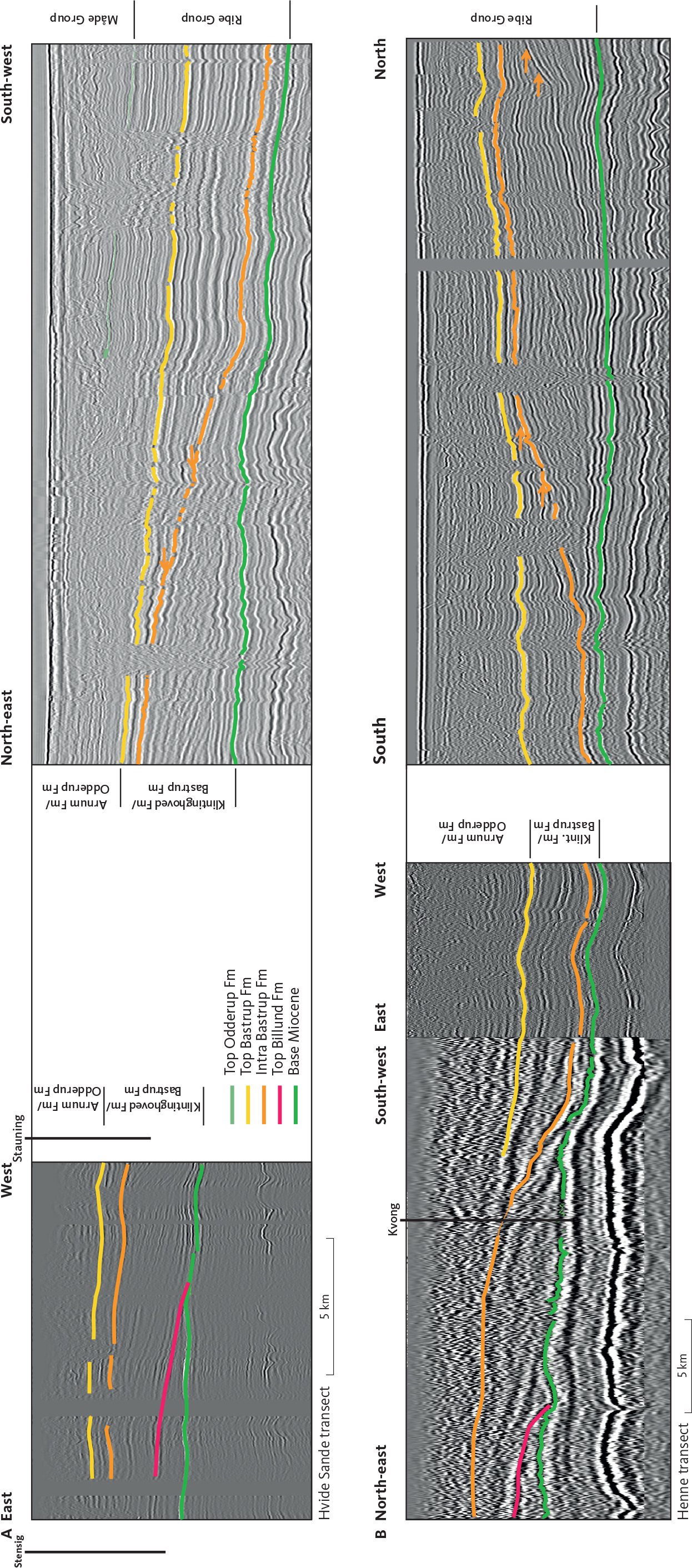
Fig. 11 Two seismic composite sections across the onshore–offshore area in Denmark showing the overall architecture of the Neogene (Miocene) succession onshore and in the easternmost offshore area, the Ringkøbing–Fyn High area. Note how the progradational and aggradational packages can be recognised across the shoreline. The locations of the cross-sections are shown in Fig. 2B.
The base Miocene boundary, which is characterised by a strong, continuous reflector, is readily recognised on both onshore and offshore data. The lowermost Miocene Vejle Fjord and Billund Formations (Rasmussen et al. 2010) are absent or very thin in the offshore realm. The pinch-out of these lowermost Lower Miocene deposits is seen on the Hvide Sande and Kvong transects (Figs 2, 11) and is confirmed by the Kvong borehole, which provided the biostratigraphic evidence.
The Klintinghoved and Bastrup Formations interfinger. A significant part of the succession comprising the Bastrup Formation is characterised by clinoformal seismic reflection pattern (Fig. 11). Laterally, west and south-westwards, this facies is succeeded by a seismic facies displaying a parallel to sub-parallel reflection pattern, which shows onlap on to the clinoformal package. This parallel to sub-parallel facies is in the North Sea realm dominated by mud, as indicated by the tie with the Luna-1 well (Fig. 12; Supplementary Files, Plate 4) and is referred to the Klintinghoved Formation. These two seismic facies are in turn succeeded upwards by a parallel reflection pattern of regional extent (e.g. Fig. 11). On the northern part of Fig. 11A, this parallel seismic pattern ties with the Stensig and Stauning boreholes. A strong reflector, forming the base of the seismic facies correlates with the top of the aforementioned lower clinoformal package, which formed the top of the lower sand unit of the Bastrup Formation in the Stensig and Stauning boreholes. A second strong reflector correlates with the base of the upper Bastrup Formation sand unit in the two boreholes, and the third reflector correlates with the top of the upper sand unit (top Bastrup Formation; Fig. 11). This upper part of the Bastrup Formation, which is characterised by a parallel reflection pattern, grades westward into the North Sea into more muddy deposits, representing a lateral interfingering with the Klintinghoved Formation.
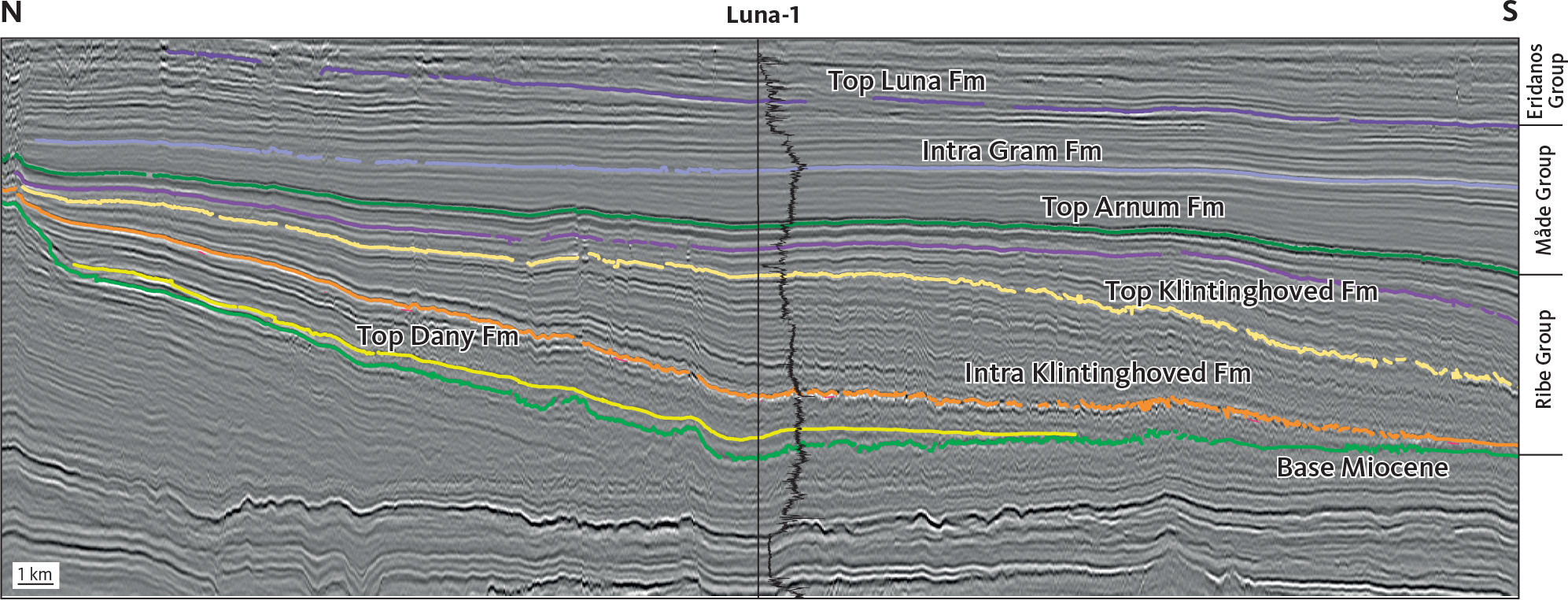
Fig. 12 N–S-trending geo-section tying the Luna-1 well in the Ringkøbing–Fyn High area.
The Arnum Formation succeeds the Bastrup and Klintinghoved Formations (Figs 1, 11, 12). This formation is expressed seismically by a parallel to sub-parallel reflection pattern, both onshore and offshore (Figs 11, 12). However, in the onshore parts of the Henne and Hvide Sande transects on Fig. 11 (see location of the transects on Fig. 2), the reflection pattern is obscured, partly due to the vintage nature of the data and partly due to poor seismic resolution in the shallow portion of the seismic data. The upper part of the Arnum Formation interfingers with the Odderup Formation. On the Ringkøbing–Fyn High, some sandy intervals correlative with the Odderup Formation have been drilled in the Luna-1 and R-1 wells.
The top of the Arnum Formation is characterised by a very distinct, continuous and high amplitude seismic reflector (Figs 11, 12). This boundary represents a major lithological change in the entire North Sea Basin (Rasmussen et al. 2010; Rasmussen & Dybkjær 2014). Onshore and in the eastern part of the offshore realm, the boundary represents a change from sandy and muddy sediments to muddy clay and clayey, glauconitic deposits. These fine-grained deposits correspond to the Hodde and Ørnhøj Formations (Rasmussen et al. 2010). These formations have not been detected seismically on onshore data, but offshore, they are characterised by a parallel reflection pattern.
The succeeding Gram Formation is thin in the onshore area, being less than 25 m in most places, and is thus not detectable on seismic data. However, in the offshore realm, the formation is up to 200 m thick (e.g. Luna-1 well; Fig. 12). Sand units intercalated in the Gram Formation are referred to the Marbæk Formation; this formation is difficult to distinguish on seismic data in the eastern part of the study area, but a clinoformal package recognised SW of the Danish west coast (Fig. 13) is correlated with the Marbæk Formation. The marked change in thickness of the Gram and Marbæk Formations from offshore to onshore is due to truncation of the formations associated with Quaternary uplift and glacial erosion (Japsen et al. 2010); the Gram and Marbæk Formations are the youngest Neogene deposits onshore Denmark (Rasmussen et al. 2010).
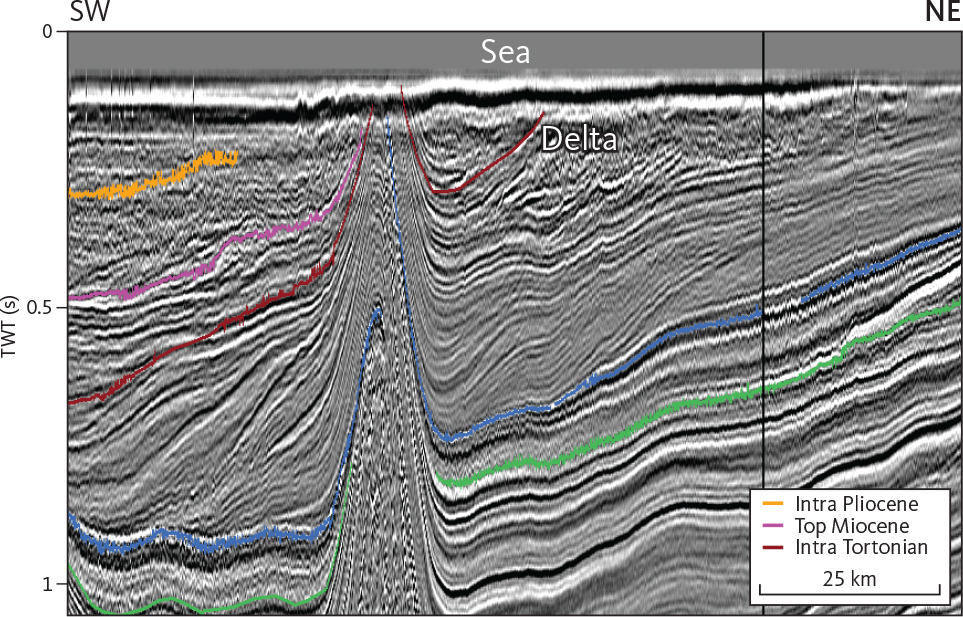
Fig. 13 Clinoformal package interpreted as a distal part of the Marbæk Formation. Modified from Japsen et al. (2007).
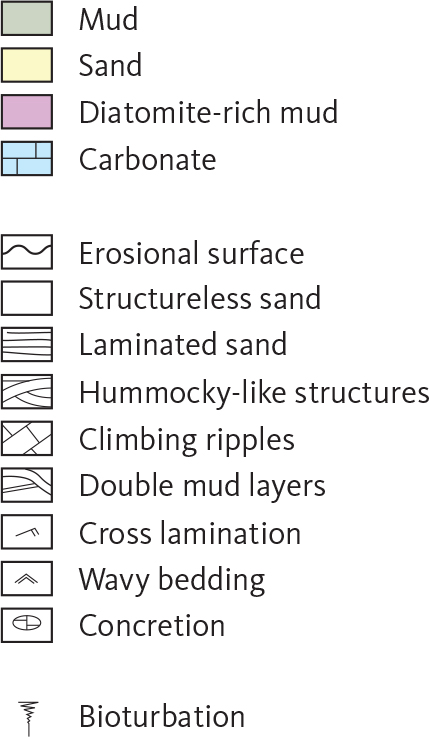
Fig. 14 Legend applicable to all cores and well logs shown in this study.
6 Updated and revised Neogene lithostratigraphy
6.1 Ribe Group
revised group
History. The Ribe Group was erected by Rasmussen et al. (2010) to include the mainly deltaic Lower Miocene formations of onshore Denmark. The group is extended here to include the wider Danish North Sea region, including the Central Graben, with the addition of two new formations, the Dany and Nora Formations.
Name. After the town of Ribe, southern Jylland (Fig. 2).
Type area. The type area is in central and east Jylland where both fluvial and marine sand and mud are exposed at several localities. The Store Vorslunde well (DGU no. 104.2325) displays a complete section from 219 to 1 m measured depth (MD; Rasmussen et al. 2010, their fig. 17. Representative North Sea wells in which the Ribe Group is well-developed are the Luna-1 well (56˚05′57″N, 5˚52′53″E) from 1297 to 632 m MD and the Nora-1 well (55˚58′09.17″N, 04˚24′04.46″E) from 1779 to 1426.5 m MD (Figs 15A, B).
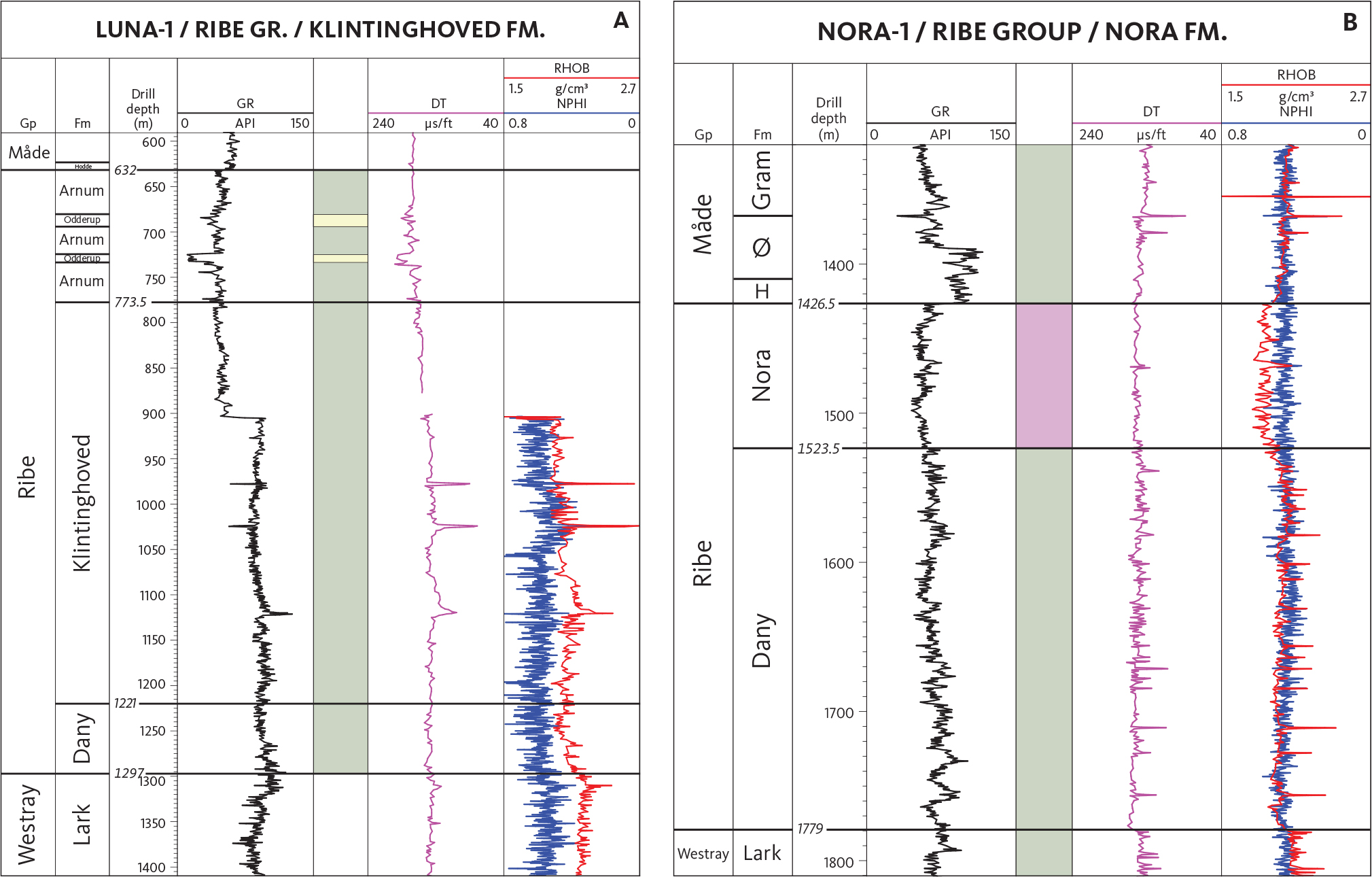
Fig. 15 The Ribe Group onshore is best represented by the St. Vorslunde borehole (see Rasmussen et al. 2010). The offshore development of the Ribe Group is displayed by the Luna-1 well on the Ringkøbing–Fyn High (A) and the Nora-1 well in a distal setting (B). In Luna-1, the Ribe Group is represented from 1297 to 632 m MD and in Nora-1 from 1779 to 1426.5 m MD. The Luna-1 well is the reference well for the Klintinghoved Formation, from 1221 to 773.5 m MD (A). The displacement of the log (log break) at ca. 900 m is an artifact due to casing. The type section for the Nora Formation is the Nora-1 well from 1523.5 to 1426.5 m MD (B). H: Hodde Formation. Ø: Ørnhøj Formation. Petrophysical logs: GR, gamma-ray; DT, sonic; RHOB, density; NPHI, neutron porosity. For legend, see Fig. 14.
Thickness. From c. 200 m to 300 m over most of the Danish sector with a maximum of c. 600 m recorded in the Cleo-1 and Luna-1 wells (Supplementary Files, Plates 1–9).
Lithology. Onshore and on the Ringkøbing–Fyn High, the group is composed of cyclic deltaic gravel, sand and mud. The sand and gravel consist mainly of quartz, flint, quartzite and some mica grains. The micaceous mud is homogenous with some intercalations of laminated fine-grained sand. The clay mineral assemblage is dominated by kaolinite and illite (Nielsen et al. 2015); gibbsite is also a common mineral of the fine-grained fraction. Coal beds are common onshore. In the most distal setting (i.e. the Central Graben), bioturbated mud and diatomite-rich deposits dominate, the latter becoming prominent in the upper part of the group.
Log characteristic. The gamma-ray log typically shows a highly serrated pattern and an overall decreasing gamma-ray response upwards. This decreasing trend can be seen in a number of intervals, but overall, there are three such intervals that reflect progradation of successive delta lobes of the Bastrup and Odderup Formations. In general, the neutron-density logs are superimposed, but in the Nora Formation, a distinct crossover is characteristic.
Fossils. Both the dinocyst and foraminifera assemblages are generally of low abundance and diversity in the lowermost part of the Ribe Group, possibly reflecting low salinity conditions and a restricted basin. Faunal/floral abundance and diversity increase upwards reflecting the establishment of more open marine conditions. Distinct variations are also seen between the marine clay-dominated units and the fluvio-deltaic sand-dominated units with the highest abundance and diversity of microfossils in the marine clay-dominated units. More detailed descriptions of the microfossil assemblages are given below in the definitions of the formations.
Depositional environment. The Ribe Group comprises sediments deposited during the progradation of three successive delta systems from the north towards the south. The main deltas were located across Jylland and on the eastern part of the Ringkøbing–Fyn High area (Hansen & Rasmussen 2008; Rasmussen et al. 2010). Sand-rich facies were deposited on the delta platform slope and in shoreface environments associated with barrier island complexes, mainly east of the main delta front. Mud was transported westwards by an anticlockwise gyre and deposited as contourites on the slope and shelf area west of the main delta. In the basin floor environment, hemipelagic mud and diatomite were deposited in estimated water depths of c. 700 m. Diatomites dominated the upper part of the group in the westernmost portion of the Danish sector.
Boundaries. The lower boundary is normally sharp and marked by a change from greenish, glaucony-rich clay to dark brown mud (Larsen & Dinesen 1959; Rasmussen et al. 2010). The glaucony-rich clay is onshore referred to the Brejning Formation and offshore to the Lark 3 unit (see Schiøler et al. 2007), while the dark brown mud onshore is referred to the Vejle Fjord Formation and offshore to the Dany Formation. On the Ringkøbing–Fyn High, there is a gap in sedimentation at this boundary. This results in deposition of Klintinghoved Formation on top of Oligocene clay. Locally, for example in the C-1 well and at the Dykær locality, a gravel layer is present representing this unconformity (Rasmussen et al. 2010). The lower boundary is subtle offshore, in contrast, being characterised by a change from dark, greenish grey mud to brown or yellowish-brown mud (Schiøler et al. 2007), especially in the westernmost part of the Ringkøbing–Fyn High and within the Central Graben area. Despite this change in lithological character from onshore to offshore, the boundary is still very distinct on seismic data. The sediments below the boundary are more consolidated, which gives rise to a prominent positive seismic reflector at the boundary. This shift in consolidation is also seen as an amalgamation in the neutron-density log (Supplementary Files, Plates 1–9). On gamma-ray logs, the base of a marked upward decrease in gamma-ray response is found at the boundary in many wells (Supplementary Files, Plates 1–11).
The upper boundary is characterised by a distinct change from sand-rich sediments to mud in the eastern part of the study area; elsewhere, over most of the Danish sector, it is defined by a marked change from brown mud, with some interbedded fine-grained sand layers, to dark brown mud or greenish, glaucony-rich clay. In most places, there is a very distinct upward increase in gamma-ray readings across the boundary; only wells in the Ringkøbing–Fyn High area (e.g. the Luna-1 and Nini-1 wells) show a more subdued increase in the gamma-ray response (Figs 15A, B; Supplementary Files, Plates 1–9).
Distribution. The Ribe Group is recognised over most of the Danish area but is truncated in the north-eastern part of central Jylland and north Jylland.
Geological age. The Ribe Group is of Aquitanian–Langhian (Early Miocene – early Middle Miocene) age.
Subdivision. The group is subdivided into a total of eight formations (Fig. 1). The two lower formations, the Vejle Fjord and Billund Formations, are not present in any wells in the Danish North Sea, but seismic data indicate that they are present in the extreme eastern part of the offshore area. These two formations are not considered further here. Relevant for this study are the Klintinghoved, Bastrup, Odderup, Arnum, Dany (new) and Nora (new) Formations.
6.1.1 Klintinghoved Formation
revised formation
History. The Klintinghoved Formation, which is a fossil-rich mud deposit (Fig. 16A), was defined by Sorgenfrei (1940). The formation was included in the first Miocene lithostratigraphic scheme of Rasmussen (1961).
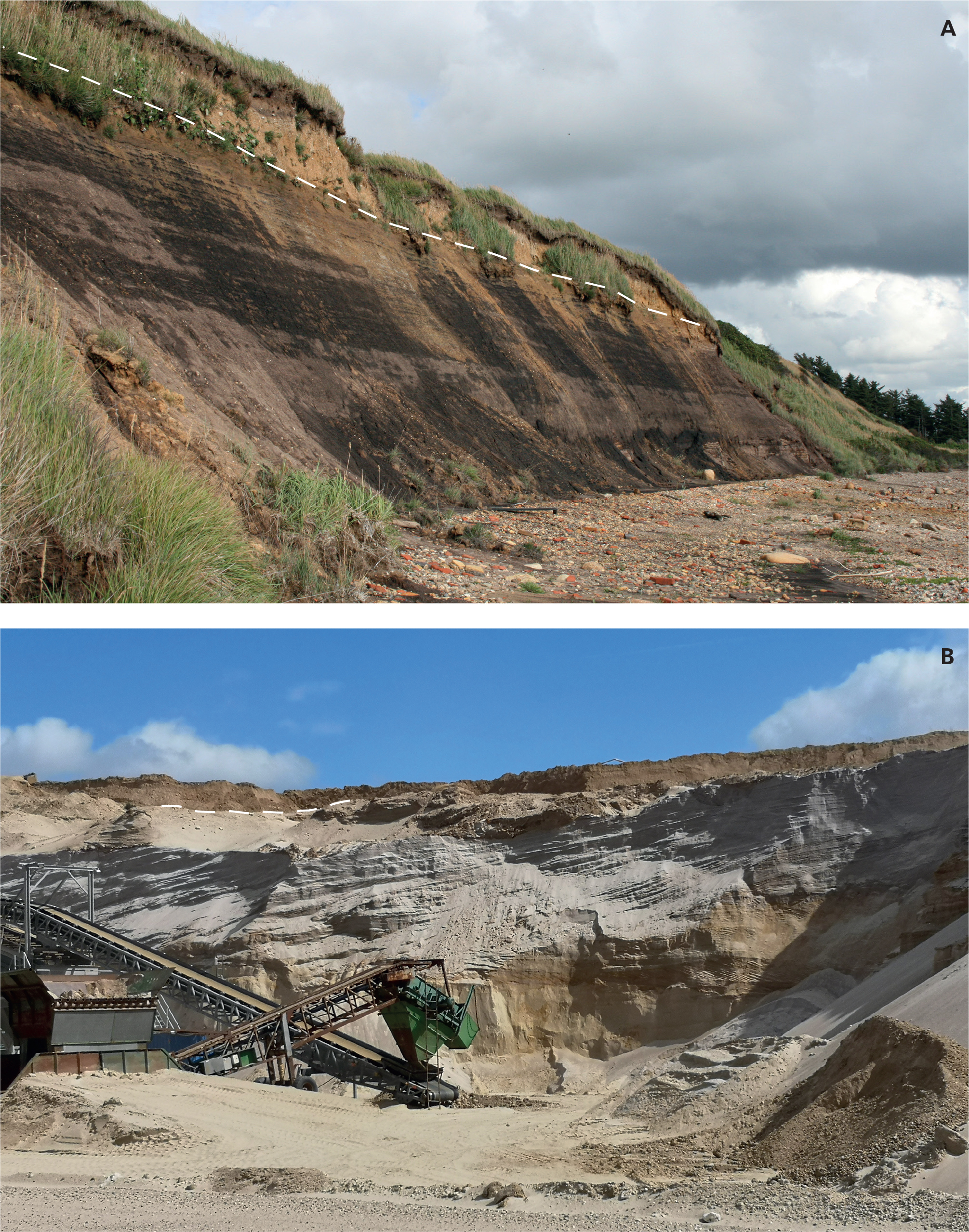
Fig. 16 (A): The best outcrop section of the Klintinghoved Formation is at Hostrup, north-west Jylland, where a 7 m thick section of mica-rich mud is exposed along a 100 m long coastal cliff. Height of the cliff is 6 m; dashed white line indicates the boundary between the Klintinghoved Formation and Quaternary sediments. (B): The Bastrup Formation crops out at Tandskov north of Silkeborg where fluvial sand and gravel forms an approximately 10 m high section; dashed white line indicates the boundary between the Bastrup Formation and Quaternary sediments.
Name. After Klintinghoved cliff at Flensborg Fjord (Fig. 2).
Type and reference sections. The type section is the outcrop at Klintinghoved cliff (54 ˚53′23.15″N, 9 ˚49′43.62″E (Rasmussen et al. 2010, fig. 40). The North Sea reference well is the Luna-1 well (56 ˚05′57″N, 5˚52′53″E) from 1221 to 773.5 m MD (Fig. 15A).
Thickness. Onshore, the thickness of the formation ranges up to c. 125 m. The formation is progressively truncated towards the east and north-east. In the North Sea realm, thicknesses up to 460 m are common. Westwards, the Klintinghoved Formation interfingers with the Dany Formation.
Lithology. The formation consists of dark brown mud with intercalated laminated sand beds or thin homogenous fine-grained sand layers (Fig. 16A; see also Rasmussen et al. 2010). The clay mineralogy is dominated by kaolinite and illite, in equal proportions, and minor smectite (up to 10%; Nielsen et al. 2015).
Log characteristics. The Klintinghoved Formation is characterised by moderate to high gamma-ray values. The log pattern is serrated due to the alternation of sand- and mud-rich deposits (Fig. 15A); a general stacking of intervals showing upward decreasing gamma-ray values (Fig. 15A, Luna-1, 1215–1150 m; 1140–1040 m; 875–773.5 m) reflects progradation and lobe switching of the delta system.
Fossils. The Klintinghoved Formation contains a moderately rich and diverse dinocyst assemblage (Dybkjær & Rasmussen 2007; Dybkjær et al. 2012; Rasmussen et al. 2015). Calcareous benthic and planktonic foraminifera are rare in the lowermost part of the formation while agglutinating foraminifera occur frequently. In the upper part, calcareous benthic foraminifera increase in abundance and diversity, planktonic foraminifera are present, and agglutinating foraminifera are rare. Diatoms and sponge spicules are present throughout the formation. Radiolaria are rare (King 1973; Laursen et al. 1992; Dybkjær et al. 2012; Rasmussen et al. 2015).
Depositional environment. The Klintinghoved Formation in the North Sea area was laid down below fair-weather wave base in front of the prograding delta and shoreface system of the Bastrup Formation and in the inner to outer shelf environment, mainly as contourites. The depositional environment was dominated by storm and tidal processes and currents formed by an anticlockwise gyre in the North Sea.
Boundaries. In the onshore and eastern part of the Ringkøbing–Fyn High area, the lower boundary of the Klintinghoved Formation is characterised by a sharp change in lithology from white to grey sand of the Billund Formation to dark brown mud of the Klintinghoved Formation (Rasmussen et al. 2010). The boundary may also be expressed by a sharp-based gravel layer, the base of which forms the boundary; the clasts of the gravel layer may be up to 5 cm in diameter (Rasmussen & Dybkjær 2020). In distal settings, the lower boundary is expressed by a change from dark brown mud with intercalated silt and fine-grained sand beds of the Bastrup Formation to mud-dominated sediments of the Klintinghoved Formation. On the gamma-ray log, this is recorded by a distinct increase in gamma-ray values. In regions with a more gradual change in sediment character, the gamma-ray readings are more gradational from slightly decreasing to increasing (Fig. 15A).
In the onshore and eastern part of the Ringkøbing–Fyn High area, the upper boundary of the Klintinghoved Formation is, by definition, characterised by the first significant sand interval of the Bastrup Formation, consisting of a sand unit at least 5 m thick, in which the sand to mud ratio is greater than 75%. In the more distal settings, the Klintinghoved Formation is overlain by the Arnum Formation; the boundary is characterised by a change from brown mud-dominated sediments with interbeds of greyish silt and fine-grained sand to dark brown mud and locally a glaucony-rich band, the base of which forms the boundary. On the gamma-ray log, the transition towards the Bastrup Formation is subtle, but towards the Arnum Formation, the upper boundary is often recorded as a weak increase in gamma-ray values (Fig. 15A).
Distribution. The formation is present in southern, central and western Jylland and in the entire Ringkøbing–Fyn High area of the North Sea (Fig. 17). In the western part of the Danish sector, in the Central Graben, the formation interfingers with the Dany Formation (e.g. Supplementary Files, Plate 4).
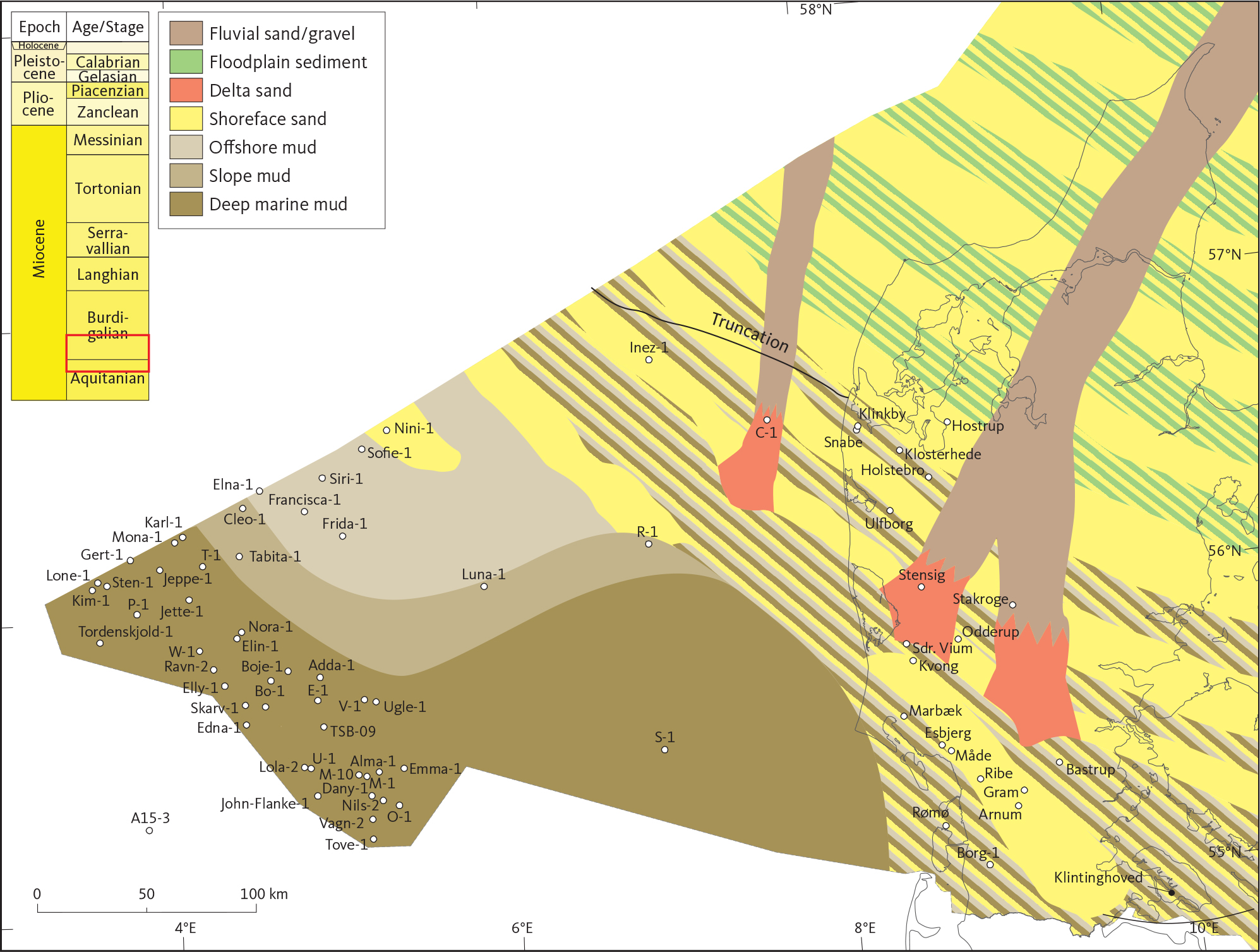
Fig. 17 Distribution of the Klintinghoved, Bastrup and Dany Formations (stratigraphic interval indicated by red box) illustrated in terms of their dominant sedimentary associations: the floodplain sediment and the channel-, delta- and shoreface sand are referred to the Bastrup Formation; the offshore mud is referred to the Klintinghoved Formation; the slope mud and deep marine mud are referred to the Dany Formation. Neogene deposits of this age have been removed by erosion east of the truncation line indicated in the offshore area; the distribution of sedimentary associations east of this line (and north-east of the onshore outcrops/wells) is hypothetical. The striped belts indicate areas that are inferred to have experienced shifting depositional settings during the late Aquitanian – early Burdigalian.
Biostratigraphy. The following dinocyst zones: the Caligodinium amiculum Zone, the Thalassiphora pelagica Zone, the Sumatradinium hamulatum Zone and the lower part of the Cordosphaeridium cantharellus Zone of Dybkjær & Piasecki (2010) have been documented in the Klintinghoved Formation in the Frida-1 well (Dybkjær & Rasmussen 2007; Dybkjær et al. 2012) and the Luna-1 well (Figs 1, 9; Rasmussen et al. 2015).
The calcareous benthic foraminifera zones recorded from the formation include the upper part of NSB9–NSB10I (Laursen & Kristoffersen 1999; Rasmussen et al. 2015). In addition, the composite zones NS34 (upper part) – NS35b (King 2016) are reported from the Klintinghoved Formation in the Frida-1 well (Fig. 9; Rasmussen et al. 2015).
Geological age. The Klintinghoved Formation comprises deposits of late Aquitanian to mid-Burdigalian (Early Miocene) age.
6.1.2 Bastrup Formation
History. The formation was erected by Rasmussen et al. (2010) as part of a major revision of the Miocene lithostratigraphy covering onshore Denmark. The previous lithostratigraphy of Rasmussen (1961) encompassed only two sand-rich units, but during the intense drilling campaign from 2000 to 2010, it became clear that the Miocene succession was formed by three discrete deltaic successions, and revision was therefore necessary.
Name. The Bastrup Formation is named after the village of Bastrup in southern Jylland (Fig. 2).
Type and reference section. The type section is the interval from 108 to 84 m MD in the Bastrup borehole (DGU no. 133.1298; 55˚24′21.58″N, 9˚14′47.40″E; Rasmussen et al. 2010, fig. 52). The North Sea reference section is the interval from 397 to 384 m MD, in the borehole R-1 (Fig. 18).
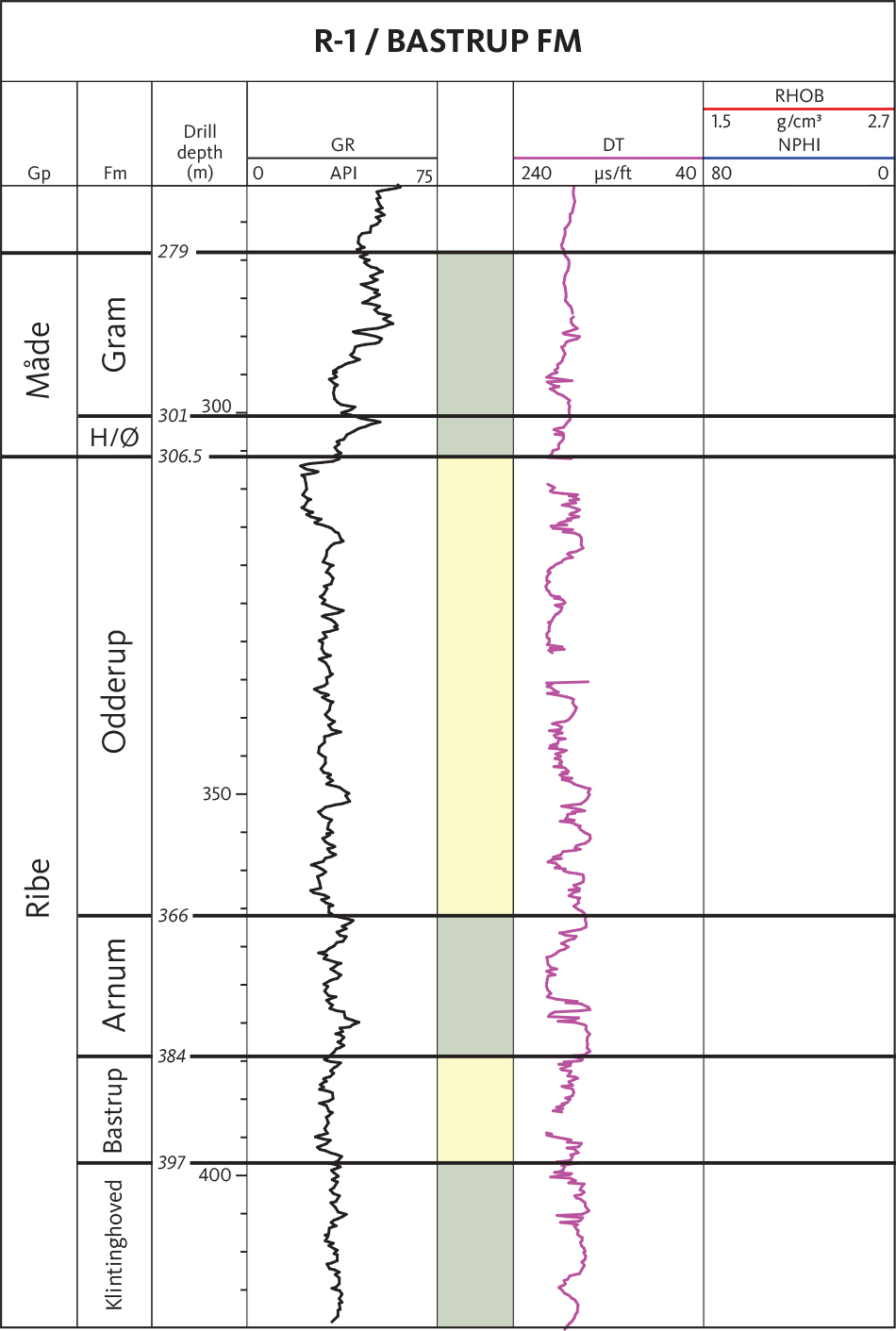
Fig. 18 The North Sea reference section of the Bastrup Formation is the R-1 well, from 397 to 384 m MD. H/Ø: Hodde/Ørnhøj Formations. For legend, see Fig. 14.
Lithology. Onshore, the formation consists of grey, medium- to coarse-grained sand with some gravel (Fig. 16B). The diameter of individual pebbles in gravel beds rarely exceeds 2 cm. The sand grains in the formation are overwhelmingly dominated by quartz and quartzite with only a minor content of mica and heavy minerals. The formation is characterised by both coarsening-upward and fining-upward depositional patterns. The upper part is commonly characterised by a 15–30 m thick fining-upward succession from coarse-grained to fine-grained sand. The formation is characterised by a succession of sand with subordinate layers of clay that are centimetres thick. If the sand-rich succession is thicker than 5 m, intercalation of thicker mud layers may occur.
Sand of the Bastrup Formation has at present not been recovered from any offshore wells. The interpretation of the presence of the Bastrup Formation in the R-1 and C-1 wells is based on subtle gamma-ray log patterns. The lithology of the formation offshore is thus uncertain.
Log characteristics. Onshore, the Bastrup Formation is characterised by low gamma-ray readings (Rasmussen et al. 2010; plates 2, 3, 6). The log pattern is serrated and shows both decreasing (e.g. in Stakroge, 130–95 m) and increasing (Fjelstervang 107–68 m) upwards trends through the succession. The upwards decreasing trend of gamma-ray readings reflects a coarsening-upward trend associated with delta progradation and the upwards increasing trend of gamma-ray response (a fining-upward trend) is associated with channel fill deposits, for example point bars (Rasmussen 2009b).
Offshore, the Bastrup Formation is only represented by the R-1 and C-1 wells. Here, the log pattern shows subtle decreasing and increasing trends, probably associated with delta-lobe switching or deposition of storm sand layers from eroded nearshore areas (Fig. 18; Supplementary Files, Plate 4).
Fossils. The distal Bastrup Formation recorded offshore Denmark contains a variable dinocyst flora, rather sparse at some levels and rich at other levels. A low diversity, but fairly high abundance of calcareous benthic foraminifera assemblage characterises the Bastrup Formation in the R-1 well (King 1973); calcareous benthic foraminifera are rare in the C-1 well (Laursen et al. 1992; Church et al. 1968).
Depositional history. The Bastrup Formation was laid down in a fluvio-deltaic environment. The fluvial sediments were deposited in meandering systems with channel depths up to 30 m (Rasmussen et al. 2010). Based on the thickness of clinoforms, the water depth in the marine realm was up to 150 m. Due to the predominance of westerly winds, the deltas were wave-dominated with formation of spit and barrier complexes south-east of the delta outlet. Seismic data and published models for modern deltaic systems strongly indicate that the mud supplied by deltas is mainly deposited along the slope as contourites. We suggest that a significant proportion of the mud from the Bastrup delta system was laid down as contourites in the Ringkøbing–Fyn High area.
Boundaries. The lower boundary with the Klintinghoved Formation is expressed by an increasing content of sand. The gamma-ray log in the R-1 well shows an initial decrease in gamma-ray response (Fig. 18). In the C-1 well (Supplementary Files, Plate 4), the boundary is characterised by a distinct decrease in gamma-ray log readings. In the R-1 well, the upper boundary is defined by an increase in gamma-ray readings, representing the transition from the sand of the Bastrup Formation to the overlying mud-rich Arnum Formation.
Distribution. The Bastrup Formation is recognised in central, western and southern Jylland. In the North Sea, the western limit, or pinch-out, of the formation probably coincides broadly with a NW–SE-striking line running just west of the R-1 well, but no other data exists apart from those from R-1 to confirm this (Fig. 18; Supplementary Files, Plate 4).
Biostratigraphy. The Sumatradinium hamulatum dinocyst zone and the lower part of the Cordosphaeridium cantharellus dinocyst zone have been recorded in the Bastrup Formation (Figs 1, 9; Dybkjær & Piasecki 2010).
The calcareous benthic foraminifera zone NSB10 (King 1989) has been recorded in the Bastrup Formation in the R-1 well (Fig. 9; King 1973; Laursen et al. 1992).
Geological age. The Bastrup Formation comprises deposits of early to mid-Burdigalian (Early Miocene) age.
6.1.3 Arnum Formation
revised formation
History. The Arnum Formation was defined by Sorgenfrei (1957) and revised by Rasmussen et al. (2010) to represent the mud-rich marine succession overlying the Bastrup and Klintinghoved Formations.
Name. After the village of Arnum in southern Jylland (Fig. 2).
Type and reference sections. Two boreholes at Arnum (DGU no.150.13, DGU no.150.25b; both at 55˚14′48.07″N, 8˚58′18.48″E), 107 to 40 m and 107.5 to 40 m MD respectively, together form the type section (Sorgenfrei 1957; Rasmussen et al. 2010). The North Sea reference section is the Luna-1 well (56˚05′57″N, 5˚52′53″E) from 773.5 to 632 m MD intercalated with two intervals of the Odderup Formation, 732–724 m and 697–684 m (Fig. 19).
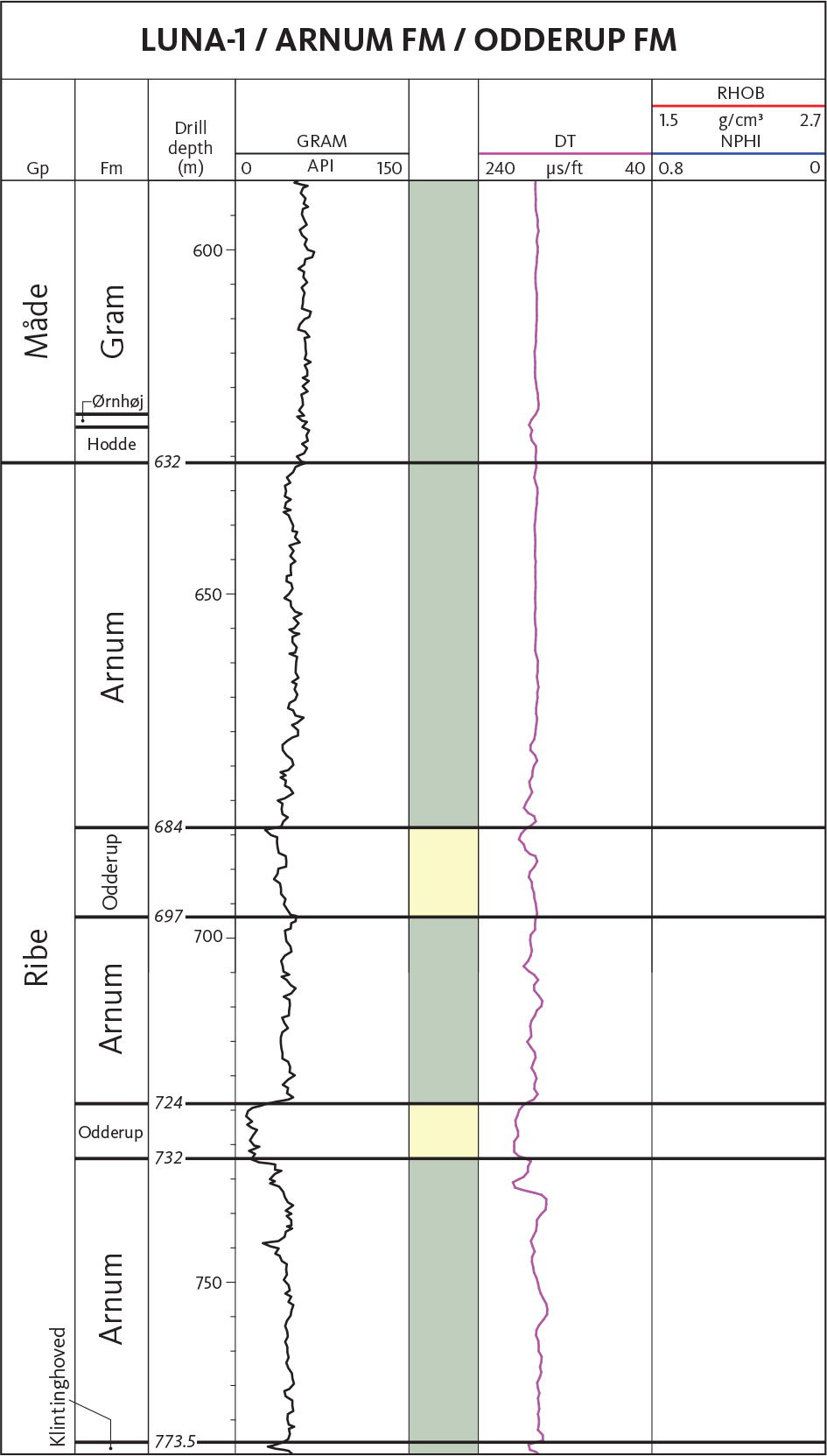
Fig. 19 The Luna-1 well is the North Sea reference section of the Arnum Formation, from 773.5 to 632 m MD and the Odderup Formation, from 732 to 724 m and 697 to 684 m MD. For legend, see Fig. 14.
Thickness. The Arnum Formation is generally up to 100 m thick (93 m in the type section) but ranges up to 140 m thick in the westernmost part of the Ringkøbing–Fyn High area.
Lithology. The Arnum Formation is composed of dark brown mud, commonly with shell beds. Laminated, fine-grained sand beds are common. The clay assemblage consists of 50–60% kaolinite, c. 20% of both smectite and illite and up to 10% chlorite (Nielsen et al. 2015).
Log characteristics. The formation is characterised by medium to high gamma-ray values and shows a serrated pattern. At some levels, it shows sections characterised by upwards decreasing gamma-ray readings (e.g. in Luna-1, 753–744 m and 643–635 m).
Fossils. The Arnum Formation is characterised by a rich and diverse dinocyst assemblage. In the Luna-1 well, high abundance and diversity calcareous benthic foraminifera assemblages and high abundance, low diversity planktonic foraminifera assemblages are present. Agglutinating foraminifera are present in higher diversity assemblages than in the intervals below and above. Bolboforma (insertae sedis, calcareous phytoplankton) are rare. Other microfossils include rare diatoms, Radiolaria, sponge spicules, fish teeth and shell debris (Rasmussen et al. 2015).
Distribution. The formation is distributed in west and southern Jylland and in the Ringkøbing–Fyn High area. In the western part, near the Central Graben, the formation interfingers with the upper part of the Dany Formation and with the Nora Formation. The boundary between the distributional areas of the Arnum and Dany Formations is arbitrarily placed at the eastern margin of the Central Graben. The boundary between the Nora Formation and the Arnum Formation is more well-defined as no diatomite-rich muds have been detected in any wells east of the Central Graben (Fig. 20).

Fig. 20 Distribution of the Odderup, Arnum, Dany and Nora Formations (stratigraphic interval indicated by red box), illustrated in terms of their dominant sedimentary associations: the floodplain sediments and the channel, swamp, delta, shoreface and offshore sands are referred to the Odderup Formation; the offshore mud is referred to the Arnum Formation; the slope mud and deep marine mud are referred to the Dany Formation; the offshore diatomite is referred to the Nora Formation. Neogene deposits of this age have been removed by erosion east of the truncation line indicated in the offshore area; the distribution of sedimentary associations east of this line (and north-east of the onshore outcrops/wells) is hypothetical. The striped belt indicates areas that are inferred to have experienced shifting depositional settings during the late Burdigalian – early Langhian.
Depositional environment. In the eastern part of the study area, the Arnum Formation was deposited in a shallow-water environment in front of a coastal plain (Odderup Formation). In the marginal marine area, the formation interfingers with fine-grained sand beds enriched in heavy minerals. In distal settings, a shelfal environment prevailed and sedimentation of mud dominated.
Boundaries. In the offshore area, the lower boundary is defined by a distinct spike/peak of low gamma-ray readings (Fig. 19; Supplementary Files, Plate 4) and a distinct change in the velocity log. These spikes correlate with the top Klintinghoved seismic marker (Fig. 12). Onshore, the boundary is lithologically characterised by a change from brown mud-dominated sediments with intercalations of greyish silt and fine-grained sand of the Klintinghoved Formation to dark brown mud. Offshore, the boundary is not documented in core.
The upper boundary is very distinct, being placed where the gamma-ray log shows a prominent shift to high gamma-ray values (Fig. 19; Supplementary Files, Plate 4). Onshore, the boundary is seen as a shift in colour from brown to dark brown clay, as illustrated by the Sdr. Vium core. No cores exist from this boundary in any offshore wells, but studies of cuttings indicate that a similar change in the colour of the mud is seen here. On seismic data, the boundary forms a prominent seismic reflection in most of the Danish area. Local unconformities associated with slope failure are recognised locally, especially in the middle part of the Ringkøbing–Fyn High area near the S-1 well (Huuse et al. 2001).
Biostratigraphy. The Arnum Formation in the Luna-1 well comprises the following dinocyst zones: the Exochosphaeridium insigne Zone, the Cousteaudinium aubryae Zone and the Labyrinthodinium truncatum Zone, except for the uppermost part (Dybkjær & Piasecki 2010; Rasmussen et al. 2015) (Figs 1, 9).The calcareous benthic foraminifera subzone NSB10II (Laursen & Kristoffersen 1999) has been reported from the Arnum Formation in the Luna-1 well (Fig. 9; Rasmussen et al. 2015).
Geological age. Mid-Burdigalian – early Langhian (Early Miocene – early Middle Miocene).
6.1.4 Dany Formation
new formation
History. The Dany Formation corresponds broadly to the lower part of the upper Lark Formation (L4) as recognised by Schiøler et al. (2007). The Lark Formation was defined in the UK sector by Knox & Holloway (1992) and adopted by Schiøler et al. (2007) to represent the Upper Eocene to lower Middle Miocene brownish grey mudstones of the Danish North Sea. Based on seismic and log stratigraphy, Schiøler et al. (2007) recognised four informal units in the Lark Formation (L1–4). L4, the uppermost unit, is formally reassigned here to the Ribe and lowermost Måde Groups; the Dany Formation is the basal formation of the Ribe Group in the Central Graben area (Fig. 8). Note, however, that the stratigraphic definition of the base of the Dany Formation (and hence the Ribe Group) in this area differs slightly from the base L4 definition given by Schiøler et al. (2007), as discussed further under ‘Boundaries’ below.
Name. After the Dany-1 well (Fig. 2).
Type and reference sections. The type section is the Dany-1 well (55˚24′18,94″N, 5˚9’38.02″E) from 1659 to 1379 m MD (Fig. 21A). The reference well is Sten-1 (56˚07′47,718″ N, 3˚37′34,687″ E) from 1810 to 1640 m MD (Fig. 21B). Part of the section was cored in the Dany-1 well (55˚24′18.94″N, 5˚9′38.02″E) from 1424 to 1403.60 m (core depth; Fig. 22).
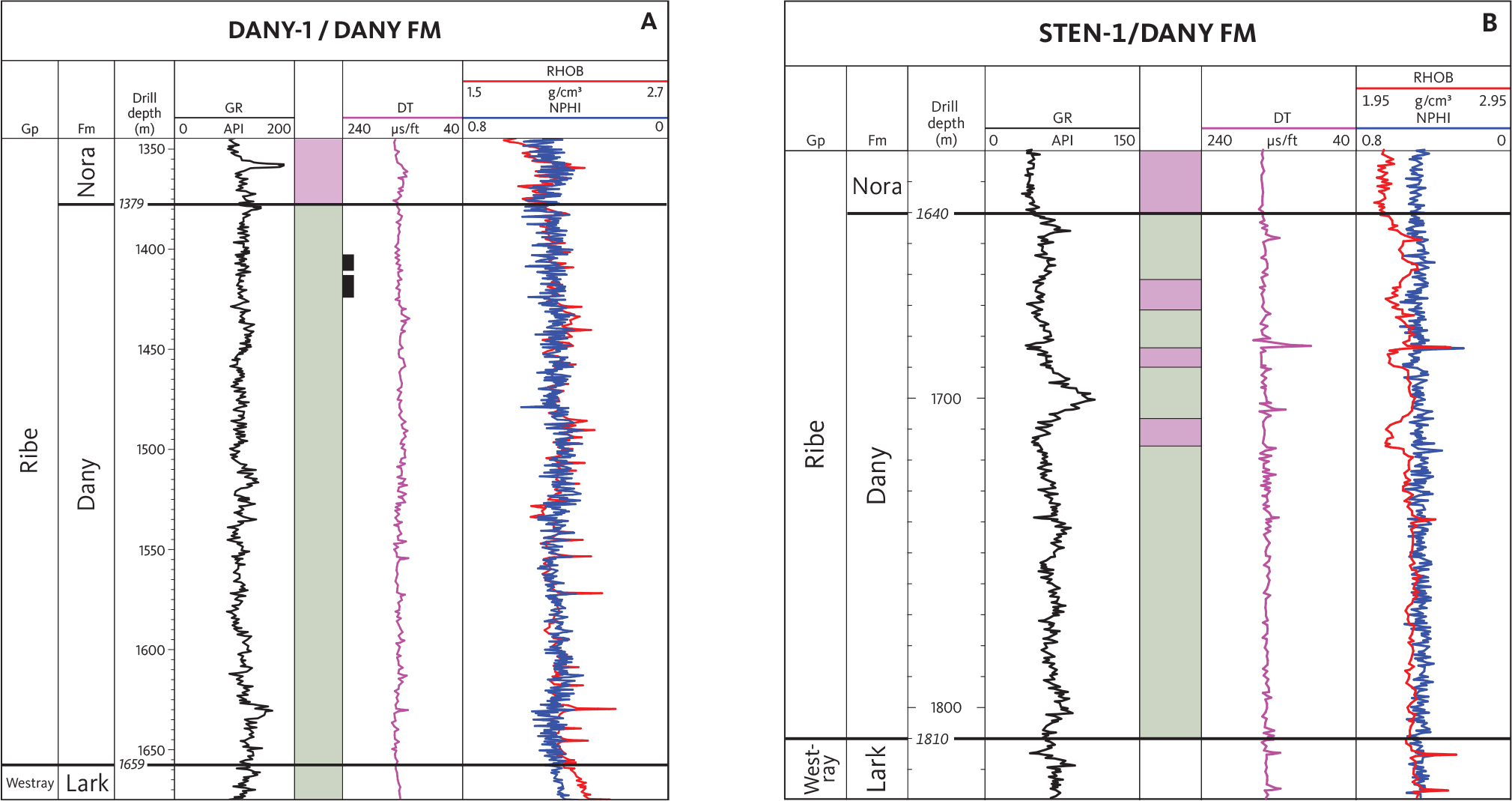
Fig. 21 (A): The type section for the Dany Formation is the interval between 1659 and 1379 m MD in the Dany-1 well. Cored interval is indicated by a black bar. Note that there is no crossover of the neutron-density logs in the Dany-1 well as there is less diatomite in the southern part of the Danish sector. (B): The reference section is the interval between 1810 and 1640 m MD in the Sten-1 well. For legend, see Fig. 14.
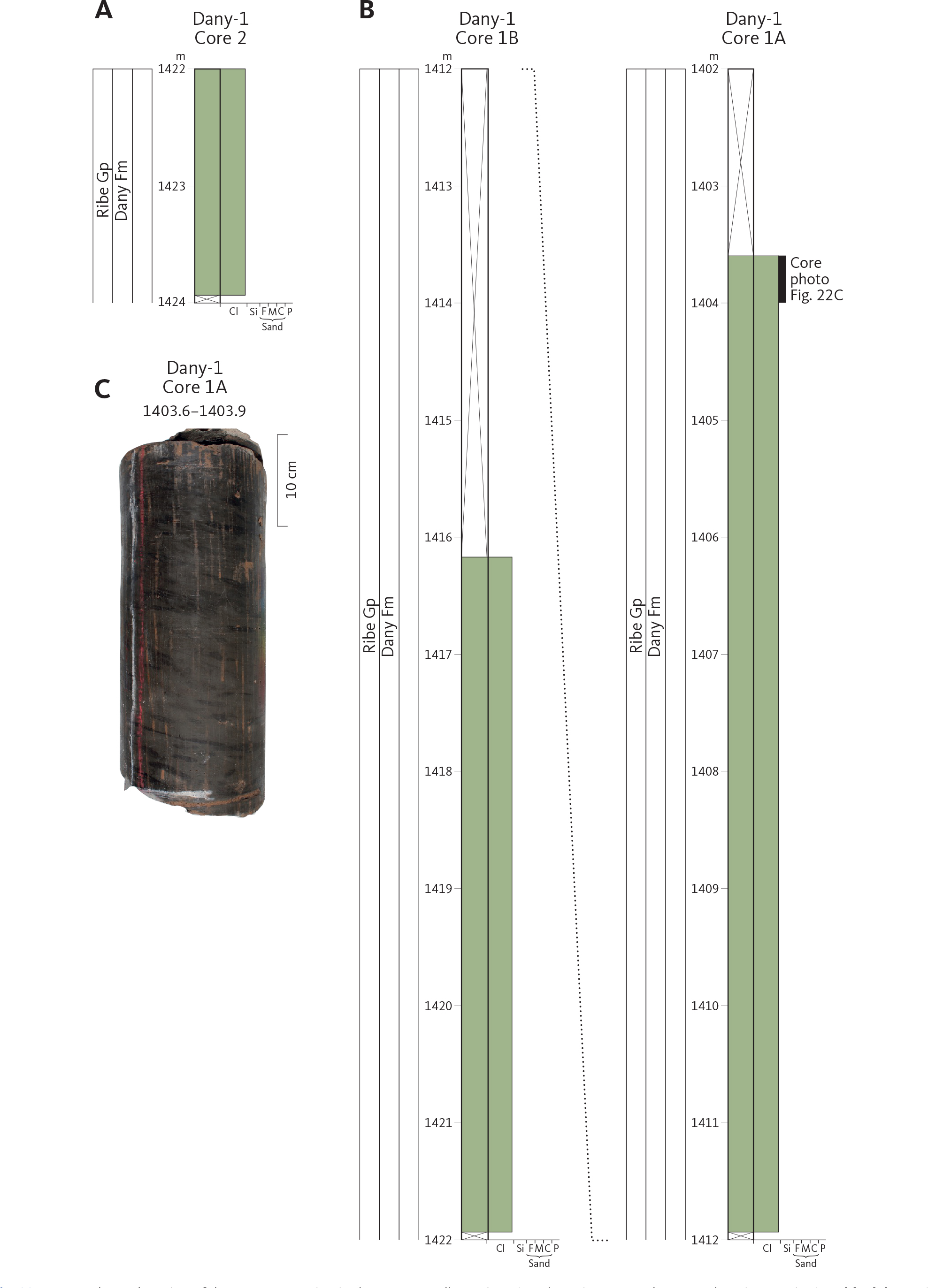
Fig. 22 Measured cored section of the Dany Formation in the Dany-1 well. (A): Core 2 and (B): Core 1A and 1B – see location on Fig. 21A (black bar). (C): Photo of the uppermost part of the core (depth interval in metres). The state of these cores is rather poor due to intense sampling activity; sedimentary structures and lithology variations are therefore obscured. For legend, see Fig. 14.
Thickness. The Dany Formation is 280 m thick in the type well, and thicknesses between 250 and 300 m are common; it is up to 500 m thick in the northern part of the Central Graben area.
Lithology. Dark brown to blackish brown mud (Fig. 22). Intervals with grey and greenish brown mud occur. In the northern Danish Central Graben, grey diatomite-rich intervals are common. The content of organic matter is relatively high, varying between 3% and 7%. The clay mineral assemblage is 40–70% smectite, 20–30% kaolinite and 10–30% illite (Nielsen et al. 2015). The content of smectite is highest in the southern part of the Danish Central Graben.
Log characteristics. The gamma-ray log shows a serrated pattern with some high readings in the lower and upper parts of the formation. The neutron-density logs are typically superimposed (Fig. 21A), contrasting with the underlying Lark Formation, which shows a clear separation. The overlying Nora Formation is characterised by cross-over of the neutron-density logs (Fig. 21B; Supplementary Files, Plates 1 and 9), reflecting the low density of the diatomite component. In the Dany-1 well, such a log cross-over is not seen in the Nora Formation due to less diatomite in the southern part of the Danish sector (Fig. 21A).
Fossils. The lowermost part of the Dany Formation is characterised by a rather poor and low-diversity dinocyst assemblage in the Alma-1 and Frida-1 wells (Schiøler et al. 2005; Dybkjær & Rasmussen 2007). The overlying (major) part of the Dany Formation is characterised by an increasing – from low to moderate – abundance and diversity of dinocysts.
The lower Dany Formation in the Dany-1, Frida-1 and Luna-1 wells is characterised by high abundance agglutinated foraminifera assemblages with varying diversities. Calcareous benthic and planktonic foraminifera are absent to rare. Radiolaria, diatoms and sponge spicules are present (Mears 1997; Dybkjær et al. 2012; Parker & Pedder 2014; Rasmussen et al. 2015). In the upper part of the Dany Formation, agglutinated and calcareous benthic foraminifera are common in the Frida-1 well, and diatoms are common in Luna-1 and Frida-1 (Mears 1997; Rasmussen et al. 2015). The Dany Formation in the Sten-1 well displays high abundance and diversity diatom assemblages (siliceous preservation) with common Radiolaria, Bolboforma and sponge spicules and relatively low diversity calcareous benthic foraminifera assemblages and generally rare agglutinated and planktonic foraminifera (see also Bailey 1983).
Depositional environment. The formation was deposited on the basin floor in water depths of more than 600 m. The lowermost part of the Dany Formation is characterised by an impoverished dinocyst assemblage, dominated by the genus Homotryblium; this probably reflects a low-salinity, restricted basin comparable to the recent Baltic Sea.
Boundaries. The lower boundary is characterised by a change from dark, greenish clay to dark brown mud, as seen in ditch cuttings samples, and further correlates with a regional seismic marker (Figs 11, 12). This seismic marker corresponds to the Oligocene–Miocene boundary (Dybkjær et al. 2012).
On gamma-ray logs, the character of the boundary is variable with some wells displaying a distinct increase in gamma-ray readings, whereas others show a distinct decrease in gamma-ray response. The neutron-density response, in contrast, is very uniform and shows an amalgamation or distinct narrowing of the two logs at the boundary (see Fig. 21A; Supplementary Files, Plates 1 and 9). The lower boundary is also commonly characterised by a distinct change in velocity from lower to higher sonic readings, indicating more compacted sediments below the boundary.
In the Central Graben area, the lower boundary of the Dany Formation correlates with the top of L3 of Schiøler et al. (2007), for example in the Alma-1 well (see Supplementary Files, Plate 6, and Schiøler et al. 2007, their plate 4), which is interpreted as correlating with the Oligocene–Miocene boundary (Dybkjær et al. 2021). However, on the Ringkøbing–Fyn High, the boundary in this study is placed on top of the Freja Member as this correlates with the Oligocene–Miocene boundary at the type section, the Lemme–Carrosio section, in Italy (Dybkjær & Rasmussen 2007; Dybkjær et al. 2012). According to Schiøler et al. (2007), however, the Freja Member is included in their L4 unit. Consequently, there is a discrepancy in the placement of the lower boundary of the Dany Formation and the top of L3 of Schiøler et al. (2007) on the Ringkøbing–Fyn High where the Freja Member is present.
The Oligocene–Miocene boundary proposed by Dybkjær et al. (2012), which correlates with a distinct seismic unconformity in the North Sea area, is typically located some tens of metres higher than previously reported. For example, in the Kim-1 well, we recognise this boundary at 1828 m, whereas Schiøler et al. (2007) placed it at c. 1905 m (their fig. 51); in the Mona-1 well, the boundary was placed at c. 2015 m by Schiøler et al. (2007) but we recognise it at 1940 m.
The upper boundary shows an abrupt decrease in gamma-ray values, particularly in wells from the north-western part of the Danish sector, for example in Sten-1 (Figs 21A, B; Supplementary Files, Plate 1). On the neutron-density logs, the upper boundary is often characterised by the onset of a cross-over. In cuttings samples, there is a clear change in colour up-section from dark brown and brown to grey mud.
Distribution. The Dany Formation, as defined in this study, is restricted mainly to the Central Graben area and represents the distal correlative of the Klintinghoved and Arnum Formations (Figs 17, 20; Supplementary Files, Plate 4). The boundary between the Dany Formation and the Klintinghoved/Arnum Formations is arbitrary. A thin succession is referred to the Dany Formation in the westernmost part of the Ringkøbing–Fyn High area, for example in the Luna-1 and Frida-1 wells (Supplementary Files, Plate 4).
Biostratigraphy. The following dinocyst zones of Dybkjær & Piasecki (2010) have been found in the Dany Formation: the Chiropteridium galea Zone, the Homotryblium spp. Zone, the Caligodinium amiculum Zone, the Thalassiphora pelagica Zone, the Sumatradinium hamulatum Zone, the Cordosphaeridium cantharellus Zone, the Exochosphaeridium insigne Zone, the Cousteaudinium aubryae Zone and the lowermost part of the Labyrinthodinium truncatum Zone (Figs 1, 9; Dybkjær et al. 2012, 2021).
In the Dany-1 well, only the lower part of the Dany Formation has been analysed for microfossils (Parker & Pedder 2014); this part is dated as calcareous benthic foraminifera zone NSB10 (King 1989). However, the lower part of the Dany Formation in the Luna-1 well is dated as upper NSB8 – lower NSB9 (Rasmussen et al. 2015). In the Sten-1 and Frida-1 wells, the Dany Formation is dated as NSB10 (composite zones NS35 of King 2016; Fig. 9; Bailey et al. 1983; Dybkjær et al. 2012).
Geological age. The Dany Formation comprises deposits of Aquitanian, Burdigalian and early Langhian (Early Miocene to earliest Middle Miocene) age. In the study by Dybkjær et al. (2012), the Oligocene–Miocene boundary succession in Frida-1 was correlated directly with the Italian Stratotype Section and Point for the Oligocene–Miocene boundary, the Lemme–Carrosio Section, using a combination of dinocysts, microfossils, calcareous nannofossils and δ13C-isotopes (Dybkjær et al. 2012). This correlation showed that the top of the Freja Member in Frida-1 is located in the uppermost Chattian, close below the Oligocene–Miocene boundary.
The lower boundary of the Dany Formation thus correlates approximately with the Oligocene–Miocene boundary and with the base of the Neogene.
6.1.5 Odderup Formation
History. The Odderup Formation was erected by Rasmussen (1961) to encompass a succession of brown coal and quartz sands. Rasmussen et al. (2010) redefined the formation to describe the regional extent of this formation onshore.
Name. The formation is named after the village of Odderup, located north-east of Varde (Fig. 2).
Type and reference sections. The type section is the borehole at the Odderup Brickworks (DGU no. 103.150; 55˚52′19.05″N, 8˚37′42.28″E) from 40.3 to 28.2 m MD (Rasmussen 1961; Rasmussen 2010). The North Sea reference well is the Luna-1 well (56˚05′57″N, 5˚52′53″E) from 732 to 724 m and 697 to 684 m MD (Fig. 19).
Thickness. The Odderup Formation is 34 m thick at the type section, but in central Jylland, it commonly exceeds 40 m. In the North Sea, the formation is generally c. 10 m thick. The minimum thickness of the sand-dominated formation is arbitrarily set at 5 m. In the R-1 well, up to 50 m of sand has been interpreted (Fig. 18) but this estimate is uncertain due to low recovery of fine-grained sand.
Lithology. In the type area onshore Denmark, the formation is composed of fine- to coarse-grained sand with some intercalations of clay and brown coal. The sand consists of quartz grains and clasts of quartzite with a minor content of mica; heavy minerals and flint grains/clasts are common. In the offshore realm, the Odderup Formation is characterised by alternating sand and mud. The formation is distinguished from the Arnum Formation in that the Odderup Formation has a sand to mud ratio of at least 3:1, and the sand-dominated unit is more than 5 m thick.
Log characteristics. The formation is characterised by a low to medium gamma-ray response (Fig. 19). An overall upwards decreasing gamma-ray trend is typical, both in the onshore type area (Rasmussen et al 2010) and in the offshore sections (Fig. 19).
Fossils. In the Luna-1 well, the dinocyst assemblages recorded from the Odderup Formation are less common and diverse than those in the Arnum Formation. High abundance, low diversity planktonic foraminifera assemblages and relatively high abundance and high diversity benthic foraminifera assemblages are present with varying content of agglutinated foraminifera. Diatoms and sponge spicules are rare (Rasmussen et al. 2015).
Depositional environment. In the onshore area, the formation was deposited in the lower to upper shoreface and the swash zone of a prograding coastal plain. Fluvial channels up to 20 m thick are common in the eastern onshore portion. Associated coal beds are interpreted to have been deposited in freshwater lakes and lagoonal swamps. They are rarely thicker than 1 m (Koch 1989), but coal layers up to 10 m thick occur locally near active fault zones. In the offshore area, on the Ringkøbing–Fyn High, the formation was laid down as storm sand layers.
Boundaries. The lower boundary of the formation is defined at the first significant sand-rich unit thicker than 5 m, in which the sand to mud ratio is at least 3:1. The gamma-ray log shows a prominent shift at the boundary from stable gamma-ray readings to a constant decreasing trend (Fig. 19).
The upper boundary is placed where the sand interval, as defined above, is overlain by dark brown mud of the Arnum Formation or dark brown, organic rich mud of the Hodde Formation. In the latter case, a very distinct shift in gamma-ray log response is common (Figs 18, 19; Supplementary Files, Plate 4).
Distribution. The Odderup Formation is recognised onshore in west, central and southern Jylland (Rasmussen et al. 2010). In the North Sea, the formation pinches out on the Ringkøbing–Fyn High south-west of the Luna-1 well (Fig. 20; Supplementary Files, Plate 4).
Biostratigraphy. The Odderup Formation in the Luna-1 well records the lower part of the Labyrithodinium truncatum dinocyst Zone (Figs 1, 9; Dybkjær & Piasecki 2010; Rasmussen et al. 2015). The Arnum Formation, which envelops the Odderup Formation in the Luna-1 well, is dated as calcareous benthic foraminifera zone NSB10II of Laursen & Kristoffersen (1999; Fig. 9; Rasmussen et al. 2015).
Geological age. The age of the Odderup Formation is late Burdigalien – early Langhian (late Early Miocene – early Middle Miocene).
6.1.6 Nora Formation
new formation
History. The T-1 well, on the Svend structure, penetrated an oil-bearing upper Lower to Middle Miocene succession. This part of the Miocene succession was characterised by a decrease in density as indicated by the density log response and cross-over of the neutron-density logs. In nearby wells, for example the Sten-1 well, this density minimum is pronounced. A close inspection of cuttings revealed an enhanced content of diatomite at this level.
Name. After the Nora-1 well (Fig. 2).
Type and reference wells. The type well is Nora-1 (55˚58′09.17″N, 04˚24′04.46″E) from 1523.5 to 1426.5 m MD (Fig. 15B). The reference well is Sten-1 (56˚07′47.72″N, 03˚37′34.69″E) from 1640 to 1546.5 m MD (Fig. 23). The upper part of the formation was cored in the E-8 well (55˚38′13.42″N, 04˚59′11.96″E) from 1267 to 1265 m (core depth; Fig. 24).
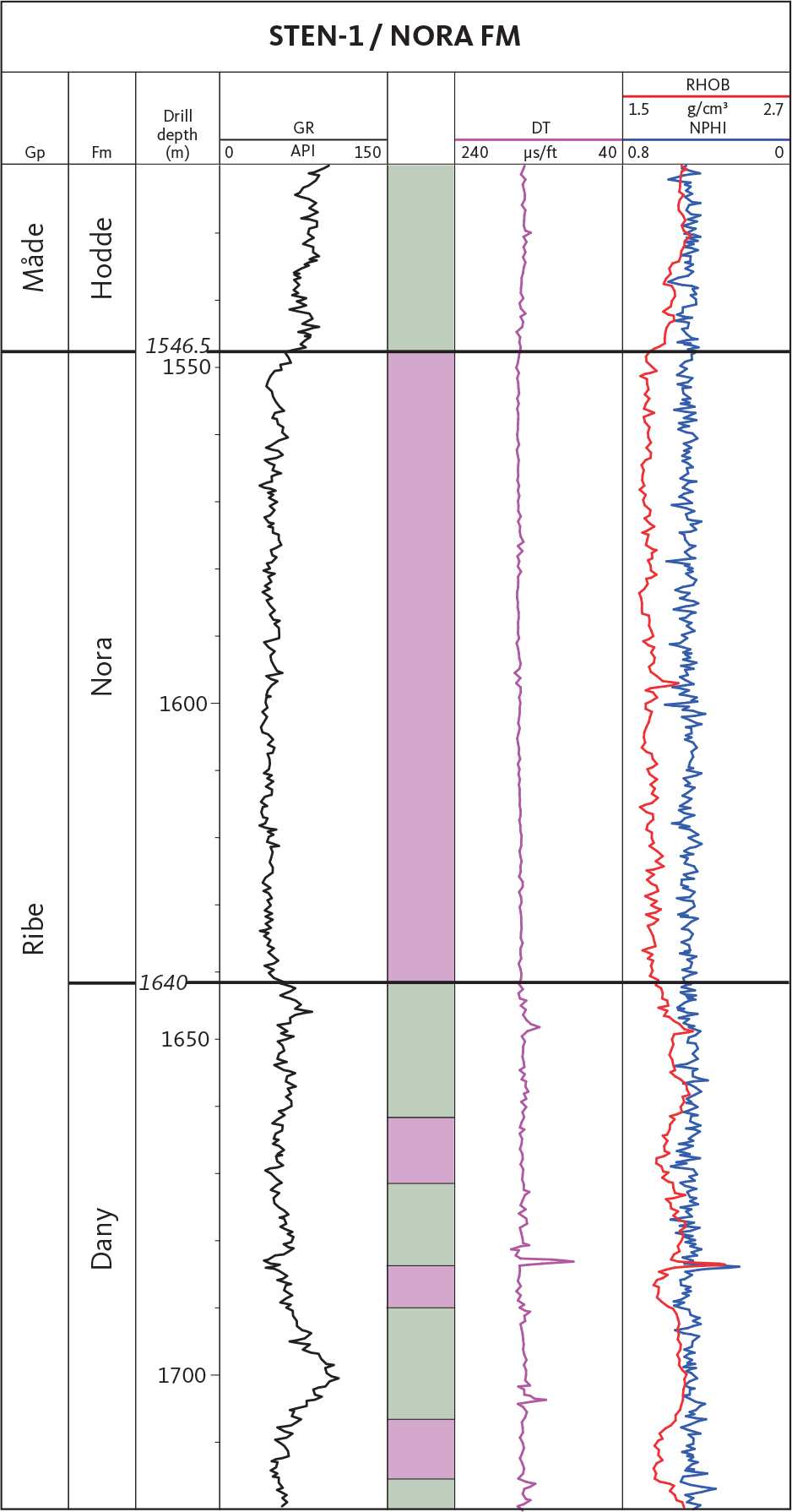
Fig. 23 The reference section of the Nora Formation is from 1640 to 1546.5 m in the Sten-1 well. For legend, see Fig. 14.
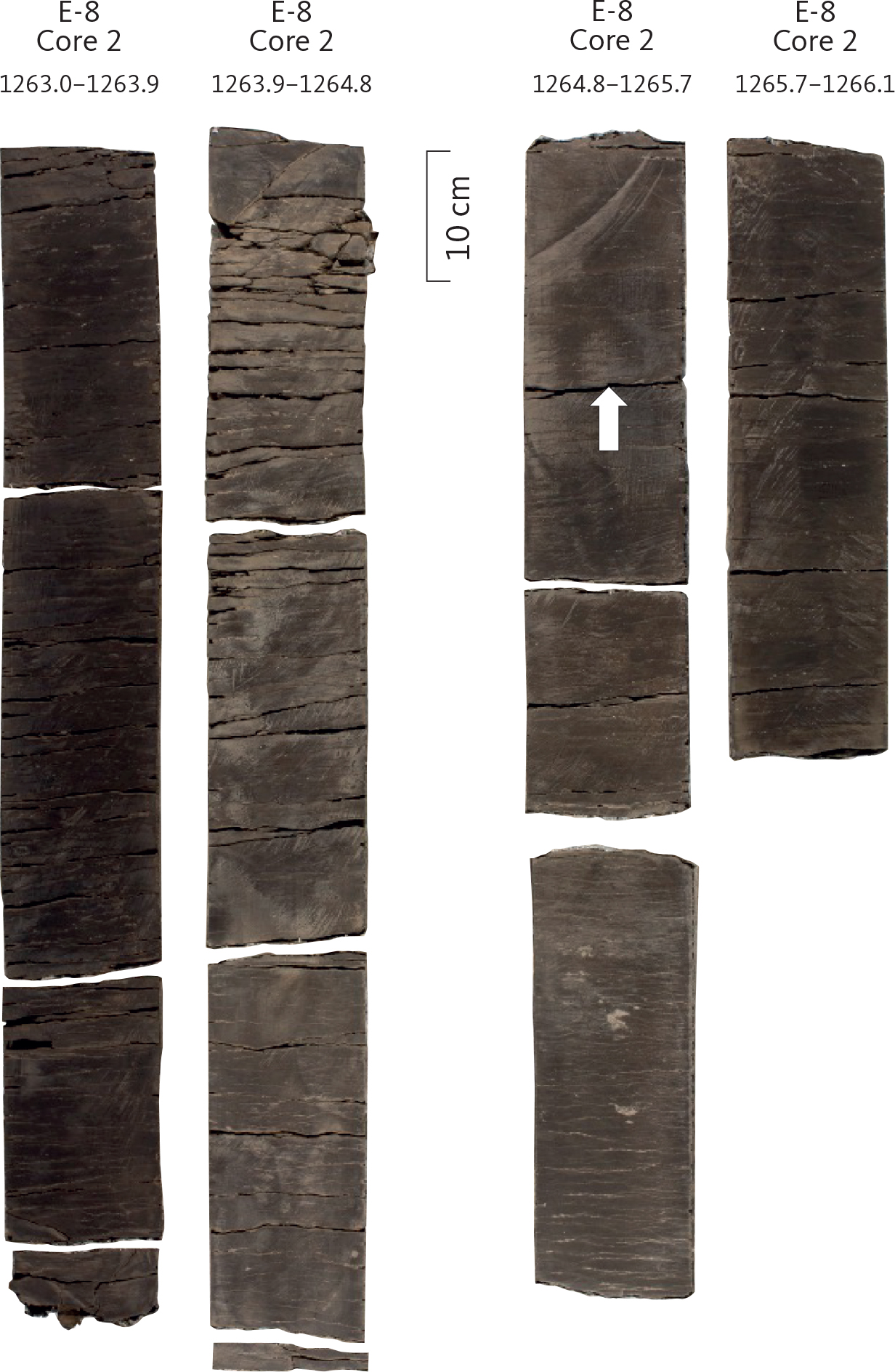
Fig. 24 Slabbed core section of the Nora and Hodde Formations from the E-8 well (depth intervals in metres). Note that the Nora Formation is muddy at this location, as indicated by the brown colour of the rock, and the upper boundary is therefore not distinct in the core but is placed at a distinct change in gamma-log readings (white arrow). The overlying Hodde Formation consists of bioturbated, dark brown to blackish mud in this part of the North Sea.
Thickness. In the type well, the Nora Formation is 93.5 m thick, but the thickness varies between 40 m and 100 m.
Lithology. Grey to brown and even dark brown (southern part of the Danish North Sea), totally bioturbated diatomite-rich mud (Figs 24, 25). In cores from the southernmost Norwegian sector (2/8-G-2), weak lamination is present in a few cases in diatomite-rich mud correlatable with the Nora Formation (Sheldon et al. 2018), but otherwise no lamination has been observed in the cores from this formation. Where most enriched in diatomite, the density is lower than 1 g/cm3 (dry samples). Where the density is below 1 g/cm3, the mud content is probably close to 40%, comparable to that recorded in the Eocene Fur Formation onshore Denmark (Pedersen et al. 2004). The clay mineral assemblage is 50–70% smectite, 10–20% kaolinite and 20–30% illite (Nielsen et al. 2015). The content of smectite is highest in the southern part of the Danish Central Graben.
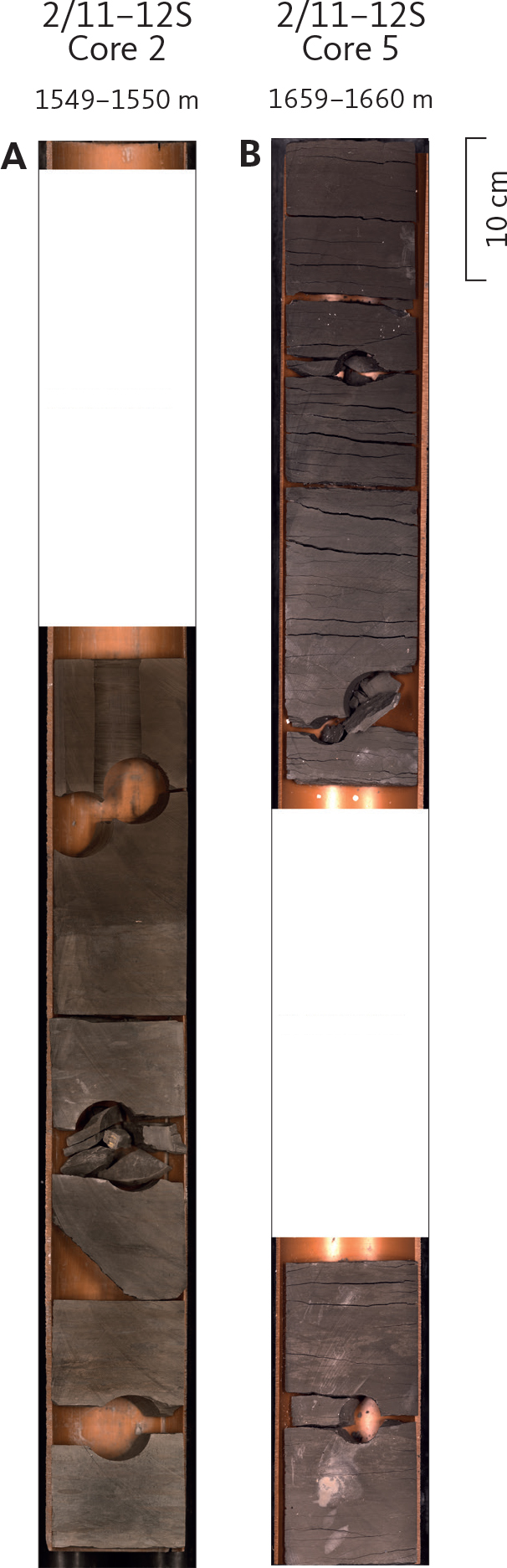
Fig. 25 Core section from the Norwegian well 2/11-12S showing the diatomite of the Nora Formation. (A): Core 2. (B): Core 5. The brownish colour is due to oil contamination.
Log characteristics. The Nora Formation is characterised by a distinct and consistent cross-over (negative separation) on neutron-density logs and in addition weakly serrated, but low, gamma-ray values (Figs 15B, 23). In the southern part of the Danish North Sea sector, the formation has a higher content of mud, and here, the cross-over of the neutron-density logs is less prominent.
Fossils. The lower part of the Nora Formation is characterised by relatively low abundance and low diversity alcareous benthic foraminifera assemblages, with rare agglutinated and planktonic foraminifera (Bailey et al. 1983; Ball et al. 1984). Calcareous benthic assemblages decrease in diversity and abundance in the upper part of the formation; agglutinated and planktonic foraminifera are rare. In the E-8 and Sten-1 wells, a rich and diverse assemblage of diatoms (siliceous preservation) and high abundances of sponge spicules and Radiolaria are present throughout the formation. The formation also contains a rich and diverse dinocyst assemblage (Quante & Dybkjær 2018; Dybkjær et al. 2021).
Depositional environment. The formation was deposited on the basin floor in water depths of more than 600 m, based on isochore data and paleodepths from biofacies. The rich assemblage of diatoms indicates a depositional setting far from clastic influx. The lack of lamination (Sheldon et al. 2018) is suggestive of intense bioturbation of the sediments although discrete traces are not identified; such wholesale biogenic reworking would imply that oxygen was present at the sea bottom.
Boundaries. The lower boundary is characterised by a change from superimposed neutron-density logs to cross-over (negative separation) of the two logs. An abrupt decrease in gamma-ray log readings is seen in wells from the northwestern part of the Danish sector (e.g. Sten-1; Fig. 22). In cuttings samples, a clear change in colour from brown to grey occurs at this boundary.
The upper boundary is characterised by a distinct increase in gamma-ray values. The neutron-density logs show a sharp (Nora-1) or more gradual (Sten-1) change from a clear separation in the Nora Formation to amalgamation in the overlying Hodde Formation (Figs 15B, 23). In the core in the E-8 well, the boundary is placed at a marked change from brown to dark brown mud (Fig. 24). In the northern part of the Danish Central Graben (Sten-1), a change from grey diatomite to dark brown mud characterises the boundary.
Distribution. The Nora Formation is recognised throughout the Danish Central Graben but has the highest content of diatomite in the northern part.
Biostratigraphy. The Nora Formation spans the Labyrinthodinium truncatum dinocyst Zone, with the exception of the lowermost part, and in addition, it includes the lower and middle part of the Unipontidinium aquaductus Zone of Dybkjær & Piasecki (2010; Sheldon et al. 2018; Quante & Dybkjær 2018; Dybkjær et al. 2021; Figs 1, 9).
The Nora Formation has been dated to the NSB12a-12b zone of King (1989) in Sten-1 (see also Bailey et al. 1983) and to the NSB10-12a zone of King (1989) in Nora-1 (Ball et al. 1984; Fig. 9). There is a slight discrepancy between palynological and microfossil dating in the uppermost part of the formation.
Geological age. The Nora Formation comprises deposits of Langhian (Middle Miocene) age.
6.2 Måde Group
revised group
History. The Måde Group was defined by Rasmussen et al. (2010) as encompassing the marine clay-dominated Middle and Upper Miocene deposits; this succession was previously termed the ‘Måde Serien’ (Rasmussen 1961). The lower part of the Måde Group exhibits an important shift in the pressure regime of the North Sea Cenozoic successions, especially in the Central Graben area (Vejbæk 2022). Detailed knowledge of this interval with respect to rock properties and stratigraphy has thus been important for energy companies operating in the North Sea. As the onshore lithostratigraphical units, the Hodde, Ørnhøj and Gram Formations (Rasmussen 1961; Rasmussen et al. 2010) can be traced lithostratigraphically into the offshore area and have been applied in daily operations in the North Sea, these names are adopted formally here. The Måde Group is equivalent to the Nordland Group in the Norwegian sector (Rasmussen et al. 2010; Eidvin et al. 2014a). In these studies, the base of the group is placed in the mid-Langhian. Schiøler et al. (2007; fig. 2) indicated a mid-Serravallian age for the lower boundary of the Nordland Group. However, this is inconsistent with the age of the top Lark Formation/base Nordland Group according to the biostratigraphy of Dybkjær & Piasecki (2010) and Dybkjær et al. (2021). The Måde Group comprises the clay-dominated Hodde, Ørnhøj and Gram Formations and the sand-rich Marbæk and Luna Formations, the latter including the Lille John Member.
Name. After Måde near Esbjerg (Fig. 2). Clay deposits from the Måde brickworks represent the fully marine upper Middle Miocene and Upper Miocene that overlie the deltaic Lower and lower Middle Miocene Ribe Group.
Type area. The Måde Group crops out at Måde, due east of Esbjerg where the clay-rich deposits referred to the Hodde, Ørnhøj and Gram Formations are exposed. The Hodde and Ørnhøj Formations are best exposed at Ørnhøj whereas the Gram Formation is exposed at the Gram clay-pit, southern Jylland (Fig. 2; Rasmussen et al. 2010). Offshore Denmark, the Gram Formation was cored in the North Sea well, Lille John-2 (Fig. 2). The sand-rich Marbæk Formation crops out north-west of Esbjerg and the lower 2 m of the Marbæk Formation is exposed in a little brook at the Gram clay-pit (Rasmussen et al. 2010). The Lille John Member of the Luna Formation was cored in the Lille John-2 well in the Central Graben, North Sea (Fig. 2).
North Sea wells in which the Måde Group is well represented are the Luna-1 well (56˚05′57.591″N, 5˚52′51.638″ Fig 26A), from 629.5 to 297 m MD, and the Nora-1 well (55˚58′09.17″N, 04˚24′04.46″E; Fig. 26B) from 1426.5 to 851 m MD.
Thickness. The Måde Group ranges in thickness from 300 m to 800 m. The group thins eastwards due to truncation.
Lithology. The group is composed of two cycles that are mud-dominated (Supplementary Files, Plate 4). Each cycle coarsens upwards and may be capped by discrete sand bodies (e.g. the Marbæk and Luna Formations; Supplementary Files, Plate 4). The sand-rich formations of the group consist of grey fine- to medium-grained sand with scattered coarse-grained sand and gravel; the fine-grained sands are rich in heavy minerals. Lignite is common in the upper cycle.
Log characteristics. In the offshore area, the lowermost part is characterised by a thin interval of distinctly high gamma-ray readings. This marked gamma-ray high is abruptly succeeded by another thin interval with medium high gamma-ray readings, followed by a distinct increase and then a gradual decrease. Above these distinct variations in gamma-ray readings in the basal part of the Måde Group, the thick upper part of the group is characterised by a rather stable, though often highly serrated log pattern (Supplementary Files, Plates 4 and 9). The upper part of the Måde Group locally shows gradual decreasing gamma-ray readings (e.g. Luna-1, E-1X; Fig. 26A; Supplementary Files, Plate 4).
Fossils. A rich and diverse dinocyst assemblage characterises the lower part of the Måde Group. Upwards, the abundance and diversity decrease gradually to a moderate level (Dybkjær et al. 2021). The calcareous foraminifera assemblages vary significantly, from being totally absent to assemblages of high abundance and diversity; the agglutinated foraminifera assemblages vary in abundance between frequent and absent. More details can be found in the following descriptions of the component formations.
Depositional environment. The sediments of the Måde Group were deposited in an open marine environment that characterised the Danish Sector during the late Middle to Late Miocene. During the early part, the area was sediment-starved due to the long distance to the shoreline and thus dominated by hemipelagic deposition with excellent conditions for formation of glaucony in the early phase. By the end of the Miocene, successive regressions gave rise to shoreface and fluvio-deltaic depositional environments in the area.
Boundaries. The lower boundary is very sharp, being defined at a change from coarse-grained sediments to fine-grained deposits. In the proximal, eastern part of the study area, this shift typically represents a change from coastal plain or fluvial sand-rich sediments to marine mud. In the more distal, offshore part, the boundary is commonly developed as a change from mud to clay or even glaucony-rich clay. This lower boundary shows an abrupt shift to higher gamma-ray values (Fig. 26A B; Supplementary Files, Plates 1–9) and forms a prominent seismic marker (the previously mentioned MMU) in the study area.
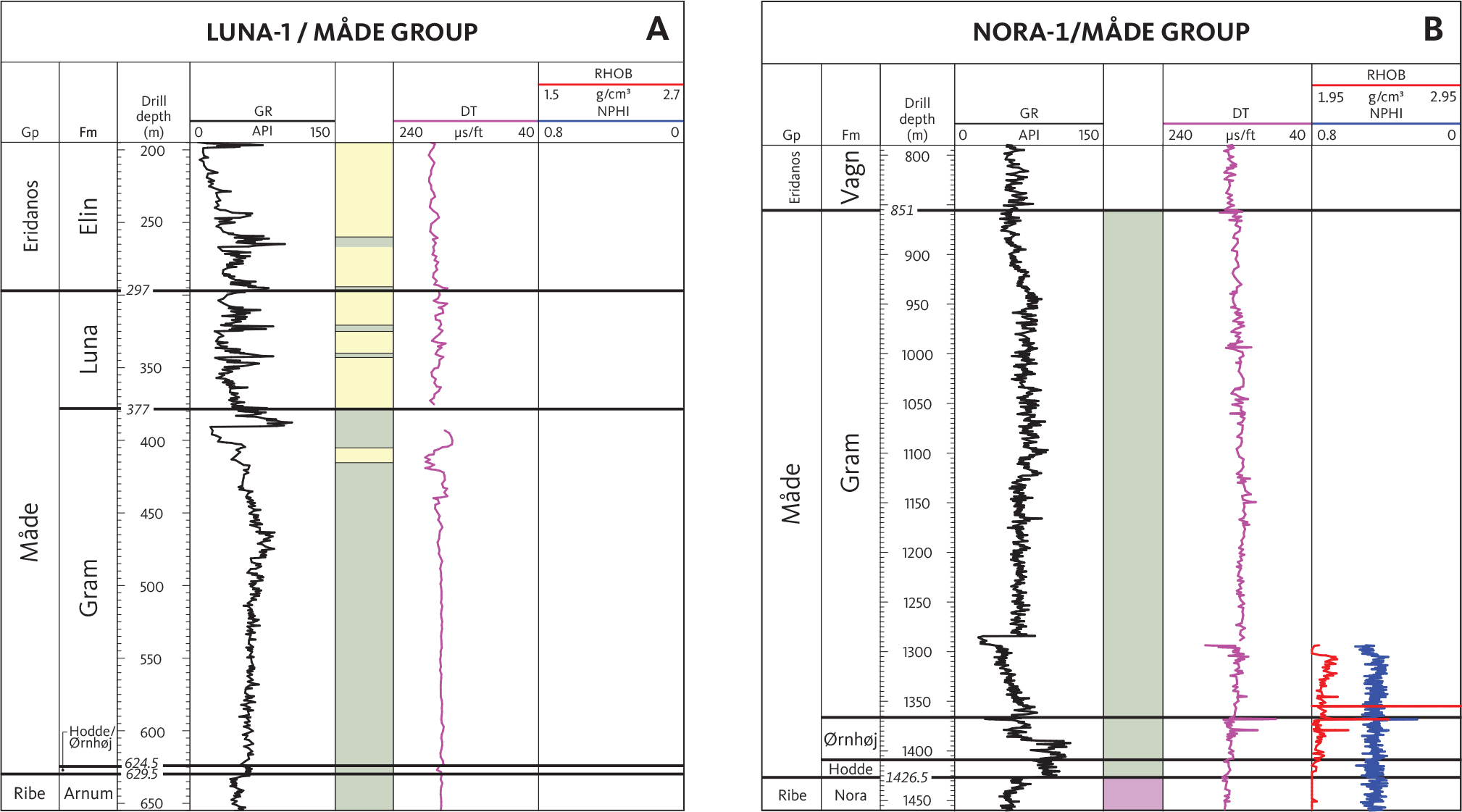
Fig. 26 Representative sections of the Måde Group are the Luna-1 well from 629.5 to 297 m MD (A) and the Nora-1 well from 1426.5 to 851 m MD (B). Note that the log breaks at c. 390 m in Luna-1 and 1280 m in Nora-1 are due to casings. For legend, see Fig. 14.
In the core in the Lille John-2 well, the upper boundary of the Måde Group is represented by an erosional surface (Fig. 43B). The boundary is typically less well-defined on petrophysical logs although in some wells there is a marked increase in gamma-ray values across the boundary (e.g. W-1, Elin-1, Nora-1; Supplementary Files, Plate 3). On seismic data, the upper boundary of the group is characterised by a continuous, medium–high amplitude reflector that shows onlap in the south-western part of the study area.
Distribution. The Måde Group is recognised in the entire offshore North Sea area in western and south-western Jylland. The disappearance towards the east and north-east is due to truncation at the base of the Quaternary.
Geological age. The Måde Group comprises deposits of late Langhian to Messinian (Middle Miocene to latest Late Miocene) age.
Subdivision. The Group is subdivided into five formations: the Hodde, Ørnhøj, Gram, Marbæk and Luna (new) Formations.
6.2.1 Hodde Formation
History. The formation was erected by Rasmussen (1961) as the basal unit of his marine Måde series, now the Måde Group. Deposition of the Hodde Formation reflects a major change in the depositional environment in the eastern North Sea Basin.
Name. After the village of Hodde (Fig. 2).
Type and reference section. The type section was defined by Rasmussen (1961) as the section from 23.4 to 13.8 m MD in the Hodde-1 borehole (DGU no. 113.33; 55˚41'04.11″N, 8˚40′14.27″E). The formation crops out at Lille Spåbæk near Ørnhøj, south of Holstebro (Fig. 2; Rasmussen et al. 2010, figs 66 and 67). The primary reference section is the interval from 51 to 44.90 m (core depth) in the cored borehole at Sdr. Vium (DGU no. 102.948; Rasmussen et al. 2010, fig. 65). The North Sea reference well is E-8, from 1265 to 1247.5 m MD (Fig. 27).
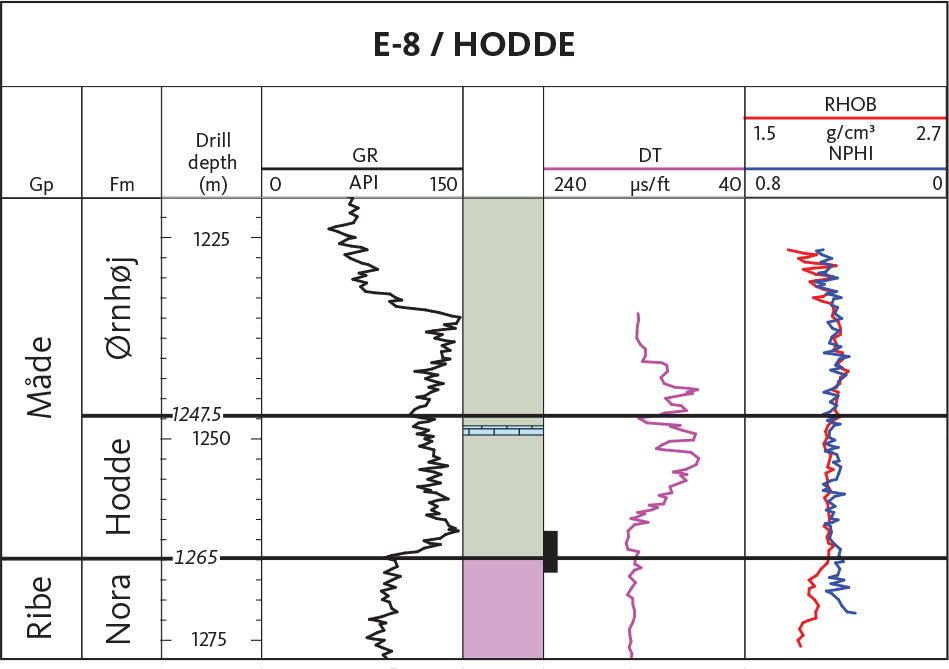
Fig. 27 The North Sea reference well for the Hodde Formation is the E-8 well from 1265 to 1247.5 m MD. The location of the lower boundary in the core is shown in Fig. 24. For legend, see Fig. 14.
Thickness. The formation is 9.6 m thick in the type section, but thicknesses up to 40 m are recorded in south-west Jylland and in the Central Graben (Supplementary Files, Plates 10 and 11).
Lithology. The Hodde Formation is composed of dark brown, organic-rich, mica-rich, bioturbated silty clay (Figs 28, 29). Pyrite is common, and glaucony occurs at different levels in the formation, particularly in the upper part. In the eastern, onshore area, a basal conglomerate is recorded and sand lenses, locally laminated, are common in the dominant silty clay. In the western (Central Graben) and southern part (around S-1 well) of the offshore area, the Hodde Formation is dominated by bioturbated dark brown clay (Figs 28, 29). Trace fossils are common at onshore localities (Asgaard & Bromley 1974).
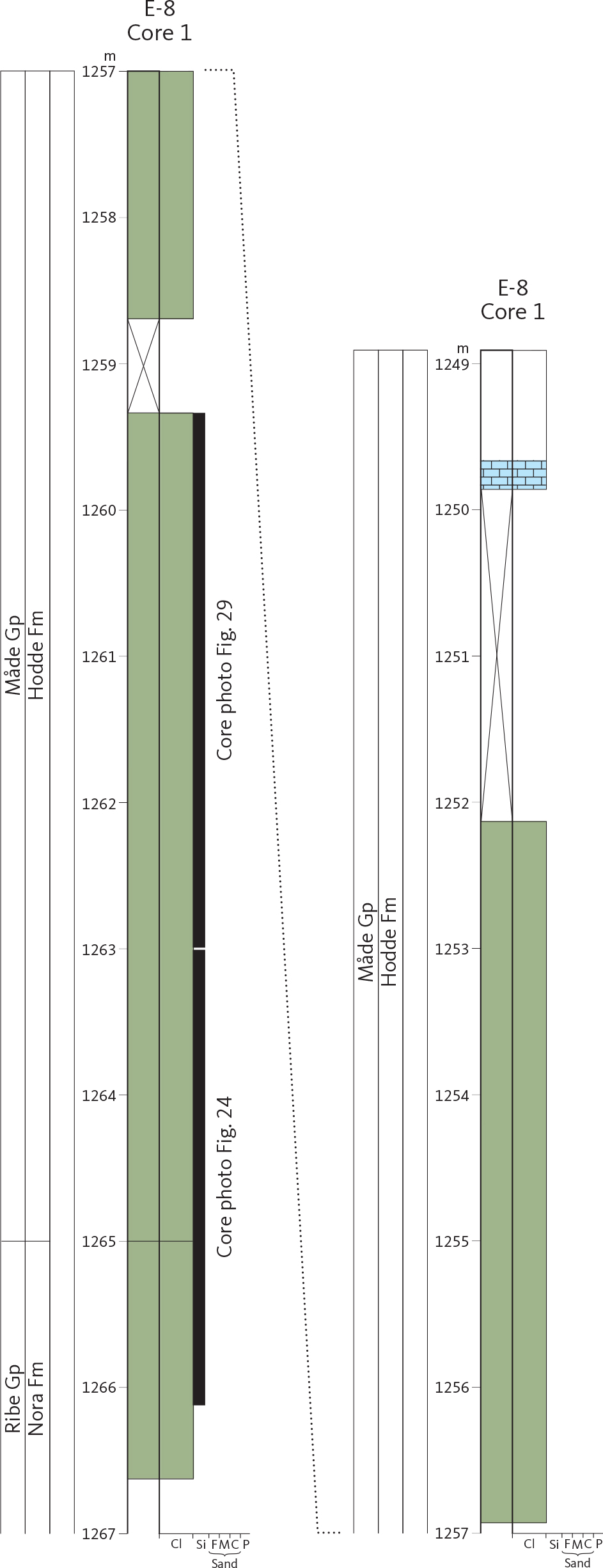
Fig. 28 Measured cored section from the E-8 well of the Hodde Formation. The location of the lower boundary in the core is shown in Fig. 24. Note that the sediment is totally bioturbated. For legend, see Fig. 14.
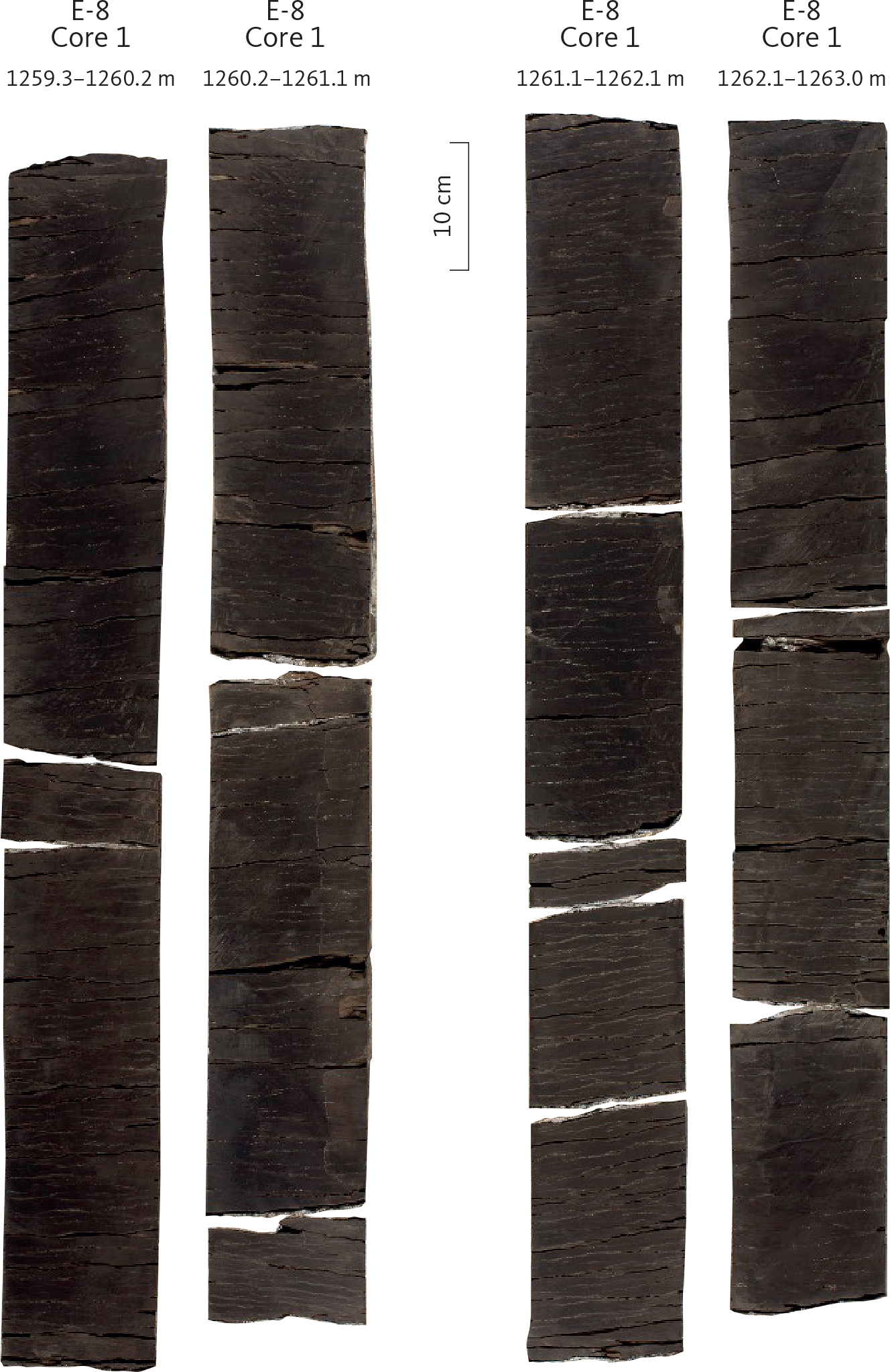
Fig. 29 Slabbed core section of the Hodde Formation from the E-8 well (Fig. 28). Note that the formation is totally bioturbated.
Log characteristics. The formation is characterised by moderate to high gamma-ray values. Two typical patterns are recognised: (1) a gradual upward increase in gamma-ray values, which is seen onshore in the wells Sdr. Vium, Stensig and Ulfborg (Rasmussen et al. 2010) and most pronounced in the Sten-1, Jens-1 and V-1 wells offshore (Supplementary Files, Plates 2, 5 and 11) or (2) a gradual upward increase in gamma-ray values followed by a gradual decrease as seen in the Føvling and Stensig wells onshore (Rasmussen et al. 2010) and in the North Sea wells Emma-1, Alma-1 and T-1 (Supplementary Files, Plates 6, 10–12). The neutron-density log shows subtle separation (E-8, Fig. 27) or amalgamation (Nora-1, Fig. 15B). However, in the north-western part of the Danish Central Graben area, a more gradual transition from separated neutron-density logs to subtle separation is seen (Sten-1, Fig. 23).
Fossils. The Hodde Formation contains a rich and highly diverse dinocyst assemblage (Quante & Dybkjær 2018; Dybkjær et al. 2021). The cored lower part of the Hodde Formation in the E-8 well contains abundant sponge spicules and common Bolboforma, radiolaria and diatoms.
Depositional environment. The depositional environment was fully marine (Rasmussen 1961; Rasmussen et al. 2010). The formation represents an overall transgression; the basal gravel layer (in onshore sections) represents a transgressive lag, deposited in a shallow marine setting, and the succeeding glaucony-rich clays were laid down in relatively deep water (>100 m). The northern and eastern part of the Ringkøbing–Fyn High area is characterised by shelfal conditions whilst an NNW–SSE-trending slope at the margin of the Central Graben occurs west of the Tabita-1 and Per-1 wells. South of the Per-1 well, the slope swings towards the east and follows a gentle curve path around the S-1 well and subsequently continues towards the SE. This pattern, which was also present during the Middle Miocene, is shown in Fig. 6. In the deeper south-western portion of the Danish sector, the water depth was in the order of 600 m based on isochore data and palaeodepth from biofacies (Fig. 10).
Boundaries. The lower boundary is sharp. The gamma-ray log shows a prominent shift to high gamma-ray readings (Fig. 27; Supplementary Files, Plates 1–12). In the cored sections in the E-8 well (offshore), the boundary is subtle but placed at 1265 m due to the distinct change in gamma-ray log response (Fig. 27). In the Sdr. Vium core (onshore), the boundary is seen as a shift in colour from brown to dark brown clay (Fig. 24). In most of the onshore area, there is a distinct change in lithology from the white, fine- to medium-grained sand of the Odderup Formation to the dark brown clayey silt of the Hodde Formation; in addition, the boundary is commonly associated with a gravel layer, the base of which forms the boundary. On seismic data, the base of the Hodde Formation (and the Måde Group) is marked by a well-defined seismic reflector in most of the Danish area. Local unconformities are present, however, especially in the slope area (Huuse et al. 2001; Rasmussen et al. 2005). In the Central Graben area, the lower boundary correlates with a high amplitude reflector that dims significantly towards the west.
The upper boundary is located at a shift from an upwards decreasing to an upwards increasing gamma-ray log response (Fig. 27; Supplementary Files, Plates 4 and 9). At the onshore type section, the boundary is placed at an abrupt change from dark brown clayey silts referred to the Hodde Formation to greenish brown clays of the Ørnhøj Formation (Rasmussen et al. 2010).
Distribution. The Hodde Formation is found in most of the Danish sector, but due to truncation, it is absent in the north-eastern part of the North Sea and in north and east Jylland (Fig. 30).

Fig. 30 Distribution of the Hodde, Ørnhøj and Gram Formations (stratigraphic interval indicated by red box), illustrated in terms of their dominant sedimentary association: these formations consist exclusively of deep marine mud. Neogene deposits of this age have been removed by erosion east of the (black) truncation line indicated in the offshore area; the distribution of sedimentary associations east of this line (and north-east of the onshore outcrops/wells) is hypothetical.
Biostratigraphy. The Unipontidinium aquaductus dinocyst zone is recorded in the Hodde Formation (Figs 1, 9; Piasecki 1980; Dybkjær & Piasecki 2010; Quante & Dybkjær 2018).
Geological age. The Hodde Formation comprises deposits of late Langhian to early Serravallian (Middle Miocene) age.
6.2.2 Ørnhøj Formation
History. The deposits referred to the Ørnhøj Formation previously formed part of the Gram Formation and were referred to the ‘Glauconite Clay member’ forming the lower part of the Gram Formation of Rasmussen (1956, 1961). Rasmussen et al. (2010) elevated this member to the rank of formation and named it the Ørnhøj Formation.
Name. After the village of Ørnhøj (Fig. 2) where the formation crops out 2 km due west of the village.
Type and reference sections. The formation is exposed at Lille Spåbæk, 2 km west of Ørnhøj (Fig. 2). The type section is the section from 44.90 to 40 m (core depth) in the cored borehole at Sdr. Vium (DGU no. 102.948; 55˚49′04.02″ N, 8˚24′46.52″E; Rasmussen et al. 2010, fig. 68). The reference section in the North Sea is the interval from 1410 to 1367.5 m MD in the Nora-1 well (55˚58′09.17″N, 04˚24′04.46″E; Fig. 31).
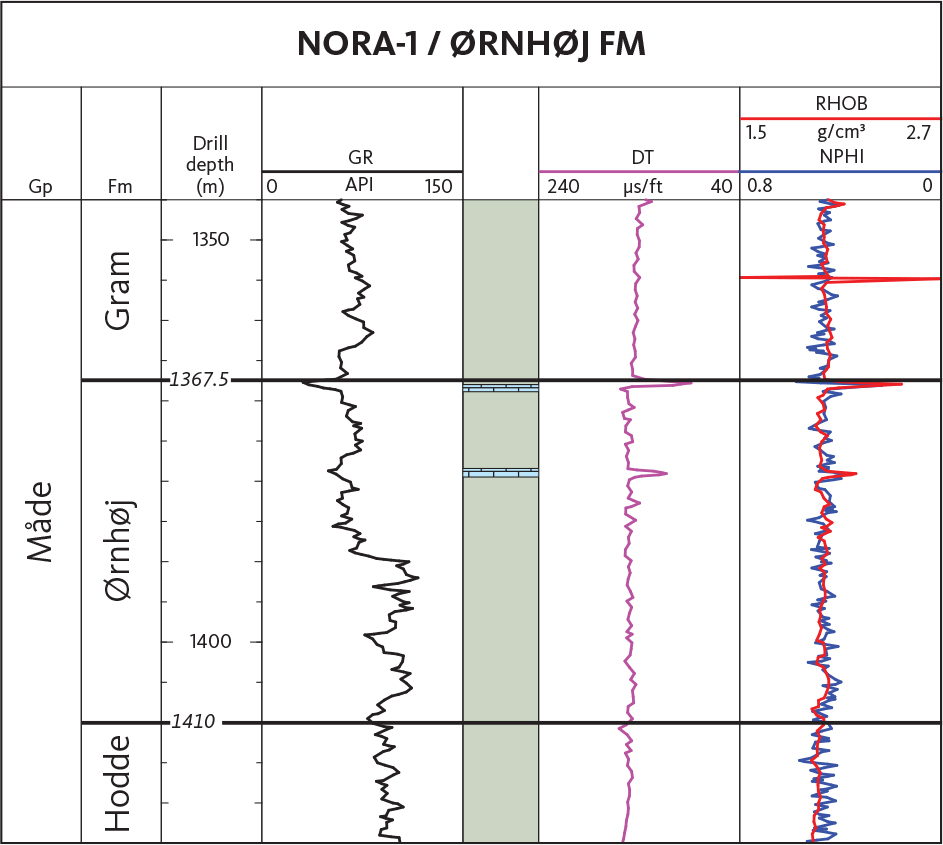
Fig. 31 The reference well in the North Sea for the Ørnhøj Formation is the Nora-1 well from 1410 to 1367.5 m MD. For legend, see Fig. 14.
Thickness. The Ørnhøj Formation is c. 5 m thick in the type borehole, Sdr. Vium, and this thickness is typical in most eastern parts of the North Sea area and in onshore Denmark. In the Central Graben, the formation is generally thicker; it is 42.5 m thick in the reference well, Nora-1 (Fig. 31).
Lithology. The Ørnhøj Formation consists of green and brown clay. In some intervals, especially in the basal part, glaucony-rich pellets dominate. In the upper part, goethification of glaucony is common, and carbonate stringers (probably concretionary) occur locally in the formation in the Central Graben area (Fig. 31).
Log characteristics. The formation is characterised by high gamma-ray readings in the lower part, abruptly succeeded in the upper part by distinctly lower gamma-ray values (Fig. 31; Supplementary Files, Plates 1–9).
Fossils. The Ørnhøj Formation contains a rich and highly diverse dinocyst assemblage (Quante & Dybkjær 2018; Dybkjær et al. 2021). Low to relatively high abundance and low diversity assemblages of calcareous benthic foraminifera are present; planktonic and agglutinating foraminifera and diatoms are rare. Bolboforma are abundant, whilst sponge spicules are abundant at some levels (Ball et al. 1984).
Depositional environment. The formation was deposited in a fully marine, sediment-starved environment that favoured the formation of glaucony. Onshore Denmark, the water depth was more than 100 m deep (Rasmussen et al. 2010), deepening slightly westwards in the North Sea area. An NNW–SSE-striking slope, separating shallower water from deeper water runs west of the Tabita-1 and Per-1 wells. South of the Per-1 well, the slope curves towards the east and follows a gentle curve around the S-1 well and thereafter continues south-eastwards (see this pattern in Fig. 6), which was also present during the Middle Miocene. Westwards of the slope, the water depth was more than 700 m (Fig. 10; Rasmussen 2004, fig. 4B).
Boundaries. The lower boundary is placed at a low gamma-ray spike followed by a distinct increase in gamma-ray log response towards extremely high values (Fig. 31). At the type section, an abrupt change from dark brown clayey silts of the Hodde Formation to greenish brown clays of the Ørnhøj Formation is present.
The upper boundary is commonly represented by a spike on the gamma-ray log and a change from the gradually decreasing gamma-ray log response of the Ørnhøj Formation to steady and highly serrated gamma-ray readings of the Gram Formation (Fig. 31; Supplementary Files, Plates 1–9).
Distribution. The Ørnhøj Formation is present throughout the offshore Danish sector and onshore in southern and western Jylland, but is truncated in northern and eastern Jylland, eastwards of the truncation line indicated on Fig. 30.
Biostratigraphy. The dinocyst zones Achomosphaera andalousiense and Gramocysta verricula of Dybkjær & Piasecki (2010) have been identified within the Ørnhøj Formation (Figs 1, 9; Dybkjær & Piasecki 2010; Quante & Dybkjær 2018; Dybkjær et al. 2021).
The calcareous benthic foraminifera subzones NSB12a-b of King (1989) are recorded in the Ørnhøj Formation in the Nora-1 (Ball et al. 1984) and E-8 wells (Fig. 9).
Geological age. The Ørnhøj Formation comprises deposits of mid-Serravallian (Middle Miocene) to lowermost Tortonian (Late Miocene) age.
6.2.3 Gram Formation
History. The Gram Formation was erected by Rasmussen (1956) to represent the marine Upper Miocene clay-rich deposits onshore Denmark. The formation was revised by Rasmussen et al. (2010), restricting the Gram Formation to the original Gram Clay member of Rasmussen (1956, 1961); this restricted usage is followed here. In this study, the onshore Gram Formation is extended into the North Sea realm, given the lithological similarity of the offshore Upper Miocene succession and the onshore Gram Formation and their geographical continuity.
Name. After the town of Gram in southern Jylland (Fig. 2).
Type and reference sections. The type section is at the clay pit at Gram (55˚18′24.90″ N, 9˚03′31.26″E; Rasmussen et al. 2010, figs 70, 71). The reference offshore well is Nora-1 (55˚58′09.17″N, 04˚24′04.46″E) from 1367.5 to 851 m MD (Fig. 32); the formation is cored in the Lille John-2 well (55˚25′11.30″N, 04˚50′08.65″E; Fig. 2), 1249.7 to 1187.68 m (core depth; Fig. 37), intercalated with an interval of the Lille John Member (Luna Formation) from 1229.61 to 1225.14 m and from 1198.37 to 1188.15 m (core depth; Figs 33, 34, 37).
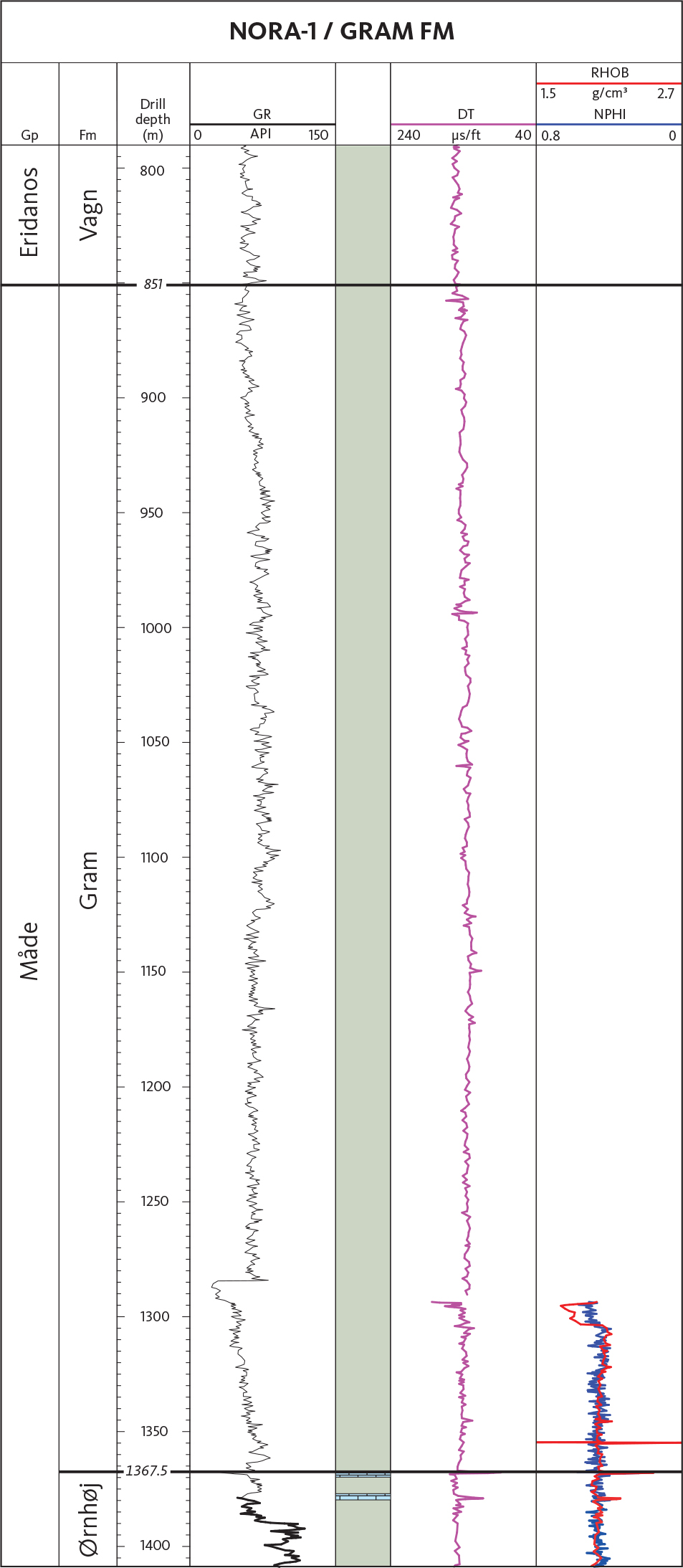
Fig. 32 The North Sea reference well for the Gram Formation is the Nora-1 well from 1367.5 to 851 m MD. Note the log break at c. 1280 m which is caused by a casing; for legend, see Fig. 14.
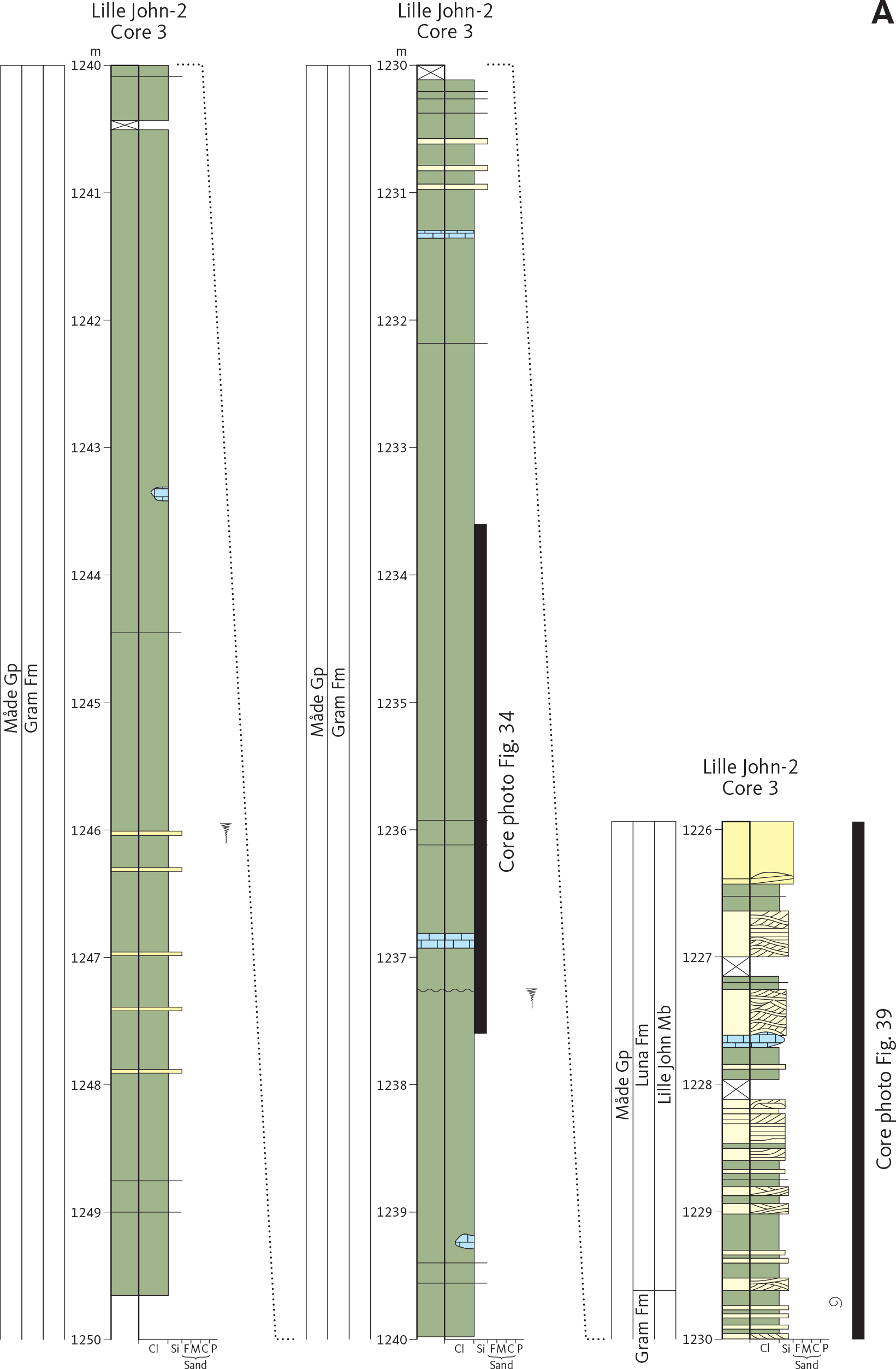
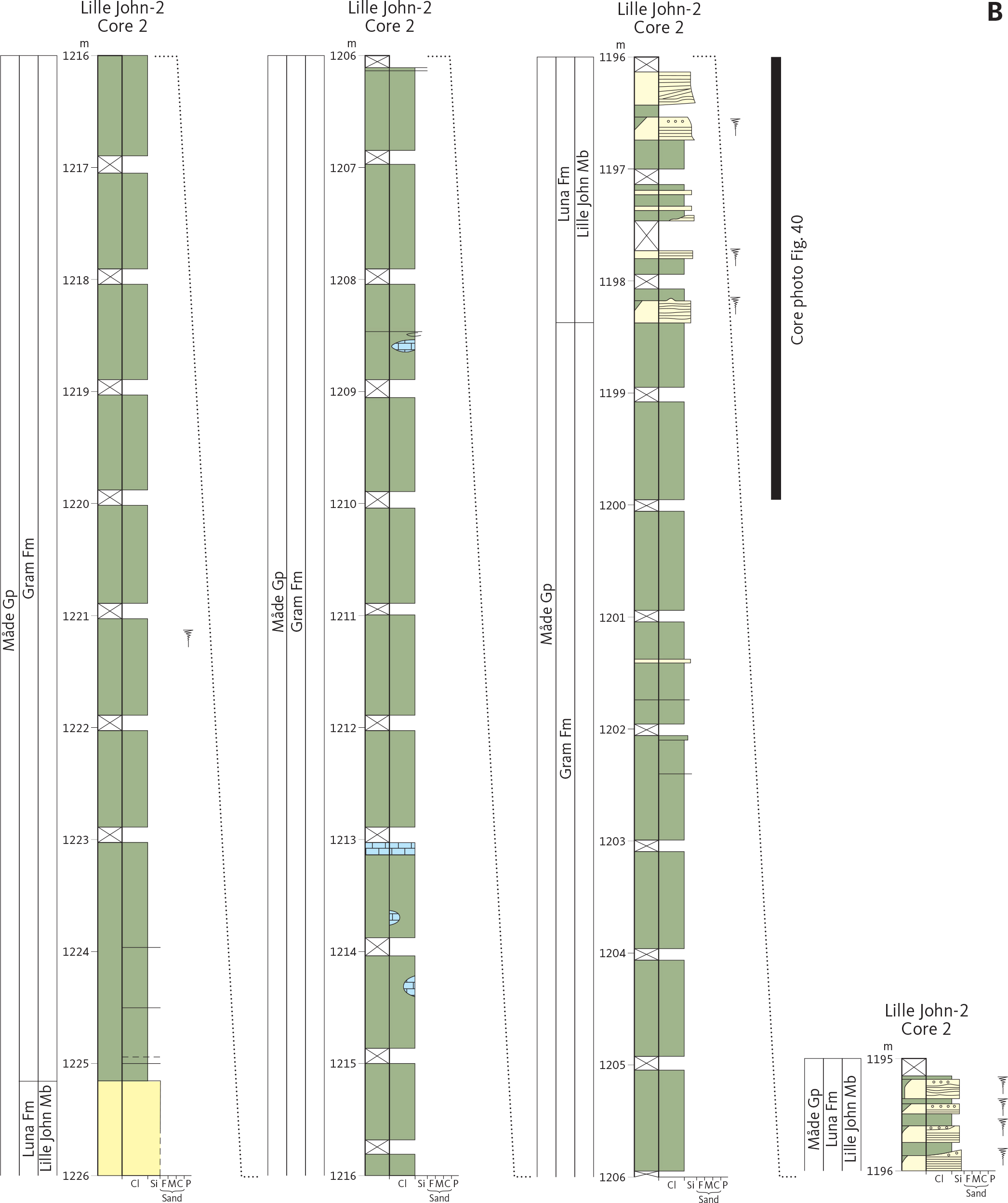
Fig. 33 Measured section of the Gram Formation from the Lille John-2 well; Core 3 (A) and Core 2 (B). For legend, see Fig. 14. Note the two silt–sand-rich intervals at 1229.61 to 1225.14 m MD and 1198.37 to 1188.15 m MD, which are referred to the Lille John Member of the Luna Formation.
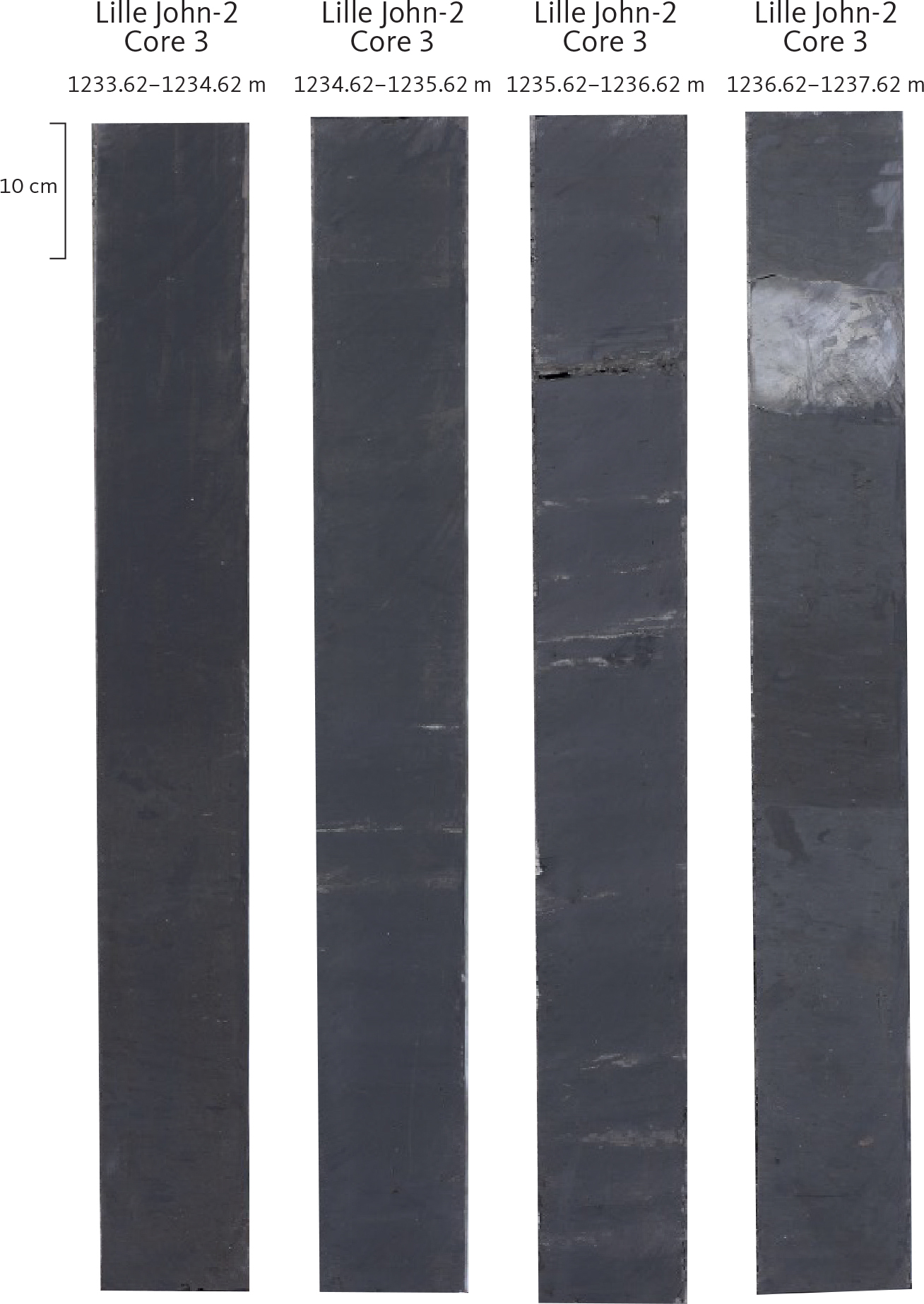
Fig. 34 Slabbed core section of the Gram Formation in the Lille John-2 well. The grey interval in the upper part of the cored section (to the right) is a carbonate concretion. The location of the illustrated core interval is indicated in Fig. 33A as a black bar.
Thickness. The type section reveals 13.1 m of the formation, though neither the base nor top are observed (Rasmussen et al. 2010); in southern Jylland, the Tinglev borehole penetrated a section 105 m thick. The thickness increases towards the west (North Sea), and thicknesses of 400 m are common in the Central Graben area (Supplementary Files, Plates 1–12). The thickest development is recorded around the Nora-1 and Elin-1 wells, where the thickness extends to more than 500 m. In the south-western part of the Central Graben, the Gram Formation thins to less than 200 m.
Lithology. The Gram Formation is characterised by dark brown clay, which appears grey when oxidised (Fig. 34). Fine-grained sand beds up to 5 cm thick are commonly interstratified with the clay in the upper part of the formation; the sands are laminated and/or show wave ripples and micro hummocky cross-stratification. Concretions (siderite) are common, especially in the lower part of the formation. The clay mineral association is composed of c. 50% of both kaolinite and illite with minor smectite (up to 10%) in the Ringkøbing–Fyn High area. In the Central Graben area, the smectite content is 20–30%, and kaolinite and illite make up 30–40% and 20–30%, respectively (Nielsen et al. 2015). The chlorite content is up to 10%; the organic content is 1–2%. The trace fossils Schaubcyclindrichnus freyi, Scolicia, Chondrites, Planolites cylindrichnus and Trichichnus are found in the formation.
Log characteristics. In the reference well (Fig. 32), the lowermost c. 70 m shows a basal interval of moderate gamma-ray peaks and a succeeding interval showing gradually decreasing values up-section; this basal pattern in the Gram Formation is common to many wells (Supplementary Files, Plates 4, 9). Above 1300 m, the gamma-ray log is highly serrated and displays rather stable, moderate values. The uppermost levels of the formation commonly show a weakly upward-decreasing trend in the gamma-ray values (e.g. at 760–660 m in Per-1, 460–415 m in Luna-1; Supplementary Files, Plate 4).
Fossils. The Gram Formation shows a stepwise decrease in dinocyst abundance and diversity from a rich and diverse dinocyst assemblage in the lower part to a sparse, low diversity dinocyst assemblage in the upper part (Rasmussen et al. 2015; Sheldon & Dybkjær 2015; Dybkjær et al. 2021).
In the Luna-1 well, calcareous benthic foraminifera assemblages are moderately abundant and diverse in the lower part of the Gram Formation, but abundance and diversity decrease upwards. Similarly, low abundance and diversity agglutinated and planktonic foraminifera assemblages characterise the lower part of the Gram Formation but are absent in the upper part (Rasmussen et al. 2015). In the cored section in the Lille John-2 well, representing the upper part of the Gram Formation, agglutinated and planktic foraminifera and diatoms are rare, whereas calcareous benthic foraminifera assemblages are moderately diverse (Rasmussen et al. 2015; Sheldon & Dybkjær 2015).
Depositional environment. Deposition took place in an open marine environment (Rasmussen 1961; Rasmussen 2005). Onshore Denmark, the water depth is interpreted to have been greater than 100 m (Laursen & Kristoffersen 1999). The environment probably deepened slightly westwards in the eastern part of the North Sea; beyond the inferred slope, described above, water depths may have reached 600 m. Progressive shallowing probably accompanied the accumulation of the Gram Formation marine muds, linked to coastal progradation exemplified by the deltaic deposits of the Marbæk and Luna Formations.
Boundaries. Onshore, the lower boundary is sharp and characterised by a change from greenish brown or brown, glaucony-rich clay to dark brown clay. In the Central Graben area, a discrete carbonate layer forms the lower boundary. This boundary is recorded on logs by a distinct sonic log peak and a marked low in gamma-ray readings (Fig. 32; Supplementary Files, Plates 1–9).
In the offshore record, the upper boundary has only been cored in the Lille John-2 well. The boundary is erosional in this core and defines an abrupt change from dark brown clay with intercalated fine-grained sand beds to dark brown clay (Figs 37, 43B). On gamma-ray logs, it is commonly characterised by a marked increase in gamma-ray readings, but in a few wells, a decrease is seen above a thin layer showing high gamma-ray readings, for example in E-1 and TSB-09 (Supplementary Files, Plate 9). The definition of this boundary is mainly based on seismic data, which show a distinct surface characterised by onlap. Unfortunately, this surface is not always clearly expressed in the log patterns.
Distribution. The eastern limit of the formation is in the eastern- and northernmost parts of southern and western Jylland (Fig. 30) where it is truncated by the base Quaternary surface. It is recognised in the entire Danish North Sea west of this truncation line.
Biostratigraphy. The Amiculosphaera umbracula, the Hystrichosphaeropsis obscura and the lower to middle part of the Selenopemphix armageddonensis dinocyst zones of Dybkjær & Piasecki (2010) are present in the Gram Formation (Figs 1, 9; Piasecki 1980, 2005; Dybkjær & Piasecki 2010; Rasmussen et al. 2015; Sheldon & Dybkjær 2015; Dybkjær et al. 2021).
The calcareous benthic foraminifera zones NSB12b to NSB13b of Laursen & Kristoffersen (1999) are present in the Gram Formation in the Luna-1 well (Rasmussen et al. 2015), while the NSB13b subzone (King 1989) is present in the cored upper part of the formation in the Lille John-2 well (Fig. 9; Sheldon & Dybkjær 2015).
Geological age. The Gram Formation comprises deposits of Tortonian and Messinian (Late Miocene) age. The upper boundary of the Gram Formation correlates approximately with the Miocene–Pliocene boundary.
6.2.4 Marbæk Formation
The Marbæk Formation is a sand-rich shoreface to deltaic unit defined onshore Denmark (see Rasmussen et al. 2010). Offshore, this formation is recognised locally on the Ringkøbing–Fyn High (R-1, S-1 wells; Supplementary Files, Plate 10), and a clinoformal package in the south-westernmost part of the Ringkøbing–Fyn High area in the German sector is tentatively correlated with the Marbæk Formation (Fig. 11). An inferred distribution of the Marbæk Formation is illustrated in Fig. 35.
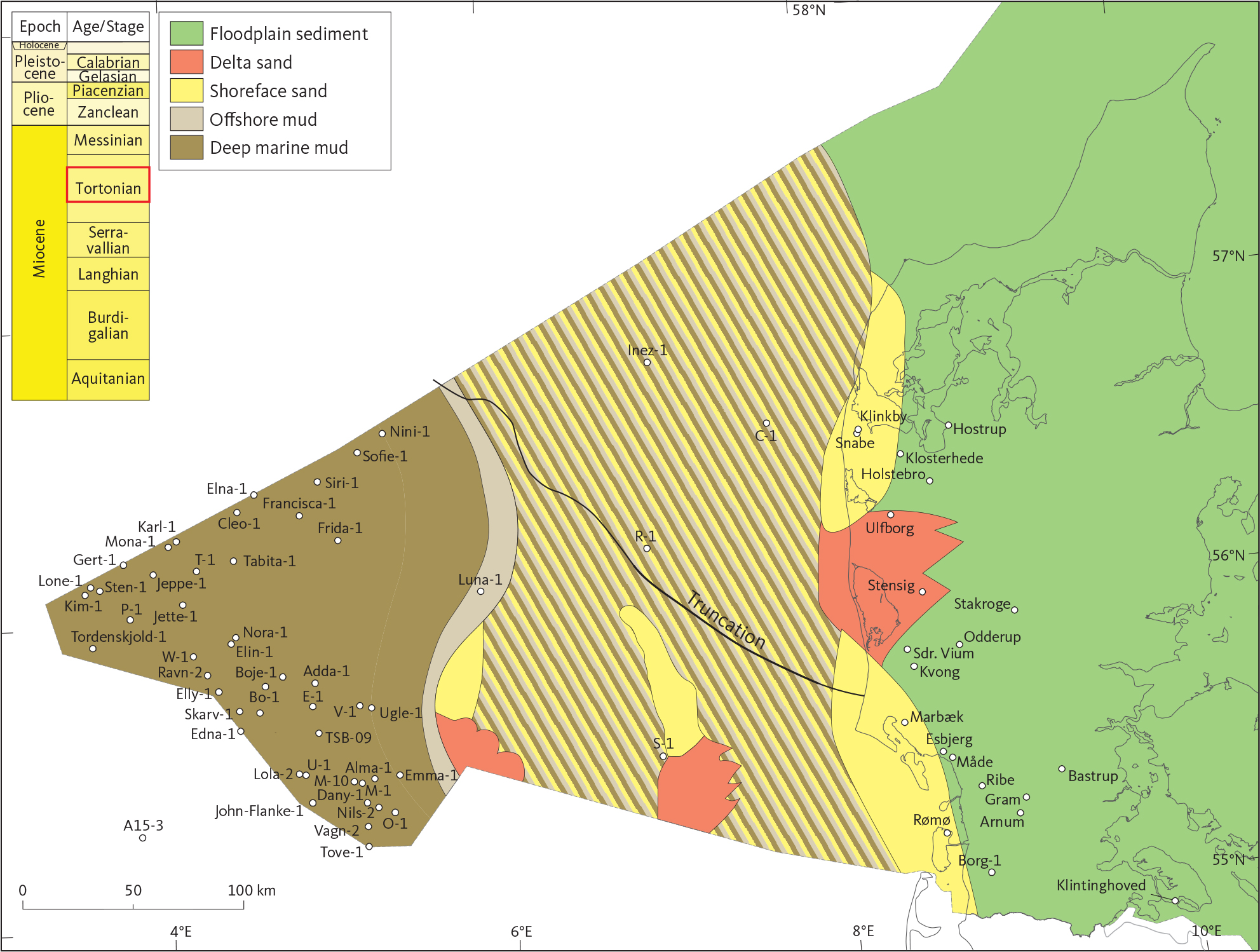
Fig. 35 Distribution of the Marbæk and Gram Formations (stratigraphic interval indicated by red box), illustrated in terms of their dominant sedimentary associations: The floodplain sediments and the delta and shoreface sand are referred to the Marbæk Formation; the offshore mud and the deep marine mud are referred to the Gram Formation. Neogene deposits of this age have been removed by erosion east of the truncation line indicated in the offshore area; the distribution of sedimentary associations east of this line (and north-east of the onshore outcrops/wells) is hypothetical. The striped belt indicates an area that is inferred to have experienced shifting depositional settings during the Tortonian.

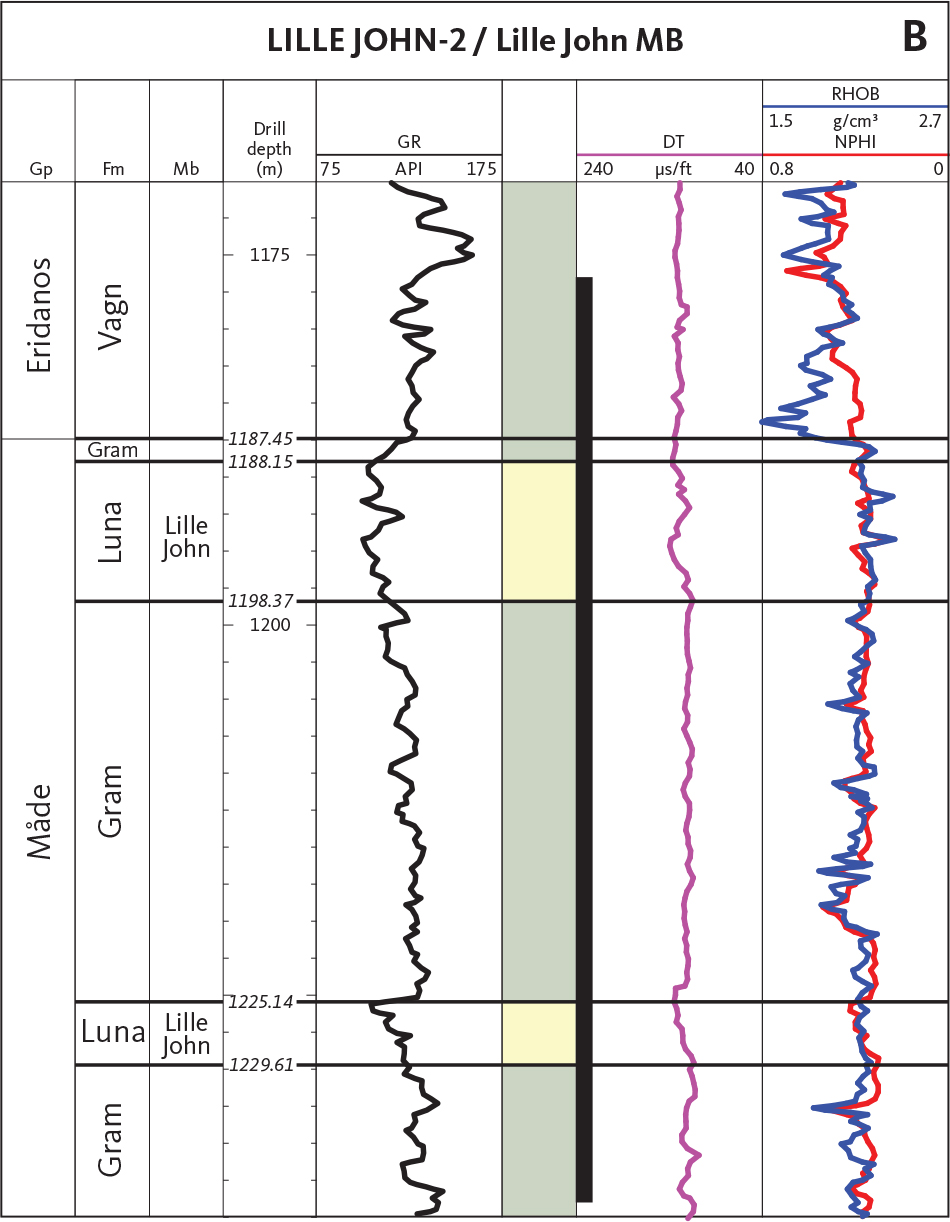
Fig. 36 (A): The type section of the Luna Formation is the Luna-1 well from 377 to 267 m MD. (B): The type section for the Lille John Member and the reference section for the Luna Formation is the Lille John-2 well from 1229.61 to 1225.14 m and 1198.37 to 1188.15 m MD (see also Fig. 33). The interval from 1239 to 1176.5 m is cored (black bar); a four metre interval spanning the upper boundary of the Måde Group is shown in Fig. 43. For legend, see Fig. 14.
6.2.5 Luna Formation
new formation
History. An oil-bearing Upper Miocene sand was penetrated in a number of wells around the John structure (e.g. in the Lille John-2 well) located in the south-western Danish Central Graben (Fig. 2). In 2012, the Lille John-1 well penetrated c. 10 m of oil-bearing silt and sand. The silt and sand intervals were confirmed by the Lille John-2 well drilled three years later; the succession was cored in this well. This relatively thin interval of silt to fine-grained sand beds (defined here as the Lille John Member), that was penetrated near the John structure, correlates with significantly thicker sand units in other wells in the North Sea, particularly in the E-1 and Luna-1 wells (Supplementary Files, Plates 4 and 9).
Name. After the Luna-1 well (Fig. 2).
Type and reference section. The type section of the Luna Formation is from 377 to 297 m MD in the Luna-1 well (56˚05′57.591″N, 5˚52′51.638″E; Fig. 36A). The reference sections are the cored intervals from 1229.61 to 1225.14 m and 1198.37 to 1188.15 m (core depth) in the Lille John-2 well (Figs 33, 36B, 37).
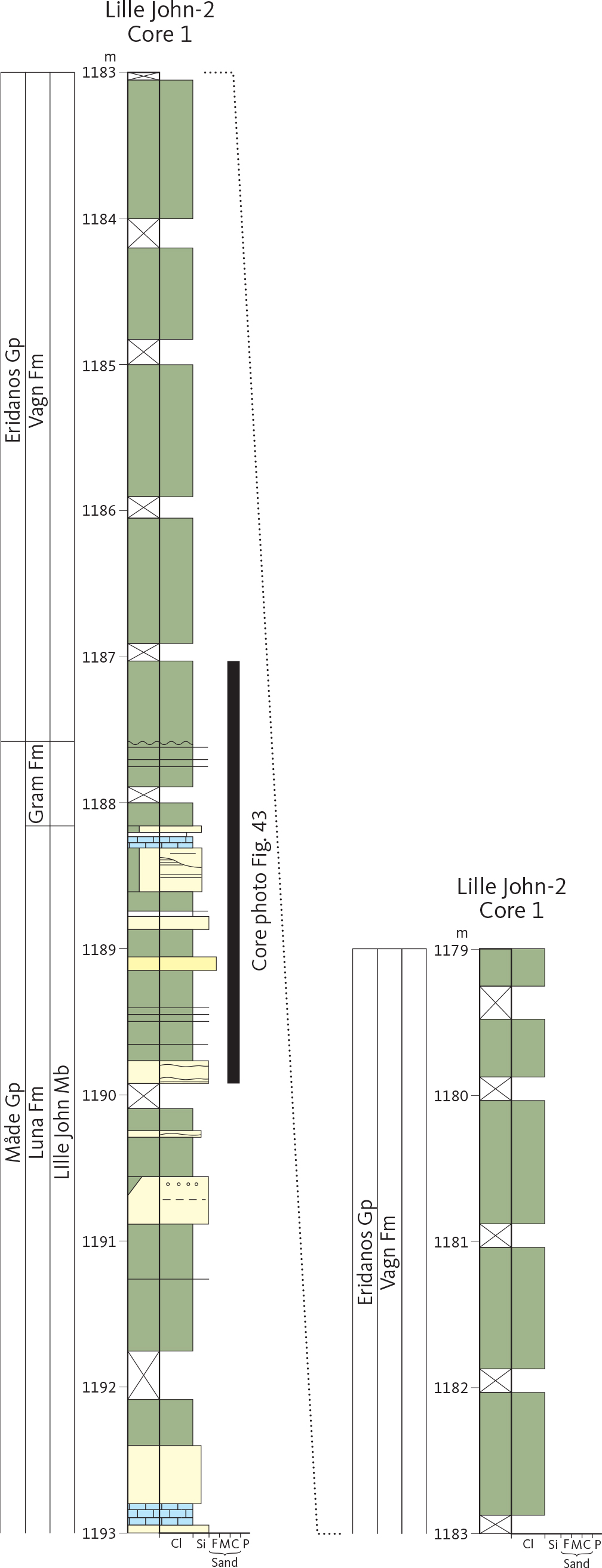
Fig. 37 Measured section of the Luna Formation (including the Lille John Member) and the Vagn Formation from the Lille John-2 well. Note the erosional boundary at the base of the Vagn Formation. For legend, see Fig. 14.
Thickness. In the type section, the formation is 135 m thick. Based on a petrophysical study, thicknesses of up to c. 130 m have also been recognised in the V-1 and E-1 wells (Supplementary Files, Plate 5).
Lithology. The Luna Formation is composed of grey, mica-rich, fine- to coarse-grained sand (Fig. 38). Cuttings samples demonstrate that angular–subangular clasts up to 6 mm in diameter are present around 362 m in the type well; at this level, some of the sand is cemented. Both lignite and shells are common (Fig. 38). The sand interval above 317 m in the Luna-1 well is composed of well-sorted sand concentrated in heavy minerals. In the more distal setting of the Central Graben, the Lille John Member of the Luna Formation consists of thin-bedded silt and fine-grained sands alternating with mud (Figs 39, 40).
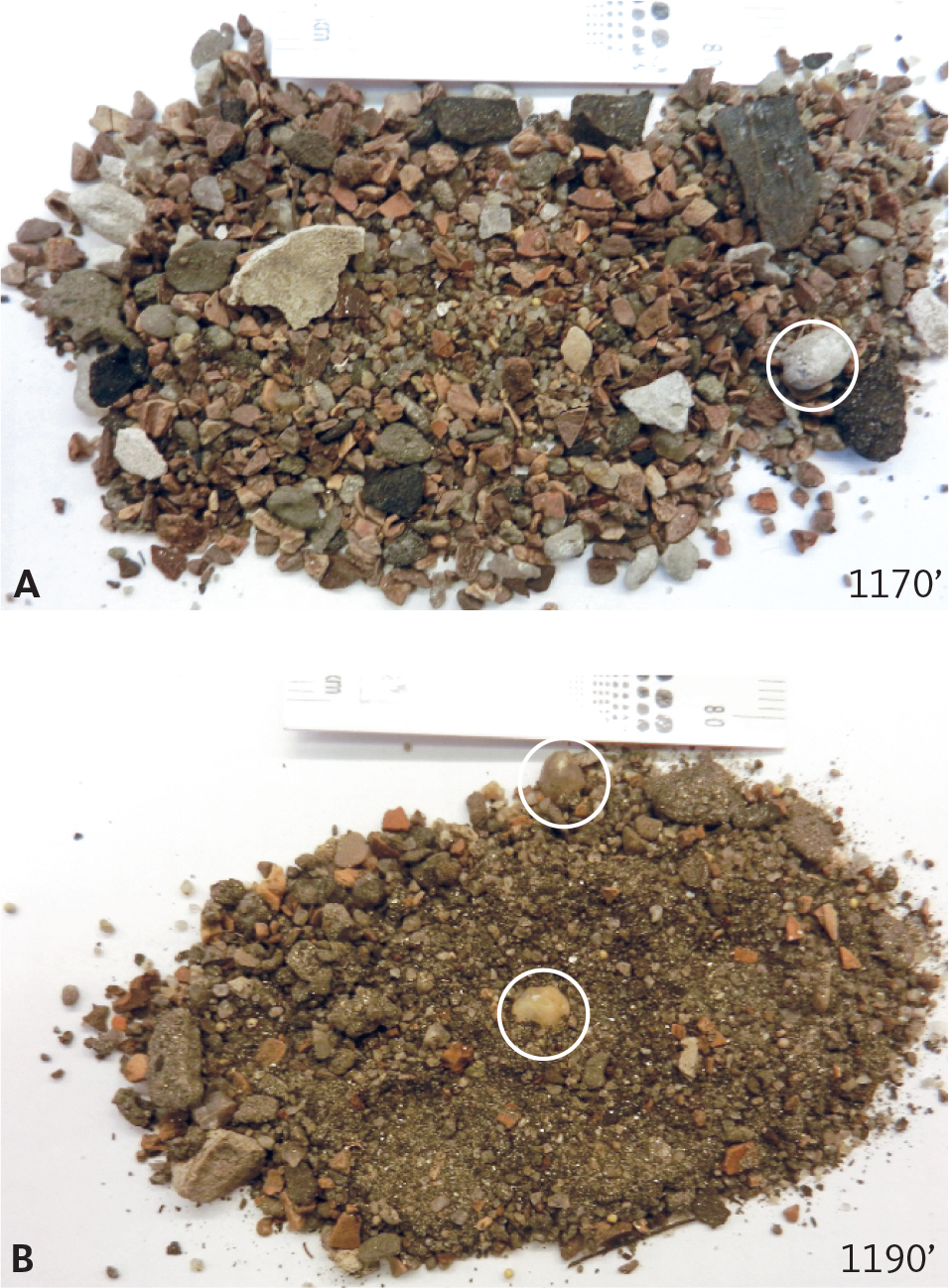
Fig. 38 Ditch cuttings samples from the Luna Formation in the Luna-1 well. Note that gravel is relatively common (encircled clasts). (A): Depth 1170 ft/357 m). (B): Depth 1190 ft/363 m).
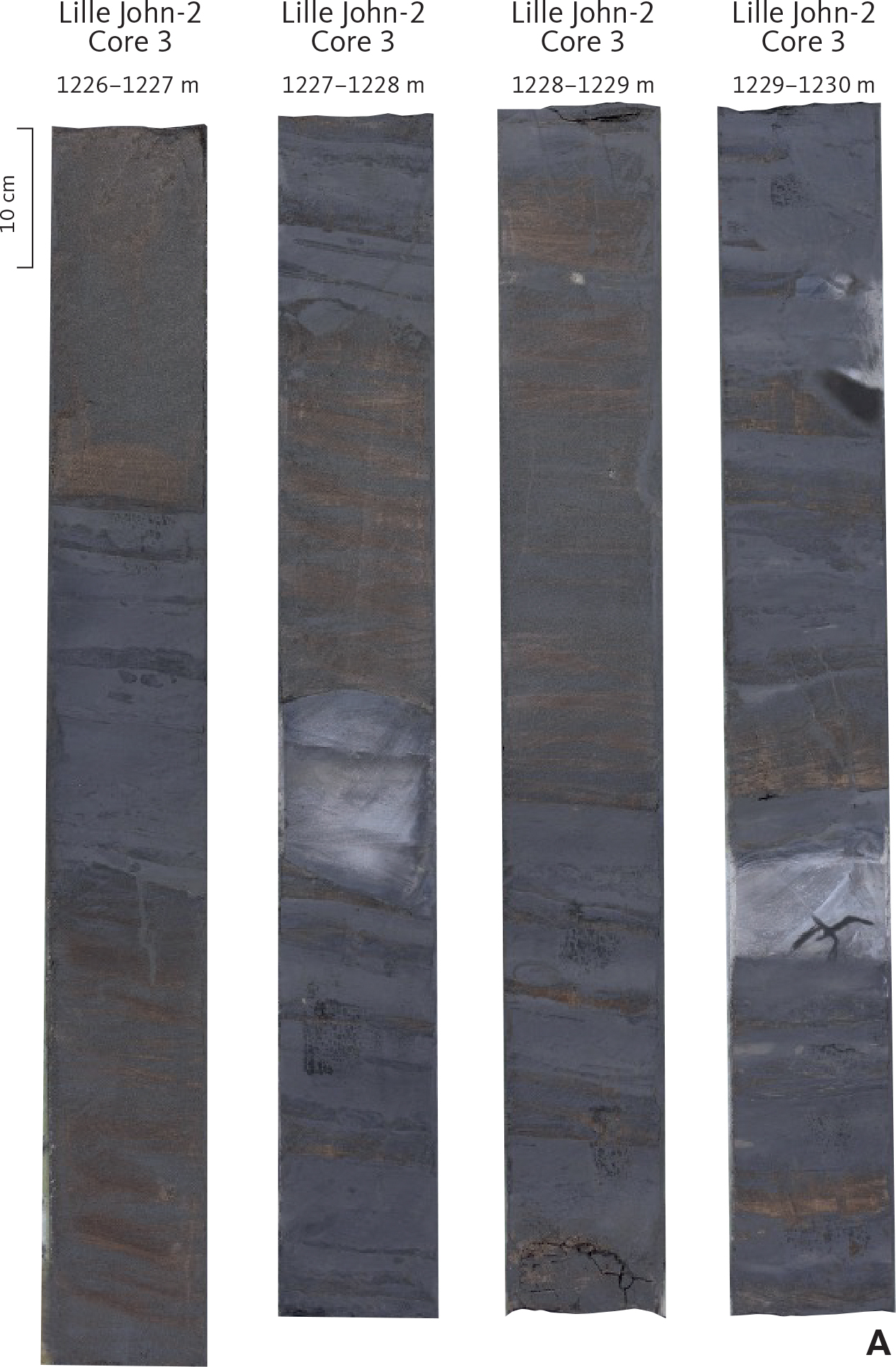
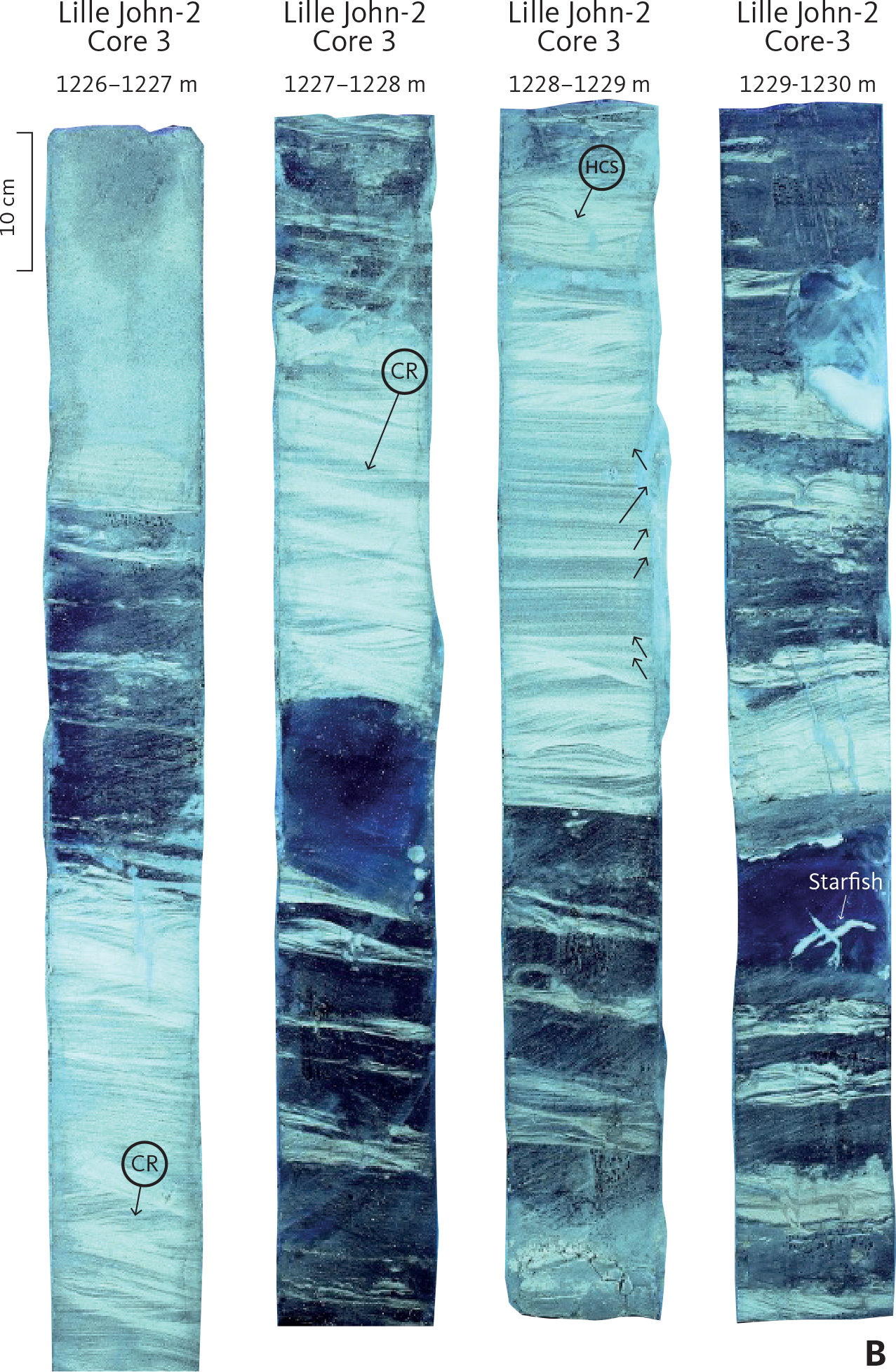
Fig. 39 Core images of the lower silt–sand interval of the Lille John Member in the Lille John-2 well (location of core shown in Fig 33A). Note the sharp bases of all silt and sand beds. Note also the grading of laminae (arrows) in B. The fining–coarsening and coarsening–fining upward small-scale cycles indicate a complex flow behaviour typically interpreted as hyperpycnal flows (Zavala & Arcuri 2016). Slabbed core under normal light (A) and UV light (B). CR: Climbing ripples. HCS: Hummocky cross-stratification.
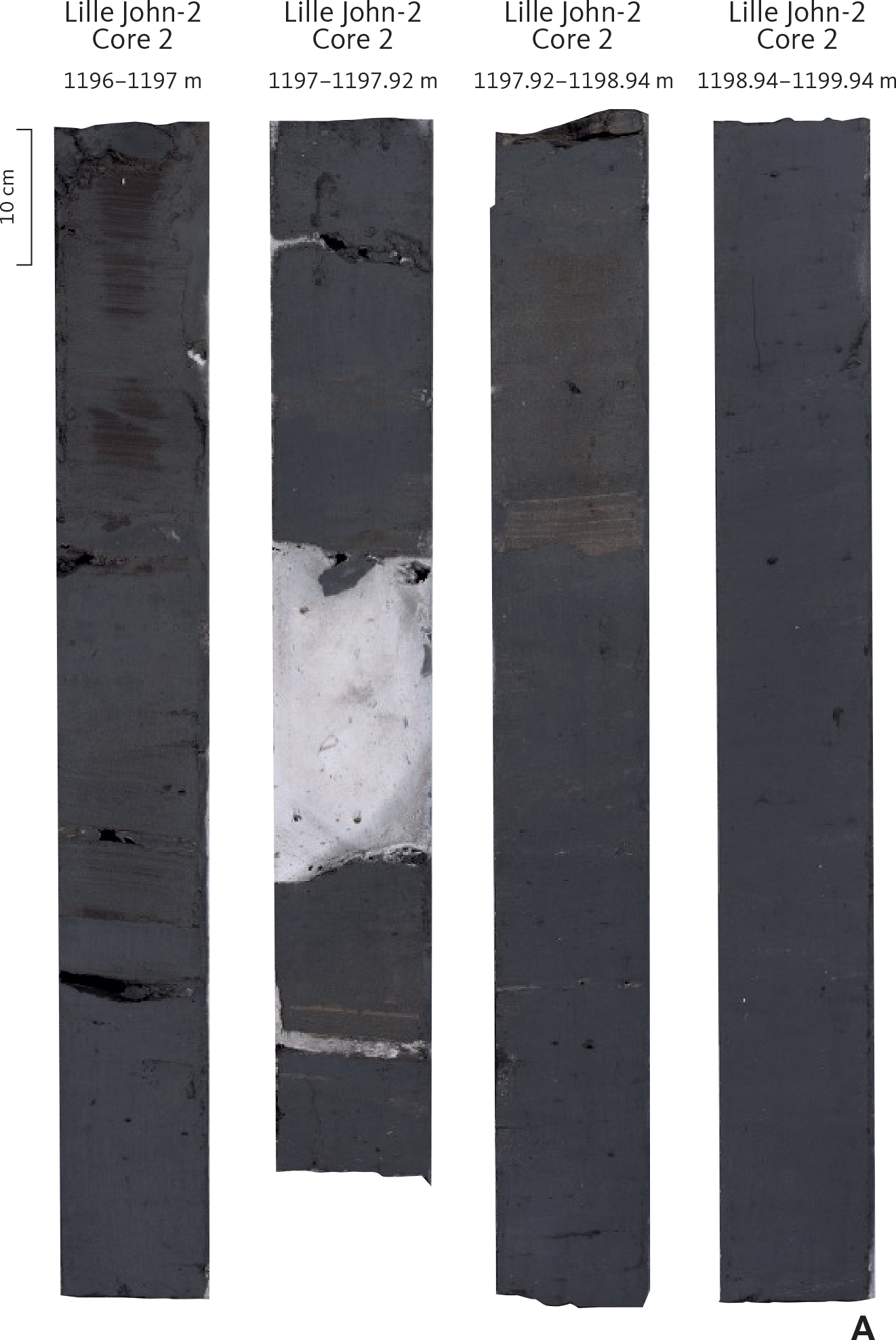
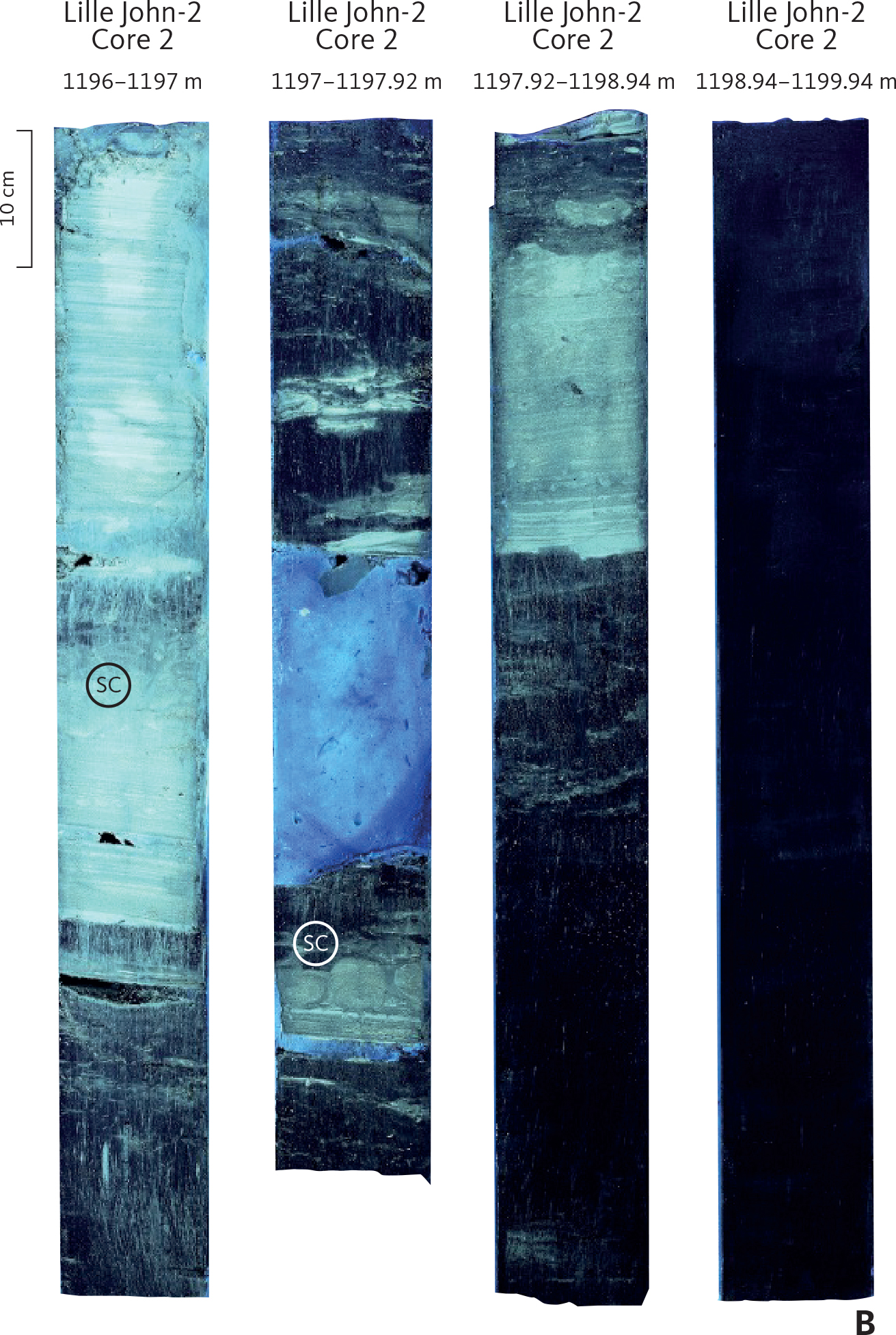
Fig. 40 Core images of the upper silt–sand interval of the Lille John Member in the Lille John-2 well. Note the sharp lower boundary of the beds (top Gram Formation, 1198.37 m) and the trace fossil Scolicia (SC) in the upper part of discrete beds. Slabbed core under normal light (A) and UV light (B).
Log characteristics. In the type well, the gamma-ray log is in the lower part characterised by three stacked intervals showing decreasing gamma-ray readings upwards, indicating a coarsening/cleaning upwards trend of the units (Fig. 36A; Supplementary Files, Plate 5). Commonly, the coarsening/cleaning upwards trend is two-fold in the formation (Supplementary Files, Plate 5). The uppermost part may either show a constant or slightly increasing-decreasing pattern of the gamma-ray readings.
Fossils. The dinocyst assemblage in the Luna Formation in the Luna-1 well is impoverished and shows a low diversity. In the cored open marine deposits of the Luna Formation’s Lille John Member (taken from the Lille John-2 well), the dinocyst assemblage is rich and shows a moderate to high diversity.
A low diversity calcareous benthic foraminifera assemblage is recorded from the Luna Formation in the Luna-1 well. Agglutinating and planktonic foraminifera, diatoms, radiolaria and Bolboforma are not recorded in Luna-1 (Rasmussen et al. 2015).
Depositional environment. The Luna Formation was deposited in a prograding delta/shoreface system. During deposition of the Luna Formation, two delta complexes coalesced in the North Sea area (the Luna Formation and the Eridanos delta system). The Luna Formation was sourced from Scandinavia and was routed via the Oslo Graben area and from valley systems in Central Sweden that were limited towards the south by the South Swedish dome (Lidmar-Bergstrøm 1996; Japsen et al. 2007). The Eridanos delta system was sourced from the east and south-east (Fig. 7) but did not reach the southernmost part of the Danish sector until the late Miocene (Thöle et al. 2014). Most of the sands of the Luna Formation were deposited on a delta front slope and associated delta shoreface environments probably including storm sands. Associated with a sea-level fall, partly responsible for the so-called Messinian crisis in the Mediterranean area (Ohneiser et al. 2015), gravity-flow deposits were laid down in the extreme westernmost part of the Danish North Sea area in c. 150 m of water (based on clinoformal height; Figs 39B, 41, 57). Based on seismic morphology, a significant portion of these sand fans were subsequently reworked into elongated sand bars due to bottom currents (tidal?; Maniar et al. 2025).
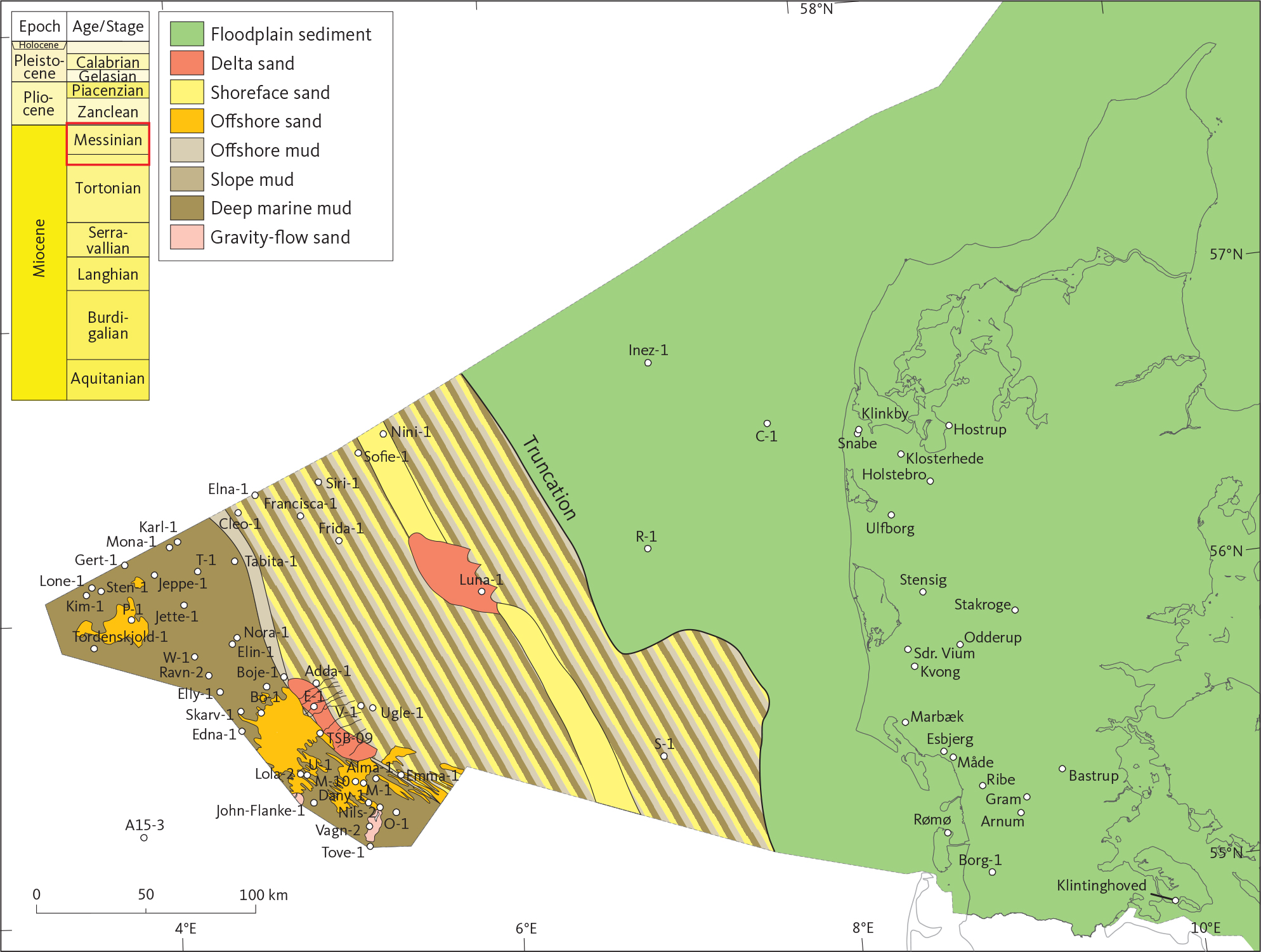
Fig. 41 Lithostratigraphic distribution of the Luna Formation, the Lille John Member and the upper Gram Formation (stratigraphic interval indicated by red box), illustrated in terms of their dominant sedimentary associations: The floodplain sediments and the delta and shoreface sand are referred to the Luna Formation; the offshore sand and the gravity-flow sand are referred to the Lille John Member; the offshore and deep marine muds are referred to the Gram Formation. Neogene deposits of this age have been removed by erosion east of the truncation line indicated in the offshore area; the distribution of sedimentary associations east of this line (and north-east of the onshore outcrops/wells) is hypothetical. The striped belts indicate areas that are inferred to have experienced shifting depositional settings during the late Tortonian and Messinian.
Boundaries. The lower boundary is located within a coarsening-upward succession grading up from dominantly mud with intercalated grey, fine-grained sand layers to sand alternating with thin mud layers; the boundary is placed at the base of the first sand-rich unit (minimum 50% sand) that is greater than 5 m thick (Fig. 36A).
The upper boundary is expressed by a change from decreasing to increasing gamma-ray readings – this change may be either sharp (e.g. in Luna-1, Fig. 36A) or gradual (e.g. in Lille John-2, Fig. 36B). The boundary is seen in the core from Lille John-2 as an abrupt change from the grey silt and sand layers of the Luna Formation to the dark brown mud of the Gram Formation (Fig. 37; Supplementary Files, Plate 5).
Distribution. The Luna Formation is present in parts of the western Danish Central Graben and is distributed eastwards to east of the Luna-1 well where it is truncated (Figs 1, 41). Within the Central Graben area, it is seen on seismic attribute maps as fan-shaped features that are most pronounced in the southern portion of the graben (Fig. 41).
Biostratigraphy. The Selenopemphix armageddonensis dinocyst zone of Dybkjær & Piasecki (2010) is found in the Luna Formation in the Luna-1 and the Lille John-2 wells (Figs 1, 9; Sheldon & Dybkjær 2015).
In the Luna-1 well, the Luna Formation includes the calcareous benthic foraminifera zones NSB13b–NSB14a of King (1989; Fig. 9; Rasmussen et al. 2015).
Geological age. Messinian (Late Miocene).
Subdivision. Sand-rich intervals within the Gram Formation in the Danish Central Graben that are cored in the Little John-1 well are referred to the new Little John Member of the Luna Formation.
6.2.5.1 Lille John Member
new member
History. Traces of oil in Miocene sand in wells drilled on the John structure (e.g. Lille John-2, Fig. 2) in the south-western part of the Danish North Sea encouraged energy companies to test the Miocene as a hydrocarbon play. Accumulation of hydrocarbons was also suggested on seismic data by amplitude anomalies, bright spots and the termination of the bright spots at a well-defined level indicating a fluid contact. The Lille John-1 well was drilled in 2012. The well penetrated c. 10 m of oil-bearing sand. To prove the size of the oil accumulation, and thus the economic potential of the prospect, the Lille John-2 well was drilled in a down-flank position in order to core the reservoir interval; approximately 72 m of alternating mud and sand, including two discrete silt- to sand-rich intervals, was cored.
The Lille John Member is referred to the Luna Formation due to the lateral association with the progradational deltaic system represented by the Luna Formation on the Ringkøbing–Fyn High.
Name. After the Lille John-1 and -2 wells (Fig. 2).
Type section. The type section is represented by the two cored sections from 1229.61–1225.14 m (core depth; Figs 33A, 36B) and 1198.37–1188.15 m (core depth; Figs 33B, 36B, 37), respectively, in the Lille John-2 well (55˚25′11.30″N, 04˚50′08,65″E).
Thickness. The member is composed of two c. 5–10 m thick heterolithic silt and sand-dominated units in the Lille John-2 well. Seismic data, however, indicate a thickness of up to 15 m in more proximal areas, east of the Lille John area.
Lithology. In the type well, the lower silt–sand unit consists of sharp-based, laminated fine-grained sand beds showing inverse and normal grading interbedded with bioturbated mudstones (Figs 33A, 39B). Hummocky cross-stratification with internal double clay drapes is present (Fig. 39B). The sand beds also display climbing ripple cross-lamination and bioturbation (Fig. 39B). In this part of the Lille John Member, Planolites traces are common in the mud-rich portion. The upper sand unit referred to the Lille John Member consists of sharp-based, laminated sand beds, some of which show low-angle cross-stratification (Figs 33B, 40). The upper part of individual sand beds is commonly totally bioturbated by Scolicia (Fig. 40B).
Log characteristics. The gamma-ray log response is characterised by medium to low gamma-ray readings and shows a decreasing response upwards (Fig. 36B; Supplementary Files, Plate 7).
Fossils. The dinocyst assemblage in the Lille John Member in the Lille John-2 well is rich and shows a moderate to high diversity. The Lille John Member was not analysed for microfossils (Sheldon & Dybkjær 2015).
Depositional environment. The lower part of the Lille John Member in the type well was deposited in a basin floor environment. Normal and inversely graded silt to very fine sand beds and climbing ripples are commonly interpreted to indicate hyperpycnal flows initiated by fluvial flooding events; this interpretation is supported by the frequent occurrence of freshwater algae in this succession (Sheldon & Dybkjær 2015). During the mid-Messinian (approximately 5.8 Ma), a major global sea-level fall took place (Ohneiser et al. 2015). Associated with this sea-level fall, incision occurred on land, and gravity-flow deposits were laid down in a number of fan systems in the western part of the Danish offshore area (Fig. 41). Due to bottom currents, probably tidally induced, most of the fans were reworked into elongated tidal sand bars. The upper sand unit was deposited during the initial rise of sea level after the mid-Messinian lowstand (Dybkjær et al. 2021). The sharp-based sand layers were most likely laid down as storm sand layers, although the presence of gravity-flow deposits (the structureless, graded beds) cannot be excluded.
Increased abundances of cold-water tolerant dinocysts combined with an influx of freshwater algae were observed in the core samples in the Lille John-2 well, representing the interval from 1232 to 1223.5 m MD. This probably reflects the Messinian glaciation and the resulting global eustatic sea-level fall (Sheldon & Dybkjær 2015; Ohneiser et al. 2015).
Boundaries. The base of the Lille John Member is located within a gradational, coarsening upward succession that passes from dominantly mud with intercalated fine-grained sand layers to sand alternating with thin mud layers; the boundary is placed at the base of the first sand-rich unit (minimum 50% sand) that is greater than 5 m thick (Fig. 36B).
The upper boundary is sharp and shows a change from intercalated grey silt/sand of the Lille John Member to dark brown mud of the Gram Formation (Figs 33, 36B, 37).
Distribution. The Lille John Member is restricted to the south-western portion of the Central Graben (Fig. 41).
Biostratigraphy. The Selenopemphix armageddonensis dinocyst zone of Dybkjær & Piasecki (2010) (Figs 1, 9) was recorded in the cores of the Lille John-2 well referred to the Lille John Member (Rasmussen et al. 2015; Sheldon & Dybkjær 2015).
The NSB13b subzone of King (1989) is inferred to be present in the Lille John Member based on microfossil analysis of the under- and overlying Gram Formation (Fig. 9; Rasmussen et al. 2015; Sheldon & Dybkjær 2015).
Geological age. Messinian (Late Miocene).
6.3 Eridanos Group
new group
General. The Eridanos Group marks a distinct change in the depositional setting in the Danish North Sea sector. During the Miocene, the sediments laid down in the Danish North Sea were predominantly sourced from Fennoscandia, but in the Pliocene, this depositional system was replaced by an immense delta complex that was mainly sourced from Central Europe (Eissmann 2002; Rasmussen & Dybkjær 2014).
The Eridanos Group, as defined here, thus comprises Pliocene deposits, sourced mainly from Central Europe but in the uppermost part it also includes deposits sourced from Fennoscandia (the Elin Formation).
History. In 1981, Bijlsma introduced the term ‘The Baltic River System’ for the Lower Miocene deltaic deposits found in for example the Voersvadsbro and Addit gravel pits and suggested that this delta complex emanated from the Baltic area. This conclusion was based on the occurrence of clasts of Palaeozoic silicified sediments and fossils that were found in outcrops in the Baltic area. The age of these deposits was not clear at that time. Recent studies of the localities used in the study of Bijlsma (1981) to prove a Baltic origin of this river system have shown a western Scandinavian, present-day Norway and central Sweden source area (Olivarius et al. 2014). The study of Olivarius et al. (2014) also demonstrated that the sediment transport route was directly towards the depocentre in present-day Denmark and not via a detour across the Baltic area. Seismic data of the Lower Miocene delta system clearly indicate a dominantly north to south sediment supply system (Rasmussen 2009b). Consequently, a huge Baltic river system probably never existed and is therefore not relevant for this study. The occurrence of clasts of Palaeozoic silicified sediments and fossils testifies to erosion of the Scandinavian Platform during the Miocene and sediment transport to the North Sea Basin. Subsequently, the ‘Baltic River system’ was renamed ‘The Eridanos Delta complex’ by Overeem et al. (2001); this deltaic complex was considered to be of Late Miocene to Quaternary age. However, as this latter name is used in several recent publications for a huge Upper Miocene to Quaternary delta complex in the southern North Sea, we have adopted the name ‘Eridanos’ for the Pliocene deltaic succession present in the Danish sector.
Name. After the so-called Eridanos Delta (Overeem et al. 2001) that filled the southern North Sea Basin with sediments during the late Neogene and Quaternary.
Type area. The Eridanos Group is best developed in the Danish Central Graben, although it is also recognised offshore in the western Ringkøbing–Fyn High area. Representative sections in which the group is well illustrated are the Vagn-2 well (55˚19′21″N, 5˚09′43.6″E) from 971 to 459.5 m MD (Fig. 42A) and the M-10 well (55˚28′28.27″N, 05˚05′08.86″E) from 880.5 to 494 m MD (Fig. 42B).
Thickness. The Eridanos Group is up to 600 m thick in the southern part of the Danish Central Graben (Supplementary Files, Plate 9). The group gradually decreases in thickness northwards and is less than 100 m thick in the Nini-1 well. The thinning is mainly due to onlap onto the Måde Group. The group is truncated towards the east on the Ringkøbing–Fyn High.
Lithology. The lower Eridanos Group consists mainly of grey mud with some intercalations of dark brown mud. The upper part of the group also includes units of grey sand that can be up to 100 m thick.
Log characteristics. The group is characterised by a serrated log pattern with medium to low gamma-ray readings (Fig. 42; Supplementary Files, Plates 1–9). Intervals showing upward-decreasing gamma-ray trends suggest minor coarsening-upwards successions associated with increasing sand content; these are typically c. 50 m thick. Thin intervals with high gamma-ray log readings commonly separate these units. Where the group is dominated by the sand-rich Emma Formation, these coarsening-upwards trends form significant log units up to 110 m thick characterised by low gamma-ray values (Fig. 42; Supplementary Files, Plates 1–9).
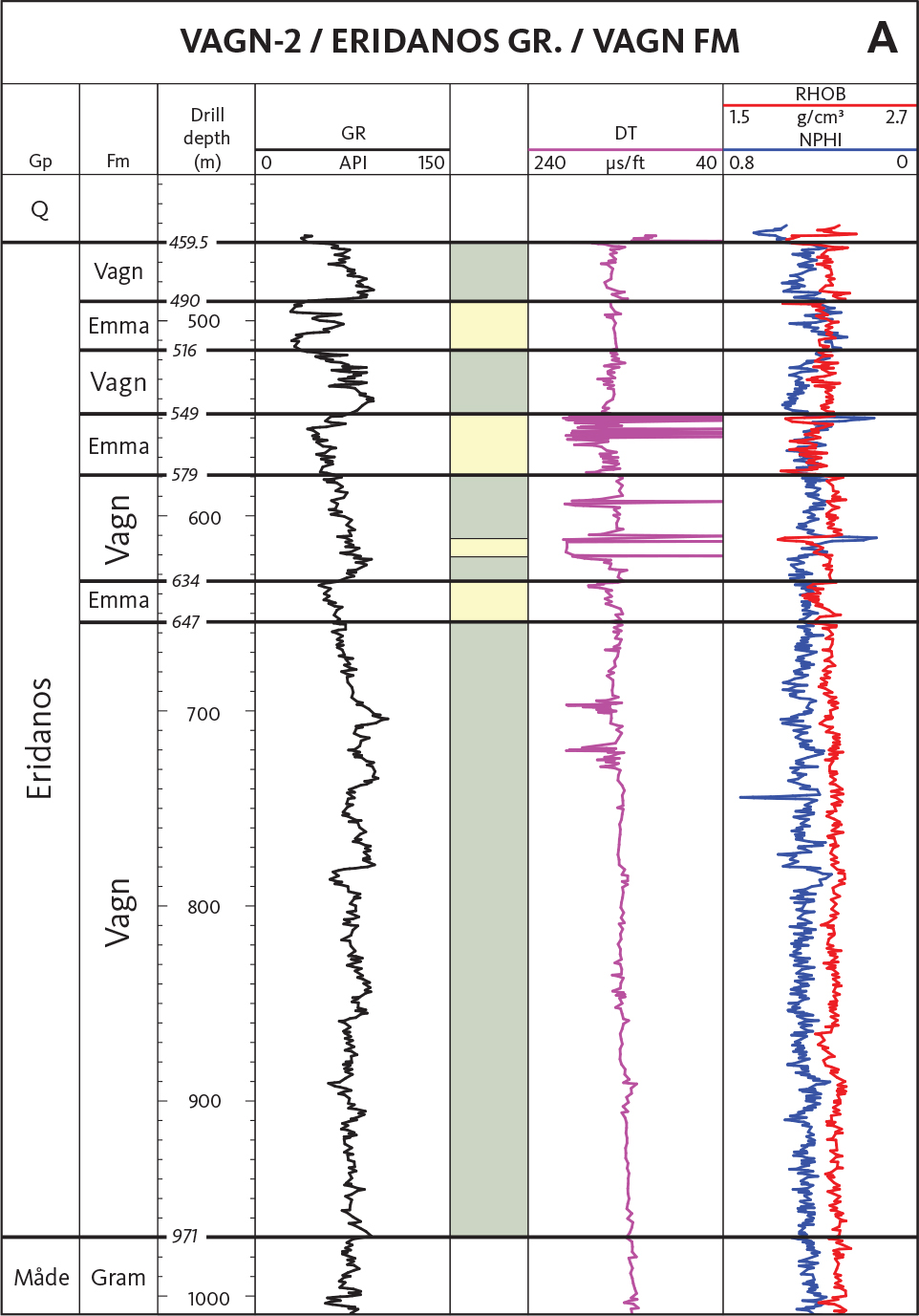
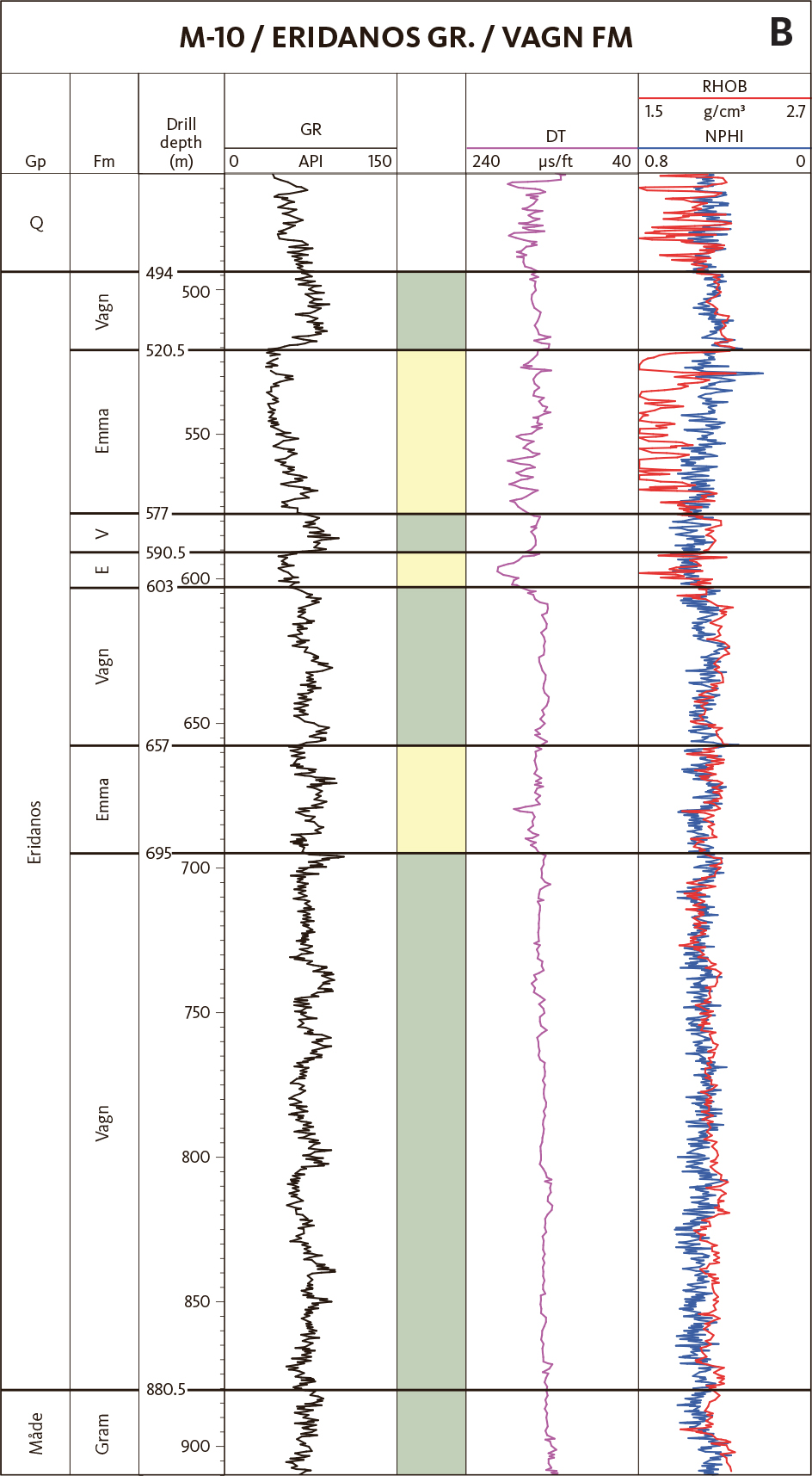
Fig. 42 Representative sections of the Eridanos Group; for legend, see Fig. 14. (A): the Vagn-2 well from 971 to 459.5 m MD. (B): the M-10 well from 880.5 to 494 m MD. The Vagn-2 well is also the type well of the Vagn Formation (971–647 m, 634–579 m, 549–516 m, 490–459.5 m MD); M-10 is the reference well (880.5–695 m, 657–603 m, 590.5–577 m, 520.5–494 m MD). M-10 is also the reference well for the Emma Formation (695–657 m, 603–590.5 m, 577–520.5 m MD). E: Emma. V: Vagn. Q: Quaternary.
Fossils. The Eridanos Group yields moderate to low diversity dinocyst assemblages, becoming gradually more impoverished upwards (Dybkjær et al. 2021). High abundance and diversity calcareous benthic and planktonic foraminifera assemblages characterise the lower part, becoming less diverse in the upper part. Planktonic foraminifera are rare or absent in the upper part (Bailey et al. 1983; Konradi 1995, 1996; Laursen et al. 1997). More detailed descriptions of the microfossil assemblages are given below in the definitions of the formations.
Depositional environment. The main part of the Eridanos Group was deposited as a huge delta system prograding from the east and south-east towards the west (Overeem et al. 2001). At a later stage, near the Pliocene–Pleistocene boundary, increased sediment supply from Scandinavia resulted in progradation from the north-east of sand-rich sediments referred to the Elin Formation. Based on thicknesses of clinothems, a water depth of more than 300 m was likely (Thöle et al. 2014).
Boundaries. In the core from the Lille John-2 well, the lower boundary is sharp and erosional, separating dark brown mud with intercalated, mottled sand beds from homogeneous dark brown mud (Fig. 43). On logs, the lower boundary is recorded by a subtle decrease in gamma-ray response (Fig. 42A). Although marked by a weak lithological signal, the base of the group is an important regional seismic surface that displays prominent onlap of the Eridanos Group on the Måde Group from the south.

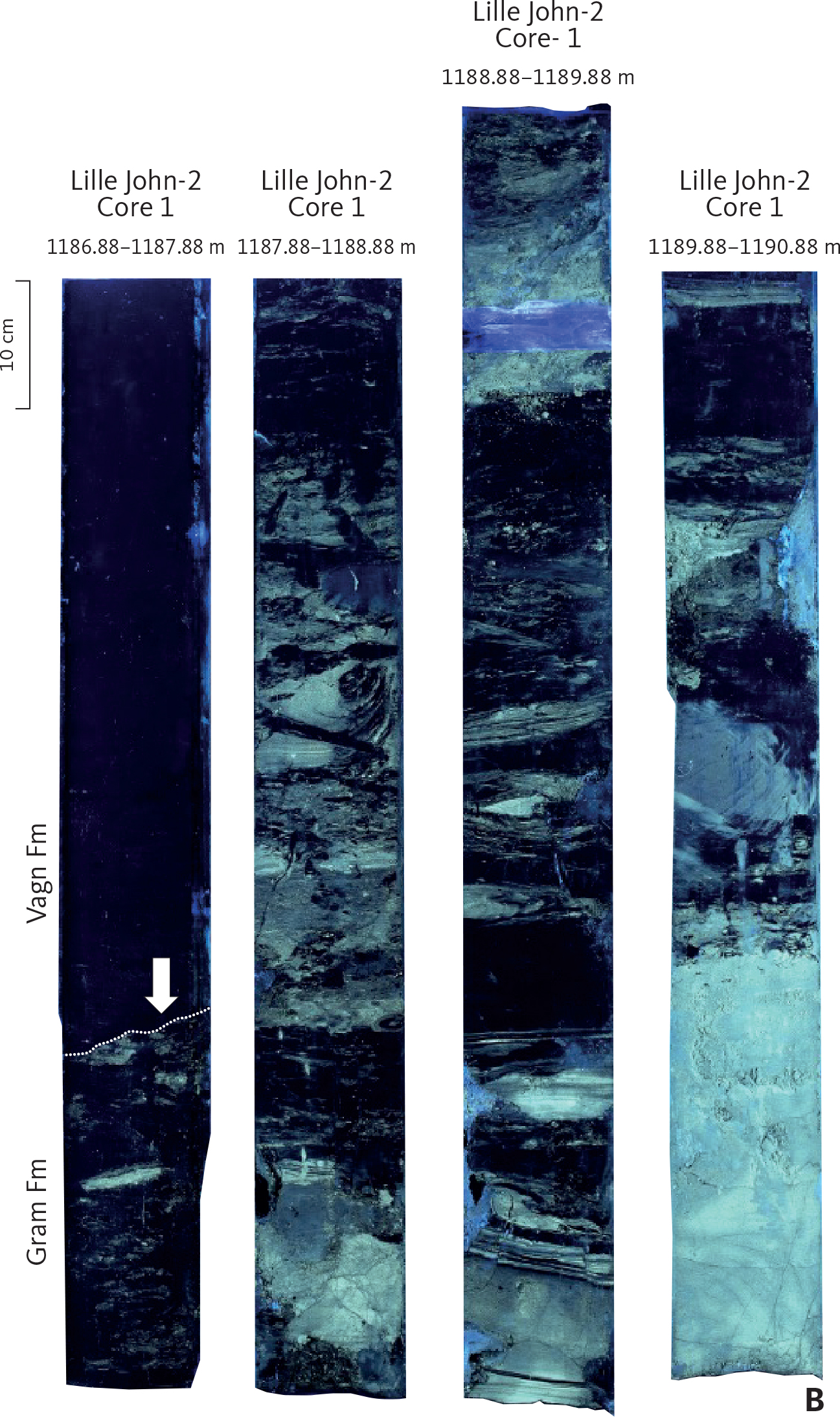
Fig. 43 Core image of the lower part of the Vagn Formation in the Lille John-2 well. Slabbed core under normal light (A) and UV light (B). Note the sharp boundary (arrow) between the Miocene Gram Formation and the Pliocene Vagn Formation on the UV processed image; the boundary between the Gram Formation and the underlying Lula Formation (Lille John Member) is at 1188.15 m. The full extent of the cored section is shown in Fig. 36B.
The upper boundary, towards the Quaternary, is also difficult to define based on log patterns alone and is therefore mainly identified based on a regional seismic marker and biostratigraphy. Where Quaternary erosional valley systems are present, the upper boundary of the Eridanos Group is commonly sharp, where mud is overlain by sand or gravel.
Distribution. The Eridanos Group is distributed in the western part of the Danish North Sea sector (the Central Graben and the westernmost Ringkøbing–Fyn High), and the eastward extent is limited by an NNW–SSE-trending boundary that crosses the middle of the Ringkøbing–Fyn High area (between the Luna-1 and R-1 wells). The succession is truncated by the base Quaternary boundary over most of the Ringkøbing–Fyn High area.
Geological age. Zanclean to Piacenzian (Pliocene).
Subdivision. The Eridanos Group is subdivided into three formations: the Zanclean–Piacenzian Vagn and Emma Formations and the upper Piacenzian Elin Formation.
6.3.1 Vagn Formation
new formation
Name. After the Vagn-2 well, located in the south-western part of the Danish offshore sector (Fig. 2).
Type and reference section. The type section of the Vagn Formation is defined in the Vagn-2 well (55˚19′21″N, 5˚09′43.6″E) from 971 to 647 m, 634 to 579 m, 549 to 516 m and 490 to 459.5 m MD (Fig. 42A). The reference well is M-10 (55˚28′29.11″N, 5˚05′07.6″E) from 880.5 to 695 m, 657 to 603 m, 590.5 to 577 m and 520.5 to 494 m MD (Fig. 42 B). This latter well is one of the few wells that have multiple log suites covering the late Cenozoic succession. The lowermost Vagn Formation is cored in the Lille John-2 well (55˚25′11.30″N, 4˚50′08,65″) from 1187.68 to 1179 m (core depth; Figs 37, 43A, B).
Thickness. The Vagn Formation is c. 400 m thick in the southernmost part of the Danish sector of the Central Graben (Fig. 42A; Supplementary Files, Plate 9). The formation thins gradually northwards; eastwards, it is truncated due to Quaternary tilting of the North Sea Basin.
Lithology. The Vagn Formation is dominated by homogenous grey mud (Fig. 43A); in the upper part of the Eridanos Group, the Vagn Formation muds commonly alternate with units of grey sand referred to the Emma and Elin Formations (Fig. 42; Supplementary Files, Plates 1–9).
Log characteristics. The formation is characterised by medium to low but highly serrated gamma-ray values (Fig. 42). Repeated units showing upward-decreasing gamma-ray trends suggest stacked coarsening-upwards successions that higher in the formation culminate in discrete sand-dominated bodies up to 100 m thick assigned to the Emma and Elin Formations (Fig. 42; Supplementary Files, Plates 1–9).
Fossils. The dinocyst assemblages in the Vagn Formation vary in diversity from a moderately diverse assemblage in the lower part of the formation, becoming gradually more impoverished upwards and showing a very low diversity assemblage in the upper part (Sheldon & Dybkjær 2015; Dybkjær et al. 2021). Calcareous benthic foraminifera are common and diverse in the lower part of the Vagn Formation (Sheldon & Dybkjær 2015) and decrease in diversity upwards in the Mona-1, Cleo-1 and M-10 wells. Planktonic foraminifera in these wells are common in the lower part and become rare or absent upwards (Konradi 1995, 1996; Laursen et al. 1997). In the Sten-1 and Vagn-2 wells, diverse assemblages of foraminifera characterise the lower part of the formation; diversity decreases upwards, but they remain common (King et al. 1976; Bailey et al. 1983).
Depositional environment. The Vagn Formation was deposited below the shoreface in the offshore transition zone and in water depths of up to 500 m (e.g. Supplementary Files, Plate 8). Thin intercalated sands were deposited as storm sand layers (combined flow deposits) or by gravity flows on the delta slope.
Boundaries. The lower boundary is sharp (Figs 42, 43) and is defined where grey to brown mud with thin sand interbeds or sand-filled burrows, representing the Gram Formation, is sharply overlain by homogenous grey mud. The upper boundary with the Emma Formation, and in the northern part with the Elin Formation, is placed within a gradational, coarsening-upward succession at the base of the first sand-dominated unit (>75% sand) that is at least 5 m thick. The lower boundary of the Vagn Formation, where it overlies sand-rich units referred to the Emma and Elin Formations, is typically sharp and marked by an abrupt gamma-ray increase (Fig. 42; Supplementary Files, Plates 1–9).
The upper boundary with the Quaternary is subtle and in this study is typically identified by a regional seismic marker and on the basis of biostratigraphy.
Distribution. The formation is recognised in the western part of the Ringkøbing–Fyn High area and in the Central Graben. The eastern limit is defined by a truncation surface at the base of the Quaternary due to tilting of the North Sea Basin (Fig. 44).
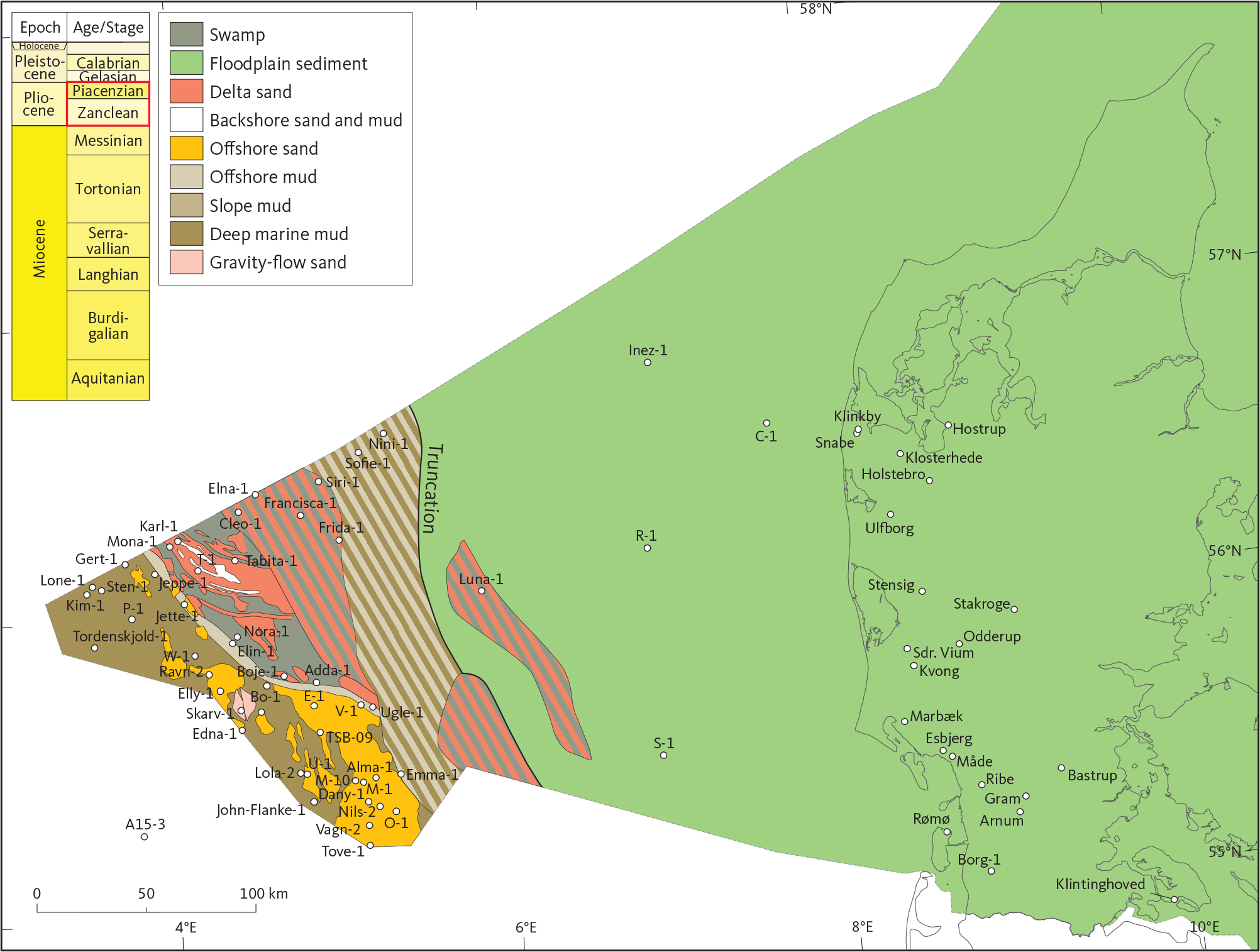
Fig. 44 Distribution of lithological units of the Vagn, Emma and Elin Formations (stratigraphic interval indicated by red box), illustrated in terms of their dominant sedimentary associations: offshore mud and deep marine mud are referred to the Vagn Formation; offshore sand and offshore gravity-flow sand are referred to the Emma Formation; swamp deposits and delta sand are referred to the Elin Formation. Neogene deposits of this age have been removed by erosion east of the truncation line indicated in the offshore area; the distribution of sedimentary associations east of this line (and north-east of the onshore outcrops/wells) is hypothetical. The striped belt indicates an area that is inferred to have experienced shifting depositional settings during the Pliocene.
Biostratigraphy. The following dinocyst zones of Dybkjær & Piasecki (2010) have been identified in the Vagn Formation: the upper part of the Selenopemphix armageddonensis Zone, the Melitasphaeridium choanophorum Zone and the Barssidinium pliocenicum Zone (Figs 1, 9; Sheldon & Dybkjær 2015; Dybkjær et al. 2021). The calcareous benthic foraminifera zones found in this formation include NSB13b–14b of King (1983, 1989; see also King et al. 1976; Konradi 1995, 1996; Laursen et al. 1997). Subzones NSB13b–14a are found in the Vagn Formation of the Lille John-2 well (Fig. 9; Sheldon & Dybkjær 2015).
Geological age. The Vagn Formation is of Zanclean–Piacenzian (Pliocene) age. The upper boundary of the Vagn Formation correlates with the base of the Gelasian (Quaternary).
6.3.2 Emma Formation
new formation
History. Sand-rich deposits penetrated in the southwestern part of the Danish sector were informally named the ‘Emma sand’ by the Danish Underground Consortium (DUC). In this monograph, this name is adopted formally for the Pliocene sand of the Eridanos Delta complex.
Name. After the Emma-1 well (Fig. 2).
Type section and reference section. The type well is the Emma-1 well (55˚29′32.11″N, 5˚21’27.52″E) from 540.5 to 516 m MD and 457 to 405.5 m MD (Fig. 45). The reference well is the M-10 well (55˚28′29.11″N, 5˚05′07.6″E) from 695 to 657 m MD, 603 to 590.5 m MD and 577 to 520.5 m MD (Fig. 42B).
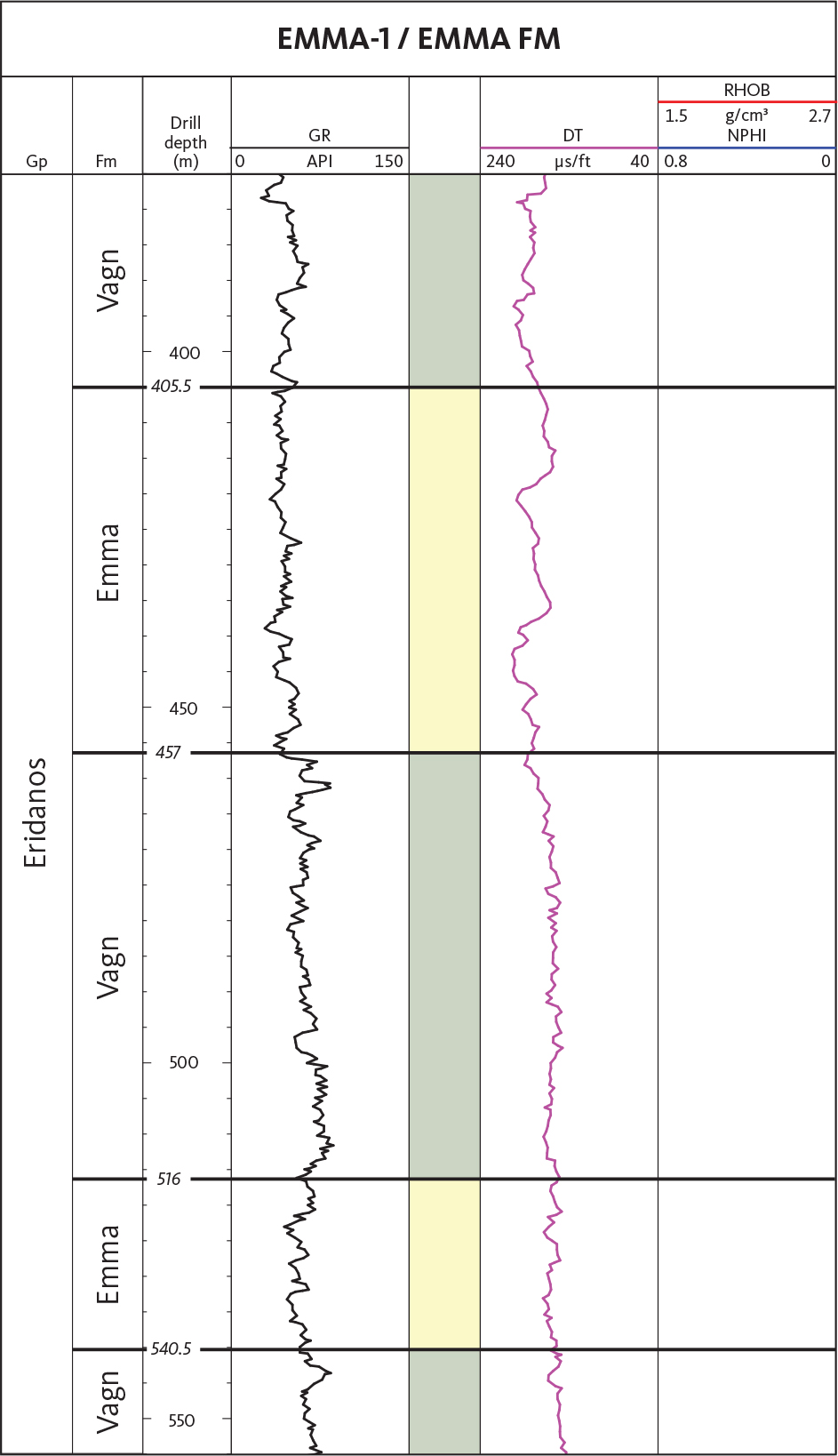
Fig. 45 The type well of the Emma Formation is the Emma-1 well from 540.5 to 516 m and from 457 to 405.5 m MD; for legend, see Fig. 14. The reference section is the interval from 695 to 657 m MD, 603 to 590.5 m MD and 577 to 520.5 in the M-10 well (Fig. 42B).
Thickness. The Emma Formation is commonly between 50 and 100 m thick (76 m in the type well).
Lithology. Grey, pebbly, medium- to coarse-grained sand (Fig. 46). The grains are subrounded to subangular; shells are common.
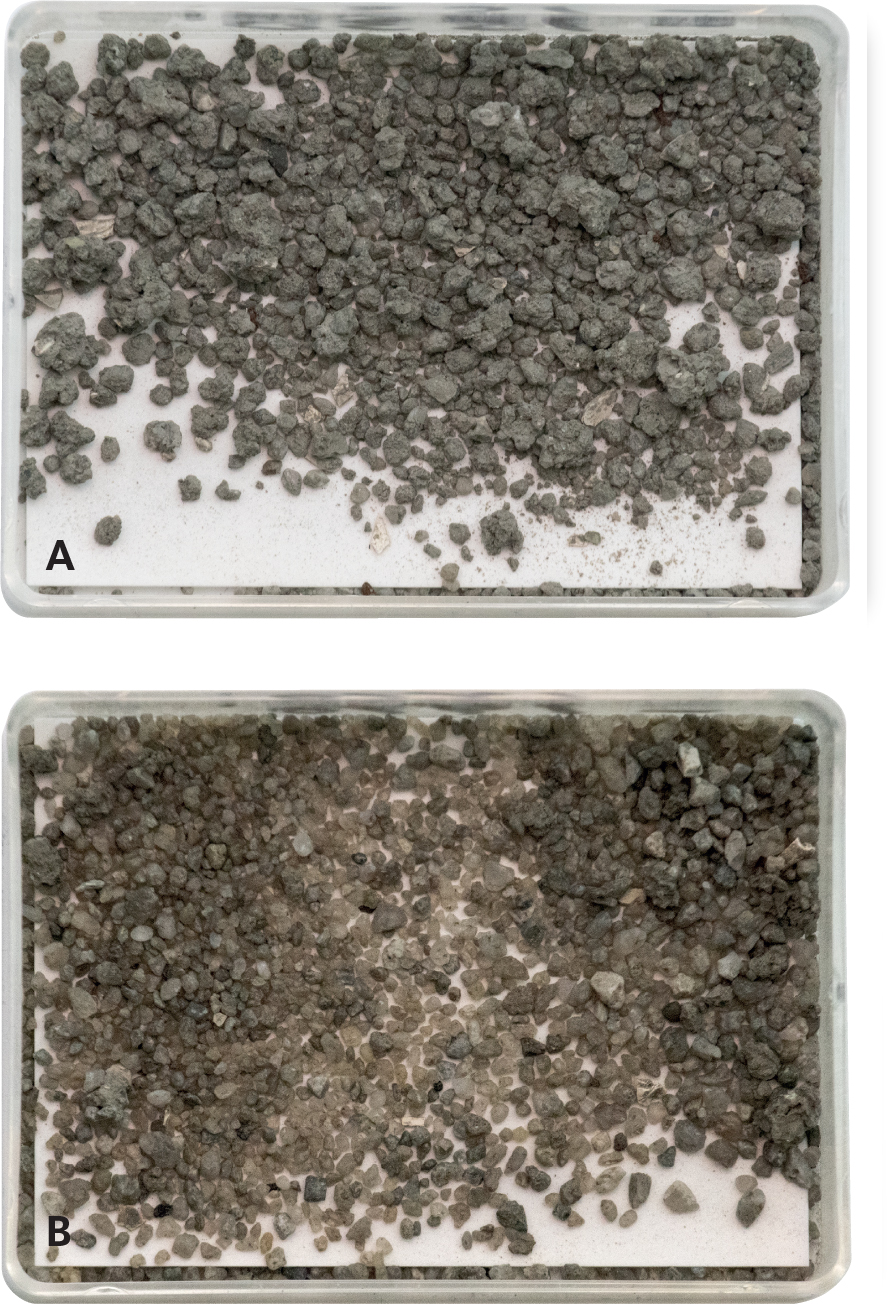
Fig. 46 Cuttings sample of sand from the Emma Formation in the Vagn-2 well: (A) 558 m MD. (B): 567 m MD. Shell fragments are common in the more fine-grained part (B).
Log characteristics. The log pattern is characterised by a highly serrated gamma-ray response that either displays gradational upwards-decreasing gamma-ray values or has a blocky pattern with very low gamma-ray response (Figs 42B, 45; Supplementary Files, Plates 3–9).
Fossils. The dinocyst assemblage in the Emma Formation is highly impoverished and of low diversity (Dybkjær et al. 2021). High abundance and diversity calcareous benthic foraminifera assemblages occur in the lower part; diversity decreases in the upper part (Konradi 1996).
Depositional environment. The Emma Formation was deposited in a deltaic environment (Overeem et al. 2001). In the Danish area, seismic data do not indicate channel-like features on seismic time slices or attribute maps. Consequently, deposition on delta platform slope and associated shoreface environments is most likely. High energy levels in this wave-dominated depositional environment resulted in mainly sand-grade sediments.
Boundaries. The lower boundary is placed within a gradational, coarsening-upward succession at the base of the first sand-dominated unit (>75% sand) that is at least 5 m thick (Figs 42B, 46). The upper boundary is sharp and defined at a change from grey sand of the Emma Formation to brown mud of the Vagn Formation. On the gamma-ray log, an abrupt increase in gamma-ray values marks the boundary (Figs 42B, 45; Supplementary Files, Plates 3–9).
Distribution. The formation is mainly restricted to the south-western Danish sector although a narrow belt of this sand-rich facies may extend as far north as the Elin-1 and Nora-1 wells (Fig. 44; Supplementary Files, Plates 3–9).
Biostratigraphy. The two dinocyst zones Melitasphaeridium choanophorum and Barssidinium pliocenicum of Dybkjær & Piasecki (2010) are present in the Emma Formation (Figs 1, 9; Dybkjær et al. 2021).
In addition, the calcareous benthic foraminifera zones NSB14a–NSB14b of King (1983, 1989) have been identified in this formation (Fig. 9; Konradi 1996).
Geological age. The Emma Formation is of Zanclean–Piacenzian (Pliocene) age.
6.3.3 Elin Formation
new formation
History. A distinct clinoformal package prograding from the north-east towards the south-west has long been recognised on seismic data in the northern part of the Danish Central Graben area, for example by Rasmussen et al. (2005) and references therein. The age of this unit has been debated (Konradi 1995, 1996; Ottesen et al. 2018) but new biostratigraphic data reveal that this formation is of late Pliocene (Piacenzian) age (Dybkjær et al. 2021). The unit is sand-rich and is therefore not included in the Vagn Formation; in contrast to the Emma Formation, this unit was sourced from the north-east (Scandinavia), based on the seismic data, and the unit is thus defined in this study as a new formation.
Name. After the Elin-1 well, located in the westernmost portion of the prograding succession (Fig. 2).
Type and reference sections. The type section is the sand from 600 to 563.5 m MD in the Elin-1 well (55˚56′51.4″N, 4˚22′20.7″E; Fig. 47A). The reference section is the sand in the Nini-1 well (56˚38′31.09″N, 5˚19′15.87″E) from 336 to 267.5 m, 249 to 235 m and from 207 to 167.5 m MD (Fig. 47B).
Thickness. The thickness is 36.5 m in the type well, Elin-1 (Fig. 47A), but thicknesses of c. 50 m are more common, for example Karl-1, Mona-1 (Plate 1), Tabita-1, T-1 (Plate 2), Nora-1 (Plate 9), Bo-1 and Adda-1 (Plate 4). In the Nini-1 well, the thickness is c. 122 m in total (Fig. 47B; Supplementary Files, Plates 1–4).
Lithology. Grey, mica-rich, fine- to coarse-grained sand, sometimes gravely. Lignite is common, especially from 310 m to 336 m in the Nini-1 well. Shells are common throughout the interval.
Log characteristics. In all wells, where it has been identified, the formation is characterised by a steady upwards decrease in gamma-ray values (Fig. 47A, B; Supplementary Files, Plates 1–4).
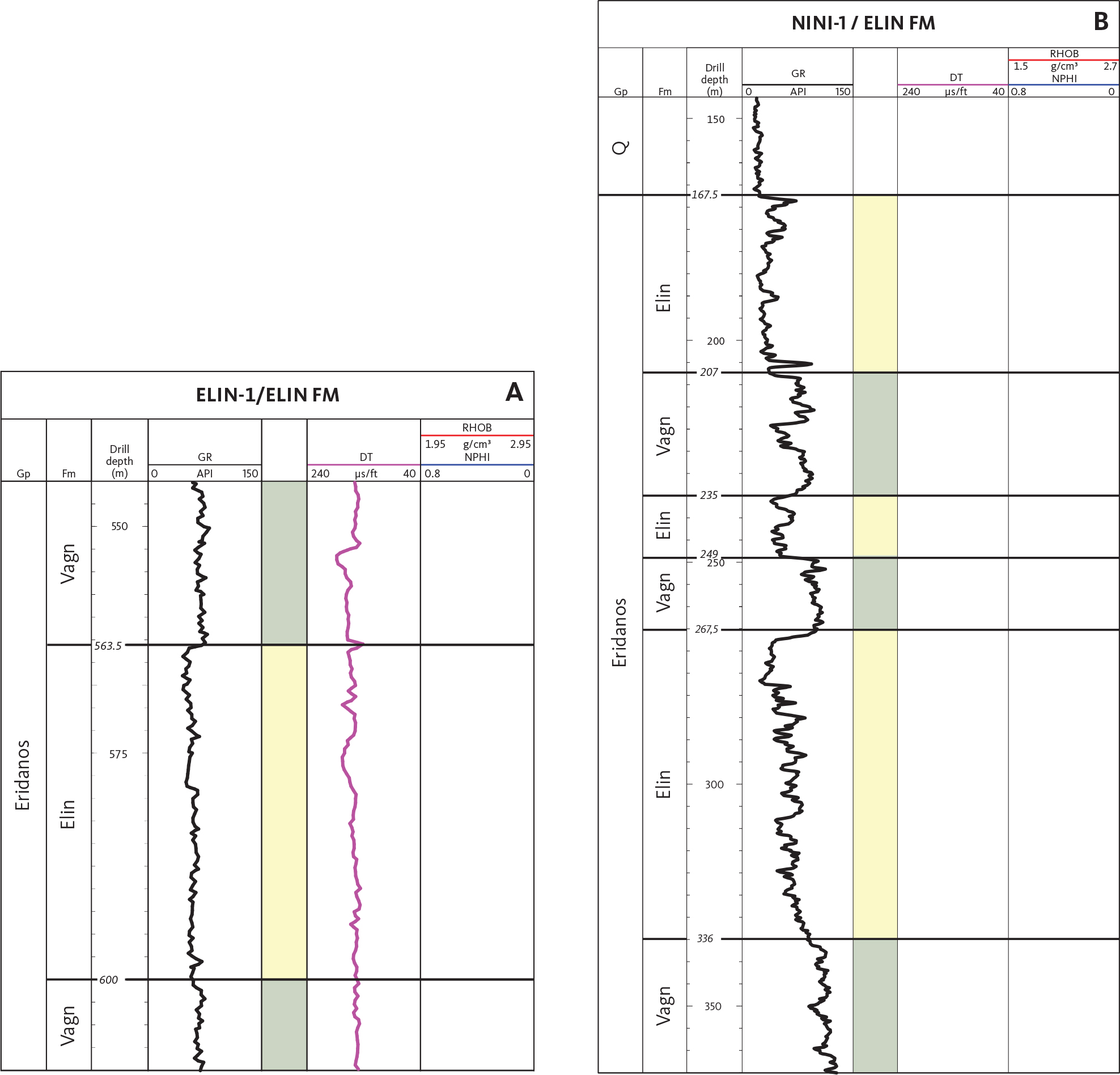
Fig. 47 (A): The type section of the Elin Formation is the interval from 600 to 563.5 m MD in the Elin-1 well. (B): The reference section is the section from 336 to 267.5 m, 249 to 235 m and 207 to 167.5 m MD in the Nini-1 well. For legend, see Fig. 14.
Fossils. Both the dinocyst and calcareous benthic foraminifera assemblages in the Elin Formation are rather sparse and of low diversity (Crittenden et al. 1983; Konradi 1995, 1996; Laursen et al. 1997; Dybkjær et al. 2021).
Depositional environment. The Elin Formation was deposited in a deltaic environment. The delta was sourced from the north-east and prograded into the northern part of the Central Graben area. On seismic data, the outline of the delta is well imaged, and depositional features, such as sand ridges, are well preserved.
Boundaries. The lower boundary with the mud-dominated Vagn Formation is placed within a gradational, coarsening-upward succession at the base of the first sand-dominated unit (>75% sand) that is at least 10 m thick (Fig. 47A, B).
The upper boundary is sharp and characterised by an abrupt change from grey sand to brown mud. On the gamma-ray log, it is seen as a distinct increase in gamma-ray values from very low to high (Figs 47A, B; Supplementary Files, Plates 4 and 9).
Distribution. The Elin Formation is found in the north-eastern and eastern portion of the Central Graben. The eastern limit of the formation is controlled by truncation at the base Quaternary surface (Fig. 44).
Biostratigraphy. The Elin Formation includes the lower and middle part of the Barssidinium pliocenicum dinocyst Zone of Dybkjær & Piasecki (2010; Dybkjær et al. 2021; Figs 1, 9).
Calcareous benthic foraminifera subzone NSB14b (King 1989) has been identified in this formation in the Cleo-1 well (Konradi 1995), and NSB14 was identified in the Elin-1 and Mona-1 wells (Fig. 9; Crittenden et al. 1983; Laursen et al. 1997).
Geological age. The Elin Formation is of Piacenzian (Late Pliocene) age.
7 Basin morphology and evolution
Basin architecture. The Miocene succession is more than 1200 m thick in the Danish North Sea (Figs 48–50; Supplementary Files, Plates 1–11). The thickest development occurs along the transition zone between the Ringkøbing–Fyn High and the Central Graben. South-westwards, the succession pinches out. The succession thins north-eastwards, partly due to the marginal position in the basin and partly because of truncation of the succession at the Base Quaternary surface (Figs 48, 49). The Miocene succession is subdivided into two groups, both of which are characterised by overall progradation: the Ribe Group (Lower to Middle Miocene) and the Måde Group (Middle to Upper Miocene; Figs 1, 48; Supplementary Files, Plates 1–11).
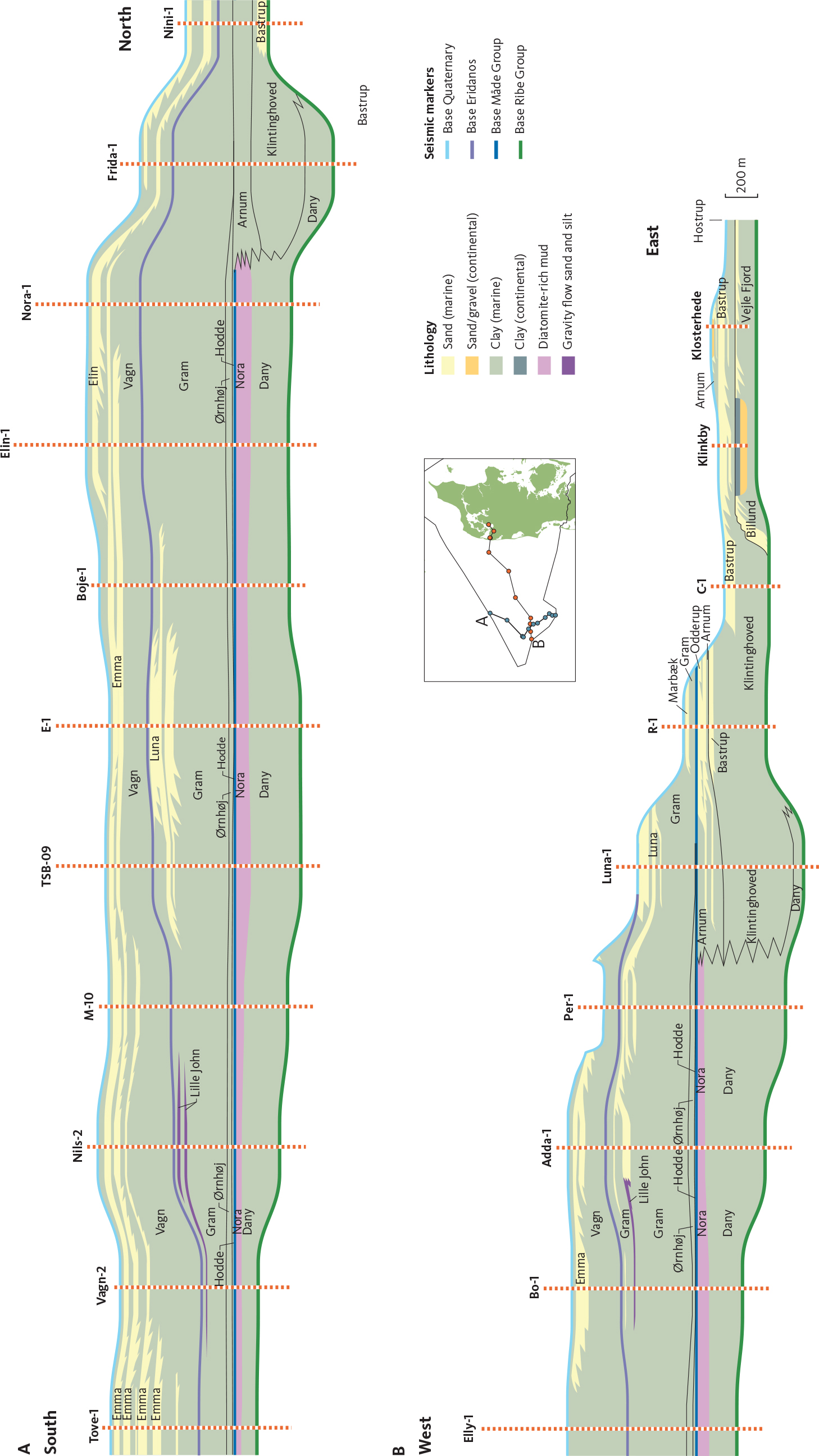
Fig. 48 Correlation panels showing the overall architecture of the Neogene succession in Denmark. (A): S–N-trending section from the Tove-1 well to the Nini-1 well. (B): W–E-striking section from the Elly-1 well to the Hostrup outcrop.
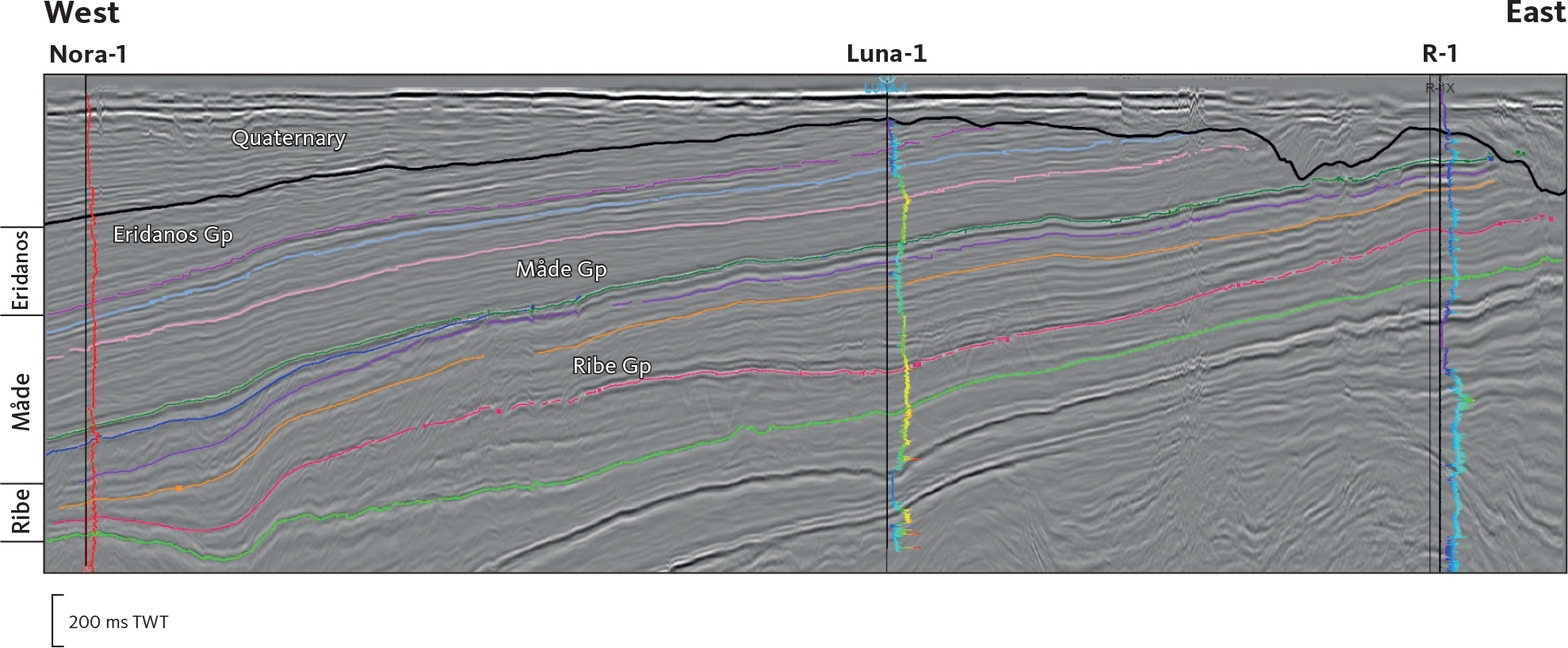
Fig. 49 W–E-trending seismic key section tying the Nora-1, Luna-1 and R-1 wells. Note the marked eastward truncation at the base of the Quaternary. The seismic section is in two-way time.
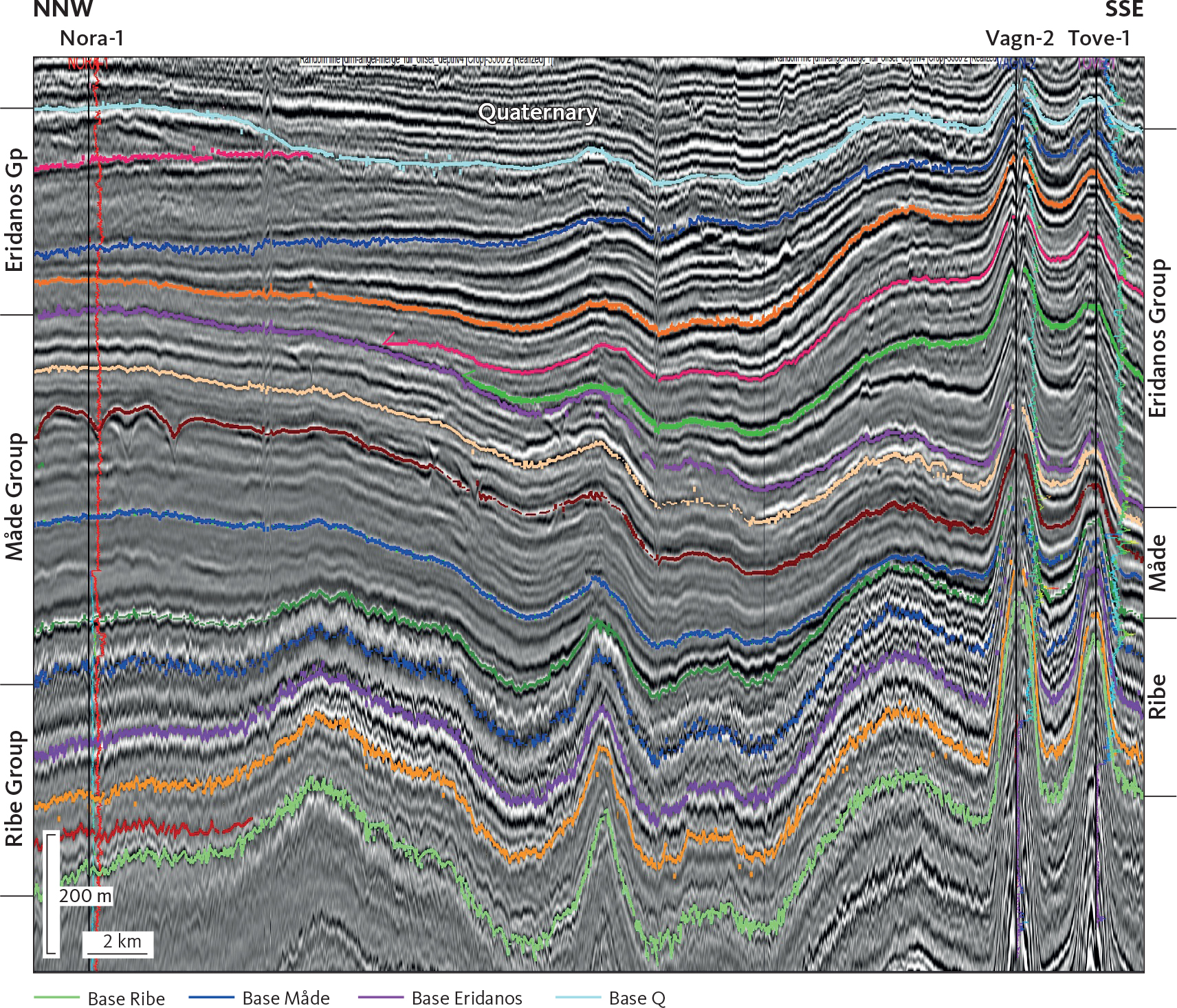
Fig. 50 NNW–SSE-trending seismic section (composite) tying the Nora-1, Vagn-2, and Tove-1 wells. The overall architecture is shown by the seismic surfaces, but note the even thickness of the Ribe Group, the pinching out of the Måde Group towards the south and the marked onlap of the lower Eridanos Group towards the north.
The Pliocene succession, referred to the Eridanos Group, is more than 700 m thick (Figs 1, 48, 50; Supplementary Files, Plates 7–9). The thickest development is in the south-westernmost part of the Central Graben and the succession is particularly thick around salt rim-synclines. The thinning towards the north-west is partly due to onlap onto the Miocene succession and partly due to truncation at the Base Quaternary surface (Figs 48, 49).
Basin evolution. During the Aquitanian (earliest Miocene), the palaeoenvironment in the eastern part of the North Sea was characterised by south-westwards progradation of a wave-dominated delta, represented by the Billund Formation (Rasmussen et al. 2010). The fluvial systems that conveyed sediments to the deltas were predominantly of braided river type (Rasmussen 2014). Two main routing systems have been recognised, one located in present-day eastern Jylland, seen in both outcrops and boreholes (Rasmussen et al. 2010), and one close to the present-day west coast of Jylland known from the subsurface, for example the Klinkby borehole (Figs 48B, 51; Supplementary Files, Plate 4). The locations of these river systems are interpreted to have been strongly controlled by the antecedent topography of the landscape (Hansen & Rasmussen 2008). The deltas that built out into the eastern part of the North Sea prograded into a sea with water depths in the order of 100 to 200 m, based on seismic morphology and biofacies (Fig. 51). The water depth gradually increased westwards, but shallower water existed in an ENE–WNW-trending area extending from the Nini-1 well in the west to the Inez-1 well in the east (Fig. 51). This shallow-water shelfal area was inherited from the progradation of Oligocene delta systems (Jarsve et al. 2015). Sand and gravel were deposited in the fluvial systems, and thick successions, up to 60 m, were deposited in incised valleys (Rasmussen 2014). The widths of these sand and gravel-rich fluvial bodies are up 75 km. In front of – and lateral to – the prograding deltas, shoreface sand accumulated alternating with floodplain and/or offshore mud. A relatively thick sand-rich succession was laid down in the down-drift portion of the delta platform (e.g. Rasmussen & Bruun-Petersen 2010). In the western part of the Ringkøbing–Fyn High area, and within the Central Graben, mud deposition dominated. Mud-rich sediment accreted to the shelf and shelf front under the influence of contourites, forming successive prograding shelf clinoforms (e.g. Hübscher et al. 2016).
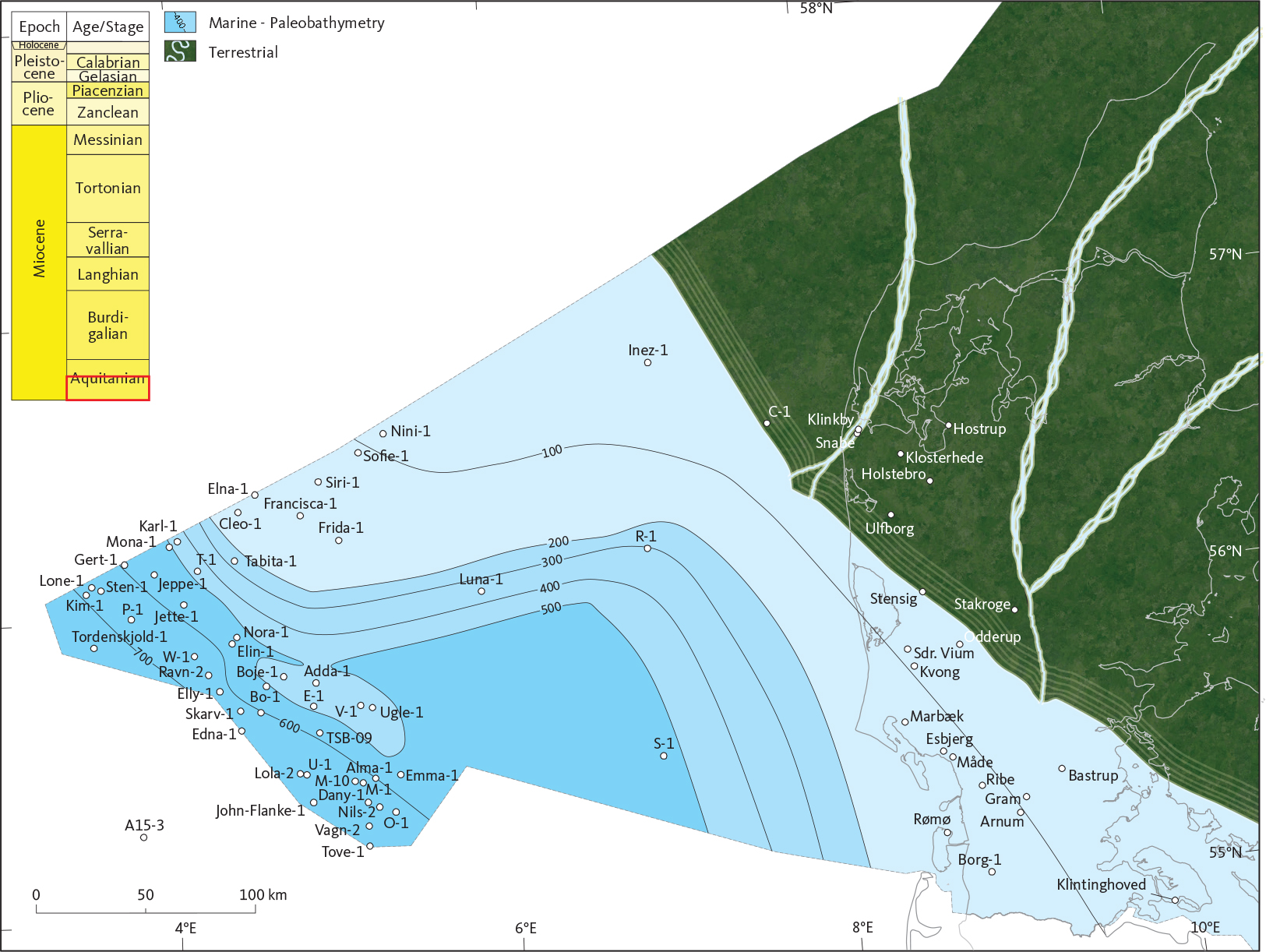
Fig. 51 Palaeogeographic reconstruction of the Danish area during the early Aquitanian (stratigraphic interval indicated by the red box). This map shows the situation during the maximal progradation of the Billund Formation. Braided rivers from the Fennoscandian area transported large amounts of sediment to the delta systems and the North Sea area. The proximal parts of the basin were characterized by deposition of muddy contourites plastered on the slope while in the more distal parts of the basin, the lower part of the Dany Formation was deposited.
During the Burdigalian, delta progradation in water depths of 100–200 m is represented by the Bastrup Formation (Fig. 52). In contrast to the Billund delta, the river system was predominantly meandering. As with the Billund delta complex, however, mud was probably transported by contour currents, accreting along the delta slope. During the late Burdigalian, the delta systems were flooded, and relatively shallow water characterised the eastern part of the North Sea Basin. The following regression was strongly dominated by deposition in a shallow-water coastal plain setting characterised by reworking of beach and shoreface deposits (Fig. 53); deltaic deposits thus had a low preservation potential, and the sedimentary section is dominated by beach barrier sands and associated lagoonal/swamp muds and coals (referred to the Odderup Formation). The shallow water conditions permitted storm sand to be transported onto the shelf and deposited as offshore bars and prograding infra-littoral wedges. During maximum progradation, in the mid-Langhian, the shoreline was close to the Sdr. Vium and Kvong wells in the onshore area and south of the Inez-1 well in the offshore area (Fig. 53). In the Central Graben area, the basin floor was characterised by deposition of mud enriched in diatomite (Fig. 53; Sülsbruck & Toft 2018). In this monograph, the succession of diatomite enriched mud is defined as the new Nora Formation.
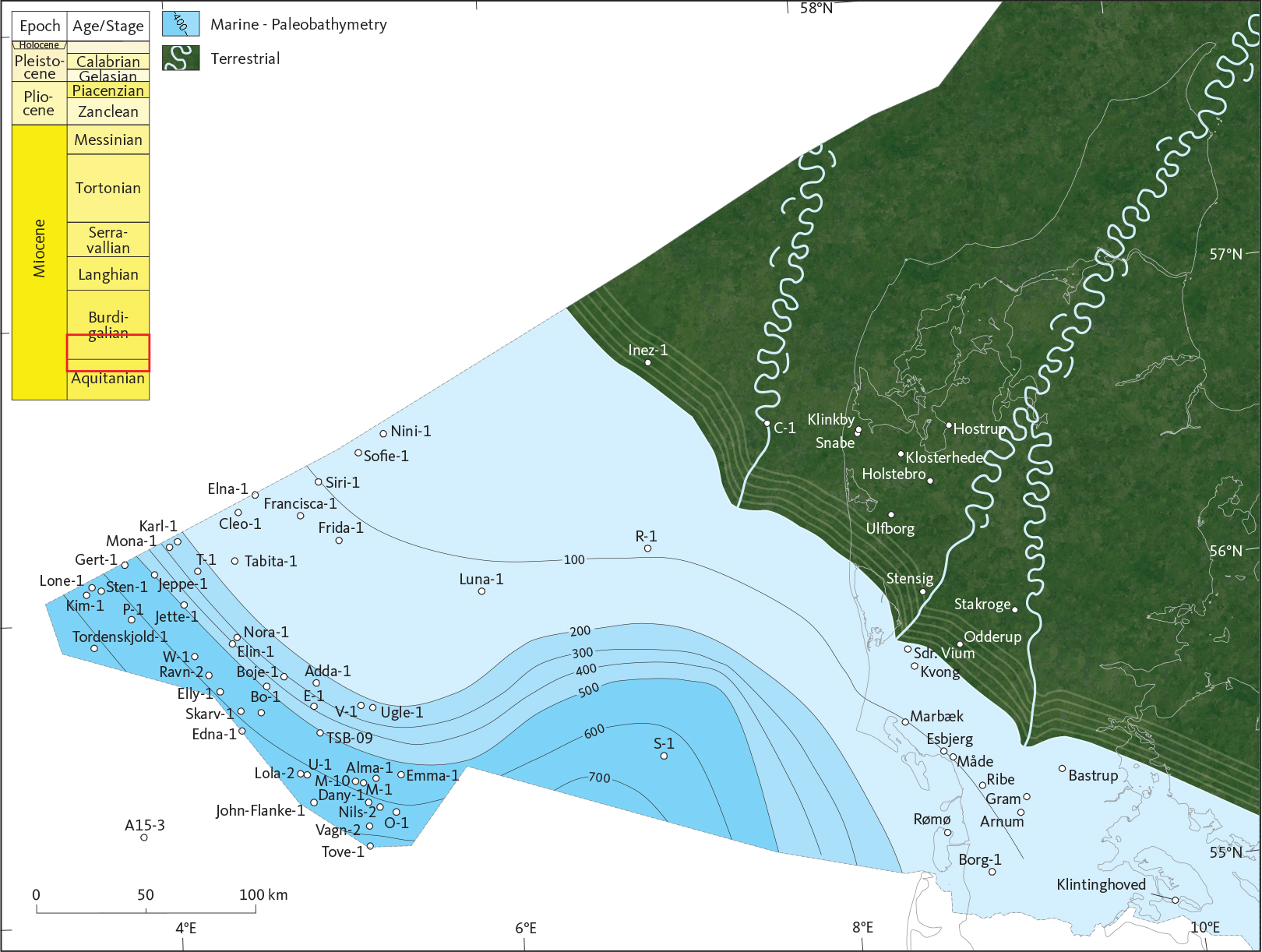
Fig. 52 Palaeogeographic reconstruction of the Danish area during the early Burdigalian (stratigraphic interval indicated by the red box). This map shows the situation during the maximal progradation of the Bastrup Formation. Meandering rivers from the Fennoscandian area transported large amounts of sediments to the delta systems and the North Sea area. The proximal parts of the basin were characterised by deposition of muddy contourites plastered on the slope. In the more distal parts of the basin, the middle part of the Dany Formation was deposited.
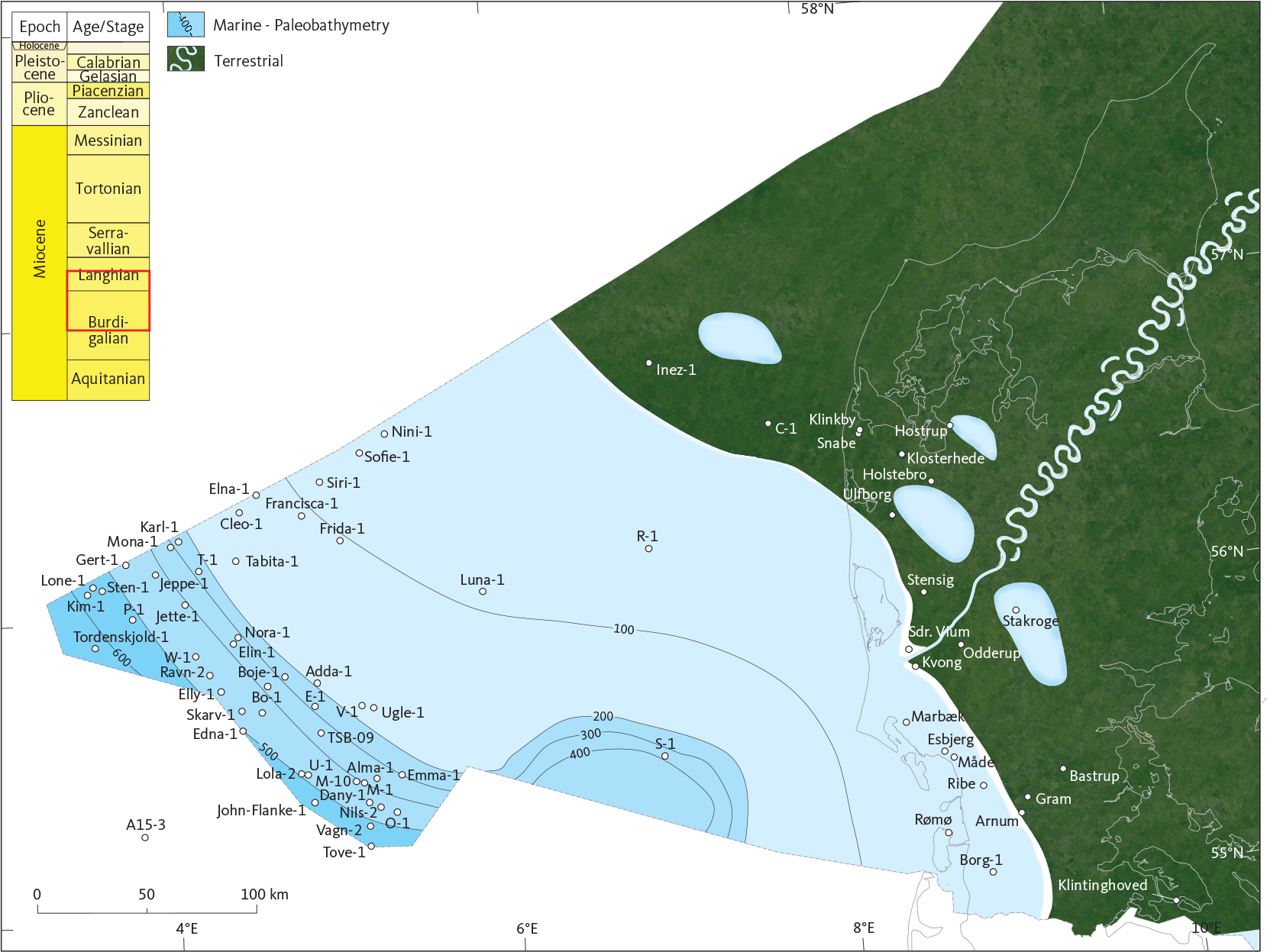
Fig. 53 Palaeogeographic reconstruction of the Danish area during the late Burdigalian and early Langhian (stratigraphic interval indicated by the red box). This map shows the situation during the maximal progradation of the Odderup Formation. The proximal parts of the basin were characterized by deposition of muddy contourites plastered on the slope while in the distal parts, in deep water, the diatomite referred to the Nora Formation was deposited.
During the late Langhian – Serravallian, a major transgression took place along the margins of the North Sea, especially in the north-eastern portion of the North Sea Basin (Fig. 54). The late part of the transgression occurred at a time of major global sea-level fall in the order of 70 m (John et al. 2011). This global sea-level fall was coincident with one of the most significant climatic deteriorations seen in the Cenozoic (Zachos et al. 2001). Consequently, the flooding of the margins of the North Sea was not eustatic but must have been associated with changes in topography. The period is renowned for major tectonic changes and reorganisation in the North Atlantic realm and coincides with the Alpine Orogeny in central Europe (Ziegler 1990; Ziegler et al. 1995; Rasmussen et al. 2008; Deckers & Louwye 2020). This marked change in the palaeogeography of the North Sea is thus interpreted to have had a tectonic origin (Rasmussen 2004a).
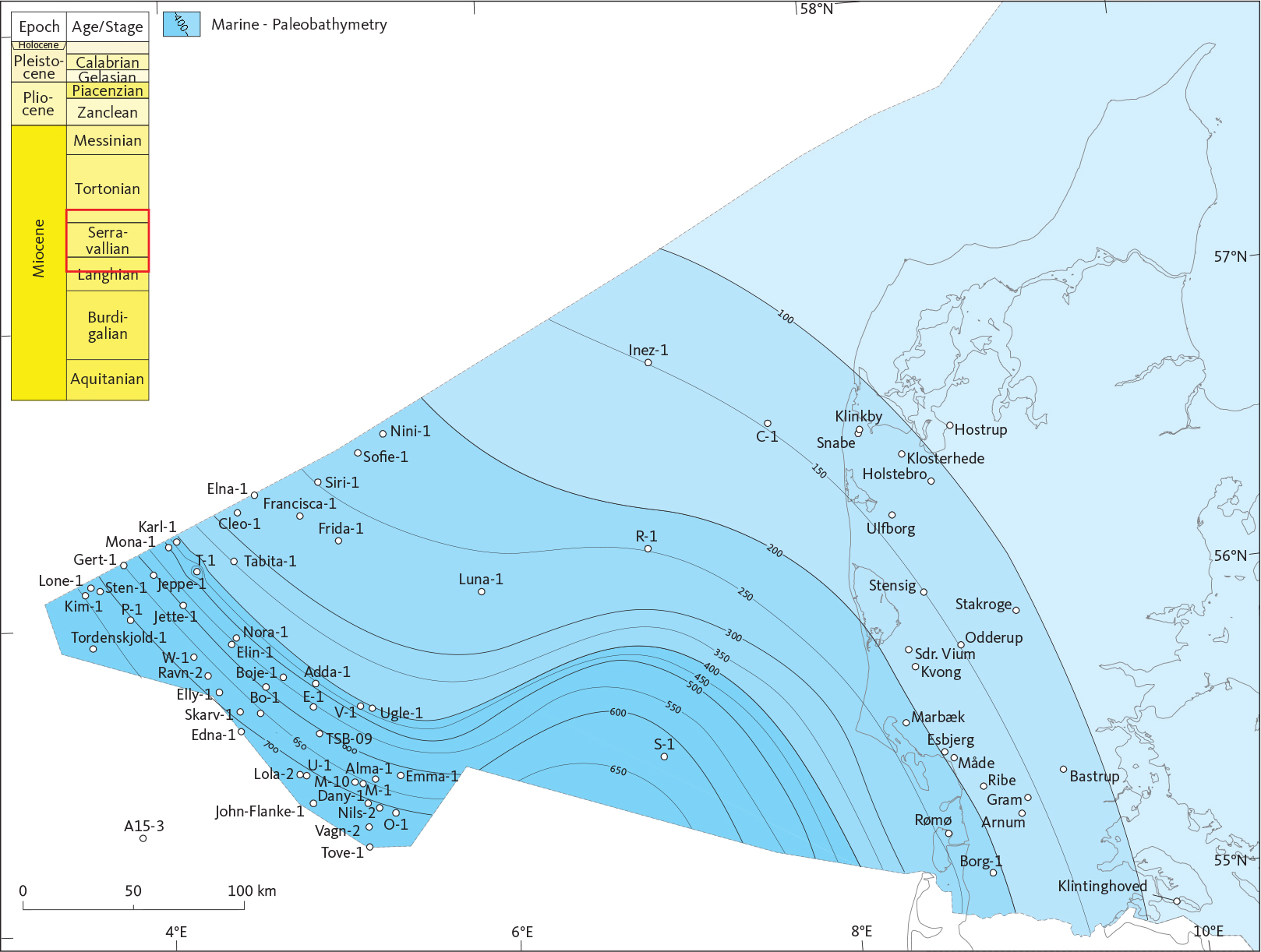
Fig. 54 Palaeogeographic reconstruction of the Danish area during the late Langhian and Serravalian (stratigraphic interval indicated by the red box). This map shows the situation during the maximal transgression of the Danish area during the Miocene leading to the deposition of the Hodde and Ørnhøj Formations. All of the Danish area was presumably flooded during this time interval.
Due to this relative sea-level rise, the North Sea margins were flooded during the late Middle – early Late Miocene, and the marine muds of the Hodde, Ørnhøj and Gram Formations were laid down in the area (Fig. 54). The water depths probably reached up to 700 m in the deepest parts of the Danish Central Graben area, while they were probably c. 100 m in present onshore Denmark (Laursen & Kristoffersen 1999). At the turnaround from progradation to transgression, extensive slope failure occurred near the S-1 well (Fig. 53; Huuse & Clausen 2001; Rasmussen et al. 2005). At the time of maximum transgression, the study area was characteristically sediment-starved, resulting in the formation of glaucony.
At the base of the Tortonian (the top of the Ørnhøj Formation), goethification of glaucony and reworking of glaucony pellets into submarine dunes (Rasmussen et al. 2010) indicate a fall in sea level, probably to c. 50 m (storm wave base), in the present onshore Denmark. Time equivalent with this, incised channels are recorded in Belgium at the base of the Diest Formation and at the base of the Diessen Formation in the Netherlands (Vandenberghe et al. 2014; Siebels et al. 2024). Following this sea-level fall, water depths increased to more than 100 m in the Tortonian (Laursen & Kristoffersen 1999) during the deposition of the Gram Formation.
Following the period of sediment starvation, shorelines around the margins of the North Sea began to prograde. The newly established fluvial systems in Central Europe began to deliver sediments to the southern part of the North Sea region. Coalescence of prograding deltas from the north and the east resulted in marked progradation of the shoreline into the central North Sea region in the mid-Tortonian. Shoreface deposits (the Marbæk Formation) are known from the west coast of Denmark (Fig. 35), and clinoforms from this time-interval are located in the North Sea near the Emma-1 well (Fig. 55). These clinoforms are interpreted to represent the westernmost positions of the shoreline in the mid-Tortonian. The strongly regressive event recorded by the Marbæk Formation correlates with evidence of cooling in the southern North Sea Basin at c. 8.7 Ma (Donders et al. 2009), suggestive of a link to a global eustatic sea-level fall.
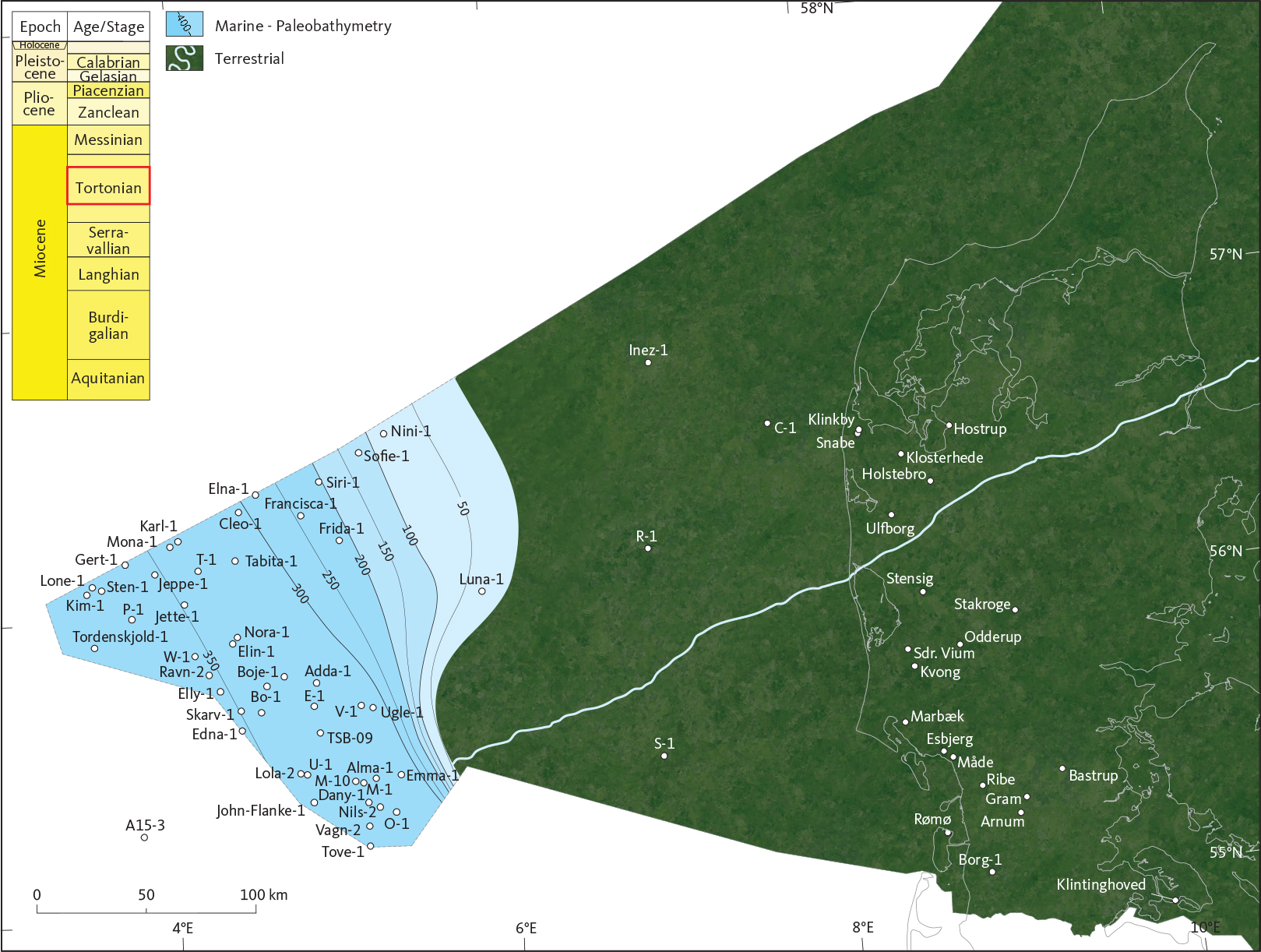
Fig. 55 Palaeogeographic reconstruction of the Danish area during the early and middle Tortonian (stratigraphic interval indicated by the red box). This map shows the situation during the maximal progradation of the Marbæk Formation. The coastline prograded far westwards and rivers from the Fennoscandian area continued to transport sediments from Fennoscandia to the North Sea area. In the more distal parts of the basin, the marine Gram Formation was deposited.
After a late Tortonian transgression, seen on seismic data as onlap onto the abovementioned package, progradation resumed, and for the first time, the shoreline reached the eastern part of the Central Graben area (Fig. 56). Associated with the Messinian lowstand of sea-level, which was a relatively large but transient sea-level fall, incision commenced on top of the shoreface prograding system (Møller et al. 2009), defined in this study as the Luna Formation. These incised channels, up to 80 m deep and 200 m wide, are best developed south of the Adda-1 well. Sediment was transported by gravity flows into the deep portion of the basin (Figs 57, 58).
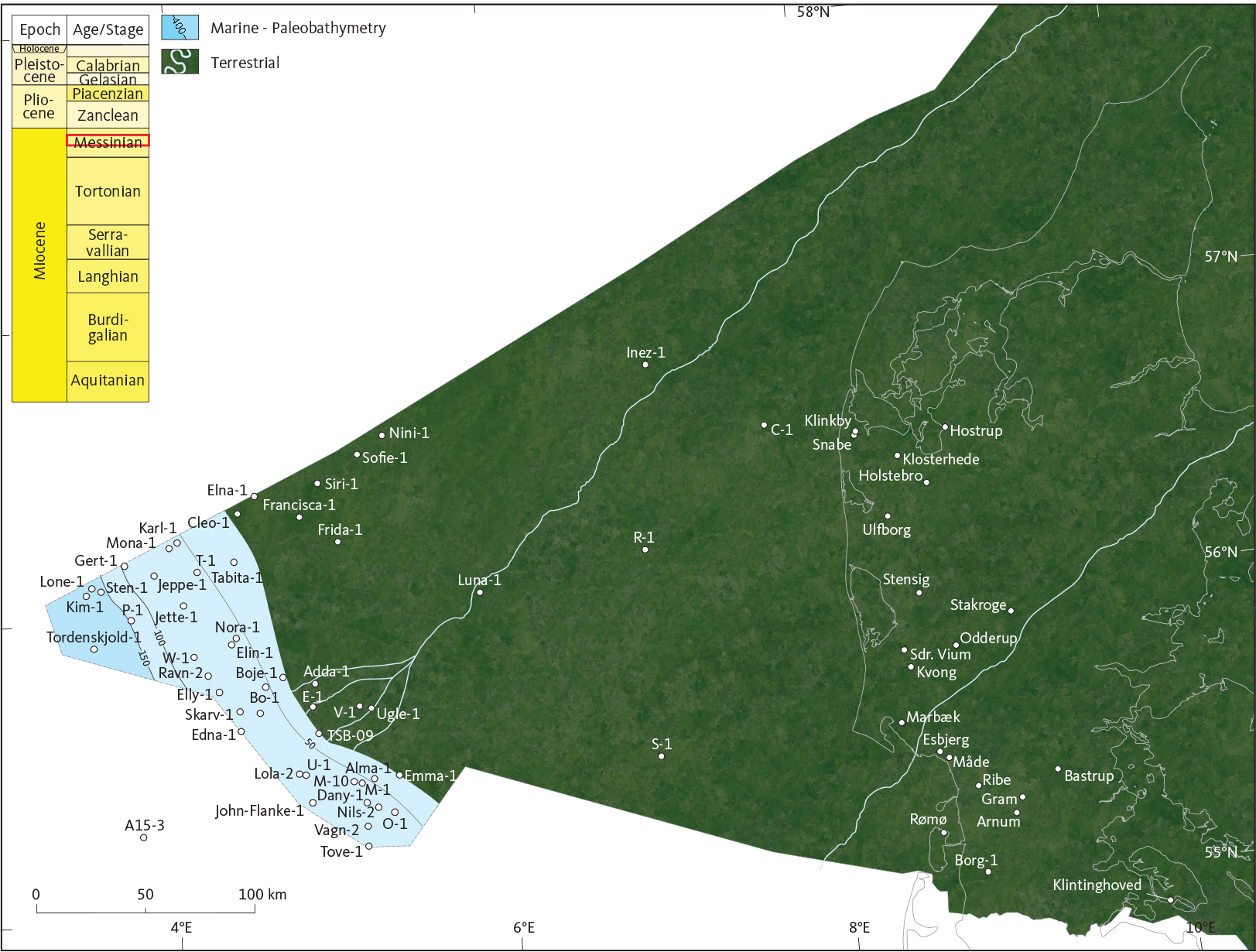
Fig. 56 Palaeogeographic reconstruction of the Danish area during the Messinian (stratigraphic interval indicated by the red box). This map shows the situation during the maximal progradation of the Luna Formation. The coastline had now moved into the central parts of the basin and rivers from the Fennoscandian area continued to transport sediments from Fennoscandia to the North Sea area. In the most distal parts of the basin, the marine Gram Formation was deposited.
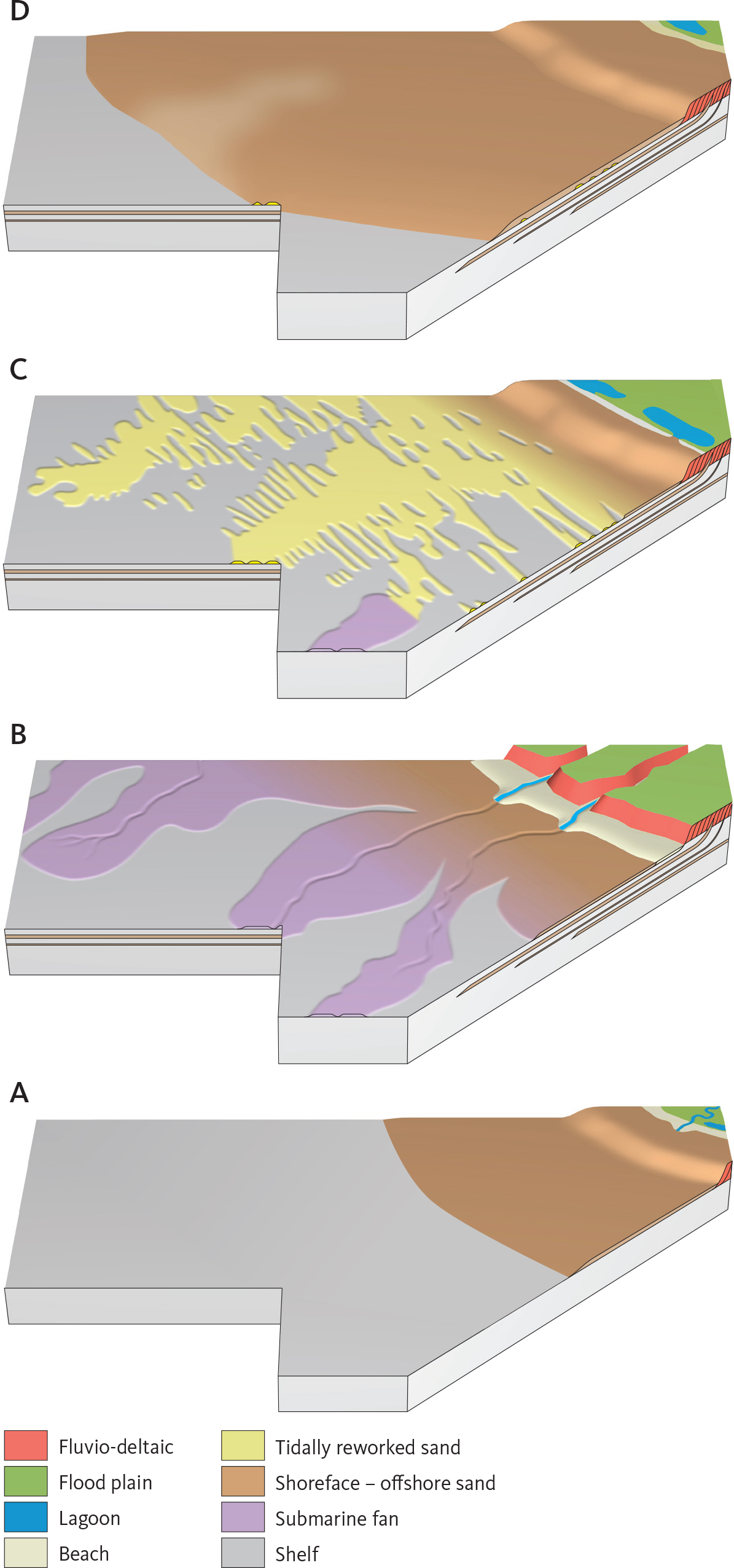
Fig. 57 Schematic diagram showing the sedimentological development of the lower sand–silt unit of the Lille John Member. (A): Initial progradation of the Luna Formation. (B): Due to sea-level fall, incision and erosion occurred and fans were laid down in the basinal setting. (C): Reworking of fans due to bottom currents and redeposition of the sand into elongated bars. (D): Due to sea-level rise and associated flooding, the area was dominated by hemipelagic mud deposition.
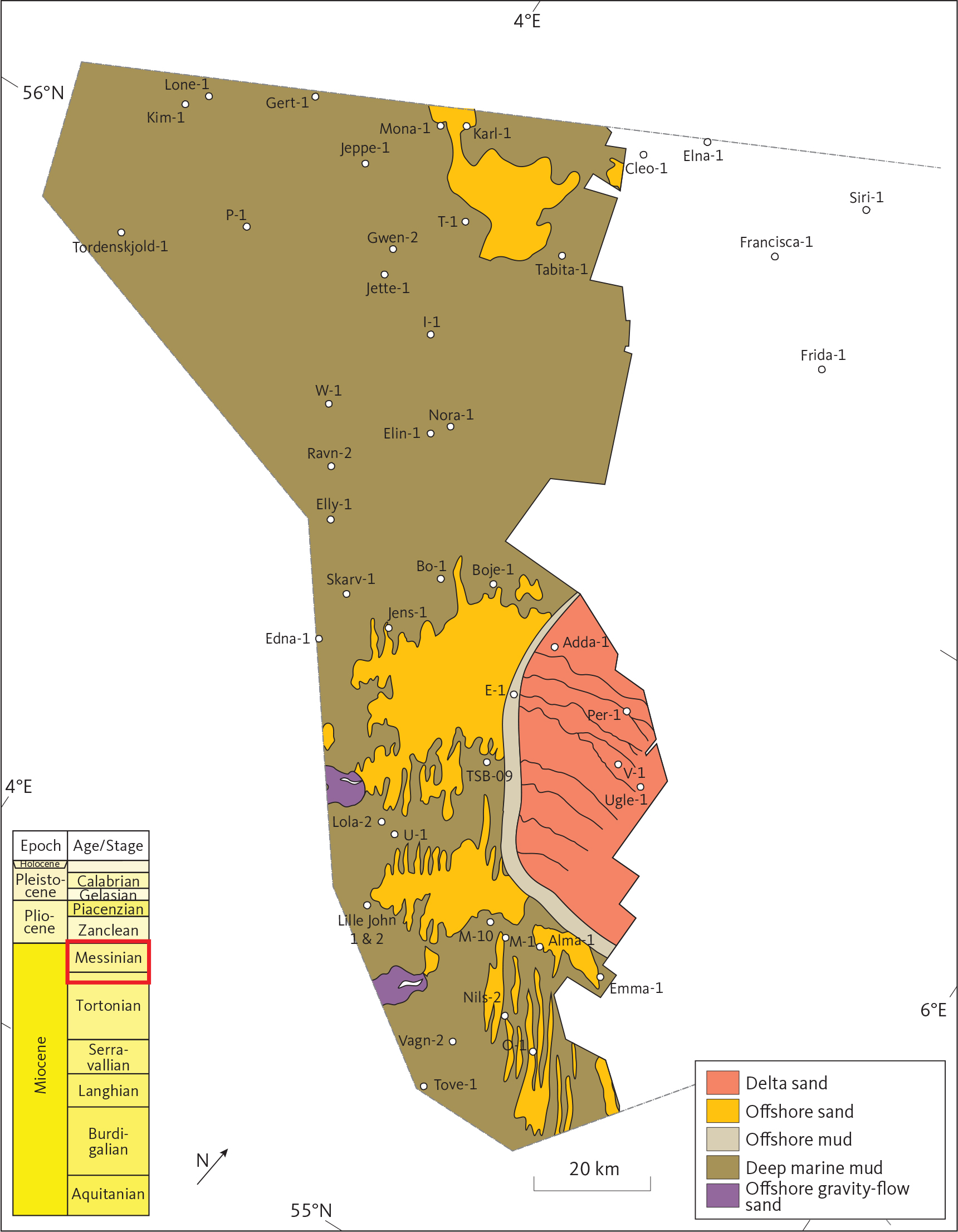
Fig. 58 Enlarged lithofacies map of the Luna Formation. Note the reworking of fans (gravity-flow deposits) into elongated bars due to current activity on the sea floor. These data are based on seismic attribute analysis.
In the early part of the Pliocene (the Zanclean), the prograding systems sourced from Scandinavia were flooded; sediment accumulation in the Central Graben and most of the Ringkøbing–Fyn High area was delivered from the south-east by the so-called Eridanos Delta (Bijlsma 1981; Overeem et al. 2001). The lower Zanclean succession consists mainly of muddy prodeltaic sediments with some deposition of sand (Vagn Formation). During the late Zanclean, relatively thick sand units were deposited. These sand units are in this monograph referred to as the Emma Formation. Some of the sand was laid down in a marginal marine to terrestrial environment, mainly as NW–SE-trending sand accumulations. A substantial part of the sand was draped on slopes as extensive sand deposits; the pinch-out of these sands northwards clearly indicates that the source was the Eridanos Delta.
At the end of the Pliocene, progradation of a delta system resumed from the north (Fig. 59). The delta system, the Elin Formation, can be traced from the Jeppe-1 well in the northern part of the study area and south-eastwards to the Elin-1 well and further southeast to the Adda-1 well (Fig. 44). Associated with progradation of the delta south-westwards, some well-developed sand ridges were formed (Fig. 60). In front of the slope, on the basin floor, offshore sand was deposited, some of which may be gravity-flow deposits (Fig. 60). The more coherent and widespread offshore sands in the south-eastern part of the Central Graben were most likely sourced by the Eridanos Delta.

Fig. 59 Palaeogeographic reconstruction of the Danish area during the Piacenzian (stratigraphic interval indicated by the red box). This map shows the situation during deposition of the Elin Formation. The coastline was in the central parts of the basin and rivers from the Fennoscandian area continued to transport sediments from Fennoscandia to the North Sea area.

Fig. 60 Enlargement of the lithofacies of the Elin (red signature) and Emma (orange signature) Formations (see Fig. 44). Note the curved character of the Elin Formation sand bodies (lobate shape); these units probably represent amalgamated beach ridges of a prograding delta. The stratigraphic level is indicated by the red box.
8 Perspectives
The Neogene succession in the offshore Danish sector has been subdivided into lithostratigraphic units. The succession is subdivided into three groups: the Ribe, Måde and Eridanos Groups (Fig. 1). The two former groups were defined onshore by Rasmussen et al. (2010), but here we describe their offshore lateral extensions. The latter group, the Eridanos Group, is erected in the present study.
The Ribe Group is subdivided into six formations: the Klintinghoved, Bastrup, Arnum, Odderup, Dany (new) and Nora (new) Formations. The lowermost Miocene Vejle Fjord and Billund Formations known from the onshore lithostratigraphy are absent in the offshore wells. In the Ringkøbing–Fyn High area, the base of the Ribe Group is an unconformity, while in the Central Graben area, the time-equivalent deposits are referred to the new Dany Formation. The other four formations in the Ribe Group defined onshore – Klintinghoved, Bastrup, Arnum and Odderup – are present in the Ringkøbing–Fyn High-area, but in the Central Graben area, these formations are absent, and the time-equivalent deposits are referred to the new Dany and Nora Formations. The Måde Group is subdivided into the Hodde, Ørnhøj, Gram, Marbæk and Luna (new) Formations; the Luna Formation includes the Lille John Member (new). The Eridanos Group (new) is subdivided into the Vagn (new), Emma (new) and Elin (new) Formations.
The Lower to lower Middle Miocene fluvio-deltaic succession in the Danish sector is extremely well preserved and documented by outcrops, penetrated by more than 100 boreholes with high-resolution petrophysical logs and covered by high-resolution seismic data. The succession is furthermore well dated by different stratigraphic methodologies (Laursen & Kristoffersen 1999; Dybkjær & Piasecki 2010; Eidvin et al. 2014). The source area is documented by mineralogical and geochemical data (Olivarius et al. 2014). Consequently, this part of the succession may form a key stratigraphic section for the understanding of geological processes in the North Sea realm. Correlation with global sea-level variations (Fig. 61) confirms that the development of this part of the succession was strongly controlled by extrinsic processes, for example, eustatic sea-level changes. Detailed knowledge of this fluvio-deltaic succession is therefore of particular significance in understanding and developing sequence stratigraphy as a predictive tool for this type of siliciclastic depositional system.
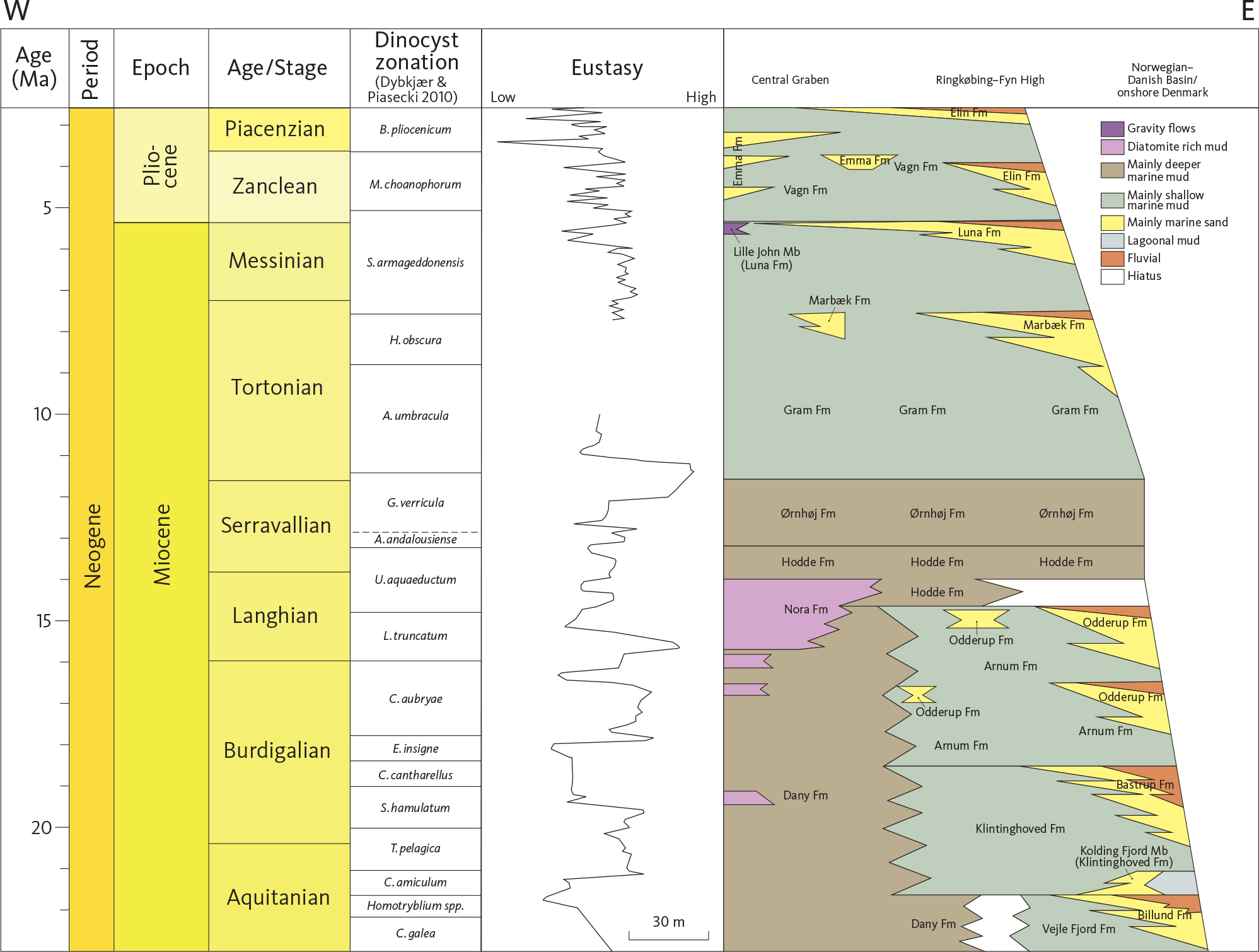
Fig. 61 Eustatic sea-level curve of the Miocene in the North Sea area. Modified from Miller et al. (2005) and Smith et al. (2023)
In a regional context, the lithostratigraphic and sequence stratigraphic subdivision defined in the Danish sector may be applicable in neighbouring areas. In the lower Rhine Basin – Ruhr Valley Graben, for example, maximum regressive surfaces (MRS) correlate with the maximum progradation of the Bastrup Formation (MRS 1; Siebels et al. 2024) and the maximum regression of the lower Odderup Formation (MRS 2; Siebels et al. 2024). In contrast, the maximum regression of the Billund Formation has not been detected in the Lower Rhine Basin and Ruhr Valley Graben. The lowermost Middle Miocene maximum regression, associated with deposition of the lower part of the Frimmerdorf Seam (MRS 3; Siebels et al. 2024), correlates with the upper Odderup Formation.
The global eustatic sea-level fall in the order of 69 m that took place during the so-called Mid Miocene Climatic Transition (MMCT) in the late Middle Miocene (John et al. 2011) was apparently outpaced in the North Sea Basin by rapid tectonically induced subsidence (Rasmussen 2004a). This event resulted in flooding of the entire Lower Miocene delta complex and in deposition of a condensed section of marine mud (the Hodde and Ørnhøj Formations; Rasmussen 2004a). This phase of tectonically induced subsidence may explain why the maximum regressive surface MRS4 recorded in the Lower Rhine Basin and Ruhr Valley Graben is not present in the Danish area. However, a Middle Miocene flooding (MFS 4; Siebels et al. 2024) also indicates an overall flooding in the Lower Rhine Basin and Ruhr Valley Graben area during this period; this probably correlates with the maximum transgression recorded by the Ørnhøj Formation. A marked change in the depositional setting occurred at the base of the Gram Formation due to a sea-level fall (Rasmussen 2004b), and this event correlates with the MRS5 of Siebels et al. (2024).
The Late Miocene development in the Danish sector is characterised by resumed progradation of delta systems from Scandinavia which correspond to the Marbæk and Luna Formations. The maximum progradation of the Marbæk Formation correlates with a cool period recognised in a Dutch borehole (Donders et al. 2009), but there does not seem to be an equivalent progradational unit in the stratigraphic section in the Lower Rhine Basin and Ruhr Valley Graben presented by Siebels et al. (2024). Similarly, the late Messinian maximum progradation of the Luna Formation does not correlate with a maximum regression in the Lower Rhine Basin and Ruhr Valley Graben, but the overall regressive trend of the Upper Miocene succession is characteristic of both areas.
The Pliocene succession in the Danish sector differs from the development in the Lower Rhine Basin and Ruhr Valley Graben. The regressive trend in the latter areas continued, but probably due to load-induced subsidence due to the progradation of the Eridanos Delta (Overeem et al. 2001), the central part of the North Sea Basin, including the Danish sector, experienced accelerated subsidence, and the delta systems sourced from Scandinavia were drowned.
Acknowledgements
Maersk Oil, now TotalEnergies, is acknowledged for financial support and for providing seismic and well data on which the present study is based. Comments on an early draft by Niels Hauberg Schødt were highly appreciated. The authors would like to thank the reviewers Ole Rønø Clausen and Dirk Munsterman and the editor Jon Ineson for constructive comments, all of which improved the manuscript considerably. We would also like to thank Jette Halskov, Annabeth Andersen, Carsten Thuesen and Jacob Lind Bendtsen for preparing the figures.
Author contributions
ESR did the seismic mapping and the sedimentology and wrote the original draft. KD selected and reviewed existing palynological data and produced new data. She further revised the original draft. JCT and FM provided the petrophysical study. ES selected and reviewed microfossil data from various reports and publications and produced new data for the present study. OBN contributed with clay mineralogy and organic geochemistry.
Additional files
Supplementary Files are available to download at https://doi.org/10.22008/FK2/8HYU7J.
Plate 1: Kim-1 – Nini-1, correlation panel, Neogene succession. Plate 2: Tordenskjold-1 – Fransisca-1, correlation panel, Neogene succession. Plate 3: W-1 – Luna-1, correlation panel, Neogene succession. Plate 4: Elly-1 – Hostrup, correlation panel, Neogene succession. Plate 5: Skarv-1 – Ugle-1, correlation panel, Neogene succession. Plate 6: Lola-1 - Emma-1, correlation panel, Neogene succession. Plate 7: Vagn-2 – Borg-1, correlation panel, Neogene succession. Plate 8: Tove-1 – Gert-1, correlation panel, Neogene succession. Plate 9: Tove-1 – Nini-1, correlation panel, Neogene succession. Plate 10: S-1 – Inez-1, correlation panel, Neogene succession. Plate 11: Rømø – Snabe, correlation panel, Neogene succession.